Most applicants compare community vs academic programs on “prestige.” That is the wrong metric. The real difference that will shape your life is call burden.
If you misjudge call, you will misjudge everything: your sleep, your learning, your mood, your relationships, and yes, your Step 3 score and fellowship chances. I have watched smart applicants rank programs based on vibes and city, then show up on July 1 and realize they signed up for a Q3 28‑hour nightmare with no night float and no backup.
You can avoid that. But you have to be systematic.
This is your structured approach to comparing call burden in community vs academic programs—so you do not get blindsided on Match Day.
1. Understand What “Call Burden” Actually Is
Most applicants think call burden means “how many nights I work.” That is too simple and will get you burned.
Call burden has five dimensions:
Frequency – How often:
- Q3, Q4, Q6, “every 5–6 days,” etc.
- Night float blocks: how many weeks per year.
Duration – How long:
- 12‑hour night shifts.
- 24‑hour call.
- 24+4 “bonus” hours.
- Home call that turns into 28 hours awake.
Intensity – How hard:
- Number of patients.
- Number of admits.
- Number of cross-cover pages.
- How often you actually sleep.
Responsibility level – How much weight is on you:
- In-house attending vs home-call attending.
- Presence of fellows or lack thereof.
- Are you the only resident in-house for the entire hospital?
Recovery time – How much you actually recover:
- Post-call days truly off vs “post-call clinic.”
- Weekend calls with no comp days.
- Rotations that ignore the concept of rest.
Academic vs community programs differ on all five points—but not in the way people assume.
2. The Hidden Call Tradeoffs: Community vs Academic
You cannot assume community = lighter and academic = heavier. That cliché is wrong more often than it is right.
Here is the real picture, summarized.
| Feature | Community Program | Academic Program |
|---|---|---|
| In-house attending | Often home call | More often in-house overnight |
| Fellow coverage | Rare outside large systems | Common in subspecialties |
| Patient volume per resident | Higher per resident | Higher overall, but more learners |
| Night float | Variable, sometimes absent | More consistently present |
| Home call | Common in surgical, OB, subspecialties | Less common, more in-house call |
Now, what that means in real life:
Community strengths:
- Fewer layers: you are closer to the attending.
- You may have more autonomy and faster decision-making.
- Some community programs genuinely have lighter call because of lower total volume or aggressive use of nocturnists/hospitalists.
Community risks:
- You might be the only resident covering a large number of patients.
- Less backup when things go bad.
- Home call can sound light but can be brutally disruptive if you are constantly called in.
Academic strengths:
- More residents and fellows to spread the work.
- More standardized schedules, often with night float systems.
- In-house attendings in many specialties, which helps with safety and decision-making.
Academic risks:
- Work compression: fewer hours on paper, same or higher workload.
- High-acuity, high-volume services (ICU, transplant, trauma) that can destroy sleep, even if “Q4.”
- Rotations where you never leave on time despite duty-hour compliance on paper.
You need a way to compare these systematically before you rank programs. Not after.
3. Build a Call Comparison Grid (Your Core Tool)
Stop reading glossy program websites. Start building a grid.
You will track specific, comparable data across programs. Not vibes. Not “the residents seemed happy.”
Step 1: Create the grid
Open a spreadsheet. Make each row a program. Columns should be objective call variables:
- Program name
- Specialty / track
- Community or academic
- Night coverage model (night float vs 24‑hour call vs hybrid)
- Average nights per month (PGY‑1, PGY‑2/3, senior)
- 24‑hour calls per month (by PGY)
- Home call presence (yes/no; which rotations)
- Average number of patients covered overnight (by role)
- Average admits per night (by service)
- Actual leave time post-call (what residents say, not what attendings claim)
- Post-call clinic? (yes/no)
- Total weeks of night float/year (PGY‑1, PGY‑2/3, senior)
- Backup system (is there anyone you can call without guilt?)
- Fellows present overnight? (by service)
- Typical post-call sleep quality (subjective, but residents will tell you)
You can add personal weightings later (e.g., nights per month matters more to you than presence of fellows).
4. Extract Hard Numbers Before Interview Season Ends
Programs rarely advertise true call burden. You have to dig it out.
A. What to look for on websites
Most websites are vague or outdated, but you can still pull basics:
- Call schedule examples (PDFs, sample rotation schedules).
- Rotation descriptions (“2 weeks of night float per block,” “1 in 5 call,” etc.).
- Presence of night float vs 24‑hour call on key rotations: wards, ICU, ED, OB, surgery.
If they post actual schedule templates, screenshot them. Put the numbers into your grid.
B. Questions to ask during interviews
Ask these to residents, not faculty. Faculty often have no idea how bad nights are now.
Use direct, structured questions so you can compare across programs:
Frequency and structure
- “On a typical inpatient block, how many nights or 24‑hour calls do interns do?”
- “Do you use a night float system, 24‑hour call, or both? For which rotations?”
Volume and intensity
- “On night float, how many patients are you covering and how many new admits do you usually get?”
- “On your busiest night, what does your responsibility look like—how many cross-cover pages?”
Recovery
- “What time do you actually leave post-call? Not the official time—the real one.”
- “Do you have any post-call clinics or mandatory conferences?”
Backup and safety
- “When you are drowning overnight, what backup exists in reality—another resident, fellow, in-house attending?”
- “Have you ever felt unsafe managing the volume or acuity overnight? What happened?”
Community vs academic specifics
- For community: “Are you ever the only resident in-house? For which services?”
- For academic: “Do fellows help with admits and cross-cover overnight or mainly use you as their work engine?”
Write down the answers immediately after each virtual or in-person day. Memory is unreliable. I have seen people mix up programs and give community credit for an academic schedule and vice versa.
5. Quantify the Year: Call Load by PGY
You are not choosing a single month. You are choosing several years of your life.
You want an approximate annual call and night burden for each postgraduate year.
Step-by-step calculation
For each program, by PGY:
List all rotations with nights/call:
- Inpatient wards
- ICU (MICU, SICU, NICU, PICU)
- ED
- OB labor and delivery
- Surgical services
- Night float blocks explicitly listed
For each rotation, fill in:
- Number of weeks per year.
- Nights per week or calls per month.
- Type: night float vs 24‑hour vs home call.
Convert to annual estimates:
- Nights per year = weeks on rotation × nights per week.
- 24‑hour calls per year = months on rotation × calls per month.
Example (PGY‑1 Internal Medicine):
- Wards: 16 weeks, 5 nights of call per 4‑week block = 20 nights.
- ICU: 8 weeks, 6 nights per 4‑week block = 12 nights.
- Night float: 4 weeks, 5 nights/week = 20 nights.
- Total ≈ 52 nights in PGY‑1.
Now compare that to another program:
- Wards: 12 weeks, no overnight call (covered by night float).
- ICU: 8 weeks, q4 24‑hour call → about 14 calls.
- Night float: 6 weeks, 5 nights/week = 30 nights.
- Total ≈ 30 nights + 14 calls.
Those two “similar” IM programs are not remotely equivalent from a lifestyle standpoint.
6. Community vs Academic: How to Interpret the Patterns
Once you have numbers, you can spot consistent patterns.
Pattern 1: Call structure
Academic:
- More night float systems, especially on wards and some ICUs.
- Formal caps and duty hour tracking, at least on paper.
- Seen in large university hospitals and big-name programs.
Community:
- More mixed systems: a bit of night float, a bit of 24‑hour call, plus home call.
- Some programs still run old-school call: Q3–Q4 24‑hour for certain rotations.
- Often less rigid enforcement of work-hour rules, especially at smaller independent hospitals.
Which is “better” depends on your priorities:
- If you hate flipping days/nights repeatedly, you may prefer fewer but longer 24‑hour calls.
- If you care most about never working 24+ hours, night float is non-negotiable.
Pattern 2: Backup and responsibility
Academic programs often excite applicants with big names and big ICUs. The hidden flip side:
- More layers (intern → senior → fellow → attending).
- You might be “scut”-heavy at the junior level, especially at large programs where seniors and fellows do the interesting parts.
Community programs:
- You may hit attending-level decisions sooner.
- At night, you might be it: no fellow, maybe a home-call attending who is half-asleep.
- More ownership, more pressure. Some residents thrive; others burn out.
Pattern 3: Home call trap (especially in community and surgical/OB subspecialties)
Home call looks gentle in a spreadsheet. Then you live it.
Problems with home call:
- You pay for every late page with fragmented sleep.
- Your partner hears your phone at 2 am. Every night.
- You still work full clinic days afterward, because “you were technically at home.”
If a community program leans heavily on home call, you must ask the only question that matters:
“How many times per week are you physically in the hospital after midnight, on average?”
If they say, “Depends,” push:
“Give me last week or a typical week number.”
If they cannot answer, assume the worst.
7. Use a Simple Scoring System (Not Perfect, But Better Than Guessing)
You are not building a dissertation. You just need a semi-quantitative feel for relative burden.
Create a Call Burden Score for each program per year. One simple system:
Nights per year:
- 0–20 → 1 point
- 21–40 → 2 points
- 41–60 → 3 points
- 61+ → 4 points
24‑hour calls per year:
- 0–5 → 1 point
- 6–10 → 2 points
- 11–15 → 3 points
- 16+ → 4 points
Presence of reliable backup overnight:
- Strong backup (in-house attending + fellows) → 1 point
- Moderate (senior + home-call attending who shows up) → 2 points
- Weak (you + home-call attending who rarely comes) → 3 points
Post-call protection:
- True post-call day off, no clinic or mandatory didactics → 1 point
- Post-call morning only, no clinic → 2 points
- Post-call clinic or required work → 3 points
Add them.
So a PGY‑1 could have a total between 4 (very light) and 14 (brutal). Compare community vs academic programs on the same scale.
To visualize this difference across programs:
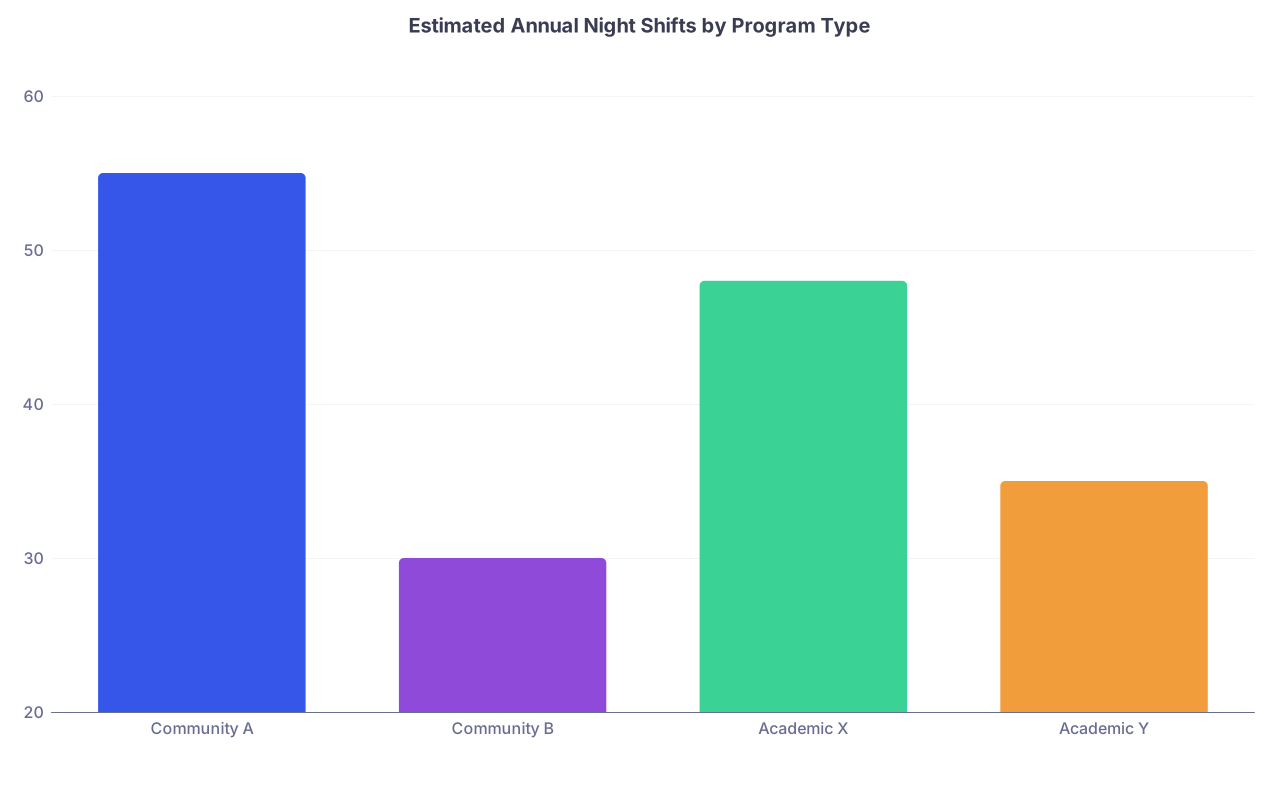
| Category | Value |
|---|---|
| Community A | 55 |
| Community B | 30 |
| Academic X | 48 |
| Academic Y | 35 |
Do not obsess over precision. You just need enough contrast to see that Program A is realistically heavier than Program B.
8. Reality Checks: Resident Culture and Burnout Signals
Numbers alone will not tell you how call feels. Culture magnifies or softens burden.
When you talk to residents, listen for these clues:
Green flags (call feels sustainable)
Residents say things like:
- “Nights are busy, but we help each other out.”
- “I feel tired sometimes, but not unsafe.”
- “I can actually read and exercise on my golden weekends.”
Behavioral signs:
- Residents show up to noon conference and seem awake.
- Seniors talk about interns as people they protect, not just workhorses.
- Multiple residents independently say, “Our leadership listens when the schedule is bad.”
Red flags (call is breaking people)
I have heard all of these phrases at programs I would rank low:
- “It is survivable.”
- “You get used to being tired all the time.”
- “Officially we are Q4, but post-call days are… variable.”
- “They care a lot about service coverage.”
Other warning signs:
- Residents dodging your questions about call.
- Only chiefs or handpicked residents available to talk.
- People making jokes about divorce, weight gain, or health issues as a normal residency tax.
You are not fragile because you care about this. Chronic sleep debt wrecks learning and performance. You are not heroic when you choose a misery factory; you are just avoidably exhausted.
9. Matching Your Priorities to the Right Call Profile
Now to the practical part: how you actually use this information to rank community vs academic programs.
Scenario 1: You are fellowship-focused and highly tolerant of workload
You want high acuity, research, and letters from big-name attendings. You can tolerate heavy call if:
- It comes with strong educational value.
- There is real backup.
- There is a clear payoff.
You might:
- Accept heavier night volume at a large academic center with transplant/ECMO/trauma.
- Prioritize programs where fellows and attendings teach on nights, not just dump work.
What to watch for:
- Hidden expectation that residents do endless scut while fellows do procedures.
- “Research” time that is constantly invaded by service needs.
Scenario 2: You care about lifestyle and family stability
You have dependents, health needs, or just know you do poorly with sleep deprivation. You are not lazy; you are realistic.
You should:
- Prefer programs with:
- Clear, capped night float systems.
- True post-call days off.
- Reasonable total nights per year (especially PGY‑2 if that is the heavy year).
- Give extra credit to:
- Community programs with hospitalists handling a large portion of nights.
- Any program (community or academic) with stable, predictable scheduling and real effort to protect days off.
Watch for:
- Home call on busy services.
- “We are like a family” used to justify overwork.
Scenario 3: You want maximum independence and hands-on experience
You want to feel like the doctor on day one of attending life.
You might accept:
- Higher call burden at a community program with fewer fellows.
- Nights where you are the primary decision-maker (with reachable attendings).
But put guardrails:
- No program is worth it if you routinely feel unsafe.
- Ask about near-miss events and how leadership responded. A mature program learns and adjusts schedules.
10. A Simple Process Map: How to Compare Call Burden Step-by-Step
Here is the whole workflow in one visual:

| Step | Description |
|---|---|
| Step 1 | Make spreadsheet |
| Step 2 | Collect website data |
| Step 3 | Ask residents targeted questions |
| Step 4 | Calculate nights and calls per PGY |
| Step 5 | Score call burden |
| Step 6 | Identify heavy vs light programs |
| Step 7 | Layer in culture and burnout signals |
| Step 8 | Match to your priorities |
| Step 9 | Adjust rank list |
Run that process for every program you are remotely serious about. It is work. A few hours now saves you hundreds of miserable nights later.
11. How to Handle Conflicting Information
You will see contradictions:
- Website says “Q4 call,” residents say “it is basically Q3.”
- PD says “we protect post-call,” residents laugh when you mention it.
Here is how to resolve conflicts:
- Always believe the residents’ lived experience over official descriptions.
- When in doubt, assume the heavier interpretation.
- Email the chief residents with specific questions:
- “Can you clarify current call structure on MICU for interns—# of nights per month and backup?”
- If you get evasive, non-specific responses, lower that program on your list. That is not transparency; that is spin.
12. Community vs Academic: Stop Thinking “Better/Worse.” Think “Better for Me.”
The wrong question:
“Are community or academic programs better?”
The right question:
“For my priorities and tolerance, which specific programs have a call structure I can sustain for 3–7 years?”
You may end up with:
- A community program with lighter, safer call that gives you the life you want and still gets you where you need professionally.
- An academic program with heavy but well-supported call where you learn a ton and still remain functional.
Both are fine outcomes. What is not fine is going in blind.
Your next step today:
Open a spreadsheet and list the top 5–10 programs on your current rank list. For each one, fill in three numbers you can find quickly or ask about:
- Approximate nights per year (PGY‑1).
- 24‑hour calls per year (PGY‑1).
- Whether post-call days are truly off.
If you cannot find or get those numbers, that is your signal: start asking harder questions or reconsider how high that program sits on your list.