
The belief that “more competitive subspecialty = more money” is wrong. Not just slightly off—flat‑out wrong in many cases.
You hear it constantly on wards: “Cards and GI are where the money is,” “Derm is OP,” “If you’re smart you’ll do ortho.” The hidden message to every student and resident: if you’re not chasing the most competitive subspecialty, you’re leaving money on the table.
Let me spoil the ending: the real drivers of income are far more boring—and far more in your control—than “how hard it is to match.”
Let’s walk through what actually happens when you follow the money instead of the myths.
Myth: The Most Competitive Subspecialties Are Always the Highest Paid
Reality: Some highly competitive subspecialties pay very well. Some pay modestly. Some mid‑tier or even “backup” fields quietly print money.
Look at any recent Medscape or MGMA compensation report and a pattern jumps out: procedure‑heavy specialties tend to earn more than purely cognitive ones. But within that, “competitiveness” jumps all over the place.
Here’s a simplified snapshot using ballpark US attending averages (pre‑tax, full‑time, not academic outliers):
| Specialty / Subspecialty | Perceived Match Competitiveness | Typical Income Range (USD) |
|---|---|---|
| Orthopedic Surgery | Very High | $600k–$800k+ |
| Dermatology | Very High | $450k–$650k+ |
| Gastroenterology | High | $500k–$700k+ |
| Cardiology (non‑interventional) | High | $450k–$650k+ |
| Emergency Medicine | Historically Moderate | $350k–$500k |
| Anesthesiology | Moderate | $450k–$650k+ |
Now three important reality checks:
- Some of the most competitive fields are not the top earners. Dermatology beats many surgical fields, but it’s not automatically above ortho or neurosurgery. Heme/Onc is quite competitive and often lands below anesthesia and GI.
- Some only‑moderately‑competitive fields quietly rival or beat hot subspecialties. Community anesthesiology, radiology, outpatient GI, certain pain practices.
- Pay spreads within a specialty often dwarf the pay between specialties. A hustling community general surgeon in a low‑competition market can out‑earn a fancy interventional cardiologist in a saturated metro.
So no, competitiveness is not a clean proxy for salary. It’s at best a blunt correlation with “more procedures” and “more RVUs.” And even that breaks down once you zoom in.
What Actually Predicts Income (It’s Not Your NRMP Percentile)
If you want to predict income decently, stop asking “how hard is it to match?” and start asking:
- How much of this work is paid per RVU and procedure vs bundled or salaried?
- How much demand is there where I want to live?
- How many other people already do this there?
- How easy is it to add side revenue—ASC ownership, imaging, procedures, telehealth, niche clinics?
Let me translate that into more concrete variables.
1. Procedural vs Cognitive
Procedures pay. Talking does not. That’s the US system.
A non‑interventional academic cardiologist in a saturated city, mostly rounding and reading echos, can easily make less than:
- A community anesthesiologist in the suburbs
- A rural EM doc stacking shifts and picking up nights
- A pain physician doing injections and stim implants
Same brainpower, same “tier” of prestige in some circles, different revenue structure.
2. Geography Beats Competitiveness
I’ve seen this play out:
- GI doc in Boston, academic hospital, massive fellowship pedigree: ~$450k, brutal call, lots of RVUs needed to touch “bonus.”
- GI doc in a mid‑sized southeastern city, large private group, same training tier: $700k+ with partnership, more autonomy, less academic pressure.
Same subspecialty. Different ZIP code. Income difference: a whole extra physician’s salary.
Apply this logic widely and you get something non‑intuitive:
Competitive‑but‑oversupplied field in big coastal city
can earn less than
Moderately competitive field in a secondary market
Want a visual?
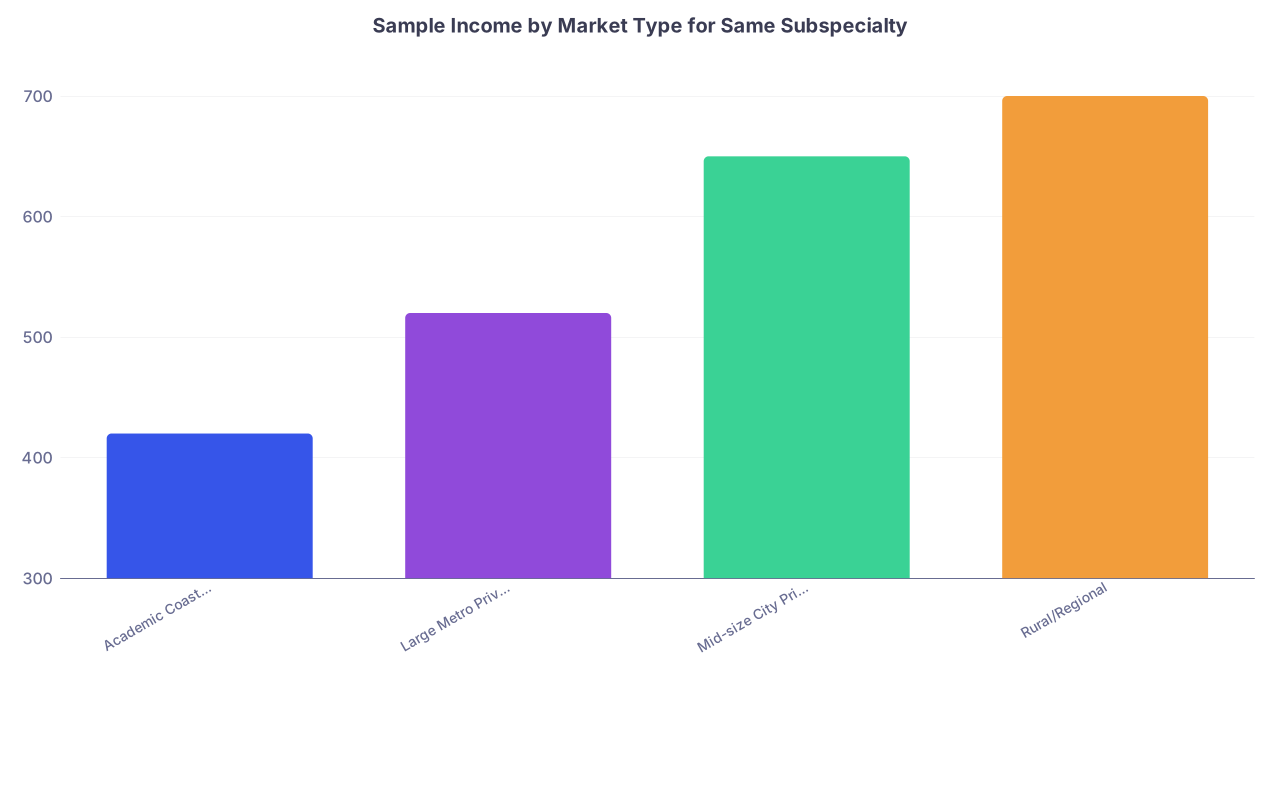
| Category | Value |
|---|---|
| Academic Coastal City | 420 |
| Large Metro Private | 520 |
| Mid-size City Private | 650 |
| Rural/Regional | 700 |
These are stylized numbers, but the shape is real. Geography and practice setting punch harder than “was my fellowship hard to get.”
3. Ownership, Partnership, and Side Streams
This almost never shows up in the med student hallway gossip, but it’s huge.
Two hospitalists, same city, same hours:
- Employed hospitalist: W‑2, fixed salary ~$280k–$320k.
- Hospitalist who also runs a local SNFist practice or telehealth operation or invests in a small urgent care: suddenly that “low‑paid generalist” can match or beat a subspecialist.
Likewise with procedural subspecialties:
- Employed interventional cardiologist on a flat salary: constrained earning.
- Private practice GI with ASC ownership: dramatically different ceiling.
You’re not hearing this from interns complaining about “only” matching IM. But it’s reality.
Where Competitiveness and Income Do Roughly Align
Now, to be fair, it’s not completely random. There are clusters where competitiveness and higher pay move together.
- Orthopedic surgery
- Neurosurgery
- Interventional cardiology
- Certain radiology niches (IR, neuro‑IR)
- Some procedural GI positions
These fields are hard to match into and typically procedure‑heavy, with strong RVU potential. So yes, they tend to land in higher income brackets, especially in private or hybrid models.
But you need to understand why:
It’s not because NRMP made them competitive.
It’s because the underlying billing structure rewards what they do, they control expensive resources (ORs, cath labs, scopes), and there’s strong, consistent demand.
The competitiveness is a byproduct of that, not the driver of individual income.
Where the Myth Completely Breaks Down
Let’s test the “competitive = more money” theory across a few common decision points.
1. Cards vs Anesthesia vs EM vs GI vs Heme/Onc
You’d think there’d be a clean hierarchy. There isn’t.
| Field (US, community-focused) | Relative Competitiveness | Typical Range (USD) |
|---|---|---|
| Interventional Cardiology | Very High | $600k–$900k+ |
| Non‑Interventional Cardiology | High | $450k–$650k |
| Gastroenterology | High | $500k–$750k+ |
| Heme/Onc | High | $380k–$550k |
| Anesthesiology | Moderate | $450k–$650k+ |
| Emergency Medicine | Moderate (now rising) | $330k–$480k |
Notice:
- Heme/Onc is quite competitive and emotionally brutal. Income is often less than anesthesia + sometimes less than strong GI.
- Anesthesia, perennially “less sexy” among top Step‑score gunners, often pays close to or above non‑interventional cards in many markets.
- EM—long marketed as “lifestyle + good pay”—is facing job market compression and corporate ownership headaches despite middle‑of‑the‑pack competitiveness.
So if your only heuristic is “harder to match = better money,” you’ll make bad calls.
2. IM Subspecialties vs Just Doing Hospitalist
A common MS3 narrative: “If you’re smart you don’t stop at hospitalist, you go into cards/GI/onc for the money.”
Here’s the quiet truth in many regions:
- Core hospitalist jobs: $260k–$350k (sometimes more in tough markets, or with nights/extra shifts).
- Academic cards or GI: $350k–$450k for several years; higher later, but with call intensity and years of extra training.
- Community GI/cards: yes, big upside. But not guaranteed, and heavily location‑dependent.
Factor in 3 extra years of fellowship at lower pay and the fact that compound interest is real. A hospitalist starting at 30 and investing early can rival or surpass the lifetime financial outcome of someone who finishes fellowship at 33 with higher but later earnings.
Not because hospitalist medicine secretly pays more. Because time and savings rate matter more than “absolute attending salary” in isolation.
How You Actually Get Paid More (Regardless of Specialty)
Let’s stop worshiping match competitiveness and talk strategy you can actually use.
1. Understand Your Field’s Income Spread
Within almost every specialty, the spread looks something like this:
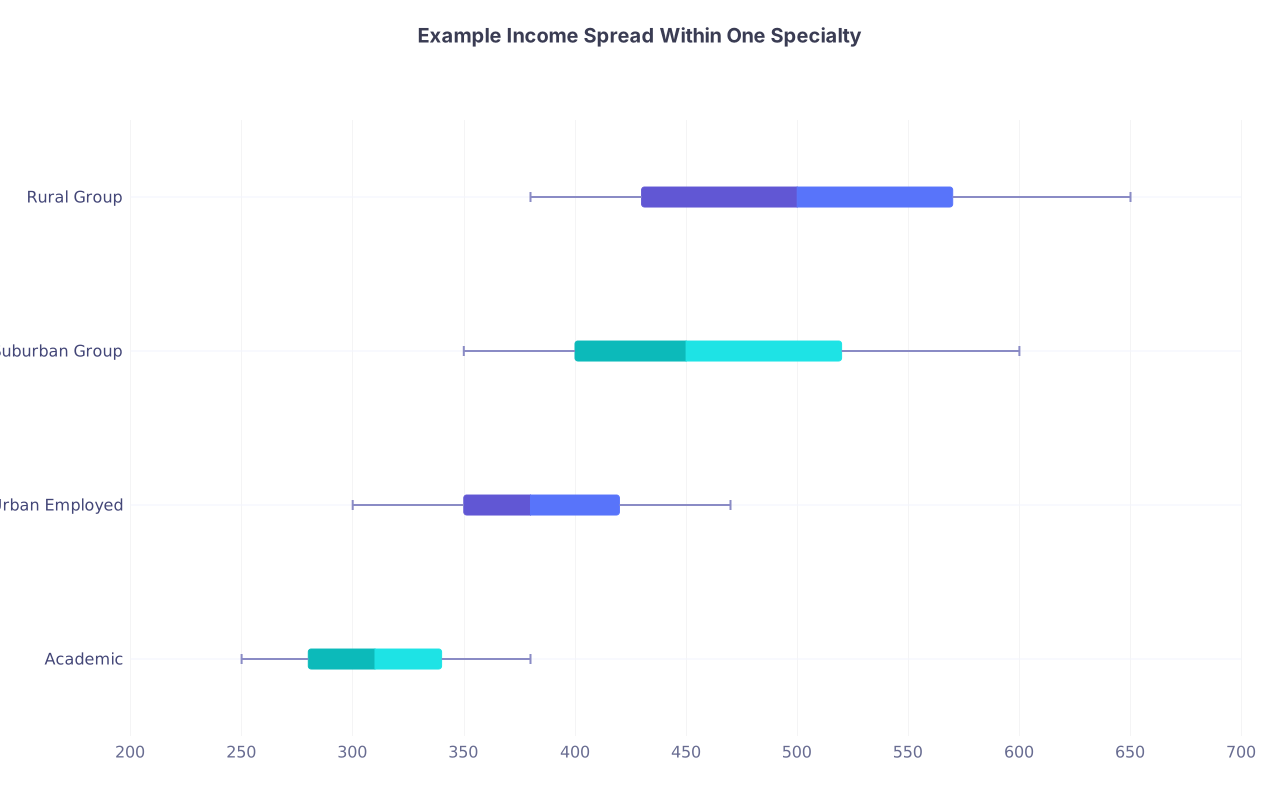
| Category | Min | Q1 | Median | Q3 | Max |
|---|---|---|---|---|---|
| Academic | 250 | 280 | 310 | 340 | 380 |
| Urban Employed | 300 | 350 | 380 | 420 | 470 |
| Suburban Group | 350 | 400 | 450 | 520 | 600 |
| Rural Group | 380 | 430 | 500 | 570 | 650 |
Same specialty. Different practice settings. Academic vs rural private group can be a $200k+ swing.
If you’re serious about income, learning that spread for your chosen field will do more for you than squabbling over which fellowship is 5 percentile points more competitive.
2. Leverage Underserved Markets
Step data and AOA status won’t tell you this, but job boards and real recruiters will:
- Rural and semi‑rural markets: higher pay, signing bonuses, loan repayment, ASC or group ownership opportunities.
- “B‑tier” metros: enough patients, less competition, better leverage to negotiate.
I’ve watched a “backup” FM doc move from a high‑prestige coastal system (~$240k, endless admin) to a Midwest group making $350k+ with better autonomy and lower cost of living. No fellowship. No extra competitiveness points. Just a different map.
3. Add One Lucrative Skill
Within generalist fields, a single procedural niche can move the needle more than your Step 1 percentile ever did:
- FM doc who does OB, vasectomies, joint injections, skin procedures
- Hospitalist who becomes the go‑to for ultrasound‑guided procedures, leads a line service, or covers a SNF panel
- Neurologist who adds EMG/EEG and botox for migraines/dystonia
These are the unglamorous, not‑talked‑about levers that actually nudge income up. They don’t require matching the “most competitive” anything.
The Psychological Trap: Prestige as a Proxy for Security
Let’s be honest about what’s actually going on in a lot of hallway conversations.
“Competitive” is being used as a stand‑in for:
- I’m safe if I do this
- People will respect me
- I’ll be financially secure forever
- I won’t end up regretting this choice
That’s why people cling so hard to the myth. It makes a chaotic job market feel deterministic. “If I just get into x subspecialty, I’m set.”
But look at what’s already happening:
- EM: From “lifestyle king” to market anxiety, corporate control, and residency overexpansion.
- Radiology: Touted as future‑proof, then AI panic, then nuanced reality (still strong, but changing).
- Anesthesia: CRNA/CAA politics, corporate rollups, shifting call structures.
- Even some procedural subspecialties: consolidation, wRVU games, hospital employment squeezing margins.
Competitiveness at the time you match does not freeze your income prospects in amber. Payment models change. Supply changes. Corporate healthcare adapts relentlessly.
The only durable “edge” you have is:
- Choosing work you can tolerate (or even enjoy) long term
- Positioning yourself in markets and practices that value you
- Understanding enough about money and contracts to not get steamrolled
- Being willing to move or pivot as needed
None of that requires you to win the fellowship Hunger Games.
How To Think About This While You’re Applying
If you’re in the residency match or fellowship application grind right now, here’s the clean framework I’d actually use.
- First cut: Can I see myself doing the day‑to‑day work of this field for 20+ years? Not “can I brag about it,” not “does this impress my classmates.” The actual clinic, call, and charting.
- Second cut: Within that field, what are the income ranges by geography and practice type? Academic, corporate employed, private group, rural vs urban. Look at the spread, not just the median.
- Third cut: How fast do I start earning attending income? Additional 3 years of fellowship at $70k while your classmates earn $300k carries a real opportunity cost.
- Final cut: How flexible is this field if the market shifts? Can you move states, switch practice settings, add skills, or toggle between inpatient and outpatient?
If a competitive subspecialty survives that gauntlet and still fits you? Great. Apply hard and stop apologizing.
But if you realize a “less competitive” path gives you:
- Earlier earning
- Similar or better long‑term financial trajectory in the markets you like
- Work you don’t hate
then the idea that you’re somehow “settling” is just borrowed shame from people who haven’t looked at a compensation report since pre‑COVID.
Bottom Line: Competitiveness Is a Terrible North Star
Let me put it as bluntly as I can.
“More competitive” specialties are:
- Sometimes more lucrative
- Sometimes equal
- Sometimes less lucrative
- Always riskier to chase if you do not actually like the work
The people who end up financially comfortable are not the ones who simply matched the sexiest fellowship. They’re the ones who:
- Picked a field they could actually practice for decades
- Chose geography and practice settings strategically
- Understood RVUs, contracts, and basic personal finance
- Stayed flexible when medicine and markets changed under their feet
You do not need to mortgage your happiness to chase competitiveness as a stand‑in for income. Look at real data. Talk to actual attendings in different markets, not just the academic superstars your program parades on interview day.
Years from now, you will not be bragging about how competitive your match was; you’ll be living the consequences of the work you picked and the life it funded. Make sure you are optimizing for that reality—not for the myth.