
The way most people “switch” from a non-competitive to a competitive specialty is backwards. They fall in love with a field, then hope their existing application magically becomes good enough. It will not.
If you’re reading this, you’re probably in one of these boats:
- You were planning primary care / prelim year / a less competitive field… and now you’re suddenly obsessed with dermatology, ortho, radiology, EM, anesthesia, ENT, urology, ophtho, psych at a top program, etc.
- Your scores or grades are average, and you’ve heard the horror stories about unmatched applicants.
- You’re late in the game (late MS3, early MS4, or even already in a prelim year) realizing you want something more competitive.
You do not have the luxury of vague plans. You need a surgical strike.
This is the playbook I’d use if you told me, “I’m pivoting from a non-competitive to a competitive specialty and I refuse to go unmatched.”
Step 1: Get Brutally Honest About Your Starting Point
You cannot plan a transition if you lie to yourself about your stats.
Pull out a blank page and write down:
- Step 1 status (Pass/Fail, year taken, any failures/remediations)
- Step 2 CK score
- Clinical grades (especially core clerkships)
- Research (number of projects, abstracts, pubs; relevance to new field)
- Class rank / quartile if available
- Any red flags (LOA, fail, professionalism issue, visa issues)
Now compare your numbers to your target specialty.
| Specialty | Step 2 CK Strong Zone | Research (median pubs) | AOA/Top Quartile Helpful? |
|---|---|---|---|
| Dermatology | 250+ | 5–10+ | Yes, very |
| Orthopedic Surg | 245+ | 4–6+ | Yes |
| Radiology | 245+ | 3–5+ | Yes |
| Anesthesiology | 235–245+ | 2–4+ | Helpful |
| EM | 235–245+ | 1–3+ | Helpful, less critical |
These are rough, change by year and program, but they’re a sanity check. If you’re significantly below these, your path is not closed—but it’s not “just apply broadly and hope.”
Ask two questions:
- Am I statistically viable at at least some programs in this specialty?
- If yes, what category am I in?
- Strong candidate: Scores at/above average, solid evals, some research.
- Borderline: Slightly below average scores or average app but late interest.
- High-risk: Low scores, red flags, no research, late pivot.
Be honest about which bucket you’re in. Your risk bucket decides how aggressively you must hedge.
Step 2: Decide Your Risk Tolerance and Backup Strategy Now
Do not wait until February to think about a backup. That’s how people go unmatched.
You need to decide early:
- Am I willing to do a prelim/transitional year and reapply if I do not match?
- Am I willing to dual-apply (e.g., Anesthesia + IM, EM + FM, Rads + IM)?
- Am I only okay matching this specific specialty, and willing to delay?
Here’s how most people screw this up: they shotgun apply to 2 specialties without a strategy and look unfocused in both.
If you’re borderline or high-risk, lean toward one of these deliberate approaches:
Primary + Backup in the Same Universe
Example: Radiology (primary) + Internal Medicine (backup)
- Use rads-focused personal statement for rads.
- Use IM-focused PS for IM.
- Be ready to explain to IM programs: “I enjoy diagnostic reasoning and imaging, but I’m ultimately committed to growing as an internist.”
Competitive + Slightly Less Competitive but Overlapping Skills
Example: EM (primary) + FM or IM (backup)
- Emphasize acute care and continuity of care in both.
- You can sell a story that fits both without obviously lying.
Competitive + Prelim Year with Explicit Reapply Plan
Example: Ortho + surgery prelim or TY
- Higher risk but more honest if you’re dead set on a field.
- Requires actual plan for research and networking during intern year.
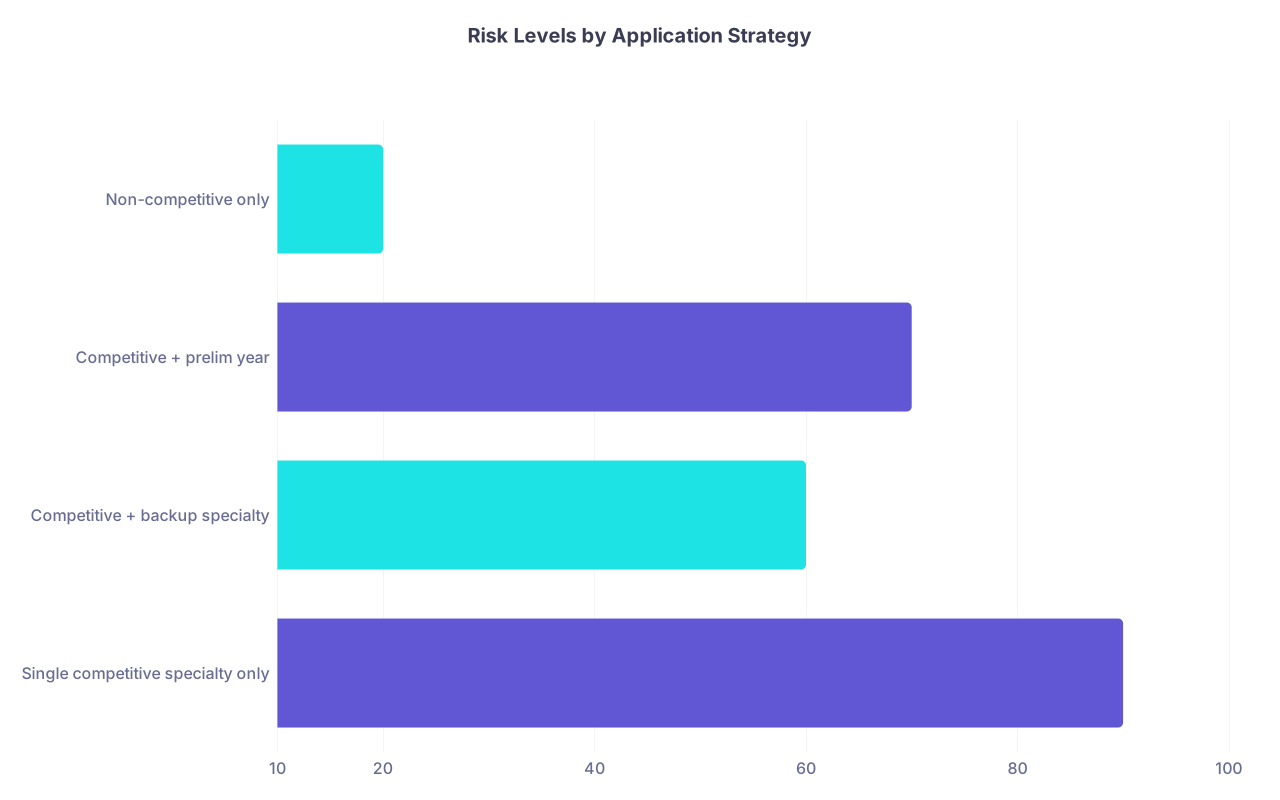
| Category | Value |
|---|---|
| Single competitive specialty only | 90 |
| Competitive + backup specialty | 60 |
| Competitive + prelim year | 70 |
| Non-competitive only | 20 |
(Think of these numbers as “relative risk of going unmatched” out of 100—exact values aren’t real, but the ranking is.)
Pick your lane now. Write it at the top of your planning page.
Step 3: Build a Compressed, High-Yield CV for the New Specialty
You do not have five years to cultivate interest. You might have 6–12 months. So you stack signal where it matters:
A. Get a True Home Rotation or Sub-I in the New Field
If you haven’t rotated in the specialty yet, your first job: get on that schedule.
- If you’re still MS3: move that rotation as early as possible.
- If MS4: ask your dean/coordinator to rearrange electives so your new specialty and at least one away rotation happen early.
- Already graduated / prelim year: line up an elective month in your institution.
On these rotations, you need:
- At least one letter from someone known in the field or at least considered credible by programs.
- Concrete examples of commitment: reading on your patients, showing up early, actually wanting to be there (this shows up in evals more than you think).
B. Attach Yourself to a Research Pipeline Yesterday
You do not need 10 first-author NEJM papers. You need:
- Evidence that you’ve been thinking about the field.
- Names on your CV that ring a bell during application review.
- Proof you can finish projects.
Go to the specialty’s division office or email the residency coordinator and say something like:
“I’m a rising MS4 very interested in [specialty]. I discovered this later in my training and I’m working hard to build experience. I’d love to get involved with any ongoing projects, even in a small role, to learn and contribute. Is there a resident or faculty member you’d recommend I reach out to?”
You’re not aiming for glamorous. You’re aiming for rapid, finishable work: chart reviews, case reports, QI projects, small retrospective studies.
Then be annoying (in a respectful way) about follow-through:
- Set your own deadlines.
- Send drafts.
- Offer to do the grunt work: data cleaning, literature review, IRB formatting.
I’ve watched “late converts” to anesthesiology turn a 0-research CV into 3 abstracts and a pub in 8 months by just being the most reliable person in the room.
Step 4: Secure Letters That Make Your Pivot Believable
Your letters will either close the loop on your story or expose it as last-minute.
You need three categories of letters:
Specialty-specific letter(s)
Non-negotiable. A dermatology app without a derm letter? Dead on arrival at many programs.Primary clerkship letter showing you’re a solid doctor
Medicine or surgery. They want to know you can manage sick patients, be a good intern.Optional: Mentor letter that explains your trajectory
From someone who knows you over time and can say, “They were always strong, and when they found [specialty] it clearly clicked.”
If you’re switching late, explicitly ask at least one letter writer to address this:
“Would you be comfortable commenting on my late transition to [specialty] and why you think I’ll still be a strong fit?”
If they hesitate, that’s a no. Ask someone else.
Step 5: Craft a Personal Statement That Doesn’t Sound Like Panic
Programs read right through, “I just discovered my passion for [very competitive specialty] last month and now it’s my calling.”
You need a story that:
- Acknowledges your previous interest without trashing it.
- Shows a clear, understandable turn toward the new field.
- Doesn’t sound like you’re just chasing lifestyle or money.
Try a structure like this:
Clinically grounded opening
Start with a specific patient or moment, not a generic “I have always been interested…” line.Thread your earlier interests into the new specialty
Example:
You liked primary care because of continuity → now you like EM because of acute stabilization and system-level problem solving, but you still care deeply about communication and follow-up.Address the transition directly (briefly)
One clean paragraph:
“I entered medical school planning for [X]. Through [concrete experiences] in [new specialty], I recognized that my strengths in [A, B, C] align more closely with [new specialty]’s focus on [Y, Z].”End with what you want to do in that specialty
Clinical interest plus one “value-add” (education, QI, advocacy, research).
Do not:
- Over-explain your guilt or confusion.
- List every pro/con you weighed.
- Trash-talk your prior field. That makes you look fickle.
Step 6: Fix the Two Most Common Anchors: Signals and Program List
A late pivot to a competitive specialty with a lazy program list is suicide. You need a targeted approach.
Use Signals Intelligently (If Your Specialty Has Them)
If your specialty uses preference signals (EM, derm, some others), you must not waste them on unrealistic reaches only.
Balance your signals:
- 1–2 true reaches (where your stats are below average but not absurd).
- 2–3 realistic mid-tier programs where your stats are near or slightly below their average.
- 1–2 safety-ish programs (community or less in-demand locations).
This isn’t about ego. It’s about match probability.
Build a Sane Program List
You want three buckets:
- Reach: 10–20% of your list.
- Realistic: 50–60%.
- Safety: 20–30% (in competitive specialties, “safety” just means programs with historically lower averages, community sites, or less popular geographies).
If you’re borderline or high-risk, the ratio shifts: fewer reaches, more realistic + backup specialty.
| Program Type | Competitive Specialty | Backup Specialty |
|---|---|---|
| Reach | 10 | 0 |
| Realistic | 35 | 15 |
| Safety | 10 | 20 |
That’s 55 programs in the competitive field, 35 in backup. Adjust for your wallet and sanity, but you see the idea.
Step 7: Tell a Consistent Story at Interviews
Your new specialty interest will come up. Every time. If your story is shaky, they’ll smell it.
You need clear answers to these:
“You originally were interested in [X]. What made you switch to [Y]?”
Your template:
- Start with respect for X.
- Point to specific experiences in Y.
- Name 2–3 strengths you have that fit Y better.
Example:
“I entered med school leaning strongly toward internal medicine because I liked diagnostic puzzles and longitudinal care. On my ICU and anesthesia rotation, I realized I’m also drawn to physiology in real time and procedures. Working with the anesthesia team in complex cases felt like the right balance of acute care, critical decision-making, and hands-on work. The more I saw, the more I recognized that my strengths—staying calm under pressure, quickly integrating new data, and communicating succinctly in a team—fit best in anesthesiology.”“If you did not match, what would you do?”
Do not say, “I haven’t thought about that.” At this stage, that’s naïve.
Reasonable answers:
- “I would pursue a prelim medicine year with a focus on [related experiences] and reapply with stronger research and clinical exposure.”
- Or if dual-applying: “I’d be happy training in [backup field] and would commit fully to that path.”
“Given that you decided on this specialty later, how do you know it’s the right fit?”
Bring receipts:
- Number of weeks in the specialty.
- Concrete tasks you loved (pre-op discussion, triage, reading images, managing airways, etc.).
- Mentors who’ve been candid with you and still supported your choice.
Keep your tone calm and matter-of-fact. If you sound like you’re trying to sell them, you’ll sound less credible. Just describe what happened.
Step 8: Avoid the Classic Mistakes Late Switchers Make
I’ve watched people torpedo themselves with the same handful of errors:
Spray-and-pray away rotations
Two away rotations are plenty in most cases. More than three can actually start to look frantic unless they’re tightly justified.Ignoring home program relationships
Your own institution’s attendings often have friends everywhere. That quiet email from your PD or chair can do more than another line on your CV. You need at least one advocate who is willing to pick up the phone.Leaving your old mentors in the dark
They find out you switched fields from the grapevine and feel used. Tell them early, respectfully. Some of them will help you more than you expect.Applying only to “prestige” programs that will never interview you
The number of applicants I’ve seen who applied to 35 derm programs consisting solely of big-name academic centers with 260+ Step medians… and nowhere else. Do not be that person.Neglecting your performance in remaining rotations
Some people mentally check out of anything that’s not their new field. Bad move. Weak evals from late MS3/MS4 months still hurt. You’re building a reputation, not just a checklist.
Step 9: If You’re Already in a Non-Competitive Residency and Want to Switch
This is a different, tougher situation—but not hopeless.
Scenario: You matched FM or IM, but now want anesthesia, radiology, EM, etc.
Here’s your sequence:
Have an honest conversation with a trusted attending or PD in your current program. Not on day 1, but once you’ve proven you’re not flaky.
Excel where you are. If your current PD can’t say, “They were one of our strongest interns,” your chances drop.
During elective time:
- Rotate in the new specialty at your hospital.
- Secure at least one strong letter from that department.
- Ask directly: “Given my background, do you think I’m a viable candidate if I apply in [specialty]?”
Start building field-specific research or QI with that department.
Work out logistics:
- Are you reapplying through ERAS as a PGY-1/2?
- Are there “advanced positions” with PGY-2/3 starts?
- Do you need to finish one year to be board-eligible as a prelim?
You’ll likely have to explain the switch multiple times. You cannot sound like you’re running from your current field. You have to sound like you’re running toward something that better fits your skills and goals.
Step 10: Manage Your Own Psychology While Playing the Long Game
Switching to a competitive specialty late feels like playing on “hard mode.” Your anxiety will spike, and you’ll be tempted to:
- Constantly re-compare your stats to Reddit flex posts.
- Rewrite your personal statement 27 times.
- Second-guess every strategy and redo your entire plan weekly.
That’s how you burn out and start making sloppy decisions.
Do this instead:
Once you’ve built a plan (program list, research, rotations, letters), lock it for a defined period. Example: “I will not touch my program list for 2 weeks unless something massive changes.”
Set process goals rather than outcome goals.
“Email 3 potential research mentors this week.”
“Pre-round on every patient and read one primary article per day.”
You control those. You don’t control whether Mayo interviews you.Choose one or two advisors you actually trust. Not 10. Too many voices will paralyze you.
A Visual Snapshot: Your 6–12 Month Transition Plan
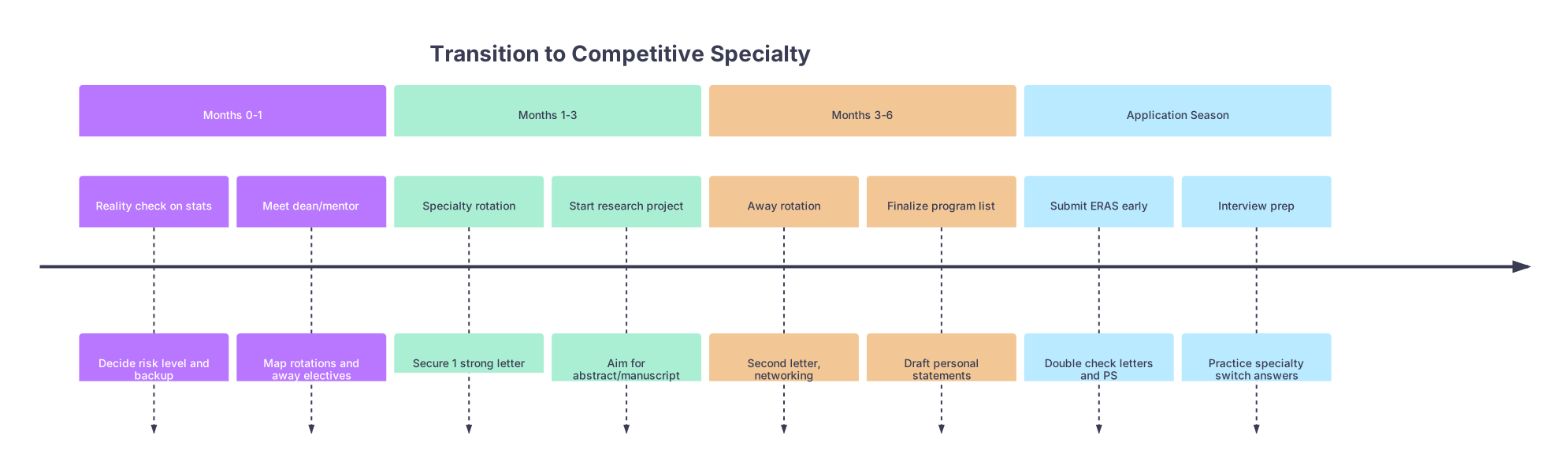
| Period | Event |
|---|---|
| Months 0-1 - Reality check on stats | Decide risk level and backup |
| Months 0-1 - Meet dean/mentor | Map rotations and away electives |
| Months 1-3 - Specialty rotation | Secure 1 strong letter |
| Months 1-3 - Start research project | Aim for abstract/manuscript |
| Months 3-6 - Away rotation | Second letter, networking |
| Months 3-6 - Finalize program list | Draft personal statements |
| Application Season - Submit ERAS early | Double check letters and PS |
| Application Season - Interview prep | Practice specialty switch answers |
One More Thing Nobody Says Out Loud
Some transitions will not be realistic this cycle, no matter how hard you push. If you’re sitting with a 210 Step 2, no research, and a late interest in derm or ortho, you’re not going to brute-force your way into a top program in 6 months. Anyone telling you otherwise is selling fantasy.
What you can do:
- Target a more attainable specialty this cycle while quietly strengthening your CV.
- Or accept a longer runway: research year, prelim year, disciplined reapplication.
Neither option is glamorous. But both are better than pretending odds do not exist.
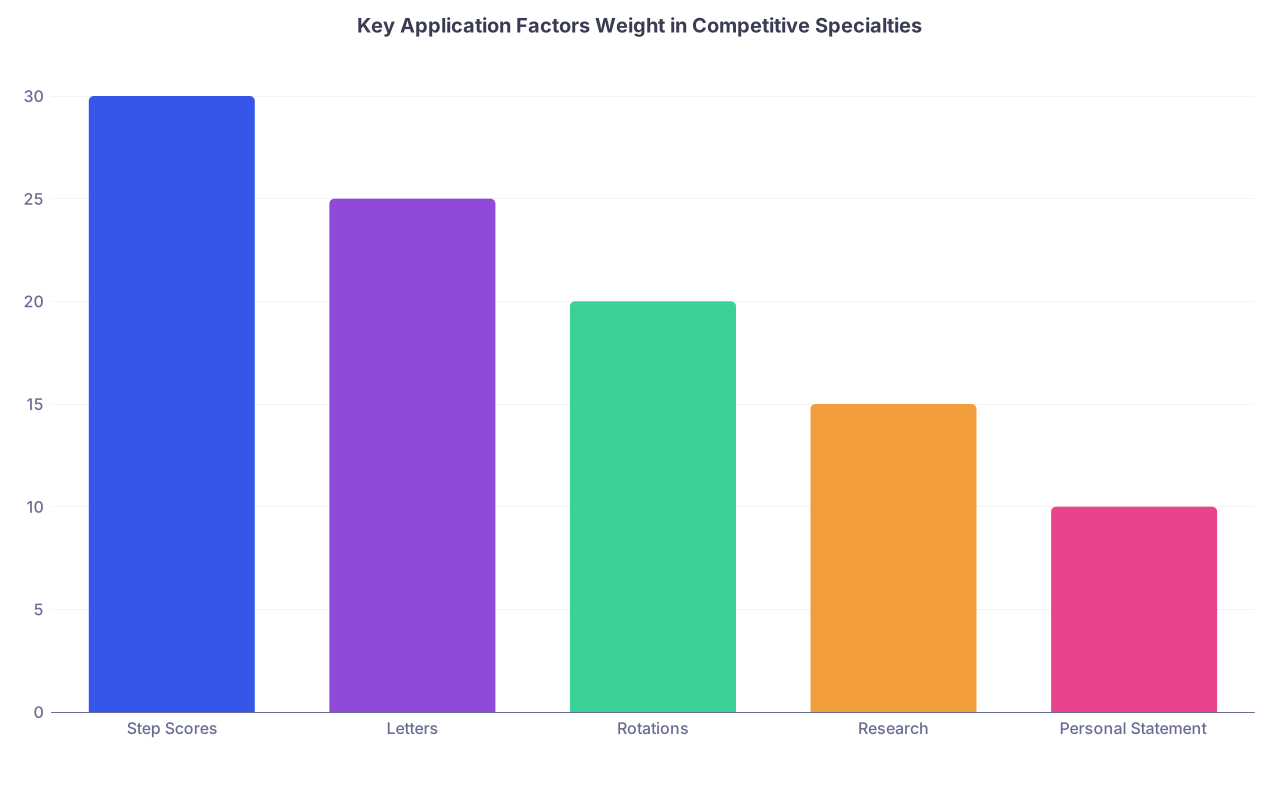
| Category | Value |
|---|---|
| Step Scores | 30 |
| Letters | 25 |
| Rotations | 20 |
| Research | 15 |
| Personal Statement | 10 |
Use this as a rough reminder: scores and letters carry a lot of weight, but they’re not everything. Your behavior in the next 6–12 months still matters. A lot.
What You Should Do Today
Do not “think about this more.” Do one concrete thing.
Today, before you go to bed, do this:
Write a single-page document with:
- Your current stats (scores, grades, experiences).
- The competitive specialty you’re targeting.
- Your risk category (strong, borderline, high-risk).
- Your chosen strategy:
- Single competitive only
- Competitive + backup specialty
- Competitive + prelim with reapply plan
- The names of three people you will contact this week:
- One potential research mentor in the new specialty.
- One faculty member in the new specialty for a rotation/letter.
- One advisor (PD, dean, or trusted attending) to sanity-check your plan.
Then send one email. Just one. To the first person on that list.
You’re not going to “wish” yourself from non-competitive to competitive. You’re going to grind your way there, one specific action at a time.