
The worst time to realize your dream specialty isn’t right for you is during an away rotation. Unfortunately, that’s exactly when it hits a lot of people.
You’re exhausted, you’re surrounded by gunners who seem born for this, and some morning on rounds you think: “I do not want this life.” Or more quietly: “I don’t fit here.” And the panic starts.
Let’s deal with that. Directly.
Step 1: Name What’s Actually Wrong (Not the Instagram Version)
The first mistake students make: they lump every negative feeling into “maybe this specialty isn’t for me.”
Sometimes that’s true. Sometimes you’re just on a toxic service in an overhyped city, with residents who haven’t slept in 36 hours and an attending who thinks shaming is teaching.
You need to separate four things:
- Do I like the work?
- Do I like the people who choose this?
- Do I accept the lifestyle tradeoffs long term?
- Do I have the horsepower and desire to stay competitive?
You’re probably confusing at least two of those right now.
On your next post-call brain, do this brutally honest check:
- When I’m actually doing the core tasks (procedures, clinic, notes, consults), do I feel:
- Drained and resentful
- Neutral
- Focused and engaged
- When I imagine myself as an attending in this field:
- Can I see a version of that life I’d be proud of?
- Or does the idea of becoming them feel like a nightmare?
And then the kicker: If this specialty had average competitiveness (like FM/IM/Peds) and no prestige attached, would I still want it?
If the answer is “no” once you strip away competitiveness, status, and money, then stop trying to bargain with reality. You’re in the wrong specialty.
If the answer is “yes, but…” then you’re likely dealing with one of these:
- Misery due to bad rotation environment
- Impostor syndrome around ultra-strong co-rotators
- Burnout unrelated to the field itself
- Fear of not matching clouding your judgment
Know which problem you’re actually solving. Otherwise you’ll blow up your whole trajectory because of one malignant month.
Step 2: Reality Check – Where Are You in the Timeline?
How you handle this depends heavily on when you’re realizing it.

| Step | Description |
|---|---|
| Step 1 | Realization |
| Step 2 | Maximum flexibility |
| Step 3 | High but not total flexibility |
| Step 4 | Moderate flexibility |
| Step 5 | Limited but real options |
| Step 6 | Very constrained |
| Step 7 | When is it? |
Now, specifically for you on an away rotation, you’re almost certainly in one of two buckets:
- Late MS3 / very early MS4 – still pre-ERAS
- Early MS4 with ERAS looming this fall
That means you still have room to pivot, but not for aimless wandering.
Ask yourself:
- Have I already:
- Taken Step 2?
- Scheduled more aways in this specialty?
- Told mentors “I’m all-in on [specialty]”?
- Do I have:
- Any solid letters in other specialties?
- A home program in multiple fields or just this one?
- Research that’s tightly bound to this one field?
You’re not starting from zero, you’re starting from “over-committed to the wrong thing.” That’s fixable, but only if you stop pretending it’s fine.
Step 3: Quietly Pressure-Test Other Options (Right Now)
Don’t send a mass “I think I hate [specialty]” text to your mentors. Don’t announce anything on this away. You’re gathering data, not detonating bridges.
You need to answer two questions fast:
- Am I truly out on this specialty, or just spooked?
- If I pivot, what’s my actual Plan B (and C)?
Here’s how you test this without blowing up your away:
A. Compare your emotional reaction to other rotations
Think back:
- On your IM/surgery/OB/peds/psych rotation, did you:
- Wake up dreading it less than now?
- Feel more “this could be okay long-term” than you do here?
- Were there specific moments where you thought:
- “I like this kind of patient/problem/workflow”?
Write down 3–5 specific days you enjoyed in prior rotations. What were you actually doing? Clinic? Inpatient? Procedures? Brief, deep conversations? That pattern matters more than the specialty label.
B. Use your current environment as a contrast tool
On this away, pay attention to very specific thoughts:
- “I wish I were just following these patients on the floor and not doing the OR time.”
- “I like the procedure…but I hate everything around it.”
- “I actually enjoy the consult thinking, but I hate the hours and culture.”
Those are signals. Don’t ignore them.
Step 4: Have the Hard Conversations – In the Right Order
If you decide this specialty probably isn’t your long-term home, you need to talk to people. But you need to talk to the right people in the right sequence.
Here’s the priority list:
- One trusted person at your home school
- Then maybe a second person in a potential new specialty
- Only later, selected people in the specialty you’re leaving (if at all)
Do not start with the away rotation attending who barely knows you.
Who to talk to first
Ideal first person:
- A faculty member or dean who:
- Knows you as a person
- Has seen your work in more than one context
- Is not emotionally invested in you going into [competitive specialty]
This might be:
- An IM attending from your core clerkship
- Your college advisor / career advisor / dean
- A research PI who actually mentors humans, not just uses them
When you meet, be direct:
“I’m on an away in [specialty]. I went into this thinking it was my long-term plan. The more time I spend here, the more I’m realizing I don’t like the day-to-day work or the culture.
I don’t want to make a panic decision based on a single rotation, but I also don’t want to force a fit.
Based on what you’ve seen of me clinically, where do you think I’ve looked most like myself?”
Then stop talking. Let them react.
You’re looking for pattern recognition from someone who’s watched many students find (or force) their paths.
Step 5: Build a Realistic Pivot Map (Not a Fantasy Jump)
A lot of students go straight from “I don’t like ortho” to “I’ll just pivot to derm/anesthesia/rads.” Lateral jumps into equally or almost equally competitive fields are often just changing the wallpaper on the same trapped room.
You need a pivot map that respects two realities:
- Your actual profile (scores, grades, research, narrative)
- This year’s application calendar
Here’s a simplified view of competitiveness and pivot feasibility if you’re bailing from a highly competitive field during away season:
| Target Field | Overall Competitiveness | Pivot Feasibility Mid-MS4 | Notes |
|---|---|---|---|
| Another super-competitive (Derm, Ortho, Plastics, ENT) | Very High | Low | Usually just trading one problem for another |
| EM, Anesthesia, Radiology | Moderate-High | Moderate | Possible if you move fast and can get letters |
| IM, Peds, Psych, Neuro | Moderate | High | Most common and workable pivots |
| FM, Pathology, PM&R | Lower-Moderate | Very High | Often quite happy attendings, less hype |
Key point: “Less competitive” does not mean “worse life” or “boring work.” Some of the happiest attendings I’ve met are in FM, PM&R, psych, and peds. They didn’t sell out. They just opted out of the arms race.
How to build your map in one week
While you’re still on this away, carve out one evening and do this:
List 3 specialties you actually enjoyed or can see yourself tolerating long-term
For each, answer:
- Do I have at least one potential letter writer?
- Have I done the core rotation yet?
- Does my Step 2 and transcript fit the field’s norms?
Eliminate fields where:
- You haven’t even rotated
- You’re so late you’d essentially be guessing
You’re trying to land on 1–2 realistic pivot fields that you can quickly build evidence for, not 6 half-baked options.
Step 6: Decide What to Do With This Current Away
You’re stuck here for the rest of this rotation. So use it strategically.
There are three paths:
- Finish strong, use it as a generic “good LOR” if needed
- Finish strong, but don’t request a letter
- If the environment is actively harmful, talk to your school about shortening or transferring
In most cases, you choose #1 or #2.
If you like at least parts of the specialty, even if you won’t apply:
“Dr. X, I’ve really appreciated learning from you this month. I’m still sorting out my career direction, but your teaching has helped me understand the field much better. Would you be willing to write a letter speaking to my clinical performance for residency applications?”
That wording:
- Signals honesty (“still sorting out my career direction”)
- Doesn’t lock you into their field
- Lets that letter be used more generically (some programs don’t care what specialty the LOR writer is)
If you know with 100% certainty you’re never applying to this field and the rotation has been rough, you might skip the letter. But still work hard. People talk. Departments talk. You don’t want a reputation as the student who mentally checked out and everyone noticed.
Step 7: Compress a Pivot Plan Into a Brutal 4–8 Week Sprint
Once you’re off this away, your next 1–2 months are critical. You’re going to temporarily live like you’re running a small startup. The product is “evidence that I belong in my new specialty.”
Here’s how that often looks if you’re pivoting before ERAS:
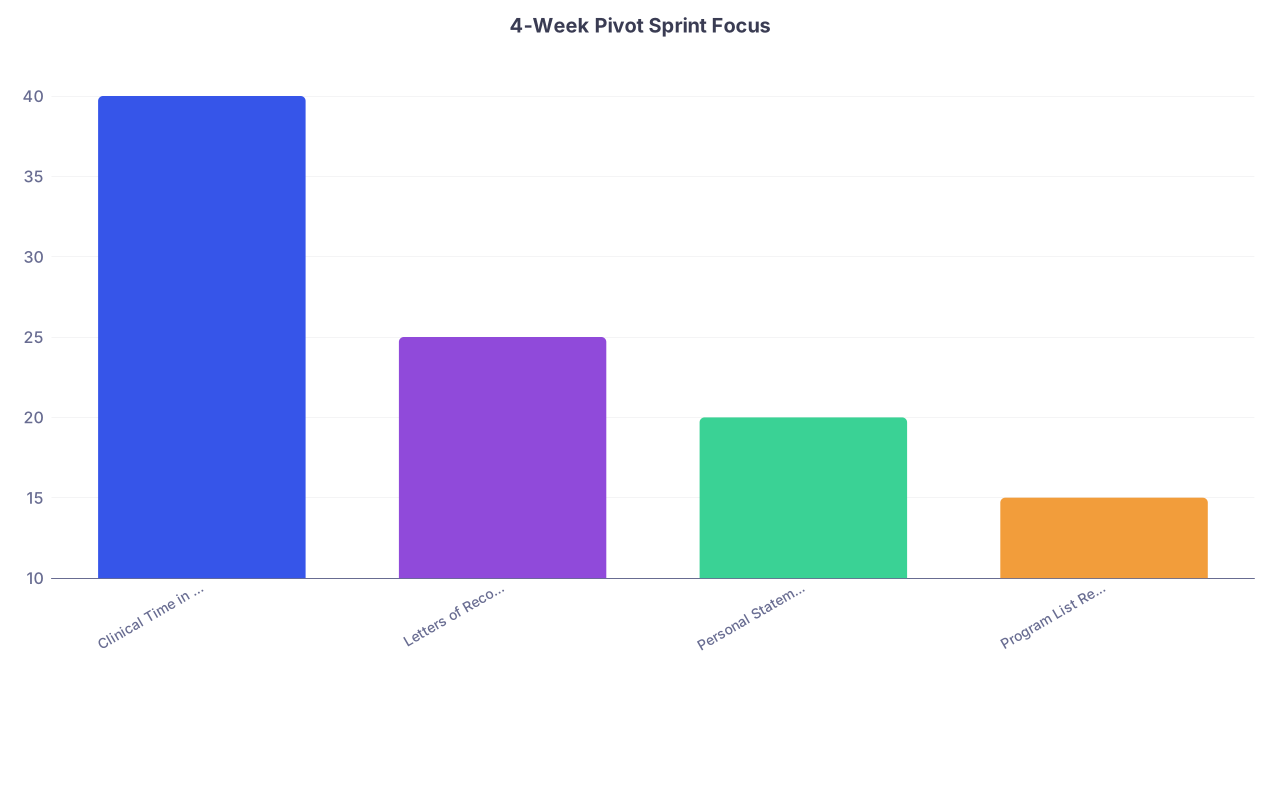
| Category | Value |
|---|---|
| Clinical Time in New Field | 40 |
| Letters of Recommendation | 25 |
| Personal Statement/Story | 20 |
| Program List Research | 15 |
Concrete moves:
- Get on a home rotation or sub-I in your potential new field ASAP
- Ask early for letters:
- Week 2 if you’re working closely with someone
- Tell attendings the truth without drama:
- “I was originally planning for [X]. On my away I realized the day-to-day wasn’t a fit. I’ve consistently enjoyed [Y experiences]. I’m now strongly considering [new field] and would value your feedback and support.”
You are not the first person they’ve heard this from. The better ones will appreciate the honesty.
If you’re pivoting after ERAS submission, the strategy changes (we’ll hit that later).
Step 8: Fix Your Application Story So It Doesn’t Sound Like Panic
You can’t submit an application that reads like: “I loved ortho, then I didn’t, so now anesthesia I guess?”
You need a through-line.
Here’s the basic structure that actually works:
Core values/patterns that have been consistent:
- You like longitudinal patient relationships
- Or you like discrete, high-impact decision points
- Or you’re drawn to complex physiology
- Or you care about communication and trust-building
Evidence for those patterns before the failed away:
- Volunteer work, research, earlier rotations, prior career
Then the honest pivot:
- “I explored [competitive specialty] because of [specific aspects you genuinely liked].
- On an away rotation, I realized that the day-to-day practice – particularly [X, Y] – didn’t match how I want to spend my time clinically.
- That experience forced me to look back at the moments in training when I felt most like myself. Again and again, they pointed toward [new field] and specifically [sub-aspects].”
Close with a forward-looking focus:
- What you want to contribute in this new field
- What environments you’re excited to train in
You’re not hiding the detour. You’re showing that you course-corrected based on data about yourself, not just fear of competitiveness.
Step 9: If You’re Realizing This After ERAS or During Interviews
This is where it gets ugly. But not hopeless.
After ERAS is submitted, before interviews
You’ve applied in the competitive field. Now you’re sure it isn’t you.
Your options:
Ride out the cycle:
- Go to interviews
- Rank programs you could tolerate
- If you don’t match, regroup and pivot fully next year
Or attempt a mid-cycle pivot:
- Talk to your dean honestly
- Ask if there’s bandwidth and political capital to:
- Signal interest to a less competitive field
- Possibly submit a second ERAS (expensive, not always allowed or helpful)
This is very school-dependent. Some schools aggressively help with mid-cycle pivots. Some shrug. You need institutional intel.
During or after interview season, you’re miserable every time you talk about the field
If you’re dreading every interview, that’s a sign. But sometimes it’s just generic interview fatigue. Try this litmus test:
On the flight/train/car home, ask:
- “If I match at that program, in this field, will I be relieved or crushed?”
If it’s leaning “crushed” consistently, ask your dean before rank list certification:
- “Is it safer for me to:
- Rank only programs I could at least tolerate, and risk going unmatched?
- Or rank them all and consider switching specialties after internship?”
Plenty of people do a prelim or transitional year, then switch. It’s not clean. But it’s survivable.
Step 10: Deal With the Ego and Grief (Because That’s What This Is)
Naming it: part of why this hurts is because you’ve wrapped identity around a “competitive specialty.”
You’ve probably said for a year:
- “I’m going into ortho/anesthesia/derm/ENT/etc.”
- You followed all the Reddit/SDN “how to be competitive” nonsense
- You chased the shiny, high-status path
And now, admitting it’s not for you feels like losing.
Here’s the blunt truth: staying in a specialty that doesn’t fit you just to protect your ego is how you end up as that bitter attending everyone hates working with.
You’re not “downgrading” to IM or FM or psych or PM&R. You’re opting out of a race that doesn’t lead to a life you want.
Give yourself a week to feel crappy about it. Then treat this like any other clinical problem: reassess, re-diagnose, adjust the plan.
Step 11: Concrete Scripts You Can Actually Use
You’re going to have to talk to multiple groups. Let me make your life easier.
To your home advisor (first conversation)
“I’m on an away in [specialty]. I came in thinking it was my top choice. The more I see, the more I realize I don’t enjoy the core work or the culture as much as I expected.
The rotations where I’ve felt most engaged have been [X and Y]. I’m seriously considering pivoting toward [new specialty], but I want your honest feedback on whether that makes sense given my performance and the timeline.”
To a potential new-specialty attending on day 1 of a sub-I
“I want to be upfront so I can get the most out of this month. I initially explored [competitive specialty], and on an away realized the day-to-day wasn’t the right fit for me. The experiences where I’ve felt most like myself have been in [new field], especially [specific aspects].
I’m strongly considering applying in [new field] this cycle and would really value specific feedback on how I’m doing and where I need to improve to be a competitive applicant.”
To the away rotation attending if they ask about your plans
“I’ve really appreciated seeing [specialty] up close. It’s helped me clarify what I value in my future practice. I’m still in the process of solidifying my plans, but I’ve realized I’m especially drawn to [aspects that may lean toward your new field]. I’m talking with my advisors back home about where that best fits.”
You do not have to give them a full confessional. Stay respectful, vague, and grateful.
Step 12: How to Know You’re Not Just Running Away From Hard Things
Last thing. Some students decide “this isn’t for me” when what they really mean is “this is hard and I feel mediocre on this away.”
You need one more reality check:
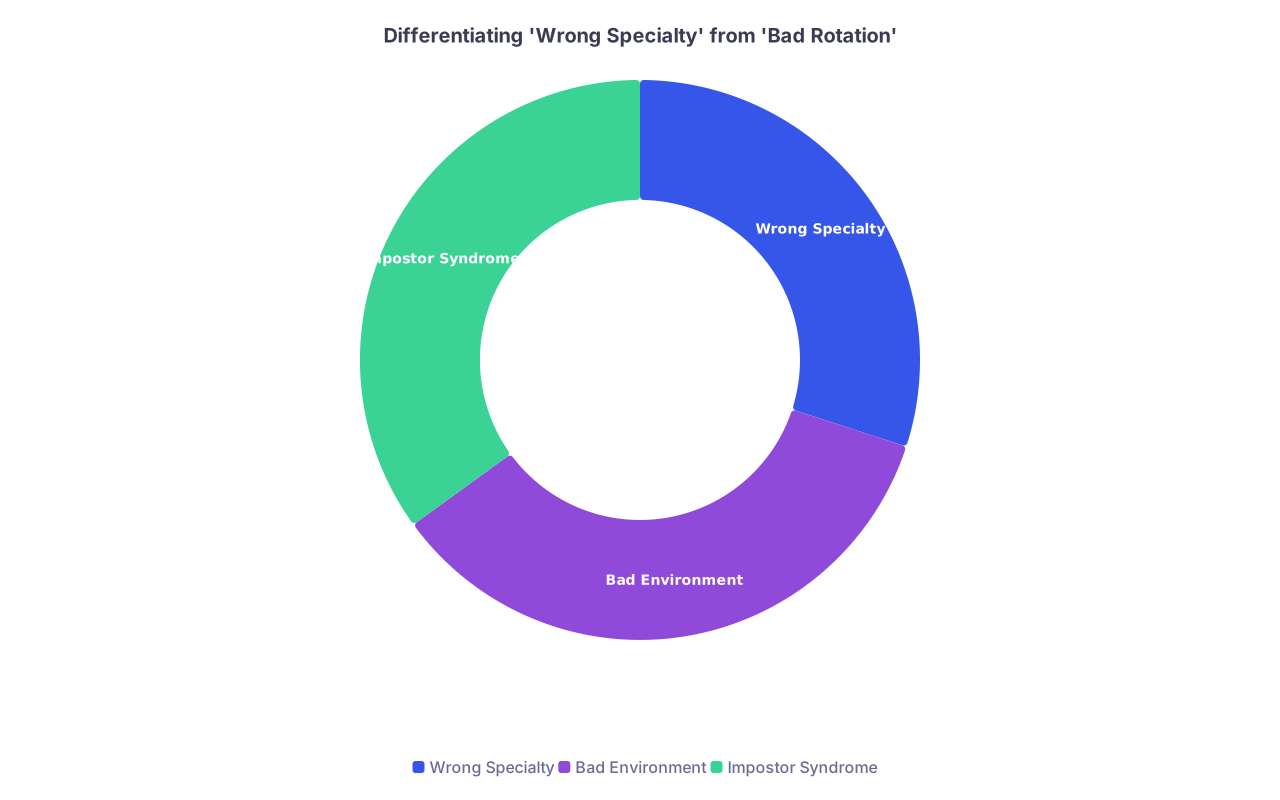
| Category | Value |
|---|---|
| Wrong Specialty | 30 |
| Bad Environment | 35 |
| Impostor Syndrome | 35 |
Ask yourself:
- When I imagine being good at this specialty, does it become appealing?
- If yes: you might be in impostor land.
- Even if I were the best resident here, would I actually want that life?
- If still no: then it’s likely truly not your field.
Also:
- Are there any attendings in this field whose life looks like something you’d want at 45?
- If your honest answer is “none,” stop trying to gaslight yourself.
Quick Visual – Your Decision Path From This Away

| Step | Description |
|---|---|
| Step 1 | Realize something feels wrong |
| Step 2 | Clarify if work or environment |
| Step 3 | Identify 1-2 new fields |
| Step 4 | Likely bad environment / burnout |
| Step 5 | Talk to home advisor |
| Step 6 | Arrange subI in new field |
| Step 7 | Get letters and rewrite story |
| Step 8 | Finish away strong |
| Step 9 | Reassess with trusted mentor |
| Step 10 | Hate work itself? |
Final Reality Check
You discovered this on an away. Late, but not too late.
If you remember nothing else:
- Don’t blow up your life based on one malignant month, but don’t ignore clear, repeated signals that the core work and culture are wrong for you.
- Quietly gather data, talk to one or two trusted humans at home, and build a focused pivot plan—1–2 realistic target fields, not six fantasies.
- Protect your professionalism on this away, even if you’re done with the specialty; you’re building your long-term reputation, not just surviving one rotation.
You’re not failing. You’re course-correcting before the stakes get even higher. That’s what competent people do.