
Are you actually “playing it safe” by ranking internal medicine or pediatrics higher than dermatology and radiology… or are you misunderstanding what competitiveness looks like in 2025?
Let me be blunt: the way most students talk about ROAD specialties—Radiology, Ophthalmology, Anesthesiology, Dermatology—as “the most competitive” is about 10 years out of date and based on vibes more than data.
You’re not crazy for thinking that. You’ve heard it from classmates, older residents, maybe even advisors: “Derm is impossible,” “Optho is insane,” “Gas is getting crazy competitive,” and the classic, “If you want a chill life and good money, you need a ROAD specialty.”
Here’s the problem: match data does not support the simplistic story that ROAD = always most competitive. Some ROAD fields are brutally hard. Some are middle of the pack. Meanwhile, a few non-ROAD specialties quietly eat applicants alive every match cycle while everyone keeps talking about dermatology memes.
Let’s go through what’s actually true.
What “Competitive” Actually Means (Not What Reddit Says)
Before arguing about which specialty is “hardest,” you have to define competitive in measurable terms. Otherwise you’re just trading anecdotes from that one guy at your school who didn’t match ortho.
When NRMP and specialty matches publish data, they give you real levers:
- USMLE Step 2 CK score distributions
- Match rates by applicant type (US MD, DO, IMGs)
- Number of applicants per position
- Proportion of unmatched among rank-listing applicants
- Research output and AOA/honors prevalence
If you want to talk about competitiveness, you look at these, not vibes.
Here’s the first myth to kill:
Myth #1: “The Road Specialties Are the Top 4 Most Competitive Fields.”
Reality: Dermatology is consistently top-tier competitive. Ophthalmology is highly competitive. Anesthesiology and Diagnostic Radiology are now mid-tier competitive at best and in some cycles borderline undersubscribed, especially for certain programs and regions.
Let’s put some structure to it.
| Tier | More Competitive Examples | Less Competitive Examples |
|---|---|---|
| Very High | Dermatology, Plastic Surgery, Ortho, ENT, Neurosurgery, Integrated IR | — |
| High | Ophthalmology, Urology, Radiation Oncology (variable), Competitive EM spots | Anesthesiology (top programs only), Radiology (top programs only) |
| Moderate | Radiology, Anesthesiology, EM (overall), General Surgery (mid programs), OB/GYN | IM subspecialty tracks, some pediatrics-heavy programs |
| Lower | Internal Medicine, Pediatrics, Family Medicine, Psych, Neuro (many programs) | Community FM, lower-demand regions |
This isn’t exact ranking—because exact rank by “competitiveness” is a dumb game—but it reflects actual patterns from recent match cycles.
The “Road” Story: Why It Used To Be True… And Why It’s Not Now
A decade ago, ROAD had a simpler narrative: lifestyle, pay, fewer nights, less scut. Everyone wanted in. But medicine changed.
Anesthesiology: From “Hyper Hot” To “It Depends”
I’ve looked at enough match cycles to say this clearly: the idea that anesthesiology is universally one of the hardest matches is outdated.
Data patterns:
- Applicant-per-position ratios have cooled compared to peak years.
- Match rates for US MDs in anesthesia are very favorable.
- Many community and mid-tier academic programs struggle to fill all their spots on the first pass.
Is it free? No. Strong Step 2, decent clinical performance, solid letters still matter. But if you put anesthesia next to plastics, ortho, ENT, or derm and say they’re “equally competitive,” you’re ignoring reality.
Radiology: The Whiplash Specialty
Radiology swings in cycles with the job market. Two decades ago it was red hot. Then it cooled. Recently, it’s been picking up again—but not to “you-need-a-260” levels for most programs.
Typical pattern:
- Competitive at top academic places, coastal cities, and IR-integrated tracks.
- Reasonably attainable at many others for a solid US MD with okay Step 2 and non-insane CV.
- DOs and IMGs still face more friction, but that’s across almost all non-primary-care specialties, not just rads.
It is absolutely not accurate to lump “rads at a midwestern community program” with “derm at a major coastal academic center” and call them the same difficulty.
Ophthalmology: Quietly Brutal
Optho never gets memes like derm, but the numbers are not soft. SF Match data routinely show:
- High Step 2 ranges for matched applicants.
- Significant research and often specialty-specific involvement.
- Meaningful unmatched rates among applicants who actually interview and rank.
The small size of the field plus early match timing plus tight networking means that for serious applicants, ophtho is clearly in the “highly competitive” camp.
Dermatology: The One ROAD Myth That’s Basically True
Derm is still a blood sport. The switch to Step 1 pass/fail did not suddenly democratize dermatology.
You see:
- High Step 2 CK scores.
- Tons of research output, often derm-specific.
- Very high proportion of AOA, honors, and home program connections.
- Limited number of positions and heavy preference for “known quantities.”
If you’re comparing “IM at a solid university program” and “Derm anywhere half-decent” and acting like those are parallel worlds, you are fooling yourself.
The Real Monsters: Non-ROAD Specialties That Are Harder Than People Admit
Here’s where the conversation usually collapses. Students fixate on ROAD while several non-ROAD fields are objectively more selective, especially at the top tiers.
Let’s say it:
If you want a truly cutthroat match, think plastics, ortho, ENT, neurosurgery, integrated IR, competitive urology. Not “gas at a community program.”
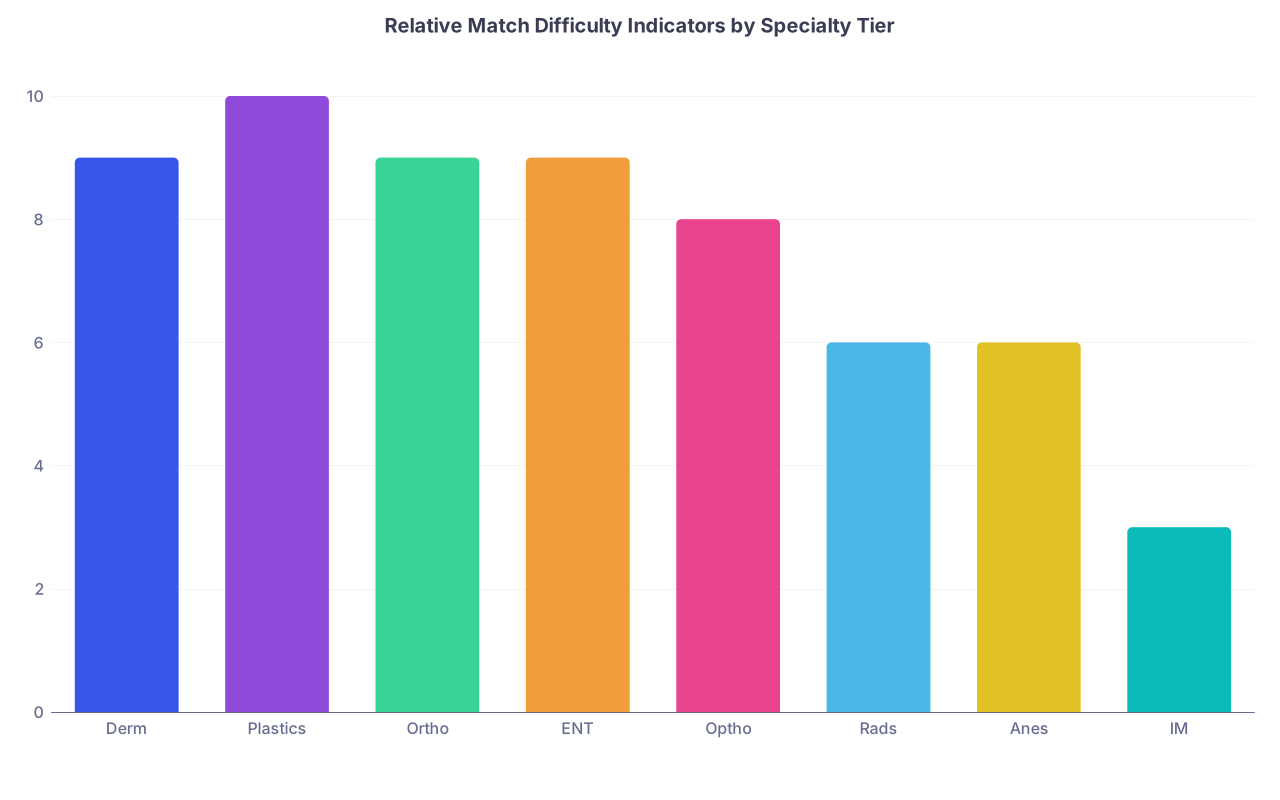
| Category | Value |
|---|---|
| Derm | 9 |
| Plastics | 10 |
| Ortho | 9 |
| ENT | 9 |
| Optho | 8 |
| Rads | 6 |
| Anes | 6 |
| IM | 3 |
(Scale 1–10, approximate composite of Step scores, unmatched risk, research load, and selection bias. Not a perfect scientific scale, but it reflects real-world difficulty bands.)
Plastic Surgery (Integrated)
Nothing in the ROAD family touches integrated plastics for brutality:
- Tiny number of spots nationwide.
- Off-the-charts research, often with multiple years of dedicated time.
- Ridiculous concentration of AOA, top-school pedigree, and home program favoritism.
This is where your “top of the class with multiple first-author pubs” types still get rejected at places they’d be a good fit for on paper.
Orthopedic Surgery, ENT, Neurosurgery
All three share the same vibe:
- Long training, heavy procedures, big egos, tight networks.
- High Step 2 expectations.
- Multiple strong letters from big-name attendings in the field are practically mandatory.
- Failure to match can derail your entire career plan.
You rarely hear, “I’m choosing IM because ortho is too competitive” with the same drama that surrounds derm, but from a numbers perspective, that’s exactly the kind of calculation many students should be making.
Integrated IR: The Overlooked Killer
Interventional Radiology (Integrated) is a trap for the uninformed:
- Very few positions per program.
- Applicants competing with some of the top radiology candidates.
- Significant procedural, research, and mentorship expectations.
If you’re saying, “ROAD is the hardest” and you’re not even including integrated IR or plastics in your mental model, you’re living in the wrong decade.
Match Rates vs. Perception: Why Your Brain Gets This Wrong
There’s a weird mismatch between how “competitive” feels and how the numbers look. Students are biased by:
- What they hear at their school (local culture, dominant departments).
- What they see on social media (derm flex posts, rads lifestyle clips).
- Survivor bias (people talk more about wild success or total failure).
Here’s the thing: the match rate for US MDs in internal medicine is high. For family medicine, higher. For dermatology, plastics, ENT, etc., significantly lower.
But “high match rate” doesn’t mean no standards. And “lower match rate” doesn’t tell you whether that’s because everyone with a 210 is tossing in an application “just to see.”
Let’s compare broad buckets.
| Specialty Group | Match Rate | Typical Step 2 Range (Matched) | Research Expectation |
|---|---|---|---|
| Derm / Ortho / Plastics / ENT | Lower | High | High, often specialty-specific |
| Ophtho / Urology / Neurosurg | Lower–Moderate | High | High |
| Rads / Anes (overall) | Moderate–High | Moderate–High | Variable |
| IM / Peds / FM / Psych | High | Wide range | Moderate or low |
The Ugly Truth: Prestige And Ego Drive A Lot Of This
A lot of the “ROAD is most competitive” myth is really “I want to sound impressive when I tell people my specialty.”
I’ve seen students aim for derm who:
- Hate clinic.
- Hate chronic disease discussions.
- Hate procedural repetition.
But they love the perceived status and lifestyle. That’s not strategy, that’s ego.
Same with people who trash IM as “backup only” while ignoring that cardiology, GI, heme/onc, and critical care fellowships are savage to get into. They think they’re “above” IM but end up in weird, unstable paths when they miss in a hyper-competitive field and never emotionally committed to a realistic second option.
The most dangerous mistake is thinking there are only two categories:
- “Insanely competitive ROAD”
- “Everything else, easy”
Reality is more like a spectrum, with clusters.
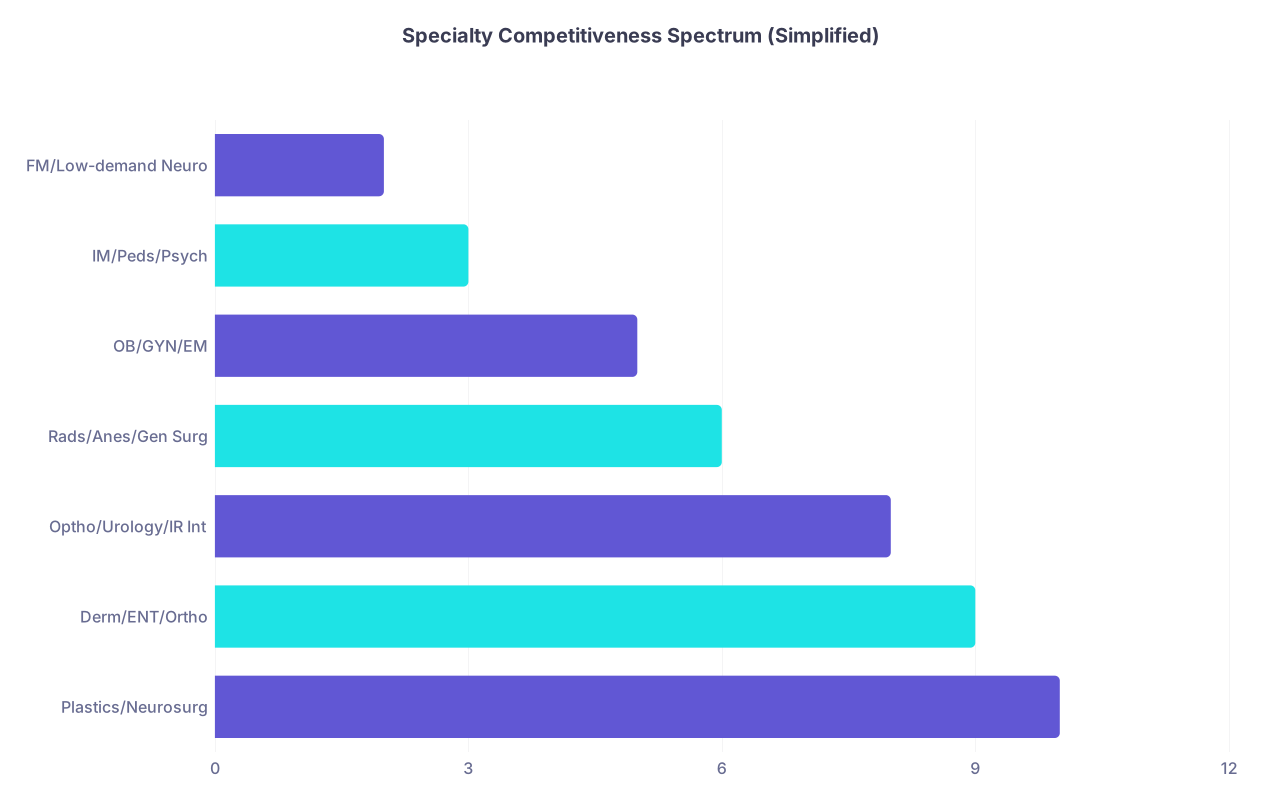
| Category | Value |
|---|---|
| Plastics/Neurosurg | 10 |
| Derm/ENT/Ortho | 9 |
| Optho/Urology/IR Int | 8 |
| Rads/Anes/Gen Surg | 6 |
| OB/GYN/EM | 5 |
| IM/Peds/Psych | 3 |
| FM/Low-demand Neuro | 2 |
Not perfect. But closer to truth than “ROAD vs non-ROAD.”
So, Are ROAD Specialties Always the Most Competitive?
No. That’s the myth.
Reality:
- Dermatology and (to a slightly lesser degree) ophthalmology belong near the top tier of competitiveness.
- Anesthesiology and diagnostic radiology sit in a moderate band overall, with some highly competitive programs and some relatively accessible ones.
- Several non-ROAD surgical and procedural fields are objectively harder to match into at a national level.
- Your individual competitiveness depends more on your scores, research, letters, and geographic flexibility than on whether a specialty happens to spell R–O–A–D.
Years from now, you won’t remember the Reddit takes about ROAD or the myths your classmates parroted; you’ll remember whether you were honest about your own profile, used real data, and chose a field you actually want to practice when the buzzwords go out of style.