12–18% of applicants to the most “competitive” specialties actually end up working in them long‑term.
The rest? They do not become failed doctors. They become cardiologists, hospitalists, intensivists, outpatient pediatricians, derm‑adjacent proceduralists, pain physicians, EM docs who love their schedule, and everything in between.
The myth I want to kill today is simple:
If you do not match a hyper‑competitive specialty, your career is permanently second‑rate.
It is wrong. And the data is not subtle about it.
What “Competitive Specialty” Actually Means (And What It Doesn’t)
First problem: people talk about “competitive” like it’s a universal truth, instead of a local market condition.
Look at actual match stats.
| Category | Fill Rate (US MD) | Mean Step 2 CK | Positions per Applicant* |
|---|---|---|---|
| Dermatology (categorical + adv) | ~95% | ~255–260 | < 0.6 |
| Plastic Surgery (integrated) | ~95% | ~255–260 | < 0.5 |
| Orthopedic Surgery | ~92% | ~250–255 | ~0.7 |
| Internal Medicine (categorical) | ~98% | ~240–245 | > 1.2 |
| Family Medicine | ~95% | ~235–240 | > 1.5 |
*Rough, based on NRMP data trends, not exact down-to-the-decimal values.
Those ratios are about supply and demand. Not quality of life. Not “intelligence”. Not career success.
- Very few spots
- Lots of lifestyle hype
- Strong geographic clustering
Not because every dermatologist is ten IQ points above every internist.
And those internal medicine numbers? More positions than serious applicants. Does that mean IM careers are mediocre? Tell that to interventional cardiologists, advanced heart failure specialists, or GI docs billing RVUs you would not believe.
This is where students get trapped: they conflate “hard to match at 27” with “better life at 47.”
Those are very different questions.
The Hidden Reality of “Failed” Competitive Applicants
I have watched this up close. Fourth‑years shaking in hallways on Match Day because they swung at derm, ortho, plastics, ENT, neurosurg, and didn’t stick.
The unspoken fear:
“I just ruined my life. I will never have the career I wanted.”
Here’s what actually happens to most of them over the next 5–10 years.
1. Many end up in the same functional space through a different door
You miss derm? I’ve seen:
- Med–peds → allergy/immunology → clinic‑heavy, procedure‑light, high control over schedule
- Internal medicine → rheumatology → tons of complex chronic disease, great continuity
- FM → skin‑heavy outpatient practice with procedural focus + cosmetics
Is that “worse”? Depends what you wanted: if you were chasing “four‑day clinic schedule + good pay,” there are more ways to get there than a dermatology residency.
You miss ortho or neurosurg?
- Anesthesia → interventional pain → procedures all day, high compensation
- PM&R → sports medicine → MSK‑heavy, procedures, athletes, ultrasound, injections
- Radiology → MSK radiology → intimately involved in the same anatomy, no pager at 2 a.m.
The obsession with the residency label hides something crucial: practice design after training matters more than the training stamp.
2. Income and lifestyle differences narrow over time
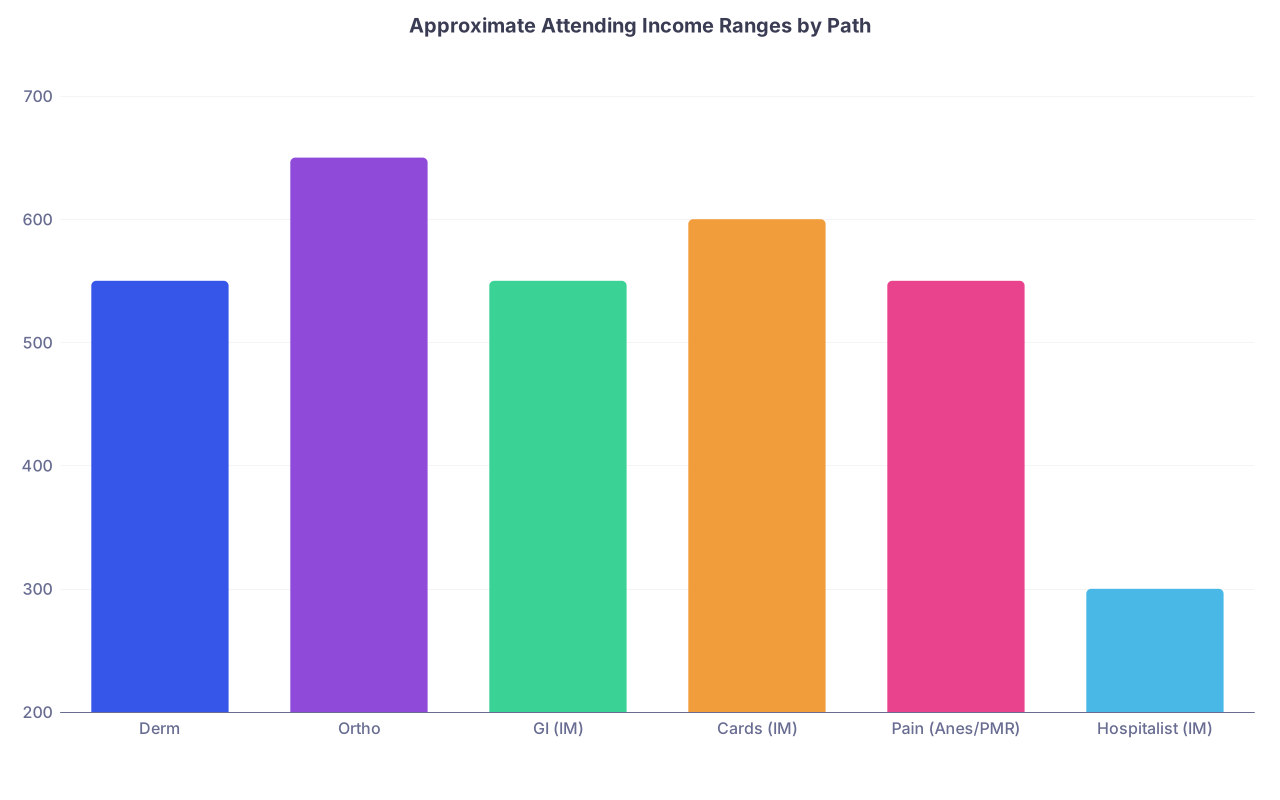
| Category | Value |
|---|---|
| Derm | 550 |
| Ortho | 650 |
| GI (IM) | 550 |
| Cards (IM) | 600 |
| Pain (Anes/PMR) | 550 |
| Hospitalist (IM) | 300 |
Numbers are ballpark US averages in thousands of dollars, not precise down to the dollar. Now add in:
- Geographic variation (rural vs major coastal city)
- W‑2 vs 1099 vs partnership
- Ownership stakes, side businesses, locums
I’ve seen outpatient GI docs out‑earning many orthopedic surgeons. I’ve seen anesthesiologists doing pain procedures making more than a chunk of plastics colleagues. The market is not as neatly tiered as “competitive > less competitive.”
Lifestyle?
A radiologist in a sane group with flexible teleradiology options can have a better day‑to‑day existence than a high‑volume cosmetic surgeon constantly chasing revenue.
Again: the specialty name does not guarantee the life.
3. Many “Plan B” doctors are happier than they expected
I remember one applicant who went all‑in on neurosurgery. No match. Went prelim surgery → neurology. Bitter for a year. Then he discovered EMG and neuromuscular, liked clinic, liked not standing for 12 hours. Now? Happy outpatient neuromuscular neurologist, teaching residents, sees his kids.
If you talk to attendings bluntly over dinner, you’ll hear it:
“A lot of us ended up somewhere we didn’t plan and are glad it worked out this way.”
You just don’t hear that as an MS3 because everyone is still in branding mode.
The Real Risk: Not “Failure,” But Strategic Stupidity
Now I am not going to swing all the way to the other extreme and say specialty competitiveness does not matter. It does. The risk is real. You can absolutely tank your short‑term career trajectory with bad strategy.
The danger is not aspiring high. It is treating the process like a romantic movie instead of a numbers game.
Data: Re‑applicants and scramble outcomes
NRMP publishes something students rarely read closely: what happens to unmatched applicants the next cycle.
Re‑applicants to ultra‑competitive fields have a lower match rate than first‑timers, especially if they don’t significantly change something (research, Step 2, degree of realism in their list). That does not mean they never match, but it is an uphill battle.
Even more relevant: many who don’t match the second time do just fine after pivoting. You don’t hear much about them on Reddit because they’re not posting “I am a content hospitalist who matched IM after missing ortho twice” every week.
That silence gets misinterpreted as rarity. It’s not.
How the “All or Nothing” Myth Warps Your Decisions
Here’s where this myth really hurts people.
It pushes you into catastrophic risk profiles
I’ve seen applicants apply:
- 45+ derm programs, 5 “backup” medicine programs, all at hyper‑competitive coastal places
- 70+ ortho programs, 3 prelim medicine, no genuine categorical IM or FM in realistic regions
Then they “don’t understand what happened” on Match Day.
This is poker without bankroll management. You are going all‑in with a mediocre hand because folding feels like personal failure. That is not ambition. That is magical thinking.
It makes you ignore the plasticity of your career
People act like the specialty choice locks everything forever.
Reality:
- You can switch during or after intern year (harder, but happens every year)
- You can sub‑specialize into pretty specific niches that change your daily work entirely
- You can add certifications (obesity medicine, addiction, sports, palliative, informatics)
- You can redesign your clinical vs non‑clinical mix over time
The residents I know who are happiest in “non‑prestige” specialties are the ones who realized early: “I’m designing a career, not trying to win a trophy.”
It cranks shame and silence to toxic levels
Because everyone performs confidence and certainty, the unmatched or the pivoters feel uniquely defective. So they don’t talk. They disappear from the class GroupMe or Slack. They quietly reappear a year later in a “backup” field.
Let me say this clearly: if 100 people apply to a field with 50 seats, 50 of them will not match. That is math. Not moral commentary.
A Smarter Way to Think About “Competitive” When You Apply
You want a plan that respects reality without surrendering your aspirations.
Forget the social media bravado for a minute. Strip it down to three questions.
1. What problem are you trying to solve with this specialty?
Be uncomfortably specific. Not “I want a good lifestyle.” What does that mean?
- Home by 5?
- Okay with call if it is in‑house and team‑based?
- Want your hands on procedures vs brain‑heavy diagnostic work?
- Want 3–4 clinic days or shift work or a mix?
- Hate continuity or crave it?
Now look at multiple paths that solve that problem.
Want procedural work, high pay, and technology? Derm, interventional radiology, ortho, GI, interventional pain, EP cardiology, MSK radiology all live on that map. Some are harder to get into than others. That does not mean the alternatives are consolation prizes.
2. What does your actual application data say?
Not your self‑esteem. Your numbers and your CV.
| Factor | Strong for Hyper-Competitive | Borderline for Hyper-Competitive | Better for Tier-2 Plan |
|---|---|---|---|
| Step 2 CK | ≥ 255 | 245–254 | < 245 |
| Research (pubs/abstracts) | Multiple, field-specific | Some, maybe not field-specific | Minimal |
| Clinical grades | Mostly honors | Mix of honors/high pass | Few honors |
| Letters | From big names in field | Mixed, 1–2 strong in field | Mostly outside field |
If you are in the right column across the board and still plan a 100% derm/ortho/PR match list, you are not being “bold.” You’re gambling with loaded dice.
It’s far smarter to:
- Apply to the competitive field
- But build a serious, geographically diverse list of related, less competitive programs where you can still build a satisfying long‑term career
3. How much risk are you actually willing to accept?
This is where people lie to themselves.
They say: “I would rather go unmatched than do anything but neurosurg.”
Then when they actually go unmatched, they are devastated, scramble into a prelim spot they hate, and spend a year miserable and panicking.
Be honest. If you would be 8/10 happy as a procedural internist, a pain doc, a sports medicine PM&R physician, or a radiologist with work‑from‑home potential, you don’t need to treat neurosurg as life‑or‑death.
You can take a rational shot at your dream field and build a real Plan B—not a token list of programs you secretly hope reject you.
How Careers Actually Evolve After “Plan B”
Let me give you the 10‑year view people never tell you.
You miss derm. You match categorical IM at a solid program in a mid‑tier city.
PGY‑1–3: You realize you like outpatient, procedure days, and high‑functioning patients. You actually enjoy explaining chronic disease management. You hate night float.
You line up:
- Derm‑heavy electives
- A mentor doing rheum and complex autoimmune
- A clinical project in psoriasis RCTs or biologics
You match rheum or allergy/immunology. Now your life 5–10 years out:
- Mostly daytime clinic
- Procedures (skin biopsies, joint injections, skin testing, challenges)
- Good pay, often in the $300–450K+ bracket depending on region and mix
- Flexible options to go part‑time, do telemedicine, or join multispecialty groups
Would your 24‑year‑old self still wish the badge said “Dermatology” instead? Maybe. Would you trade your current life and relationships to roll the dice again? Most do not.
Same pattern in other fields. Missed ortho → PM&R sports. Missed ENT → pulm/critical care with bronchs and procedures. Missed ophtho → IR, MSK rad, or even EM with ultrasound and procedures.
The big message: over a 30‑year career, your micro‑choices—group selection, geography, call structure, partners, part‑time vs full‑time—have more impact than the single specialty decision you made in your mid‑20s.
A Quick Sanity Check Flow
If you’re reading this while you’re mid‑application or about to build a rank list, walk your situation through this simple flow.

| Step | Description |
|---|---|
| Step 1 | Choose dream specialty |
| Step 2 | Add robust Plan B specialties |
| Step 3 | Apply broadly, accept risk |
| Step 4 | Balance applications across A and Plan B |
| Step 5 | Reevaluate dream vs actual priorities |
| Step 6 | Application is top tier for this field |
| Step 7 | Okay with going unmatched or reapplying |
| Step 8 | Plan B is genuinely acceptable life |
If at step F you realize your Plan B is “fields I secretly look down on,” then the problem is not the Match. It is your mindset.
The Bottom Line: You’re Not a Failed Doctor
The “all or nothing” myth survives because it preys on anxiety and identity. It tells you your worth as a physician is captured in one match email and one word on your badge.
The evidence and the lived reality say otherwise.
Two things to walk away with:
Hyper‑competitive specialties are about supply and demand, not inherent superiority. Over a career, thoughtful practice design in a “less competitive” field can equal—or beat—the lifestyle, income, and satisfaction of the glitter specialties.
The real mistake is not missing a competitive match. The real mistake is building an all‑or‑nothing strategy and tying your self‑worth to a lottery. Aim high if you want. Just don’t confuse a label at 27 with success at 47.