You were supposed to be in the OR.
You picked the rotations that maximized OR time. You chased the hardest cases, stayed late, learned to tie one‑handed knots on the bus. Your letters say “born surgeon.” And then your body pulled the plug.
Maybe it was a needlestick that led to a new diagnosis. Maybe it was a back injury moving a patient. Maybe a pre‑existing condition finally caught up with you. Either way, you’re staring at your surgical specialty plans—orthopedics, neurosurgery, ENT, whatever—and realizing: this might not be physically possible anymore. Or at least not in the way you imagined.
You’re in the residency application phase. Timelines are real. ERAS is either open or about to be. People keep asking, “So what are you applying into?” And you’re not sure if the answer you want is the answer your body can handle.
This is where you are. Let’s deal with that.
Step 1: Get brutally clear on your actual functional limits
Do not start with, “Can I still do ortho?” Start with, “What can my body actually do, consistently, for years?”
You need specifics. “I have a bad back” is useless. “I can stand for 3–4 hours with breaks, but 8 hours kills me the next day” is actionable.
You want answers to questions like:
- How long can you stand comfortably?
- How much weight can you safely lift/push/pull—repeatedly?
- What repetitive movements aggravate your condition (neck flexion, wrist pronation, fine motor, wearing loupes/headlights, etc.)?
- Are there time‑of‑day limitations? (e.g., meds that cause sedation at night, severe morning stiffness)
- What accommodations have actually helped? (ergonomic stools, breaks, assistive devices)
You’re not guessing this yourself. You get it from:
- A treating physician who understands the reality of residency work, not just “light duty” clinic life.
- A physical or occupational therapist who has watched you work or at least simulated the motions you’ll need.
- Your own recent experience: how you actually felt on long OR days vs clinics vs call.
Be explicit with them:
“I am deciding whether I can safely and realistically do a surgical residency. That means:
- 60–80 hour weeks
- Frequently being on my feet
- Long cases, sometimes 6+ hours
- Night call I need you to help me figure out what is realistic long term, not just whether I can push through the next six months.”
Push back if the answer is just “see how it goes” or “you’ll know if it’s too much.” That’s how people end up permanently injured, or dropping out PGY‑2 when options are narrower.
Get it documented. A clear, written functional assessment is gold later if you need accommodations or to justify a change in specialty.
Step 2: Get real about what your chosen surgical field actually demands
Now the other half of the equation: what the work really looks like. Not the brochure.
Different surgical fields beat up your body in different ways. Extremely rough sketch:
| Specialty | Standing & Case Length | Fine Motor & Vision | Heavy Lifting | Night/Call Burden* |
|---|---|---|---|---|
| General Surgery | Long cases, variable | Moderate | Moderate | High |
| Orthopedics | Long cases, high | Moderate | High | High |
| Neurosurgery | Very long cases | High (micro work) | Low–Mod | Very High |
| ENT | Moderate | High (microscope) | Low | Moderate–High |
| Urology | Moderate | High (scopes, lap) | Low–Mod | Moderate |
| OB/GYN | Variable, deliveries | Low–Mod | Moderate | High |
| Ophthalmology | Short–mod cases | Very high | Minimal | Low–Mod |
| Plastics | Long aesthetic cases | High | Low–Mod | Moderate |
*Call burden depends a lot on setting, but this is the usual pattern in training.
This is where you need some uncomfortable conversations with people actually doing the work. Not just the “cool attending” who loves everything and says, “You’ll be fine.”
Pick 1–2 attendings and 1–2 residents and be very direct:
“I have X injury/condition that limits Y. I’m trying to decide whether it’s realistic to pursue this specialty. Can you walk me through the most physically brutal parts of your job? The parts where a limitation would get someone—or a patient—hurt?”
Ask:
- What does a bad week physically feel like for you?
- When were you most physically exhausted during training?
- Any residents who had to switch specialties for physical/health reasons? Why?
Watch how they respond. If someone minimizes everything—“we’re all tired, you’ll be fine”—that’s not who you listen to. You want the person who says, “My back is wrecked from standing retracting as an intern” or “We had a resident with hand issues who just couldn’t safely operate.”
Then compare that to your functional limits from Step 1. If your PT says you should not regularly stand more than 3–4 hours without breaks, and your future field has routine 8+ hour cases with no reliable ability to sit, that’s not “grit territory.” That is “you are lying to yourself” territory.
Step 3: Decide which of three paths you are actually choosing
At this point, you’re usually landing in one of three zones:
- “With proper accommodations, I can likely still do my intended surgical specialty safely.”
- “I probably cannot safely do my original specialty, but I might be able to do a less physically demanding surgical field.”
- “Operating as a primary surgeon is no longer compatible with my functional capacity.”
Let me walk through each.
Path A: Staying in your original surgical field—with eyes open
You’ve gone through the assessment, heard from real surgeons, and it looks hard but not impossible. Next step: remove the magical thinking.
You need to answer:
- What exact accommodations would keep me functional and safe? (stools in OR, scheduled micropauses, no heavy retraction, no 24‑hour q3 call, etc.)
- Are those realistically available in most residency programs in this field?
- If my condition worsens slightly (and it usually does), do I still have a margin of safety?
This is where disability services and GME (Graduate Medical Education) offices come in. And you want that conversation before you blast ERAS to 50 programs.
Message your med school’s disability office and say plainly:
“I’m deciding whether to apply into a physically demanding surgical specialty with a documented injury/disability. I need to understand:
- What accommodations were successfully implemented for previous residents/students in surgical fields?
- How residency programs typically respond to requests like stools in OR, modified call, restricted lifting, etc.
- Whether there are example accommodation plans I can review.”
Then, reach out (carefully) to 1–2 PDs in your own institution or places where you have strong mentors. You don’t start with “Will you still rank me if I can’t retract?” You say:
“I have a documented physical limitation affecting [standing / lifting / fine motor]. I am working with my doctors to determine what’s realistic. Without sharing diagnosis, can you tell me:
- Have you trained residents who needed physical accommodations?
- Were accommodations feasible in your setting?
- Is there a threshold of physical limitation where you’d advise against this specialty altogether?”
If the answers are basically, “No, we’ve never figured this out; our system is not set up for that”—you factor that in.
If you choose to apply anyway, you’re taking a calculated risk. Then your strategy becomes:
- Target programs with a reputation for supporting residents with families, illnesses, or disabilities.
- Lean on your record: high scores, strong letters, evidence that you already thrived in the OR after your diagnosis/injury (if true).
- Decide early how much you disclose in your personal statement (we’ll talk strategy later).
Do not build your whole shot at a physically brutal specialty on “I’ll just be tougher than my body.” That lands people in worker’s comp, withdrawal from residency, or worse.
Path B: Pivoting within surgery to something your body can handle
Maybe ortho or neurosurgery is out. But ENT, urology, ophthalmology, or plastics might be on the table. Or general surgery with a trajectory toward more endoscopy and less heavy exposure.
Here’s where people mess up: they think of this as “downgrading” or “settling.” That mindset makes you cling to a bad fit for too long.
Instead, be brutally tactical:
- Which surgical fields rely more on fine motor and less on brute force?
- Which have shorter, more controlled case lengths?
- Which offer viable long‑term paths into clinic‑heavy or procedure‑heavy (but not OR‑heavy) practice?
Then start talking to those residents and attendings exactly like you did before. Use the same script. Ask the same “worst week” questions. Then run it by your PT/physician again: “Could I reasonably do this instead?”
You’re not just checking physical feasibility. You’re checking your own reaction. If you talk to the ENT or ophtho residents and secretly feel relief—less time standing, more controlled schedules—that’s data. You’re allowed to change what you want when reality hits.
Path C: Accepting that primary surgical practice isn’t viable—and finding what is
Sometimes the answer is no.
No, your hand strength is not going to support delicate microvasc work. No, your spine will not tolerate decades of standing and lead. No, your progressive neurologic condition isn’t going to cooperate with a pager and 28‑hour calls.
If you’re here, it hurts. I’ve watched people grieving like they lost a person. And in a way, you did: the future self you’d been building.
But once you let yourself actually accept that, the options widen:
- Procedural but not “full OR” work: interventional radiology (with its own physical issues, yes), GI, pulm, cards (cath).
- Cognitive specialties with procedures: cards (clinic and echo/TEE), GI clinic with scopes, rheum with injections, pain management.
- Completely non‑procedural but still intense: heme/onc, nephrology, hospitalist, EM (depending on your limitations), radiology, pathology, anesthesia (again, depends which movements/standing you can do).
You are not exiled from medicine because you can’t hold retractors. But you do have to let go of the fantasy that “maybe it’ll just get better” if all your medical advisors say otherwise.
Step 4: Strategy for this application cycle (ERAS, SOAP, or delay)
Now you know roughly which path you’re on. Next question: Do you apply this cycle, switch specialties late, or delay?
Here’s the decision logic, simplified:

| Step | Description |
|---|---|
| Step 1 | Injury or new disability |
| Step 2 | Functional & specialty demands assessed? |
| Step 3 | Get medical and PT eval |
| Step 4 | Apply to original field with targeted programs |
| Step 5 | Pivot to new surgical field this cycle |
| Step 6 | Apply to new non surgical field this cycle |
| Step 7 | Consider delaying or SOAP strategy |
| Step 8 | Original specialty still realistic? |
| Step 9 | Another surgical field feasible? |
| Step 10 | Enough time to pivot apps now? |
If you’re early enough in the timeline
If you’re months from ERAS opening or at least 6–8 weeks from submission:
- You can realistically pivot specialties this cycle.
- You can adjust letters (ask for more general letters or letters addressing your strengths beyond the OR).
- You can rewrite your personal statement for the new field instead of pretending nothing changed.
In that case, your main job is rewriting your narrative from “lifelong surgeon” to “I’ve always liked X aspects of medicine, and here’s why this specialty fits.”
If you’re late—ERAS basically locked and interviews looming
This is the ugly scenario: your injury hits right as applications are in, or you tried to push through and only now realize your body cannot do this.
You have three main plays:
Stay the course, interview, and decide later.
Risky, but sometimes reasonable if your future capacity is genuinely uncertain. You can:- Quietly monitor your physical tolerance during sub‑I / AI.
- Simultaneously explore backup fields informally.
- If it becomes clearly impossible, you may withdraw from the Match and reapply next cycle in a different field. Painful but not career‑ending.
Pivot within the cycle.
If you realize early in interview season that e.g. ortho is out but gen surg or ENT might be in, you can send late apps. They’re less likely to yield interviews, but it’s not impossible, especially at your home institution.Finish the cycle, then SOAP or reapply.
If you completely miss out or decide late to pull back from your original field, you may:- Go unmatched, then SOAP into something more feasible (often prelim medicine, TY, or another open spot).
- Use a prelim or research year to reposition and apply to a more compatible specialty next year.
None of these options are ideal. But “forcing yourself into a physically unsustainable residency and washing out PGY‑2” is worse.
Step 5: What and how to disclose in your application
Now the messy part: Do you tell programs about your injury/disability? How? When?
There’s no one right answer, but there are stupid ways to do this. Let’s avoid those.
Guiding principles
- You are not required to disclose a diagnosis.
- You are responsible for not hiding safety‑critical limitations (e.g., if you know you can’t safely take in‑house call or lift more than 10 lbs and the job clearly requires that).
- Most programs are not sophisticated about accommodations. You’re dealing with variable levels of understanding and some implicit bias.
So you balance risk:
Reasons to disclose (at least partially):
- You will need visible accommodations from day one (stools, modified call, assistive device).
- Your transcript or CV shows a big gap, LOA, or drop in performance because of the injury.
- You want to explain a narrative: “I had a major health event, grew from it, and am now back to full capacity with [defined limitations].”
Reasons to be cautious about detailed disclosure:
- Programs do discriminate, even if they legally should not. Less so overtly, more in that vague “fit” language.
- You sometimes don’t know exactly what accommodations you’ll need until you’re working there.
A middle ground I’ve seen work:
- In your personal statement, reference a “significant health challenge” that impacted your path, focus the bulk on what you learned and how you adjusted, and clearly state your current functional status (in plain English, not vague fluff).
- Speak more concretely only at second look or after ranking if you’re comfortable—or earlier with programs you trust.
Example style (not verbatim to copy):
“During my third year, I developed a spinal injury that required a medical leave and physical therapy. That period forced me to re‑evaluate how I approach work, resilience, and sustainability in medicine. With treatment and rehabilitation, I returned to clinical duties and completed demanding surgical rotations, using adaptive strategies to protect my long‑term health. This experience strengthened my commitment to [specialty], and I’ve confirmed—with my care team and faculty mentors—that I can meet the physical demands of residency safely.”
Notice what’s missing: diagnosis, MRI results, dramatic language. You answer the silent question in PDs’ heads: Can this person actually do the job? Without oversharing.
Step 6: Handling the emotional fallout and identity shift
Everyone focuses on the logistics. But this absolutely wrecks people emotionally if you ignore that layer.
You’ve lived as “the surgeon” in your class. People came to you for suture help. Faculty pegged you early as an operative person. Now you’re trying to picture yourself in, say, rheumatology clinic and your brain rebels.
I’ve watched people stay stuck here and sabotage their own pivot.
A few things that help:
- Name the loss out loud. To a mentor, therapist, or friend: “I’m grieving the loss of being a surgeon.” Not “I’m bummed.” Grieving. It’s a real loss.
- Talk to someone who pivoted successfully. Every institution has at least one story: the orthopedic‑bound student who became an excellent physiatrist; the aspiring neurosurgeon who’s now a brilliant neuroradiologist. Listen to how long it took them to psychologically buy in.
- Separate ego from daily work. Some of what you’re mourning is prestige, not tasks. Plenty of people realize they loved anatomy, problem‑solving, and longitudinal relationships more than they loved sewing things.
And frankly: remind yourself that destroying your own long‑term health to cling to an identity is not noble. It’s just self‑harm with a white coat on top.
Step 7: Get tactical about next steps—concrete to‑do list
If you’re in this mess right now, here’s how I’d structure the next 2–4 weeks.
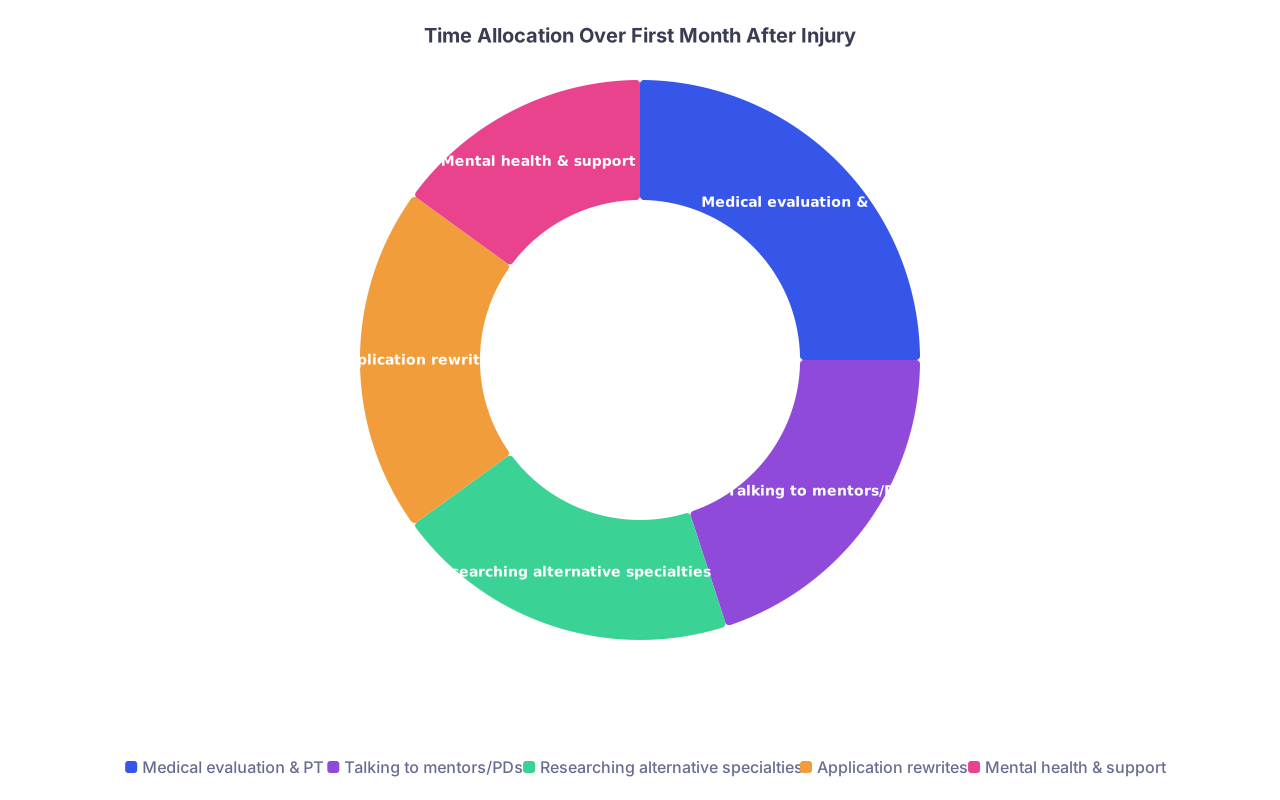
| Category | Value |
|---|---|
| Medical evaluation & PT | 25 |
| Talking to mentors/PDs | 20 |
| Researching alternative specialties | 20 |
| Application rewrites | 20 |
| Mental health & support | 15 |
Week 1:
- Schedule detailed visit with treating physician and PT/OT. Get written functional summary.
- Start a note on your phone tracking physical reactions to workdays (pain, fatigue, specific tasks that hurt).
Week 2:
- Talk to 2–3 attendings and 2–3 residents in your original specialty. Ask the “worst week” questions.
- In parallel, talk to 2 people in at least one alternative specialty (inside or outside surgery).
- Contact your med school’s disability office and, if possible, GME or a trusted PD for general guidance.
Week 3:
- Decide which of the three paths you’re realistically on (stay field, pivot within surgery, pivot out).
- If a pivot is likely, map what application pieces need updating: personal statement, school specialty form (if applicable), targeted letters.
Week 4:
- Execute: rewrite, request adjusted letters, finalize list of programs (favoring those known to be humane).
- Start practicing how you’ll answer, “Why this specialty?” without sounding like you’re just here because surgery fell apart.
That’s the practical skeleton. Obviously, timelines compress or stretch depending on where ERAS is, but you get the idea: medical clarity → career reality → application strategy.
A quick reality check on competitiveness and “downgrading”
You mentioned competitiveness. You’re probably thinking:
“I built an ortho/NSGY/ENT application. If I pivot to something ‘less competitive,’ will I look weird? Overqualified? Like damaged goods?”
Programs do not sit around saying, “Why on earth is someone with a 260/260 applying to our field?” They say, “This person is strong. Why us? Does their story make sense?”
If your stats are high and you pivot to a moderately competitive field:
- You’re fine. Use your PS and interviews to explain the shift in a grounded way (health challenge, reassessment of long‑term sustainability, discovery of genuine fit with new specialty).
- Do not overcompensate with syrupy “I always loved Rheumatology since childhood” nonsense. People smell that.
If you’re pivoting from a highly competitive surgical field to a field you used to publicly look down on—or have zero track record in—that’s trickier. You fix that by:
- Getting at least one meaningful clinical experience or mini‑rotation in the new field, even if short.
- Asking for at least one strong letter from the new field, not just generic “good med student” letters from surgery.
Your competitiveness is not the problem here. The story is. Make the story coherent.
The long game: thinking beyond residency
You’re fixated on “Can I match?” right now. Fair. But your condition probably isn’t going away on July 1 of PGY‑1.
So quietly think 10–20 years out:
- Will this field allow you to shift to more clinic/reading room/office‑based work if your body needs it?
- Are there non‑OR niches? (e.g., hepatology instead of transplant surgery; interventional pathways instead of open; academics with more teaching and less case volume)
- Are there built‑in off‑ramps if your health changes again? (hospitalist medicine, outpatient subspecialty, telemedicine, radiology‑adjacent, etc.)
This doesn’t mean you pick something you hate just because it’s “safe.” It means you don’t chain yourself to a career that’s going to grind your condition into dust by 45.
Looking ahead
You’re in the ugly middle chunk of this story—the part where plans exploded and nothing new has settled yet. It feels like every decision is permanent and every option is worse than what you lost.
It won’t always feel like that.
Over the next year, your focus shifts from “What specialty did I lose?” to “What kind of work can I do well, sustainably, and with some pride?” As you interview, as you talk to residents living lives you never pictured for yourself, your imagination will start to catch up to reality.
For now, your job is narrow and concrete:
- Get a hard, honest medical read on your capacity.
- Match that against the real demands of each field.
- Commit to a path this cycle that you can physically sustain, not just emotionally defend.
Once you’ve done that, then we can talk about how to crush interviews with a coherent story and how to handle the awkward questions about your “change of heart.” But that’s the next chapter, not this one.