
The way most students pick competitive specialties is backwards. They chase prestige first, then try to rationalize it as “impact” or “lifestyle” later.
You need the opposite: start with your real priorities—pay, lifestyle, impact—then choose the specialty that actually matches them, not the one your classmates brag about on Reddit.
Here’s the answer you’re looking for: there is no “perfect” specialty, but there is a best-fit competitive specialty for your mix of priorities. You just have to be brutally honest about what you care about most.
Step 1: Get Clear on Your Real Priorities
Forget what sounds noble for a minute. Rank these three for yourself, honestly:
- Pay (income, financial security, payoff for long training)
- Lifestyle (control over schedule, nights/weekends, call, burnout risk)
- Impact (depth and immediacy of your effect on patients or systems)
You’re not allowed to say “all three equally.” That’s how people end up in the wrong field and miserable by PGY-3.
To make this concrete, think in scenarios:
- Pay-first person: Massive loans, want options for part-time later and still earn well, willing to grind in training if the long-term income is strong.
- Lifestyle-first person: You care about control over your time—sleep, family, hobbies, maybe academic work or side projects. You hate being chained to unpredictable emergencies.
- Impact-first person: You want to see or feel that what you did today changed something important—saved a life, fixed a complex problem, altered a disease course, or moved the system.
Once you know your order—like Pay > Lifestyle > Impact, or Impact > Pay > Lifestyle—we can match that to specific competitive specialties.
Step 2: What “Competitive” Actually Looks Like
You’re not choosing between FM vs derm here. You’re asking, “Among high-demand, high-competition specialties, where do my priorities fit?”
Here’s a rough comparison for a few major competitive fields (think US MD/DO, strong applicant):
| Specialty | Competitiveness | Lifestyle | Pay (relative) | Impact Style |
|---|---|---|---|---|
| Dermatology | Very High | Excellent | Very High | Chronic, quality |
| Radiology | High | Good | High | Diagnostic, indirect |
| Anesthesiology | High | Variable | High | Acute, procedural |
| EM | High | Mixed | Moderate-High | Acute, episodic |
| Ortho | Very High | Moderate | Very High | Procedural, functional |
| Neurosurgery | Extreme | Poor | Very High | Life/death, complex |
Yes, this is simplified. But it’s realistic enough to make decisions.
Step 3: Match Your Priorities to Specialty “Profiles”
I’m going to break this down into common priority orders and tell you which competitive specialties tend to fit, and which are a bad idea.
1. Pay > Lifestyle > Impact
You want strong income, decent control of your time, and you care about impact but it’s not the main driver.
Best-fit competitive specialties:
Dermatology
- Pay: Top-tier earning, especially procedural-heavy private practice.
- Lifestyle: Clinic-based, few emergencies, predictable hours. Call is usually light or phone-based.
- Impact: You improve quality of life, manage cancer, chronic disease, but it rarely feels “ER life-or-death.”
- Catch: Hyper-competitive. You need high Step scores, strong research, and networking. This is the classic “pay + lifestyle” specialty everyone chases.
Diagnostic Radiology
- Pay: High. Even higher with certain subspecialties (IR, neuro, MSK).
- Lifestyle: Good control over schedule; can be shift-based. No clinic, minimal direct patient drama.
- Impact: You’re the brain in the background. You guide decisions but rarely see the hug at the end.
- Catch: You must enjoy staring at screens for hours, tolerating high cognitive load and constant subtle pattern recognition.
Interventional Radiology (IR)
- Pay: Very high.
- Lifestyle: Worse than diagnostic rads—more call, more emergencies.
- Impact: High; you’re doing procedures that change outcomes immediately (strokes, bleeds, cancer).
- Catch: Very competitive, long training path, hybrid lifestyle of rads + procedural call.
Decent but more variable fits:
- Anesthesiology
- Pay: Strong.
- Lifestyle: Depends heavily on practice. Some groups have great schedules; others have brutal call.
- Impact: High-acuity impact. You keep people alive in the OR and ICU, but rarely long-term relationships.
- Good for: People who like physiology, immediate problem-solving, and are okay being “behind the scenes.”
Specialties that look like they fit but often don’t:
- EM: Pay can be good early, but lifestyle and burnout are big issues. Shift work sounds great until you’re 12 years in with rotating nights and violence in the ED. If pay and lifestyle are your top two, I’d be cautious with EM long-term.
2. Lifestyle > Pay > Impact
You want a life. You’re okay not being the top earner in your class, but you refuse to live in the hospital.
Best-fit competitive specialties:
Dermatology
Still the king here. If lifestyle is #1 for you and you’re willing to grind in med school to match, derm checks almost every box.Radiology (especially outpatient-heavy jobs later)
You get controlled work hours, no clinic, minimal nights if you choose your job well. telerads, outpatient imaging centers, daytime-only gigs are increasingly common.Allergy/Immunology (not quite as “hyper-competitive,” but still not easy to get)
- Lifestyle: Excellent, mostly outpatient, minimal emergencies.
- Pay: Good, above average.
- Impact: Good for chronic disease management, quality of life.
- Access: Usually requires an IM or Peds residency first.
Ophthalmology
- Lifestyle: Often very good. Outpatient, OR days, limited call; emergencies exist but are manageable.
- Pay: High, especially surgical and private practice.
- Impact: Huge effect on quality of life (saving vision is no joke).
- Catch: Requires good microsurgical skills and comfort with very fine motor work.
Watch-outs:
- EM: Flexible schedule, yes. But rotating nights/weekends/holidays crush many people. Time “off” doesn’t always feel like true rest with circadian chaos.
- Anesthesia: Can be lifestyle-friendly in some private practice groups, but residency + early career can mean lots of call and early mornings.
3. Impact > Pay > Lifestyle
You want to feel like what you did today actually mattered in a high-stakes way. You’ll sacrifice some sleep.
Best-fit competitive specialties:
Neurosurgery
- Impact: Maximum. Tumors, aneurysms, trauma. You see life-and-death shifts in real time.
- Pay: Very high.
- Lifestyle: Rough. Long hours, long training (7+ years), heavy call. This is not a “balance” specialty.
- Fit: For people who genuinely do not mind living inside the hospital during their 20s and early 30s and like big complex problems.
Interventional specialties (IR, interventional cardiology via IM, some advanced GI)
- Impact: You open blocked arteries, stop bleeding, treat cancers.
- Pay: High.
- Lifestyle: Often tough—nights, weekends, call. Emergencies don’t wait for office hours.
Emergency Medicine
- Impact: Very visible, very immediate. You resuscitate, stabilize, and save lives.
- Pay: Moderate-high.
- Lifestyle: Shift-based, but night/weekend/holiday-heavy. Burnout is not a theoretical issue; it’s everywhere now.
- Fit: If you feel most alive in chaos, like rapid decisions, and don’t need continuity.
Anesthesiology (especially critical care or cardiac)
- Impact: You’re the one keeping unstable patients alive in the OR/ICU.
- Pay: High.
- Lifestyle: Depends heavily on subspecialty and practice; critical care and cardiac have more call and intensity.
If impact is #1 and you’re not being honest about lifestyle, you’ll be fine in residency and then potentially miserable in your 40s. So think about your future self too.
4. Impact > Lifestyle > Pay
You’re less money-driven. You want meaningful work and a tolerable life.
Here, some competitive but not “top 3 crazy” specialties start to look very good:
EM (again, but with eyes open)
Great if you like acute impact and can tolerate—or even enjoy—shift work. The main issue long-term is burnout, not money.Surgical subspecialties with better lifestyle niches later
For example:- Ortho: You restore function, fix fractures, replace joints. Impact is big and tangible. High pay. Lifestyle in residency is rough; in practice, highly variable. Some ortho surgeons have great setups, others are always on call.
- ENT: Broad impact (airway, cancer, hearing, sinus disease). Lifestyle can be decent in many practices.
Ophthalmology
Again: high-impact on quality of life, decent lifestyle. This is a very solid choice for this priority set.
Step 4: Understand the Real Tradeoffs (Not the Instagram Version)
Every competitive specialty sells a dream. The reality is messier.
Here’s a blunt reality check:
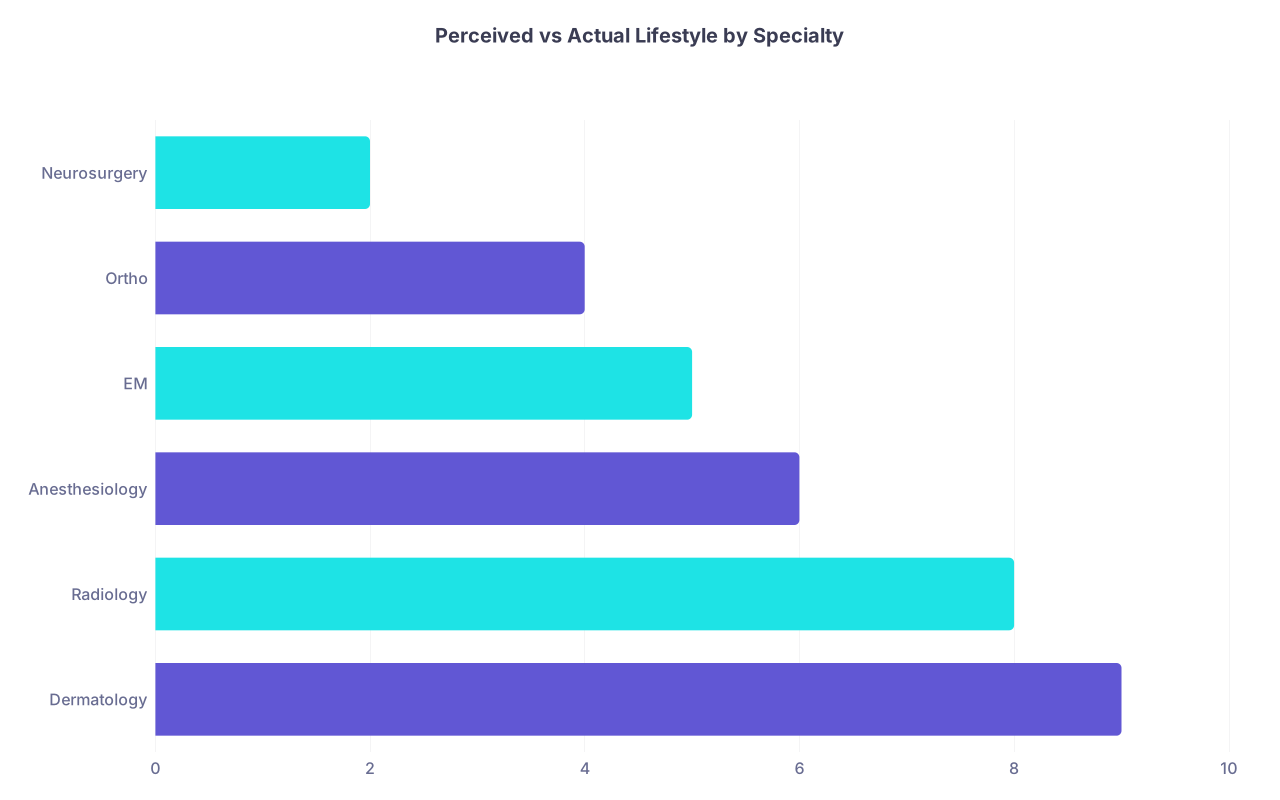
| Category | Value |
|---|---|
| Dermatology | 9 |
| Radiology | 8 |
| Anesthesiology | 6 |
| EM | 5 |
| Ortho | 4 |
| Neurosurgery | 2 |
Scale 1–10, where 10 = most controllable lifestyle. What students think often doesn’t match what attendings actually live.
Also, “pay” is not just salary; it’s:
- How many hours you work for that money
- How long your training is before you can earn attending pay
- How stable the market is (EM and radiology have both felt real shocks in the last decade)
And “impact” is not always dramatic. For many, long-term chronic disease management (like derm oncology or ophtho) ends up feeling more meaningful than the flashbang of resuscitations.
Step 5: Use a Simple Decision Framework
Here’s a basic decision flow that’s more useful than “follow your passion” nonsense.

| Step | Description |
|---|---|
| Step 1 | Rank Pay, Lifestyle, Impact |
| Step 2 | Consider Derm, Rads, IR, Anesthesia |
| Step 3 | Consider Ortho, Neurosurg, IR |
| Step 4 | Consider Derm, Rads, Allergy, Ophtho |
| Step 5 | Consider EM, Anesthesia, IR, Neurosurg |
| Step 6 | Reassess priorities or broaden specialties |
| Step 7 | Pay is #1? |
| Step 8 | Lifestyle #2? |
| Step 9 | Lifestyle is #1? |
| Step 10 | Impact is #1? |
Don’t overcomplicate this. You’re not marrying a vibe; you’re choosing a job type.
Step 6: Reality-Check Yourself with Rotations and Data
Two non-negotiables before you commit:
Live a week like the residents.
On your rotations or aways, stop watching only attendings. Watch the PGY-2 getting crushed by consults at 2 a.m. Watch how often people are actually home for dinner. That’s your near future.Look at burnout and satisfaction data, not just salary.
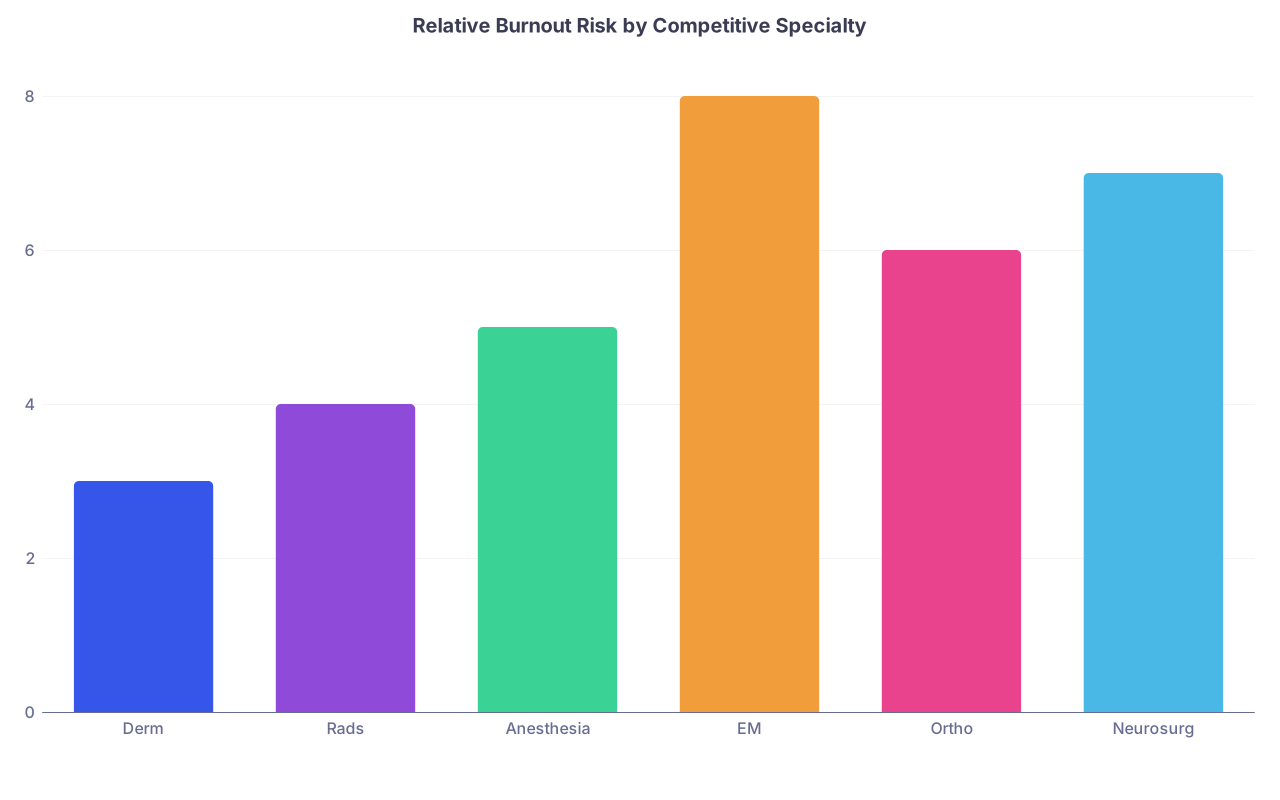
| Category | Value |
|---|---|
| Derm | 3 |
| Rads | 4 |
| Anesthesia | 5 |
| EM | 8 |
| Ortho | 6 |
| Neurosurg | 7 |
Again, rough 1–10 scale. EM and neurosurg are not lifestyle specialties no matter how many “3 days a week!” TikToks you see.
If what you say you value doesn’t match how you feel after a rotation, trust the feeling. The clinic that bores your classmates but makes your days fly by—that’s a signal.
Step 7: Match Strategy If Your Dream Specialty Is Ultra-Competitive
If you’re targeting derm, ophtho, rads, IR, ortho, neurosurg, etc., you need to play offense:

| Step | Description |
|---|---|
| Step 1 | Choose Target Specialty by MS2 |
| Step 2 | Identify 3-5 Home or Nearby Mentors |
| Step 3 | Join 1-2 Research Projects |
| Step 4 | Excel on Key Rotations and Aways |
| Step 5 | Apply Broadly and Early |
| Step 6 | Have a Realistic Backup Plan |
And yes, you absolutely should have a backup specialty that still fits your priorities reasonably well. Example: If you want derm for lifestyle + pay, radiology or allergy-immunology can be good second-line fits.
Step 8: Specialty “Archetypes” by Priority Set
Here’s a quick mapping cheat sheet:
| Priority Order | Strong Fits | Possible Fits |
|---|---|---|
| Pay > Lifestyle > Impact | Derm, Rads, IR | Anesthesia, Ophtho |
| Pay > Impact > Lifestyle | Neurosurg, Ortho, IR | Cards (via IM), GI (via IM) |
| Lifestyle > Pay > Impact | Derm, Rads, Allergy, Ophtho | Some Anesthesia, outpatient-heavy EM |
| Impact > Pay > Lifestyle | EM, Neurosurg, IR, Cards | Anesthesia, Trauma surgery |
| Impact > Lifestyle > Pay | EM, Ophtho, ENT | Ortho (select practices) |
| Lifestyle > Impact > Pay | Derm, Allergy, Ophtho | Rads (select jobs) |
This is not perfect. It’s directional. But it’s a far better starting point than “What’s the most prestigious thing I can match into?”

FAQs
1. If I care about all three—pay, lifestyle, and impact—equally, what should I do?
You’re lying to yourself or you haven’t thought hard enough yet. Force a ranking. If you truly can’t, look at “balanced” competitive options like ophthalmology, ENT, or anesthesia, where you can find niches that lean more toward whichever priority eventually emerges. But do the work now—talk to attendings, journal after rotations, and commit to an order before you apply.
2. Is dermatology really that much better for lifestyle and pay?
Yes. It’s not mythology. Most derm practices are outpatient, weekday-heavy, with minimal emergencies. Pay is top-tier, especially for procedural practices and private groups. The tradeoff is front-loaded: it’s brutally competitive to get in. That means high scores, research, and often years of intentional preparation. If you want derm, act like it by M2, not during ERAS season.
3. How risky is it to choose EM right now?
Emergency medicine is in a rough spot. Certain markets are saturated, some job offers are weaker than a decade ago, and burnout is objectively high. Does that mean “never choose EM”? No. But if your top priority is lifestyle or long-term stability, you need to scrutinize EM very hard. If your top priority is high-acute impact and you live for resuscitations and chaos, EM can still be an excellent fit—you just can’t pretend it’s a chill lifestyle specialty.
4. What if my Step/COMLEX scores aren’t competitive for my dream specialty?
Then you have two jobs: improve every other part of your application, and find a Plan B that still fits your priorities. Example: If you wanted derm but your scores are average, maybe you look seriously at allergy-immunology (via IM or Peds) or radiology if your app is otherwise solid. Do not force yourself into a completely misaligned fallback like general surgery just because “it’s still competitive.” Align the backup with the same priorities.
5. How much should I care about what my mentors and attendings think I’d be good at?
Use their input as data, not destiny. When three different surgeons independently tell you, “You’re wired like an internist,” listen. It means something. But at the end of the day, they’re observing you for a tiny slice of time. If what they say matches what you feel during your best rotations, that’s a strong signal. If it clashes, trust your day-to-day lived experience more than a flattering comment on your eval.
6. What’s the biggest mistake students make picking competitive specialties?
They choose identity over reality. “I’m a neurosurgery person” sounds cool on X. Living that life for 30 years is a different story. The biggest mistake is not actually visiting the future: not picturing yourself at 2 a.m. on your 7th consult, or missing your kid’s event because of call, or realizing you hate clinic even though your chosen field is 80% clinic. Match your specialty to how you like to spend your hours, not how you like to be perceived.
Two things to walk away with:
- Rank your priorities—pay, lifestyle, impact—and be brutally honest. No ties.
- Choose a competitive specialty whose average life fits those priorities, not just its highlight reel.