
The idea that the Couples Match is only for married partners is flat‑out wrong—and that myth quietly screws over a lot of students who could be using it strategically.
Let me be blunt: NRMP does not care about your relationship status. They care about how you structure your rank list. That’s it. The rest—married vs dating, engaged vs “it’s complicated”—is drama you and your classmates invented.
You’re not being screened for rings, anniversaries, or joint leases. You’re being screened by an algorithm.
Let’s break the mythology apart and talk about what the Couples Match actually is, who can use it, when it backfires, and when it’s the smartest move you can make.
What Couples Match Actually Is (And Isn’t)
Couples Match is not a special, romantic track for legally bound partners. It’s a technical option in the NRMP algorithm that lets two applicants link their rank lists so the algorithm treats them as a unit when assigning positions.
Key facts, straight from NRMP rules (and how they actually play out):
- You do not have to be married.
- You do not have to live together.
- You do not have to be in a romantic relationship at all.
- You do both have to be participating in the Main Residency Match.
- You do have to register as a couple and build paired rank lists.
I’ve seen:
- Dating couples of six months use it.
- Engaged couples use it.
- Married couples use it.
- Close friends use it.
- Siblings use it.
- Classmates with zero emotional attachment, just a shared plan: “We want training in the same city.”
NRMP’s language is hilariously neutral: you may register as a couple “to have their rank order lists linked to each other.” That’s it. Zero mention of marriage.
So where does the myth come from? Faculty and older residents who:
- Went through the match before Couples Match was common.
- Still think of it as a purely “relationship” tool.
- Love telling students “Don’t do Couples unless you’re married” because that’s easier than explaining how the algorithm works.
Convenient, but wrong.
Who Is Actually Eligible? (The Real Criteria)
Forget the ring finger. The real eligibility test is mechanical, not emotional.
To Couples Match, you and your partner:
Must both be registered in the same NRMP Main Match year
(Different specialties fine. Different programs fine. Different locations potentially fine.)Must both agree to “participate as a couple” in NRMP
You each log in, identify the other person, and confirm.Must each build a rank list with paired combinations
Example:- You: Internal Medicine
- Partner: Pediatrics
One “line” on your rank list is: - (Your IM at Program A, Their Peds at Program X)
Next line: - (Your IM at Program A, Their Peds at Program Y)
And so on.
There’s no checkbox labeled “married,” “engaged,” or “just vibes at the anatomy lab”.
| Pair Type | Eligible for Couples Match? |
|---|---|
| Legally married partners | Yes |
| Engaged partners | Yes |
| Long-term dating couple | Yes |
| New(er) relationship | Yes |
| Close friends | Yes |
| Siblings or relatives | Yes |
Practical rule: if you both care where the other person ends up enough to restructure your rank lists, you’re “eligible” in the only way that matters.
The Myth: “Only Real/Married Couples Should Use It”
This myth has a few common flavors. Let’s gut each one.
Myth 1: “NRMP will think we’re gaming the system”
NRMP doesn’t think. The algorithm doesn’t “care.” It just solves a constrained optimization problem with your paired ranks. The main constraints:
- Both of you match to the highest combination you both can get, given your ranks and program ranks.
- If one of you cannot match into a particular combo, that combo is skipped.
- If you rank “(Your Program A, Their No Match),” that’s a real option. People use it.
No human is sitting there going, “Huh, they’re not married, reject their couple registration.” That’s fantasy.
Myth 2: “Programs don’t take non-married couples seriously”
Programs mostly don’t care what NRMP box you checked. They care about:
- Your application
- Your interview
- Your fit
Everything else is background noise.
Do programs sometimes ask, “Are you couples matching?” Yes. Usually to:
- Plan for multiple applicant scenarios.
- Understand if your geographic preferences are highly constrained.
They’re not asking for your relationship certificate. Half the time, they never even ask what your relationship is. Just: “What specialty is your partner in, and where are they applying?”
Myth 3: “You shouldn’t Couples Match unless you’re 100% sure you’ll be together forever”
I’ve seen married Couples Match pairs divorce by PGY-2. I’ve seen 10‑month dating couples successfully stay together through residency and beyond.
The idea that marriage status correlates tightly with “forever” is fiction. The data on divorce rates alone should end that conversation. The match is a 4–7 year training decision, not an eternal cosmic oath.
If you’re betting your training on relationship permanence, you’re already playing a risk game. Just admit that to yourself instead of hiding behind “We’re not married yet, so we can’t couples match.”
When Couples Match Makes Sense (Married or Not)
The real question isn’t: “Are we married?”
It’s: “Do we have shared geographic priorities that are strong enough to trade off some individual program options?”
You should seriously consider Couples Match if:
You both care more about being in the same city (or close) than about maximizing individual program prestige.
Example: You’d both rather be at two solid mid‑tier programs in the same city than at separate “top 10” programs thousands of miles apart.You have realistic, overlapping target regions.
If one person says “Coasts only” and the other says “Must be in Midwest near family” and neither will budge, Couples Match won’t fix that incompatibility. It will just formalize the chaos.Your competitiveness levels are not wildly, delusionally mismatched in your target region.
Mismatch is OK. Delusion is not. If one partner is 250+ Step 2, AOA, heavy research, and the other is barely passing with multiple red flags—Couples Match becomes more fragile. Not impossible, but fragile.You’re both willing to rank options that don’t look like fairy tales.
Such as:- One matches in the city, the other takes a preliminary/transitional year nearby.
- One has an academic program; the other takes a strong community spot.
- You rank “(Program X, No Match)” near the bottom to preserve at least one match.
Evidence and Outcomes: Does Couples Match Hurt Your Chances?
Here’s where people really get misled. You’ll hear: “Couples Match is risky” yelled down the hallway like gospel.
Let’s anchor this in data.
NRMP regularly publishes match results. The pattern repeats:
- Couples have a slightly lower overall match rate than individual applicants.
- But that’s because the couples algorithm is trying to optimize both at once, not just one person.
This doesn’t mean Couples Match is a bad idea. It means:
- You’re solving a more constrained problem.
- So yes, fewer perfect outcomes.
- But also: more jointly acceptable outcomes.
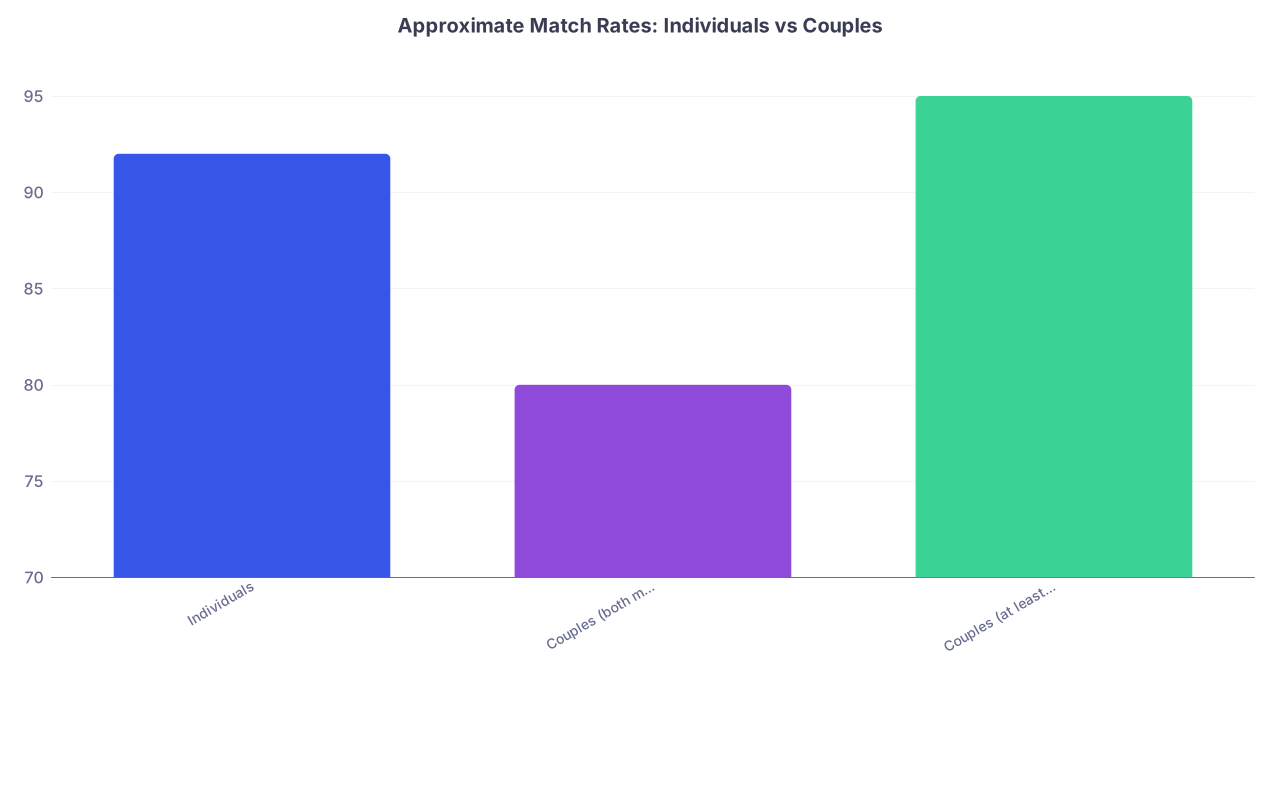
| Category | Value |
|---|---|
| Individuals | 92 |
| Couples (both matched somewhere) | 80 |
| Couples (at least one matched) | 95 |
Rough pattern (ballpark, varies by year):
- Individuals: ~90–93% match rate (US MDs higher, DO/IMG vary)
- Couples: Lower rate that both match to some program
- But if you include “at least one of the pair matched,” the number jumps up again
Translation: if you’re honest and flexible on your rank list, you’re not “doomed” by Couples Match. You’re just playing a more complex game.
The danger isn’t the “couples” status. The danger is:
- Overly narrow geographic ranges
- Unrealistic program lists
- Ego-driven prestige chasing that ignores your actual application strength
Not your lack of a marriage certificate.
How It Actually Works Under the Hood (The Part Nobody Explains)
Under individual matching, your rank order list is simple:
Program A, then B, then C…
In Couples Match, each line of your list is a pairing:
- (Your Program 1, Their Program 1)
- (Your Program 1, Their Program 2)
- (Your Program 2, Their Program 1)
- …
The algorithm tries:
- Your top pair.
- If either of you cannot match into that combo (because the program ranked you too low, spots filled, etc.), it moves to the next pair.
- And so on, down the list.
That’s why couples lists get long—and why being unrealistic kills you. You’re not just ranking programs; you’re ranking combinations.
Here’s the kicker: you can rank “(Program X, No Match)” explicitly. That’s NRMP’s way of letting you say:
“If we can’t be together at any of our listed pairs, I’d rather at least one of us match somewhere than both go unmatched.”
Plenty of couples do this, especially when one partner is significantly more competitive.

| Step | Description |
|---|---|
| Step 1 | Start Couples Match |
| Step 2 | Algorithm checks top pair |
| Step 3 | Assign both to these programs |
| Step 4 | Move to next pair on both lists |
| Step 5 | Consider No Match options or scramble |
| Step 6 | Can both match to this pair? |
| Step 7 | Reached end of pair list? |
Notice what’s missing from that flowchart? Any branch that says “Are they married?” It’s all about rank logic, not social labels.
When You Shouldn’t Couples Match (Regardless of Relationship Status)
Now let’s flip it. There are scenarios where I’d tell you to avoid Couples Match—even if you’re married, engaged, or fused at the hip.
Your relationship is already unstable or transactional.
If you’re quietly thinking, “We might break up after graduation,” do not anchor your entire training location on this. Just don’t.One of you absolutely needs geographic flexibility.
Example: Visa issues, specialty change, SOAP risk, or major competitiveness gap. In those cases, anchoring them to you may sabotage their match.You can’t agree on what you’d both be happy with.
If every conversation ends in, “I won’t rank that city” or “Your program list is insane,” your problem is not NRMP—it’s incompatible priorities.One person secretly plans to change their rank list later.
Yes, this happens. People agree to couples match, then quietly alter their list last minute. It is a brutal way to destroy trust. If you don’t fully buy into the joint plan, don’t couples match.
Friends and Siblings as “Couples”: Smart or Stupid?
Let’s tackle the taboo one: matching as a couple with a friend or sibling.
Is it allowed? Yes. Explicitly.
Does it sometimes work well? Also yes.
Situations where I’ve seen this make sense:
- Two friends both want to end up in the same metro area, but don’t care which specific programs as long as they’re decent and nearby.
- Siblings with strong family obligations (caregiving, finances, shared housing).
- Partners who don’t want faculty or classmates knowing they’re dating, but still want the algorithm benefits.
The downside:
- You may end up making sacrifices for someone you could just as easily move away from if your futures diverge.
- The emotional calculus is uglier. It’s easier to resent a friend you “compromised for” than a spouse.
Is it “gaming the system”? No. The system is literally built to allow it. The only question is whether it’s strategically and emotionally smart for you.
How to Decide—Without Hiding Behind the Marriage Myth
Forget the “only for married couples” nonsense. Ask yourselves four actual questions:
If we matched in two different cities, would one of us seriously consider breaking off the relationship or derailing other plans?
If yes, couples matching becomes rational, not romantic.Are we both realistic about our competitiveness and willing to build a long, flexible paired list?
If no, you’re pretending you’re more competitive than you are. That’s how couples go unmatched.Would we rather share a decent city at decent programs than maximize our individual prestige?
If prestige is your god, couples match is the wrong religion.If this relationship implodes, will I still be able to live with the training path I chose?
You need to be able to say yes. Because breakups happen. Marriages fail. People change.
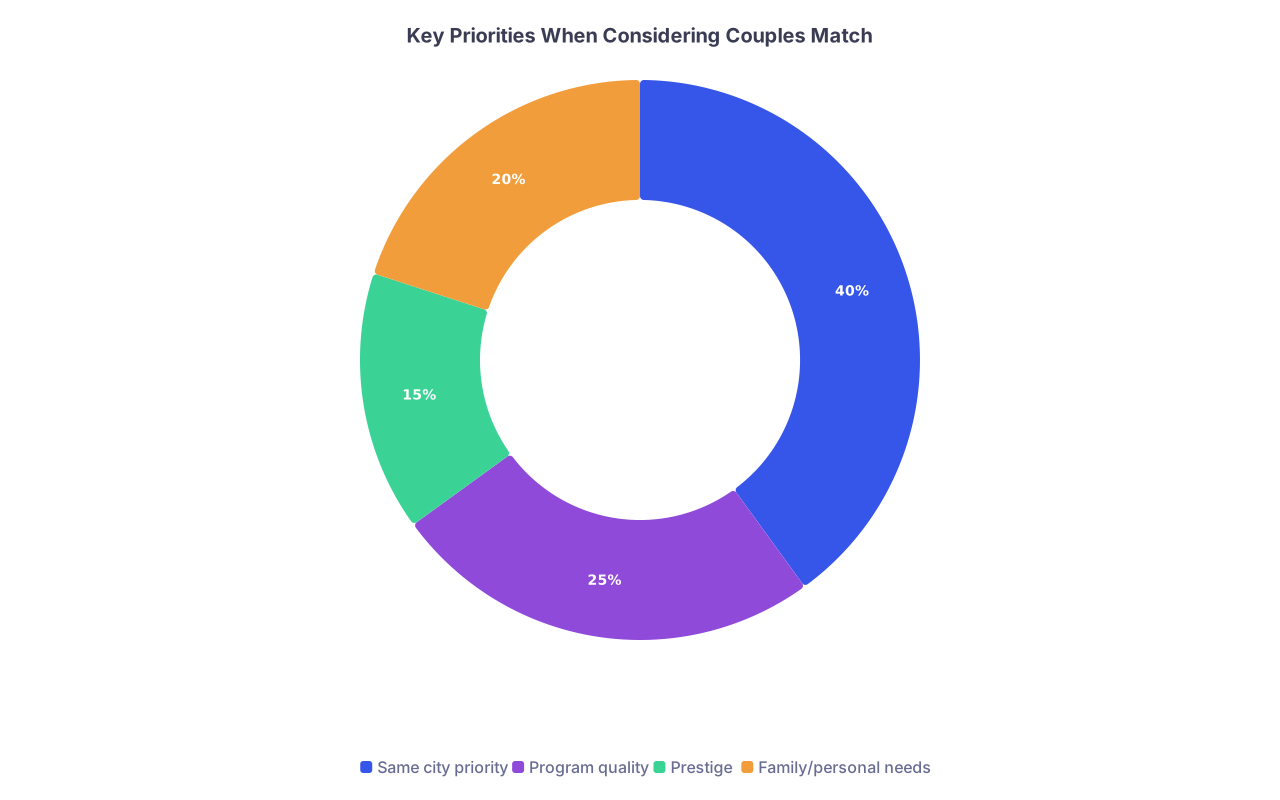
| Category | Value |
|---|---|
| Same city priority | 40 |
| Program quality | 25 |
| Prestige | 15 |
| Family/personal needs | 20 |
Honesty on these questions beats any “but we’re not married” excuse.
Reality Check: What Programs and Advisors Actually Care About
Here’s what I hear in real conversations:
From program directors:
- “If they’re couples matching, I just want to know how locked into this region they are.”
- “Sometimes you get one amazing partner and one weaker one. We weigh that, but we’re not discriminating based on relationship label.”
From advisors:
- “I worry more that couples don’t rank enough combinations than whether they’re married.”
- “Students get fantasy-brained. They forget you have to rank backup cities and less sexy programs.”
From residents:
- “Couples match saved us.”
- “We didn’t couples match because we were ‘only dating,’ and we spent 3 years long distance and almost broke up.”
- “We couples matched as friends to be in the same city. Honestly? One of the best decisions I made.”
Notice the pattern: the people actually in the system talk about geography, numbers, and list strategy. Not your relationship title.
Bottom Line
Couples Match is a tool, not a moral statement. The algorithm does not ask if you walked down an aisle. It only cares how you ranked program combinations.
Using it just because you’re married is stupid.
Avoiding it just because you’re not married is equally stupid.
Use it if:
- You both care deeply about ending up in the same place.
- You’re willing to be data‑driven and ego‑light about your program lists.
- You can talk honestly about worst‑case scenarios and still agree on a strategy.
Ignore it if:
- Your relationship—or friendship—is too fragile to bet 3–7 years of training on.
- One of you needs maximal flexibility.
- You can’t build a long, sane list of pairs you’d both accept.
Years from now, you won’t remember whether you checked “married” on some form. You’ll remember whether you built a life you actually wanted—and whether you had the courage to align your training decisions with the reality of your priorities, not with someone else’s myths.