
The worst interview questions are the ones that make you wonder if answering honestly will cost you the job.
If you are asked about your health status in an interview, something has already gone wrong—but it is not you who messed up. You are now dealing with a legal, ethical, and power problem in real time. Let’s walk through exactly what to do.
1. What Counts as an Illegal Health Question?
Let me be blunt: most interviewers are not trained properly on disability law. Some are careless, some are ignorant, and a few are just reckless. You need to know the rules better than they do.
Under laws like the ADA (and similar frameworks in other countries), employers/programs generally cannot ask you questions that:
- Directly ask about a diagnosis (“Do you have depression?” “Are you diabetic?”)
- Ask about treatment or medications (“Are you on meds for that?” “Do you still see a psychiatrist?”)
- Probe past or current medical conditions unrelated to performing the job (“Have you ever been hospitalized for mental health?”)
- Ask about sick days, FMLA, disability leave history (“How many sick days did you take last year?”)
- Ask about genetic or family history (“Does cancer run in your family?”)
They’re also not allowed to ask questions aimed at sniffing out disability, even if disguised as small talk, like:
- “You limped a little coming in—old injury or something more serious?”
- “You mentioned burnout—are you mentally stable enough for this specialty?”
What can they ask? Narrowly:
- Whether you can perform the essential functions of the job with or without reasonable accommodation
- Whether you’ll be able to meet schedule and call requirements
- Post-offer, they can sometimes require a standardized medical exam, if done for all hires in the same category
| Question Type | Example Question |
|---|---|
| Illegal | Do you have any chronic illnesses? |
| Illegal | Have you ever been treated for anxiety or depression? |
| Illegal | How many sick days did you take last year? |
| Legal | This job requires overnight call. Can you meet those requirements with or without accommodation? |
| Legal | Are you currently able to perform the essential duties listed in the job description? |
If a question asks about a condition, it’s almost always inappropriate. If it asks about capability in neutral terms, that’s usually fair game.
2. Real-Life Scenarios You’ll Actually See
Let me give you scenarios I’ve seen or had reported by applicants. These are not theoretical.
- Residency PD: “I see a leave of absence here. Was that for medical reasons?”
- Faculty interviewer: “You mentioned anxiety earlier. Is that ongoing, or is it resolved?”
- Private practice hiring partner: “Do you have any health issues that will make it hard for you to keep up with full-time work?”
- Fellowship interview: “We have a busy call schedule. Any physical or mental limitations we should know about?” (and then they just… stare at you)
All of these can be handled. But not the same way.
You need a playbook you can run in the moment without freezing.
3. Your Four Main Response Options (And When To Use Each)
You basically have four tools:
- Redirect to abilities
- Give a vague, minimal answer then pivot
- Name the boundary (call out the question)
- Refuse and change the frame
Let’s break them down with scripts.
3.1 Redirect to abilities (lowest risk, most practical)
Use this for mild or awkward-but-not-hostile questions, especially if you care about the opportunity and do not want to escalate.
Question: “Was your leave of absence for medical reasons?”
Response:
“I took that time to address some personal circumstances and I’m now fully able to meet the demands of a full-time training schedule. Since returning, I’ve had no issues with attendance or performance.”
You didn’t answer the medical part. You shifted to: I am capable now. That’s what they’re supposed to be asking about anyway.
Another one:
Question: “Any health issues that might affect your ability to take call?”
Response:
“I’m fully able to meet the call schedule and clinical responsibilities as laid out for this role.”
Short. Direct. Capability-focused. No diagnosis talk.
3.2 Minimal answer + pivot (for when the elephant is huge)
Sometimes there’s a highly visible event—long LOA, big gap, or something already disclosed in your file—and a non-answer will only fuel suspicion. In those cases, you can give a one-line category, then immediately pivot to outcomes.
Question: “Can you tell me more about the reason for your one-year leave?”
Example response:
“I had a health issue that required focused treatment and recovery. It’s now well-managed, and since returning I’ve completed all requirements on time and with strong evaluations. I’ve also built routines that help me sustain performance long term.”
Or:
“It was for a time-limited medical issue. What matters for you, I think, is that I’m fully cleared, able to meet all responsibilities, and my recent performance reflects that.”
Key features:
- You do not name the diagnosis.
- You do not describe symptoms.
- You do immediately move to: “Here’s why this won’t affect my work now.”
3.3 Name the boundary (for when you want them to feel the line)
This is for blatant or repeated illegal questions, or when you’ve already decided you probably do not want to be there.
Question: “Are you currently being treated for depression?”
Response option 1, polite and controlled:
“I’m not comfortable discussing specific medical history. What I can tell you is that I’m fully able to perform all the essential functions of the job.”
Response option 2, a bit sharper:
“That’s getting into protected health information. I prefer to focus on my qualifications and my ability to meet the demands of the position, which I can.”
You’ve now:
- Signaled you know the line
- Protected yourself legally
- Kept the door barely open if you still care about the opportunity
3.4 Refuse and reframe (for worst-case behavior)
If someone is way out of line, you are allowed to shut it down.
Question: “We have had problems with residents with bipolar disorder. You don’t have anything like that, do you?”
Response:
“I’m not going to discuss specific diagnoses. That’s protected medical information. If it’s helpful, I can speak to my track record: I’ve maintained full clinical responsibilities, met deadlines, and received strong evaluations.”
If they push again, you can escalate:
“Asking about specific diagnoses is not appropriate for an interview. I’m happy to keep talking about my experience and how I’d contribute here.”
That’s you throwing a flag on the play. Hard.
4. The Split-Second Decision Tree: How to Choose Your Move
When the illegal question hits, your brain will want to freeze. Instead, run this simple mental flow:

| Step | Description |
|---|---|
| Step 1 | Hear Question |
| Step 2 | Answer with capability only |
| Step 3 | Minimal answer + pivot |
| Step 4 | Redirect to abilities |
| Step 5 | Name boundary or refuse |
| Step 6 | Is it directly about a diagnosis or treatment? |
| Step 7 | Do I care about this job? |
Couple of practical checks you can do in under two seconds:
- Does answering honestly give them ammunition to screen me out?
- Is there already obvious evidence in my file that something medical happened (LOA, big gap)?
- Do I actually want to work with people who ask this?
Your answer guides your approach. There’s no single “right” choice—there’s the choice that best balances protecting your privacy and preserving opportunity, given your goals.
5. Scripts for Common Medical Training Situations
Let’s get even more concrete. I’ll give you word-for-word options for very specific medical training scenarios.
5.1 Gap or leave of absence in medical school
Question: “Why did you take time off between your second and third year?”
Option A – minimal health frame:
“I had a health issue that needed dedicated time to address. It’s now resolved/managed, and since coming back I’ve been able to meet all clinical and academic expectations without difficulty.”
Option B – no health mentioned at all (if school documentation is vague):
“I had significant personal circumstances that required my full attention. That period is behind me now, and my subsequent rotations and evaluations reflect my current level of functioning.”
Both are fine. Use whichever feels safer given what’s already in your file.
5.2 Visible disability or mobility aid
Question (bad): “So what’s the story with the cane? Is that permanent?”
You are not obligated to educate them about your condition.
Response:
“I use a cane for stability. It doesn’t prevent me from performing the essential duties of the role, and I’ve successfully managed full clinical workloads with it.”
If they push:
“The specifics of my medical situation are private, but I’m happy to talk about any functional concerns you may have about call, procedures, or clinic.”
5.3 Mental health disclosure that you regret mentioning
Sometimes you overshare earlier in the day, then someone latches on.
Interviewer: “Earlier, you mentioned struggling with burnout and anxiety. Is that still an issue?”
Response:
“I went through a tough period during [specific context, e.g., the early pandemic] and sought appropriate support. That phase is behind me, and I’ve since built better systems for balance and resilience. My recent performance and evaluations show I’m functioning at a high level now.”
You’re framing it as:
- Time-limited
- Responsibly managed
- Currently stable and effective
6. When You Might Choose to Disclose (Strategically)
I’m not going to pretend disclosure is always a bad idea. Sometimes it helps, especially when:
- You’re applying for a role where your lived experience is genuinely valued (e.g., psychiatry, PM&R, disability advocacy, med ed)
- The program has a real reputation for supporting disabled trainees, not just pretty wellness slides
- You want to normalize disability representation and you’re prepared for some risk
If you disclose, do it on purpose and with a clear frame:
- Name the condition briefly, if you choose to at all.
- Emphasize management and stability, not symptoms.
- Tie it to strengths and insight you bring to the role.
Example:
“I live with a chronic autoimmune condition that’s well-managed with treatment. It’s taught me a lot about navigating complex care systems and being attentive to patient experience. I maintain full clinical responsibilities and have built robust routines to protect my health and performance.”
What you do not do:
- List flares, hospitalizations, side effects in detail
- Apologize for having a disability
- Ask permission to exist
You are not a liability. You’re a professional who also happens to have a health condition.
7. Protecting Yourself After the Interview
If the question was blatantly illegal or felt bad, you have post-interview options.
7.1 Document the incident
Right after the interview, while it’s fresh:
- Write down exact wording of what was asked
- Note who asked (name, role) and when
- Describe your response and any follow-up comments or reactions
This is not being dramatic. This is preserving evidence, in case you need it.
7.2 Decide your priority: change vs opportunity
You have to be honest with yourself:
- If this is your dream program and you have limited options, you might decide: “I’ll protect myself in the future and let this one go for now.”
- If you have alternatives and a strong application, you might decide: “If this is how they act on interview day, I’m out.”
Neither choice makes you weak or heroic. It just needs to be conscious.
7.3 Routes to flag problems
Options, escalating in intensity:
Quietly rank them lower or not at all (residency/fellowship) or decline the position.
Email a trusted contact (program coordinator, diversity officer) and say:
“During my interview with Dr X on [date], I was asked several questions about medical diagnoses and treatment that I understand are not appropriate for an interview setting. I wanted to flag this for you, because it was uncomfortable and seemed out of step with your stated commitment to inclusion.”
Talk with your med school’s disability services, student affairs, or GME office. They’ve heard these stories before.
In more severe cases, consider formal complaints (institutional HR, EEOC, or equivalent). That’s a heavier lift and usually not something you do while still in the match process unless the behavior was egregious.
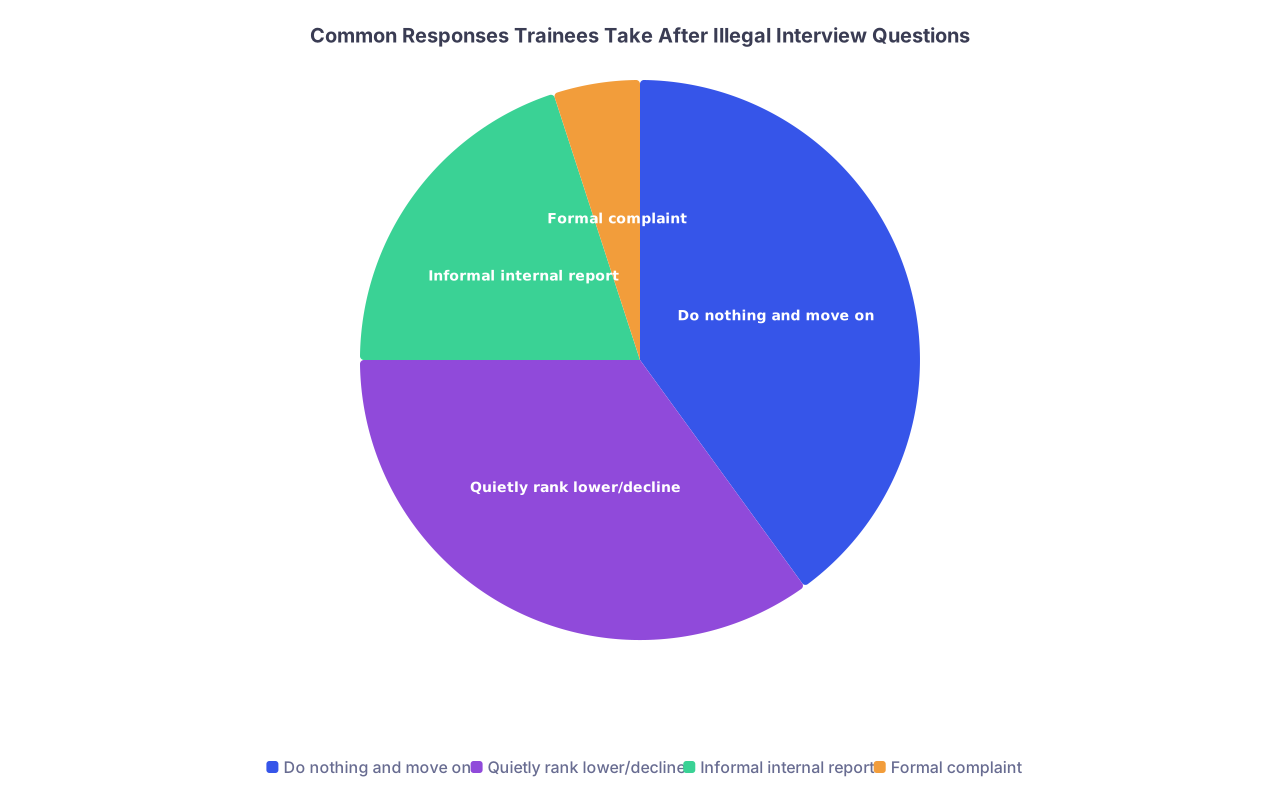
| Category | Value |
|---|---|
| Do nothing and move on | 40 |
| Quietly rank lower/decline | 35 |
| Informal internal report | 20 |
| Formal complaint | 5 |
I’ve seen applicants do all four, successfully. The “right” move depends on your risk tolerance, your leverage, and how bad the situation was.
8. Preparing Before the Interview So You Don’t Freeze
You handle these situations better if you’ve rehearsed before you’re sitting in a suit under fluorescent lights.
8.1 Write your default lines now
Literally type or handwrite 2–3 stock phrases you’ll rely on, tailored to your situation. For example:
- “I had a time-limited medical issue that’s now well-managed, and I’m fully able to meet all the demands of training.”
- “I prefer not to discuss specific medical history, but I can assure you I can perform the essential functions of the job.”
- “My health is stable, and my recent performance reflects that. I’m comfortable with the expected schedule and responsibilities.”
Practice saying them out loud. In the shower, in the car, to a friend. You want them ready to come out of your mouth without effort.
8.2 Decide your personal red lines
Before interview season, answer for yourself:
- What will I disclose if pushed about gaps or LOAs?
- What will I never disclose in an interview, under any circumstances?
- At what point would I be willing to say, “That’s not an appropriate question”?
Write your answers. Clarity now prevents panic later.
8.3 If you need accommodations AFTER you match/hire
Many people think, “If I do not disclose now, I can never ask for accommodations later.” That’s wrong.
Most systems allow you to:
- Disclose after you’ve matched or been hired
- Engage disability services or HR privately
- Request accommodations based on functional needs, not diagnoses
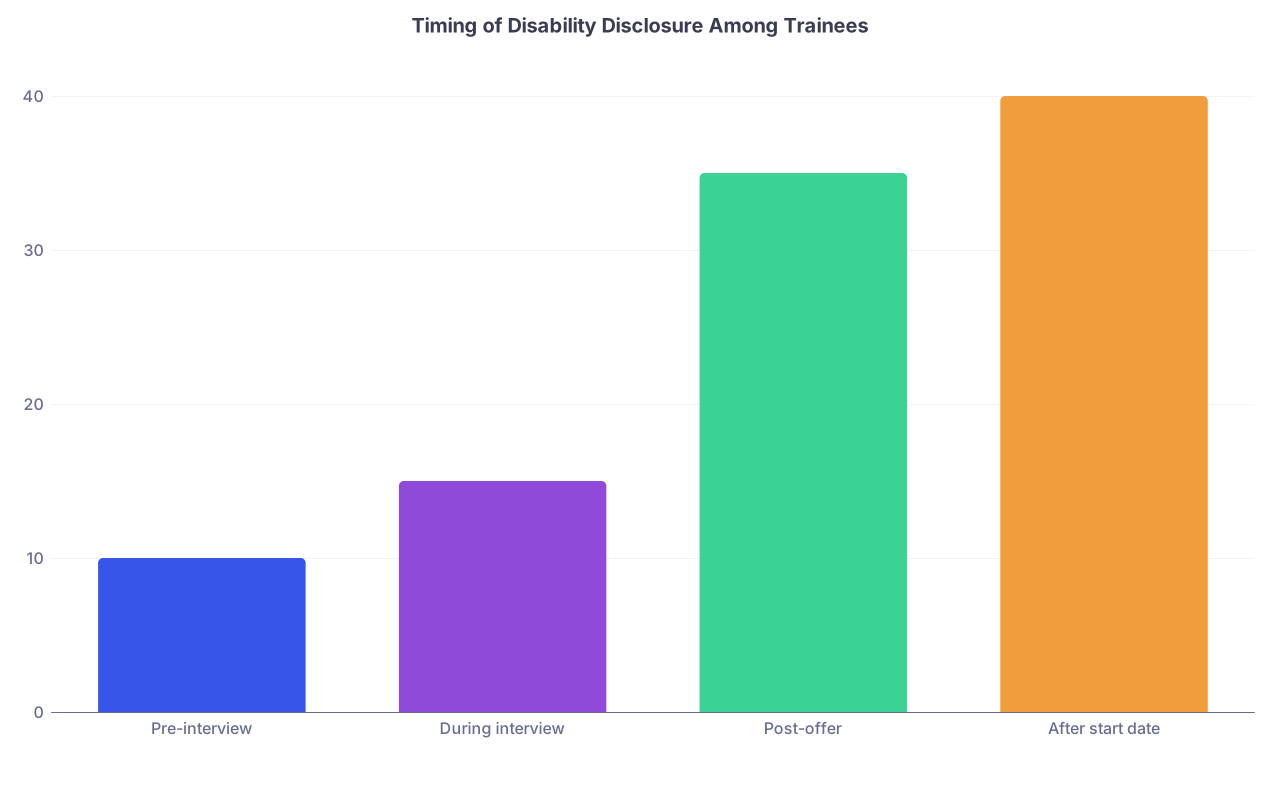
| Category | Value |
|---|---|
| Pre-interview | 10 |
| During interview | 15 |
| Post-offer | 35 |
| After start date | 40 |
If you’re worried about this, talk to your med school disability office or an employment lawyer before interview season. Get clear on your rights and options now.
9. The Future: This Should Not Be Your Problem—But It Is
In a sane system, you would never need any of this. Interviewers would be trained. Disability would be normalized. Questions would focus on capability and support, not diagnoses and suspicion.
We are not there yet.
You’re operating in a medical culture that still:
- Praises “resilience” while punishing vulnerability
- Romanticizes self-sacrifice
- Pathologizes disability and chronic illness in physicians and trainees
So for now, you need to be strategic. Protect your health information. Guard your options. And remember: an interviewer who violates your boundaries in a 30-minute conversation is giving you very valuable data about what it would be like to work under them for years.
You are not obligated to set yourself on fire to be “honest” with people who are misusing their power.
If you remember nothing else:
- You are never obligated to share specific diagnoses or treatment details in an interview. Ever.
- Shift illegal questions to capability: “I can perform the essential functions of the job.”
- Have 2–3 rehearsed lines ready so you can respond calmly instead of freezing.