
Hybrid MD–DO letters are not a magic key to ACGME programs. Most of the hype is coming from anxious applicants and bad advising, not from actual match data.
Let me be blunt: programs are not sitting around in committee saying, “We were going to rank this DO applicant lower, but then we saw an MD–DO co‑signed letter, and suddenly they became a star.” That fantasy lives in Reddit threads and hallway gossip, not in selection meetings.
If you want to understand whether hybrid letters help you, you have to stop asking, “Do MD letters look better than DO letters?” and start asking, “What do programs actually use letters for, and who can provide that best evidence for me?”
Let’s walk through what’s real, what’s mythology, and what actually moves the needle.
The Myth: “Hybrid MD–DO Letters Prove You’re ‘Good Enough’ for ACGME”
The dominant myth goes something like this:
- ACGME (especially university) programs “trust” MD faculty more
- DO letters are seen as second‑tier
- Therefore, if you can get one letter co‑signed by an MD and a DO, you prove you’re “acceptable” across both worlds and your application becomes more competitive
On the surface, it sounds plausible. It’s also mostly wrong.
Here’s what selection committees actually care about when they skim your letters at 10 p.m. after reviewing 90 applications that day:
- How strong is the content?
- How credible is the author for the kind of evaluation they’re making?
- Is the letter consistent with the rest of the application?
Notice what’s missing? “Is this MD or DO?” is not the primary axis. Once you’re in the door, nobody is shocked you’re a DO applying to ACGME. They already know that from your school, your board exams, your transcript.
The MD vs DO obsession is mostly driven by applicants feeling defensive, not by programs demanding hybrid signals.
What Programs Actually Use Letters For
I’ve watched faculty read thousands of applications. Most letters get about 30–60 seconds of attention each on first pass. If you think they are decoding the degree type in the signature line as a major filter, you’re imagining a level of scrutiny that simply does not happen at scale.
Here’s what they do pay attention to when it matters:
- Is this writer someone who has seen the applicant work clinically?
- Are there specific, believable examples of work ethic, clinical reasoning, teamwork, professionalism?
- Do they compare the applicant to a meaningful reference group (e.g., “top 10% of students I’ve worked with in the last five years”)?
- Do they comment on things not obvious anywhere else: complex patient care, resilience, integrity under stress, ability to take feedback?
Now ask yourself: who is more likely to write that kind of letter for you?
- A DO attending who directly supervised you for four weeks on a busy inpatient service and thinks you’re phenomenal
or - An MD associate professor who met you for three half‑days in clinic, barely remembers your name, and is signing a generic template that your DO preceptor drafted?
Hybrid letter or not, content loses every time if the writer barely knows you.
What the Outcomes and Behavior Actually Show
Let’s talk data and observed behavior, because this is where the myth really falls apart.
We do not have a big NRMP study titled “Impact of MD–DO Hybrid Letters on Match Outcomes for Osteopathic Applicants.” That doesn’t exist. But we do have:
- NRMP Charting Outcomes in the Match (for DO seniors)
- NRMP Program Director Survey
- Match statistics before and after single accreditation
- What programs themselves tell you (and what they actually request)
None of those sources say: “Hybrid MD–DO letters are preferred.” Not once.
Programs consistently rank these as most important for selecting and ranking candidates:
- Step/COMLEX scores (or pass/fail + Step 2)
- Clerkship grades
- Class rank / AOA / Sigma Sigma Phi
- Specialty‑specific rotations and performance
- Standardized Letters of Evaluation (SLOEs) in EM, for example
- Personal knowledge of the applicant
- MSPE / Dean’s letter
Letters of recommendation are there, yes. But “MD vs DO vs hybrid” doesn’t make the top of any list. It’s just not where the real action is.
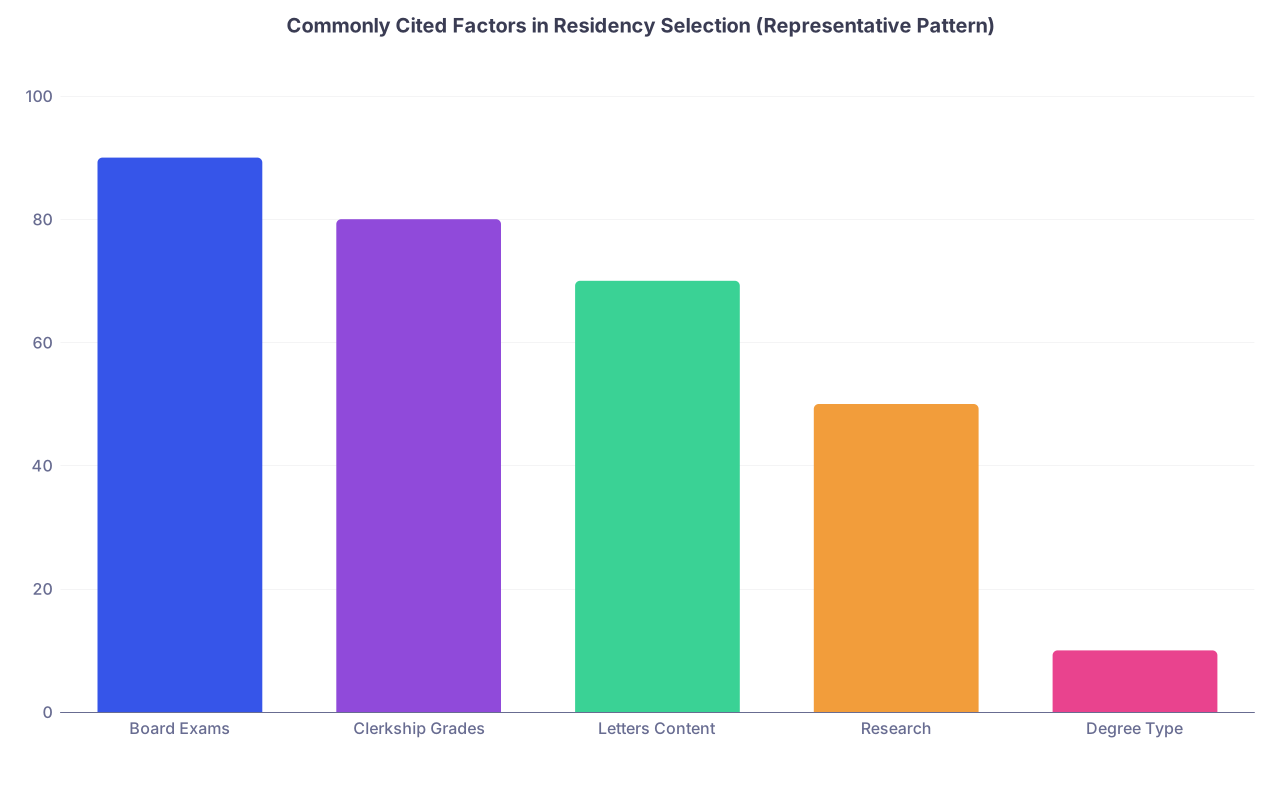
| Category | Value |
|---|---|
| Board Exams | 90 |
| Clerkship Grades | 80 |
| Letters Content | 70 |
| Research | 50 |
| Degree Type | 10 |
Those percentages aren’t from a single table; they reflect the general pattern in multiple NRMP PD surveys: exams and performance dominate; letters matter for nuance; degree type mostly matters earlier in screening and in certain hyper‑competitive fields, not in the signature line of your letter.
What you do see in actual outcomes:
- DOs match into ACGME programs every year with entirely DO letters.
- DOs get into top‑tier university programs without any MD involvement in their letters.
- DOs get screened out from some competitive specialties despite having MD letter writers, because the rest of the application is not competitive.
If “MD letter” or “hybrid letter” were fundamentally decisive, those patterns would look very different.
Where Hybrid or MD Letters Actually Help
Now, let’s be fair. There are cases where MD or MD–DO letters add real value. But it’s not because of the letters’ optics. It’s because of the writer and the context.
There are a few situations where an MD (or hybrid) letter can actually move the needle:
MD faculty with real name recognition or direct connection to the target program
Example: a DO student rotates at a major university hospital, works their tail off, and the MD clerkship director—who is on the selection committee—writes:
“We will be ranking this student highly. They performed at the level of our home students.”
That matters. Not because “MD,” but because that specific person is credible and influential.Specialties where standardized or specialty‑specific letters are dominated by MDs
Emergency medicine SLOEs are often written by MD faculty at academic centers. If you want a true SLOE, you will likely need MD letter writers. Again, the value is in the format and the role, not the degree.Bridge situations, like DO at a non‑affiliated school rotating at an ACGME academic site
If you’re a DO student trying to show you can hang at an academic medical center, a strong letter from an MD faculty member in that environment can help reassure people who are nervous about the unknown. But that’s about signal of performance in that environment, not the MD label.
You’ll notice something: in all three examples, the letter could have been written solo by that same MD and it would have been just as valuable. The DO co‑signature does not add magical extra points.
The Hybrid Letter Problem: Usually It’s a Weak Letter in a Fancy Suit
Let me be harsh for a second.
Most “hybrid letters” I’ve seen look like this behind the scenes:
- DO preceptor actually knows the student and writes the core narrative
- MD department head or clinic director is asked to “co‑sign” to make it look more impressive
- MD has barely worked with the student, if at all
- Letter turns into vague, generic fluff to avoid misrepresenting MD’s level of knowledge
Committees can sniff that out. Phrases like “I have not worked with the student directly but fully support Dr. X’s assessment” are dead giveaways. That sort of line instantly dilutes the strength of the letter.
A strong letter says, “I saw this person do X, Y, Z, repeatedly, under pressure, and here’s how they compare to others.”
A hybrid vanity letter often says, “We think they’re nice and they’re pursuing residency in your field.”
That’s not an upgrade. That’s cosmetic surgery on a perfectly good face.
What Actually Makes a “Good” Letter for ACGME Programs
Forget hybrid for a second. If you want your letters to pull their weight for ACGME programs, they need three things: proximity, specificity, and credibility.
- Proximity: The writer actually supervised you directly. On real patients. For a non‑trivial period of time.
- Specificity: The letter includes concrete stories—how you handled a difficult patient, how you responded to feedback, how you communicated on rounds.
- Credibility: The writer is in a position to judge residents. Attendings, clerkship or program directors, sometimes senior fellows in your specialty.
That can absolutely be:
- A DO hospitalist who ran a viciously busy inpatient service
- A DO program director in a community ACGME program
- A DO subspecialist who has been writing letters for years and knows what PDs want to read
Or it can be MDs in equivalent roles. The key is role + content, not initials.
For most DO applicants, the strongest possible mix looks something like this:
| Letter Type | Writer Priority |
|---|---|
| Core specialty letter 1 | Attending (MD or DO) who directly supervised you on an away or home sub‑I |
| Core specialty letter 2 | Another supervising attending or clerkship director with specific examples |
| Supplemental letter | IM/FM/peds/surgery attending who can speak to reliability and clinical reasoning |
| Optional “prestige” letter | Only if the big‑name MD or DO actually knows you and will write strongly |
Nowhere in that strategy do you see: “Force a hybrid MD–DO co‑signed letter just for appearances.”
How Hybrid MD–DO Letters Can Actually Backfire
There are a few very real ways the hybrid obsession can hurt you:
You prioritize optics over strength
You chase an MD cosign instead of asking the DO who really knows you to go all in and write a detailed, specific letter. You trade substance for branding.You signal insecurity
Committees are not dumb. A DO applicant with solid COMLEX/Step 2 scores, strong rotations, and all DO writers signals confidence and coherence. An applicant bending over backward to “prove” themselves by manufacturing MD signatures sometimes looks unsure of their own training.You end up with tepid, committee‑authored letters
The more people involved in a letter who barely know you, the more generic and non‑committal it becomes. Hybrid structures tend to drive that genericism.
There’s also a quiet undercurrent here: the idea that DOs must be “endorsed” by MDs to be taken seriously. You don’t need to reinforce that narrative in your own application unless a specific MD in a specific context can actually help you.
What You Should Do Instead
Here’s the practical, evidence‑aligned approach:
First, read what your target programs actually say. Many explicitly state:
- “We accept letters from MD or DO faculty.”
- “Letters should be from physicians who supervised you clinically.”
- “We prefer at least one letter from [specialty] at an ACGME‑accredited site.”
You’ll notice the word hybrid is absent from nearly all of these instructions.
Then, build from there:
- If your strongest clinical mentor is a DO who thinks you walk on water, put them at the top of your letter list.
- If you have the chance to rotate at a strong ACGME academic site and impress an MD faculty member there, do that rotation well and ask for a real letter, not a drive‑by signature.
- If your school pushes hybrid letters as some kind of requirement, push back and ask: “Will both signers write specifically about my performance? Have they supervised me directly?”
And if the answer is no, skip the hybrid and go with the person who will actually go to bat for you.

| Step | Description |
|---|---|
| Step 1 | Identify Potential Letter Writers |
| Step 2 | Low priority - avoid |
| Step 3 | Medium priority - generic letter |
| Step 4 | Use as supplemental letter |
| Step 5 | High priority - core letter |
| Step 6 | Did they directly supervise me? |
| Step 7 | Can they cite specific examples? |
| Step 8 | Are they attendings/PDs in relevant field? |
Notice: nowhere in that flowchart is “Are they MD or DO?” or “Can I force a hybrid?” as a primary decision node. Because in practice, it is not.
Where a Hybrid Letter Is Perfectly Reasonable
I’m not saying hybrid letters are always bad. They’re neutral tools that sometimes make sense when they arise naturally.
If you worked on a combined MD–DO inpatient team and your DO hospitalist and MD associate program director both supervised you closely, saw your work, and want to jointly sign a letter they both actually contributed to—fine. That can be strong.
If you’re in a small community site where the DO preceptor runs the service and the MD is the site director who truly knows you and wants to jointly endorse you—also fine.
The key: the hybrid structure should emerge from shared, meaningful supervision. Not from fear that a DO‑only letter is automatically second class.
The Bottom Line
Three points, then we’re done:
- Hybrid MD–DO letters are not inherently better for ACGME programs. Committees care about who actually supervised you and what they say, not how many credentials sit in the signature line.
- The strongest letters—MD or DO—come from people who know your work deeply, write specifically, and sit in roles that naturally evaluate residents. That’s what correlates with better outcomes, not the MD label or a cosmetic hybrid structure.
- If you have to choose between a lukewarm hybrid and a detailed, glowing DO‑only letter, pick the DO letter every single time. Content beats optics. Every year.


