

You’re on a Zoom call with a friend from school. She’s an IMG from the Caribbean; you’re an IMG too—but also a DO student at a U.S.-accredited osteopathic school with a campus abroad. She says, “Programs hate IMGs, I’m dead.” You start to wonder: am I in the same bucket? Am I being read as an IMG, a DO, or the cursed combination—both?
If you’re in this IMG-DO dual status situation, you’re sitting in a weird gray zone many program directors barely understand. Some will treat you like any DO. Some will lump you in with offshore Caribbean schools. A few will openly tell you they did not know your school even existed. You need a plan that assumes confusion and fixes it.
Let’s walk through what to do—step by step—if you are both an IMG and a DO in the ACGME world.
1. First: Understand How Programs Actually See You
Do not guess. You need to understand concretely how your application will land in a coordinator’s or PD’s brain.
There are three levers that shape perception:
- Your school’s accreditation and location
- How ERAS labels you
- The specialty and program culture
A. School status: what “counts” as U.S. vs IMG
If you’re at:
- A U.S.-based DO school with a main campus in the U.S. but you did some rotations abroad → You’re not typically considered an IMG.
- A DO school that is U.S.-accredited (COCA) but located outside the continental U.S. (e.g., certain branch campuses abroad) → Many programs will mentally tag you as “IMG-ish DO” even though COCA says you’re U.S. osteopathic.
- A foreign med school granting an MD-equivalent where you later did a DO bridge or similar → Programs may view you as primarily IMG unless clearly explained.
If COCA accredits your school, you are officially a U.S. DO graduate. The problem: not every PD knows or cares about the nuance. They react to “Where is this school?” and “Have we had anyone from there before?” far more than to formal definitions.
B. How ERAS and NRMP classify you
On ERAS, you’ll ultimately be classified based on:
- School accredited in the U.S. or Canada → “U.S. graduate” (DO or MD)
- Anything else → “IMG”
Some dual-path or branch-campus DO students have had their school show up in ERAS in ways that confuse coordinators. If your campus is outside the U.S., assume confusion and be ready to explain clearly in your application that:
- You are a DO from a COCA-accredited institution
- Your degree is equivalent to other U.S. DOs in ACGME eyes
- You completed core clinicals in ACGME-affiliated sites (if true)
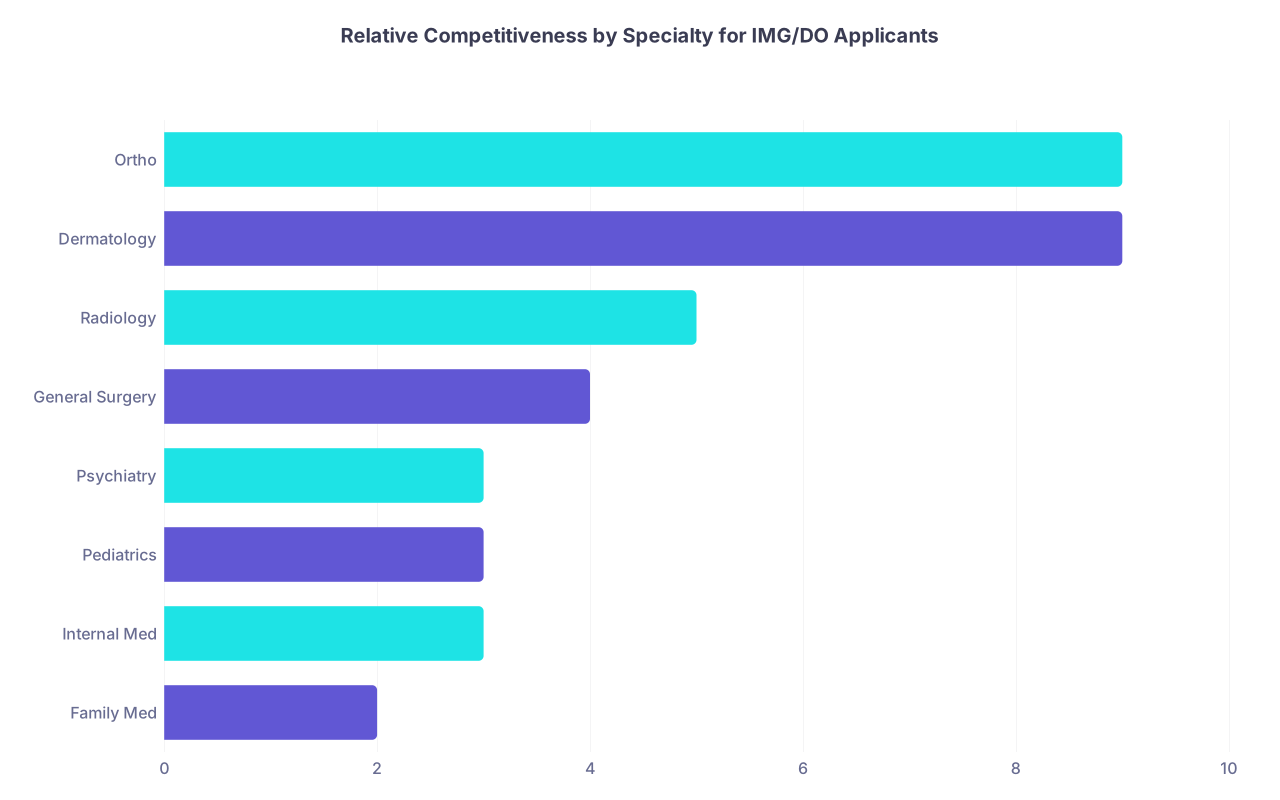
C. Specialty culture: how much the “IMG-DO” label matters
Some specialties care a lot about pedigree and geography. Some less so.
| Category | Value |
|---|---|
| Family Med | 2 |
| Internal Med | 3 |
| Pediatrics | 3 |
| Psychiatry | 3 |
| General Surgery | 4 |
| Radiology | 5 |
| Dermatology | 9 |
| Ortho | 9 |
1 = most accessible to IMG/DO; 10 = toughest
If you are IMG-DO and aiming at Derm/Ortho/Rads with mid stats and no home department, you are playing on “nightmare mode.” Not impossible, but you cannot afford to pretend you are a typical U.S. DO applicant.
So the first task: be honest about your risk tier. You’re likely:
- Tier 1: U.S.-accredited DO school, solid U.S. rotations, mid-to-strong scores
- Tier 2: U.S.-accredited DO school but foreign campus, weaker name recognition, mixed U.S./international clinicals
- Tier 3: Foreign med school first, then DO pathway; or heavy non-U.S. clinical exposure, lower scores
Your strategy depends heavily on which bucket you fall into.
2. Build a CV That Offsets Both “IMG” and “DO” Bias
You’re not fighting one stereotype; you’re fighting two:
“IMG = lower training quality” and “DO = weaker academically / less competitive specialty.”
Is that fair? No. Does it exist? Absolutely.
You tackle this on multiple fronts.
A. Standardized scores: your most objective currency
USMLE Step 2 and COMLEX Level 2 are your biggest weapons. If Step 1 is pass/fail and COMLEX Level 1 is pass/fail, then numeric Step 2 becomes the default filter.
For IMG-DO, treat Step 2 as non-negotiable unless you have a very clear reason to skip it in a DO-friendly, lower-competitiveness specialty.
| Specialty Tier | Competitive Target (Step 2) | Minimum to Stay Viable |
|---|---|---|
| Less competitive (FM, IM community, Psych) | 230+ | 220+ |
| Moderately competitive (Peds, OB/GYN, Neuro) | 235–245 | 225+ |
| Competitive (Rads, Anes, EM, Gen Surg) | 245+ | 235+ |
| Hyper-competitive (Derm, Ortho, ENT, Plastics) | 250+ | 240+ |
If your scores are below these ranges, the response is not despair. It’s targeted application strategy and volume.
B. Clinical experience: your rotations cannot look flimsy
Programs already worry about IMG clinical exposure. DO schools sometimes pile on with sketchy, unstructured community rotations. So as an IMG-DO you must show:
- Clear ACGME-affiliated core rotations (IM, FM, Surg, Peds, OB/GYN, Psych)
- U.S. clinical experience in the specialty you’re applying to
- Strong letters from recognizable faculty or at least ACGME programs
If you did significant clinical time abroad, frame it correctly:
- Emphasize any structured teaching, call, team integration
- Clarify roles: were you just shadowing, or were you functioning as a sub-I equivalent?
- Make sure your U.S. clinicals are strong enough that nobody thinks “this person has never seen U.S. medicine.”
C. Research and scholarly work
For IMG-DO, research is your credibility multiplier, especially for anything above FM/IM community.
You do not need a Nature paper. You do need:
- Evidence you can complete projects
- A mix of case reports, QI projects, chart reviews, maybe a poster or two
- Something in the specialty you’re targeting
If your home DO school or campus is weak on research, then you hustle:
- Cold email faculty at ACGME programs near your rotation sites
- Ask preceptors outright: “Do you have any projects a medical student could help with?”
- Join multi-center resident-led QI projects as the data grunt
I’ve watched multiple IMG-DO candidates turn “no home department, no lab” into 3–5 mid-level projects and posters in under 18 months just by being annoyingly consistent with follow-up.
3. How to Present Yourself in ERAS When You’re Both
This is where people really screw it up. They either ignore the dual status and confuse PDs, or they over-explain and look insecure.
You want:
- Clarity on what you are (U.S. DO with international training context)
- Confidence without defensiveness
- Focus on what you bring, not on apologizing for your school
A. Personal statement: one short, explicit clarification
You do not need a whole essay about being IMG-DO. One line or short paragraph is enough.
Something like:
“I completed my DO training at [School], a COCA-accredited U.S. osteopathic medical school with a campus in [Country]. My core clinical rotations were based at ACGME-affiliated hospitals in [State/Region], where I worked closely with residents and faculty in [Specialty].”
That’s it. You’ve:
- Named your credential (DO)
- Highlighted U.S. accreditation
- Anchored your clinical training in ACGME hospitals
Do not write: “I know my school is not well known,” or “As an IMG-DO I realize I face barriers.” That just screams insecurity.
B. Experiences section: prove integration into U.S. systems
Use your entries to:
- Highlight roles with direct patient care responsibility
- Call out any sub-I / acting-intern roles in U.S. hospitals
- Make sure at least one experience entry explicitly shows integration into an ACGME department (e.g., “Acted as subintern on the inpatient internal medicine service at [Program Name], managing 4–6 patients with direct attending supervision.”)
C. Letters: pick people who understand your context
Ideal LOR mix for IMG-DO:
- 1 letter from a U.S. ACGME faculty in your target specialty (ideally PD/APD/Chair)
- 1 letter from another U.S. attending who supervised you in heavy responsibility setting
- 1 optional letter from someone who can speak to your pathway (e.g., dean, mentor) if they can briefly and authoritatively say, “This is a U.S.-accredited DO program; we’ve matched graduates to ACGME residencies for X years.”
One sentence from a dean: “Graduates of our program are fully eligible for ACGME residencies in the U.S., and historically our match rate has been ___%” can do more than you apologizing for 500 words.
4. Targeting Programs: Who Is Actually Going to Read You Fairly
Stop sending applications into a black hole. Where you apply matters more for you than for a standard U.S. MD.
You’re looking for three signals:
- DO-friendliness
- Some IMG history
- Realistic competitiveness match to your CV
A. Build a program list that tilts your odds
This isn’t “spray and pray.” It’s “biased and strategic.”
Use these filters when you research:
- Freely takes DOs: Look up current residents. If you see several DOs per class, check.
- Has at least 1–2 IMGs in the last 5–7 years: Better yet. Shows they do not categorically exclude.
- Not top 10 prestige programs (unless your stats and research are exceptional)
- Geographic proximity to where you did U.S. rotations: They may have seen your school or your preceptors before.
If you’re applying to IM, for example, your rough distribution might be:
- 20–30 programs with clear DO + IMG history
- 20–30 programs with strong DO history, unknown IMG history
- 10–15 “reach” programs where your scores/research justify the risk
- 10–15 community programs considered DO- and IMG-open but less desirable geography
B. Direct outreach: when and how to email
If your school is less known or foreign-campus DO, some selective outreach can help.
You email:
- Program coordinators to confirm you meet criteria (e.g., “Do you consider DO graduates from [School]?”)
- PDs/APDs only when you have a very specific, value-adding reason (sub-I there, research with their faculty, strong regional tie)
A clean coordinator email:
“Dear [Name],
I’m a fourth-year DO student at [School], which is fully COCA-accredited in the U.S. but has a campus in [Country]. I completed my core clinical rotations at ACGME-affiliated sites in [State/Region]. Could you confirm whether your program considers applicants from my institution as eligible U.S. DO graduates?
Thank you for your time,
[Name], OMS-IV”
Short. Clear. Professional.
If they respond yes, you apply with more confidence. If they hesitate or say no, you saved yourself a fee and emotional energy.
5. OWNING the Dual Identity on Interview Day
You will get questions like:
- “So tell me about your school. I’m not familiar.”
- “How did your campus in [Country] work exactly?”
- “Did you feel prepared coming into U.S. rotations?”
If you look defensive or confused, interviewers will smell it.
A. Your 20–30 second “school explanation” script
You need a polished, boringly confident answer. Something like:
“My school is a COCA-accredited U.S. osteopathic medical school. I completed my pre-clinical years at the [Country] campus, then my core clinical rotations at ACGME-affiliated hospitals in [States]. The curriculum and graduation requirements are the same as the U.S. campus; our graduates regularly match into ACGME residencies in IM, FM, Psych, and other fields.”
Then you stop talking. Let them ask anything else.
Do not volunteer insecurities. Do not say “I know it’s controversial” or “Some people think…” You hand them a clean frame: U.S.-accredited DO, same curriculum, ACGME rotations, proven match.
B. Reframing “IMG-like” experiences as strengths
If you lived or trained in another country, that’s not a penalty if you spin it correctly. Examples:
- “Working across two health systems helped me get comfortable quickly with new workflows and teams.”
- “Practicing in [Country] forced me to rely on physical exam and clinical reasoning when imaging wasn’t readily available.”
- “Navigating licensure and transitions made me well-organized and resilient, which made 80-hour weeks on medicine more manageable.”
You show that what could be perceived as instability is actually adaptability.
C. Subtle bias: how to respond without getting derailed
Sometimes you get the clumsy question:
“Why didn’t you just go to a ‘normal’ U.S. med school?”
A calm response:
“I chose this program because it combined U.S. accreditation with the opportunity to train in [context—global health, resource-limited settings, etc.]. What mattered most to me was being fully eligible for ACGME residency and getting strong U.S. clinical experience, which I did through my core rotations and sub-internships in [States].”
If they keep pressing or seem dismissive, make a mental note. That program may not be where you want to spend 3–7 years anyway.
6. Backup Plans and Red Lines: Being Ruthless With Your Reality
Some IMG-DO candidates need to hear this: you might need more than one cycle. Or a strategic backup specialty. Or a prelim/TY year.
A. When a prelim or TY year is a smart move
If you:
- Have decent scores but a weaker school brand
- Got only a handful of interviews or none
- Are committed to a slightly competitive specialty (Anes, Rads, EM, Gen Surg)
… then a solid prelim medicine or surgery year can:
- Give you U.S. attending advocates
- Provide fresh letters from ACGME faculty
- Prove you can do the work at residency level
Just do not count on switching easily into ultra-competitive specialties without strong new performance and some luck.
B. Reapplying vs switching specialties
If you went all-in on a competitive field and struck out:
- Look at your data honestly: scores, research, interview count.
- Talk to mentors who have advised reapplicants, not just friends.
- Decide between:
- Reapplying with a bolstered application (research, prelim year, Step 2 improvement), or
- Pivoting to something like IM, FM, Psych where IMG-DO dual status is far less of a blocker.
You’re not a failure for pivoting. You’re a grown adult looking at odds.
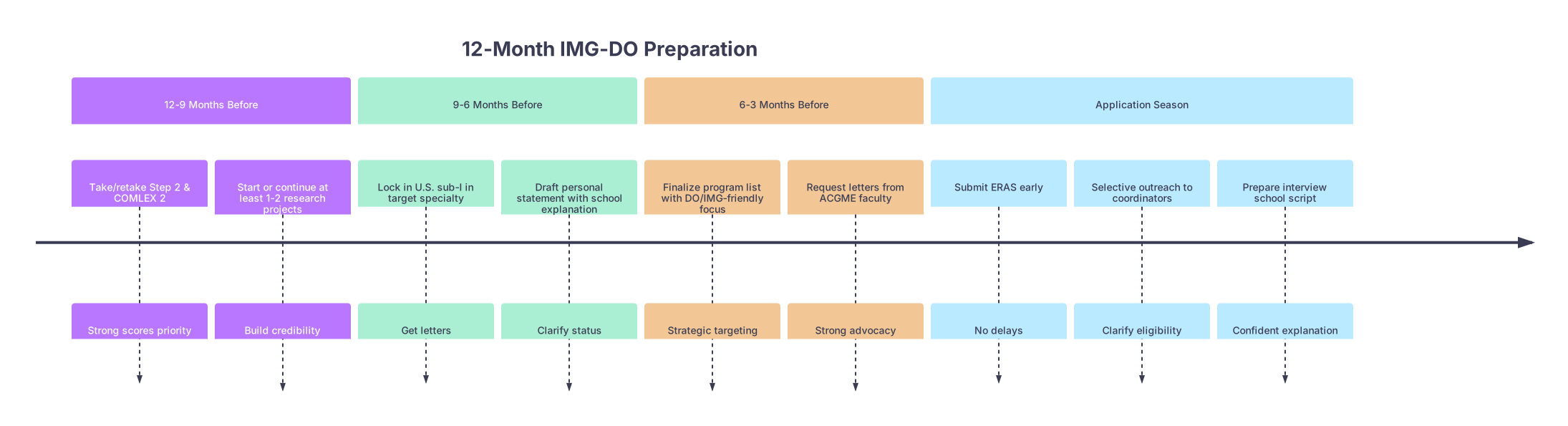
7. Practical Action Plan: 12 Months Before Rank Lists
Let’s put this into an actual timeline so you are not just nodding along.
| Period | Event |
|---|---|
| 12-9 Months Before - Take/retake Step 2 & COMLEX 2 | Strong scores priority |
| 12-9 Months Before - Start or continue at least 1-2 research projects | Build credibility |
| 9-6 Months Before - Lock in U.S. sub-I in target specialty | Get letters |
| 9-6 Months Before - Draft personal statement with school explanation | Clarify status |
| 6-3 Months Before - Finalize program list with DO/IMG-friendly focus | Strategic targeting |
| 6-3 Months Before - Request letters from ACGME faculty | Strong advocacy |
| Application Season - Submit ERAS early | No delays |
| Application Season - Selective outreach to coordinators | Clarify eligibility |
| Application Season - Prepare interview school script | Confident explanation |
Quick checklist
By ERAS submission you should have:
- Step 2 score that does not sink you for your chosen specialty
- COMLEX 2 done (or scheduled with a very clear pass strategy)
- At least 1–2 ACGME faculty letters in your target field
- A one-sentence school explanation in your personal statement
- A program list biased toward DO + IMG-friendly places
- A 20–30 second script for your school and training path
Drop the fantasy that programs will “just understand” because COCA says you are equivalent. You control the framing—or they will.

| Category | Value |
|---|---|
| Step Scores | 9 |
| US Clinical Experience | 8 |
| Letters | 8 |
| School Name | 5 |
| Research | 6 |
| Personal Statement | 4 |

FAQs
1. Should I take USMLE Step 2 if I already have COMLEX as an IMG-DO?
If you’re IMG-DO and remotely worried about bias, yes—take Step 2 unless you’re in a very DO-heavy, less competitive field and your advisors (real ones, not classmates) say you’re safe. Many ACGME programs just do not know how to interpret COMLEX scores and will quietly screen them out. A solid Step 2 gives them a familiar, easy comparison. If test anxiety is extreme and your COMLEX 2 is already strong, talk to someone who has seen match outcomes from your school before deciding, but default to taking it.
2. How many programs should I apply to as an IMG-DO?
More than your U.S. MD classmates, usually more than your U.S.-only DO classmates. For IM or FM, 60–100 programs is often reasonable if your scores are mid-range. For Psych, Peds, OB, Neuro, think 70–110. For competitive fields, you may be looking at 80–150 depending on scores and research. But volume without strategy is pointless—you must bias toward DO- and IMG-friendly programs, plus regions where you have U.S. clinical experience or ties.
3. Will programs see me as an IMG or a DO for visa and eligibility purposes?
If your school is COCA-accredited and you graduate with a DO degree, you’re a U.S. DO in terms of educational credential. Visa-wise, you’re still subject to whatever your citizenship and immigration status are. Some programs lump all non–U.S. citizens mentally into “IMG territory” for visa headache reasons, even if you’re a U.S. DO. That’s reality. So if you need a visa, assume you’ll face some of the same screening IMGs face and prioritize programs that have historically sponsored residents—regardless of whether they’re used to DOs, IMGs, or both.
Key points:
- You must define yourself clearly: U.S.-accredited DO with international training context, not “mysterious IMG-DO hybrid.”
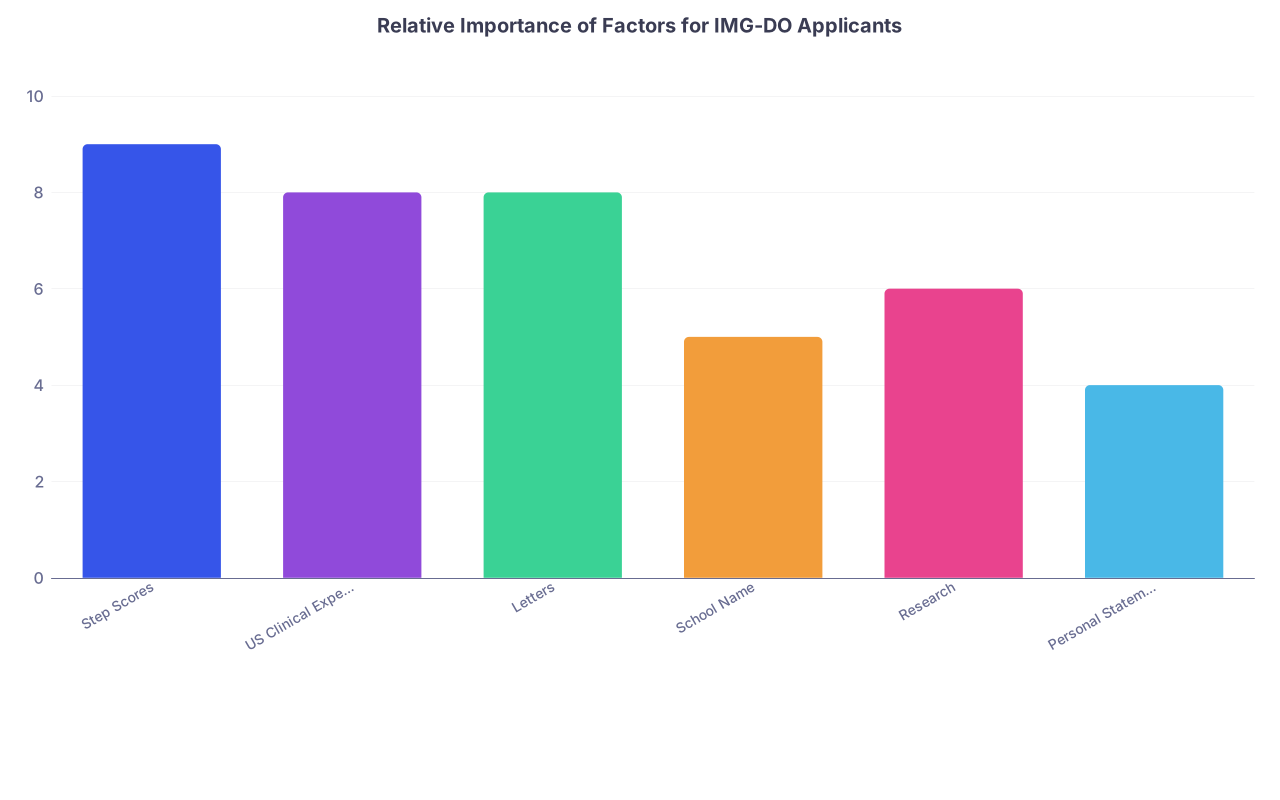
- Your scores, U.S. clinical experience, and letters from ACGME faculty are the three pillars that blunt both IMG and DO bias.
- Program targeting and framing are not optional; if you are both IMG and DO, you cannot afford a lazy, generic application plan.


