
The obsession with “MD or bust” is wrecking people’s sanity.
The Terrifying Scenario: DO Acceptance vs Lower-Tier MD
So here’s the nightmare loop playing in your head:
You’re holding a DO acceptance from a solid school you actually liked on interview day. Then, late in the cycle, a lower‑tier MD acceptance comes in. Not top-50. Not even close. Maybe it’s newer, maybe it’s in a location you don’t love, maybe the stats are borderline. But it’s MD.
Now you’re stuck thinking:
Did I just ruin my future if I choose DO?
Will I regret not taking any MD for the rest of my career?
What if this one decision silently closes every competitive door forever?
And the ugliest thought:
“What if everyone was right and DO really is ‘less than’… and I find out too late?”
You’re not crazy for spiraling here. I’ve watched people refresh SDN and Reddit at 2 a.m. for weeks over exactly this choice. I’ve seen people literally cry after committing to one or the other, convinced they just made the “wrong” branch of their life.
Let me be blunt: the FOMO here is real, but it’s also badly distorted.
You’re not choosing between “real doctor” and “fake doctor.” You’re choosing between two different paths to the exact same license, with different ceilings, different hassles, and different trade-offs.
Let’s unpack the ones that actually matter, not the ones your cousin’s friend’s dad is fear‑mongering about.
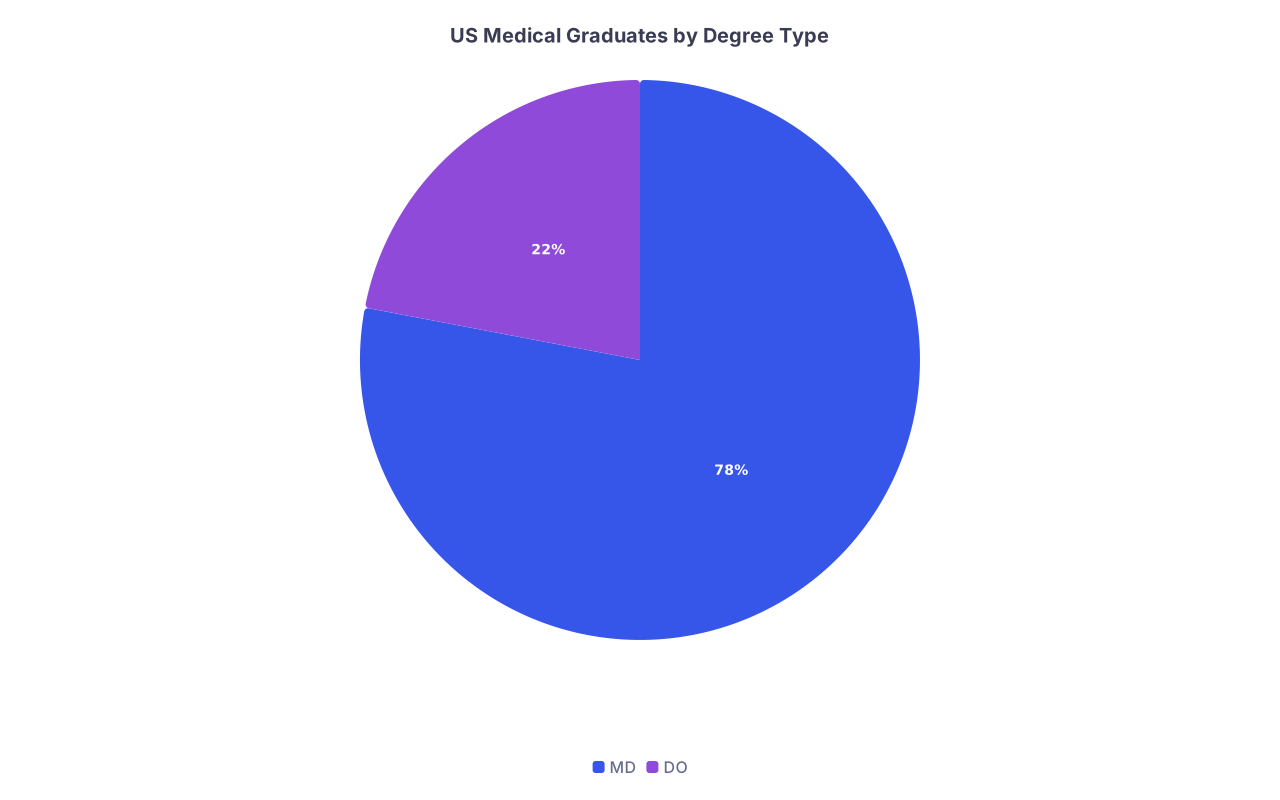
| Category | Value |
|---|---|
| MD | 78 |
| DO | 22 |
What Actually Changes With DO vs Lower‑Tier MD (And What Doesn’t)
First, the part your brain keeps minimizing:
Both DO and MD are fully licensed physicians. Same boards (now that COMLEX + USMLE is the norm for DOs trying to keep doors open), same residency Match process, same DEA number, same “Doctor” on the white coat.
Where they don’t differ as much as you think:
You can absolutely:
- Be a hospitalist, primary care doc, EM doc, anesthesiologist, psych, peds, IM, FM, OB, etc. from either.
- Make a very comfortable income from either.
- Be respected by patients from either (most patients literally do not care about the letters).
- Have a fulfilling career and a decent work‑life balance from either.
Where they do differ and where your anxiety is actually pointing in the right direction:
Competitiveness for certain residencies
It gets harder (not impossible, but undeniably harder) as a DO for:- Derm
- Plastics
- Ortho
- ENT
- Neurosurgery
- Some competitive academic IM programs A lower‑tier MD still often gets a smoother ride into these, especially if you crush Step 2 and have research.
Program bias
Some residencies still quietly (or loudly) prefer MDs. Not all. But enough.
There are literally program spreadsheets where DOs are “rare” or “almost never” matched. It’s better than 10 years ago, but the bias isn’t dead.Extra exams / hassle
As a DO, you’re juggling COMLEX and likely USMLE Step 2 if you want a competitive, open‑door match. That’s extra money, extra stress, extra ways to trip yourself up.Academic vs community careers
If you dream of heavy research, NIH funding, and being faculty at a big‑name academic center, MD—even from a lower‑tier school—often makes that road less obstructed.
So no, your fear isn’t completely irrational. There are real differences. Anyone saying “they’re identical” is selling you something or hasn’t been on the application side of residencies.
But here’s the twist:
The lower‑tier MD vs solid DO decision is usually way closer than social media makes it sound.
The Big Ugly Variable: You Don’t Know Your Future Specialty
This is the part that keeps you up: you don’t know what future‑you is going to want.
Right now you might be saying, “I don’t care about prestige, I just want to be a doctor. I’m happy with FM or IM.”
Then third year hits. You rotate through derm. Or rads. Or anesthesia. Or EM.
Suddenly you do care.
This is why this choice feels so loaded. You’re basically gambling with:
- Future specialty doors
- Future academic opportunities
- Future version of you who might be a lot more competitive and ambitious than current panicked‑you believes.
Let me say the uncomfortable thing:
If there’s even a 30–40% chance you’ll be gunning for a competitive specialty, the MD—even a lower‑tier MD—usually gives you fewer obstacles. Not no obstacles. Fewer.

| Category | Value |
|---|---|
| Primary Care (FM, IM, Peds) | 20 |
| Mid-competitive (EM, Anesthesia, OB/GYN) | 60 |
| Highly Competitive (Derm, Ortho, ENT, Plastics) | 90 |
That doesn’t mean “always pick MD, end of story.” It means:
If your gut tells you, “I might care about matching somewhere big or into something competitive,” it’s not irrational to weigh MD more heavily.
But here’s where that fear of missing out lies to you.
Where FOMO Completely Warps Reality
FOMO in this decision sounds like:
“If I don’t take the MD, I’ll never forgive myself.”
“If I choose DO, I’m closing 90% of doors.”
“If I don’t go MD, everyone will think I wasn’t good enough.”
Let’s dismantle those.
“I’ll never forgive myself if I don’t take MD.”
You’re imagining a future version of yourself, 10 years from now, staring out a rainy window thinking about “the MD I turned down.” That’s not how this plays out.
The way it actually plays out is:
You’re drowning in third‑year rotations, trying not to fall asleep on post‑call rounds, barely keeping up with notes, living from exam to exam. Your thoughts are:
“Did I pre‑chart on that patient?”
“Am I about to get pimped on obscure step‑2-level nonsense?”
“Can I pee before this 4‑hour surgery?”
Nobody on rounds is standing there going, “If only I had gone MD instead of DO.” They’re thinking, “I need coffee or I’m going to die.”
Regret is much more likely to come from:
- Crushing debt from choosing an insanely expensive MD over a cheaper DO for ego.
- Location misery (hating the city you’re stuck in for 4 years).
- Burnout from being in a toxic school culture when you could have been somewhere more supportive.
“I’m closing 90% of doors with DO.”
No. You’re closing some doors, especially in the high‑tier academic/ultra-competitive lane. But 90% is fantasy‑level exaggeration.
If we’re being honest:
- For primary care: DO vs lower‑tier MD is basically a wash. You’ll match if you’re competent and pass your boards.
- For mid‑tier competitive stuff (EM, anesthesia, OB/GYN, some IM fellowships): DO is a disadvantage at some places, but not a wall. People match these from DO every year.
- For super competitive specialties: MD has the advantage. Full stop.
The thing is, a lot of people who swear in MS1 that they’re going derm/ortho/ENT don’t actually end up there.
Because their scores aren’t there.
Or they fall in love with something else.
Or the lifestyle trade‑offs look worse up close.
You’re trying to perfectly engineer for a future that’s 3–5 years away, in a system that shifts under your feet constantly. That’s impossible.
“Everyone will think I wasn’t good enough.”
Some people will think that. The ones who don’t matter. The ones whose medical knowledge begins and ends with “Grey’s Anatomy.”
Here’s who won’t care:
- Your patients
- Your co‑residents once they see you actually know what you’re doing
- Attendings who depend on you to not screw up patient care
- Literally anyone outside medicine
The MD/DO status anxiety is loudest before you start. Then it gets replaced by: board scores, clinical performance, interpersonal skills. That’s the stuff that makes or breaks your actual day‑to‑day life.

| Stage | Activity | Score |
|---|---|---|
| Before Decision | Obsess over rankings | 4 |
| Before Decision | Scroll Reddit/SDN | 5 |
| Making the Choice | Compare future specialties | 4 |
| Making the Choice | Worry about regret | 5 |
| Early Med School | Adjust to workload | 3 |
| Early Med School | MD/DO label fixation | 2 |
| Clinical Years | Focus on patient care | 4 |
| Clinical Years | Worry about Match | 5 |
How I’d Personally Decide If I Were You
If you want an actual stance instead of “it depends,” here’s mine.
If I had:
- A DO acceptance from a reasonably established school
(not brand‑new, has solid match lists, not in total chaos administration-wise)
and
- A lower‑tier MD with:
- Rough location
- Way higher tuition
- Mediocre match outcomes
Here’s how I’d think it through.
I’d lean MD if:
- I even slightly suspect I might want a competitive specialty or academic medicine.
- The MD school isn’t a total mess (like on probation, awful Step/COMLEX pass rates, or horror‑story culture).
- The cost difference isn’t catastrophic.
I’d lean DO if:
- The DO school’s match list shows consistent success into solid community and some academic programs in fields I can see myself doing.
- The DO school is significantly cheaper or in a place I’d actually handle living in for 4 years.
- The MD school feels like I’d be miserable there, or its outcomes are genuinely bad (lots of unmatched, low board pass rates).
This isn’t about pride. It’s resource management. Mental, financial, academic.
The truth most people don’t say out loud:
A good DO school can be a better choice than a truly bad or chaotic MD school.
“MD” on the diploma does not magically fix everything else.
How to Stop the “What If I Ruin My Life?” Spiral
You’re not going to logic yourself into zero anxiety. That’s not how this works. But you can at least make sure the anxiety is based on reality, not Reddit ghosts.
Do this, concretely:
Pull the last 3–5 years of match lists from both schools if available.
Look for your likely interests, not just derm/ortho flexes.Look up board pass rates (Step 1 if still reported, Step 2, COMLEX if DO).
Low first‑time pass rates at either school are a red flag.Actually price out tuition + cost of living.
Not pretend numbers. Realistic estimates. Add interest. Forty years from now, that math still matters.Talk to current students at both schools.
Ask the uncomfortable stuff: admin support, mental health resources, fail policies, remediation culture, how people talk about DO vs MD there.
Then—and this sucks, but it’s true—you accept that there is no 100% perfect, regret‑proof choice. There’s just the best decision you can make with incomplete information.
You’re not choosing “good path vs ruined life.”
You’re choosing “good path A vs good path B with different friction points.”

The Part Nobody Tells You Until It’s Too Late
In the end, residency directors don’t care about your premed angst. They care about:
- Do you pass your boards on the first try?
- Are your scores at least in the range they want?
- Can attendings trust you on the wards?
- Are you going to be a stable, non-toxic human at 3 a.m. during a code?
I’ve seen DO students beat MD students for spots because they were clearly better clinically and had stronger letters. I’ve seen MD students from “nothing” schools match at incredible places because they worked their asses off. I’ve also seen both DO and MD grads flame out because they thought the letters after their name would carry them.
If you choose DO and commit, you’ll need to:
- Take COMLEX seriously and probably take USMLE Step 2.
- Over‑prepare for clinical rotations because you might feel like you have more to prove.
- Be proactive with research and networking if you’re leaning toward competitive fields.
If you choose MD, you don’t magically get to slack. You just get a bit more default credibility in some corners of the system. You can absolutely waste that advantage if you coast.
Either way, you don’t escape the grind. You only pick which flavor of grind and which walls you might run into.

Quick Reality Check Before You Lose Another Night of Sleep
You are not about to “throw your career away” with either choice. That’s the catastrophizing talking.
Three things to actually hold onto:
- DO vs lower‑tier MD is not “doctor vs not‑doctor.” It’s “what kind of hassle and what kind of doors do I want to deal with later?”
- If there’s a real chance you’ll chase a competitive specialty or big‑name academic center and the MD school isn’t a total disaster, MD usually gives you fewer obstacles.
- A well‑chosen DO with good outcomes, sane culture, and reasonable cost can be absolutely the smarter, healthier long‑term choice over a sketchy, miserable MD.
You won’t make this decision fear‑free. That’s fine. Make it informed, then commit hard to whichever path you pick.
You don’t need the “perfect” path.
You just need one solid path, and then you need to show up for yourself on it.