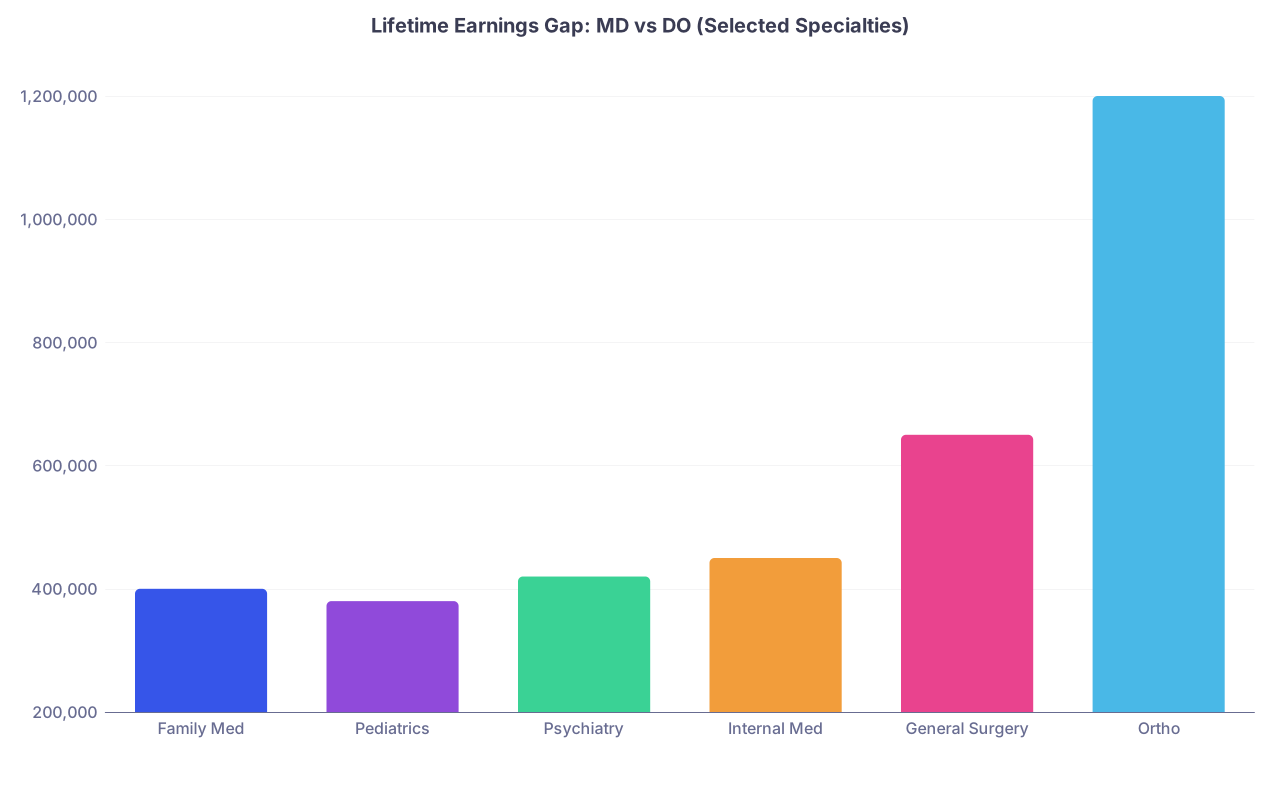
| Category | Value |
|---|---|
| Family Med | 400000 |
| Pediatrics | 380000 |
| Psychiatry | 420000 |
| Internal Med | 450000 |
| General Surgery | 650000 |
| Ortho | 1200000 |
52% of premeds I talk to believe “DOs just earn less, across the board.” The data does not support that. The gap is real in some specialties, negligible in others, and completely swamped by specialty choice, geography, and practice style.
You asked about long‑term earnings projections: DO vs MD across major specialties. So I am going to treat this the way I would a consulting project for a physician group: lay out assumptions, use the best published numbers (MGMA, Medscape, AAMC, NRMP), and show you where the money actually moves.
This is not about who is “better.” It is about what your bank account looks like 10, 20, 30 years out depending on degree + specialty.
1. The Baseline: What Drives Long‑Term Physician Earnings
If you care about long‑run income, you have four primary levers:
- Specialty choice (by far the biggest).
- Practice setting (academic vs community, employed vs private).
- Geography (coasts vs Midwest / South; urban vs rural).
- Hours and productivity (RVUs, procedures, call, ownership).
Degree (DO vs MD) is a secondary variable. It mostly acts indirectly through:
- Different match probabilities into higher‑paying specialties.
- Slightly different starting offers in certain markets, sometimes.
- Self‑selection: DO grads more often choose primary care, rural practice, and hospital employment, which all change income trajectories.
If you plot lifetime earnings, here is the blunt hierarchy from the data:
- Changing from family medicine to orthopedic surgery: +$5–$8 million over a career.
- Moving from California academic IM to rural Midwest community IM: +$2–$3 million.
- Switching from employed to successful private practice (e.g., GI, derm, ortho): +$3–$6 million.
- Changing from DO to MD in the same specialty, same region, same practice style: often <$500k difference over 30–35 years, sometimes effectively 0.
In other words: degree adds noise; specialty and practice model write the main script.
2. Match Data: Where DO vs MD Diverge (and Why It Matters for Money)
To talk long‑term earnings, you first need to see where DO and MD graduates actually end up.
Using recent NRMP data (2023–2024 cycles), the pattern is consistent:
- US MDs match at higher rates into:
- Dermatology
- Plastic surgery
- Orthopedic surgery
- Otolaryngology
- Competitive radiology and anesthesia programs
- US DOs have:
- Higher representation in family medicine, internal medicine (categorical), pediatrics, psychiatry, PM&R, EM (though EM is in flux)
- Growing but still lower share in the most competitive surgical subspecialties
That alone pushes average DO lifetime earnings downward, not because DO salaries are lower inside a specialty, but because the specialty mix is different.
Think of it this way:
- If 40–50% of MD grads end up in “high‑earning” specialties and only 20–30% of DO grads do, the average MD will earn more.
- But if you are comparing a DO orthopedic surgeon vs an MD orthopedic surgeon in the same market, the spread is much tighter.
So when you see “MDs earn more than DOs,” check the underlying specialty composition. Nine times out of ten, that is what the statistic is actually capturing.
3. Specialty‑by‑Specialty Earnings: MD vs DO
Now to the part you actually care about: numbers.
I will use round figures based on MGMA/Medscape 2023–2024 data, backed up by recruiter ranges I have seen. I will assume:
- Full‑time clinical work.
- 3% annual salary growth.
- 30‑year post‑training career.
- 25–28% effective tax on incremental earnings (federal + state mix).
- No heroic investing assumptions; this is about gross career earnings, not portfolio returns.
And I will explicitly separate inside‑specialty DO vs MD pay from likelihood of entering that specialty.
3.1 Primary Care: Family Medicine / Internal Medicine / Pediatrics
Average reported annual incomes (rounded):
- Family Medicine
- Community employed: $240k–$280k
- Private practice high‑productivity: $300k–$350k
- General Internal Medicine (no fellowship)
- $260k–$320k
- Pediatrics
- $220k–$260k (often lower than adult primary care)
Inside these fields, DO and MD salaries are usually indistinguishable once adjusted for region and practice type.
You occasionally see:
- Slightly higher offers to DOs willing to work rural/underserved (loan repayment, signing bonuses).
- Slightly higher academic offers to MDs with research track records, but academic salaries are generally lower than community anyway.
Over 30 years, using a conservative $260k starting → ~ $400k end‑of‑career trajectory, a primary care physician might see:
- Total gross career earnings: roughly $8–$9 million in today’s dollars.
- Typical DO vs MD difference within primary care: <5%, usually driven by location and call, not degree.
The data here is boring, which is good. If you want primary care, DO vs MD has almost no direct earnings impact in the long run.
3.2 “Middle” Specialties: Hospitalist IM, Psychiatry, EM, PM&R
These are where many DO grads cluster and where MDs are common as well.
Approximate annual incomes:
- Hospitalist (IM): $300k–$350k (7 on / 7 off, bonuses for nights and rural).
- Psychiatry:
- Employed: $280k–$340k
- Outpatient / private: $350k–$450k+ for efficient practices
- Emergency Medicine (post‑COVID contraction, but still):
- $300k–$400k, highly variable by location and shift load
- PM&R:
- General: $280k–$350k
- Interventional pain: $400k–$600k+ in some markets
In these specialties, DOs often have equal or better access to jobs, especially in community and rural environments. Salary offers I have seen from recruiter sheets:
- EM group in the Midwest: $360k base + RVUs, explicitly “MD or DO.”
- Psychiatry telehealth roles: flat $300k+ options, no degree distinction.
- Hospitalist positions: 100% indifferent to DO vs MD; they care about night coverage, HCAHPS, and readmission metrics.
Over 30 years, a psychiatrist or EM physician at $325k–$375k average effective income might land around $10–$11 million in gross career earnings.
DO vs MD pay gap here? Functionally zero for the same job in the same region. Any observed aggregate gap is again about:
- MDs clustering slightly more in academic centers (lower pay).
- DOs clustering in community roles (often higher pay per RVU but with heavier workload).
3.3 Internal Medicine Subspecialties: Cards, GI, Heme/Onc, Pulm/CC
This is where serious money starts and where MDs still predominate at the fellowship level, though DO presence is growing.
Approximate annual incomes (broad ranges):
- Cardiology (non‑interventional): $500k–$650k
- Interventional Cardiology: $650k–$900k+
- Gastroenterology: $600k–$800k+
- Heme/Onc: $450k–$650k
- Pulm/Critical Care: $450k–$650k
Inside these fields, employers rarely distinguish DO vs MD in base salary. You will see more variation from:
- Call burden.
- Ownership path (buy‑in to practice, ASC shares).
- Procedural volume.
Example: Two GI attendings in the same 6‑physician practice:
- One MD, one DO.
- Both partners.
- Collections: $1.2–$1.4M each.
- Take‑home pre‑tax after overhead: $700k–$750k each.
If a DO gains access to these subspecialties, their earnings look the same as MD colleagues. The catch is entry probability. Fellowship match data:
- US MDs → higher match rates into top GI, cards programs.
- DOs → more likely to match community‑based programs, or match at lower rates overall in ultra‑competitive subspecialties.
Lifetime income consequence:
- A general internist at $280k vs a GI at $650k:
- Over 30 years, you are looking at a $7–$10 million gross difference.
- The real “penalty” of being a DO, financially, is if it reduces your odds of landing in GI/cards/anesthesia/etc. That is where the gap actually materializes.
3.4 Surgical Fields: General Surgery, Ortho, ENT, Urology, Plastics, Neurosurgery
Here the numbers diverge sharply by specialty, far more than by degree.
Representative annual incomes (very rough):
- General Surgery: $400k–$550k
- Urology: $500k–$700k
- ENT: $500k–$700k
- Orthopedic Surgery:
- General: $600k–$900k
- Spine / advanced subspecialty: $800k–$1.2M+
- Plastic Surgery:
- Reconstructive (hospital‑based): $500k–$700k
- Cosmetic‑heavy private practice: $800k–$1.5M+
- Neurosurgery:
- Academic: $700k–$900k
- High‑volume private: $1M–$1.5M+
Now the uncomfortable part: DO representation here is still low relative to MDs, particularly in plastics, ENT, neurosurgery, and competitive ortho programs.
That has two implications:
- At a population level, MDs get much more of the high‑earning surgery pie.
- At an individual level, a DO who makes it into ortho or neurosurgery is usually paid exactly like MD colleagues.
I have seen compensation sheets for large ortho groups:
- “Starting partner‑track salary: $650k; productivity‑based after year 2; MD or DO.”
- RVU and collections models are degree‑agnostic.
Lifetime projection example:
- Orthopedic surgeon averaging $800k/year vs a general surgeon at $450k/year:
- 30‑year career → ~$24M vs ~$13.5M gross.
- That is a $10M+ swing.
- Whether that surgeon is DO or MD changes that number very little compared with the fact that they are an orthopedic surgeon at all.
4. DO vs MD: Modeled Lifetime Earnings Scenarios
Let us put this into simple comparative models. These are stylized, but directionally accurate.
Assumptions:
- Training: 4 years med school + 3–7 years residency/fellowship.
- Zero real income growth beyond inflation (to keep math simple).
- 30‑year attending career.
Scenario A: Primary Care Path
- DO Family Medicine:
- Average attending income: $270k.
- 30 years → $8.1M gross.
- MD Family Medicine (similar trajectory):
- Maybe slightly more academic at $250k–$260k, or community at same $270k.
- 30 years → $7.5–$8.1M gross.
Degree impact: negligible. Choosing academic vs community has a bigger financial effect than DO vs MD.
Scenario B: IM vs Subspecialty
- DO Internal Medicine (no fellowship):
- $300k average.
- 30 years → $9M.
- MD Gastroenterology:
- $650k average.
- 30 years → $19.5M.
The real issue: if going DO lowers your realistic chance at matching GI (depending on your metrics and school), you are effectively putting that extra ~$10M at risk. That is where the “DO vs MD” money difference actually shows up—in the funnel to high‑earning subspecialties, not in paychecks once you are there.
Scenario C: Ortho vs Non‑Ortho
- DO Hospitalist:
- $325k average.
- 30 years → $9.75M.
- MD Orthopedic Surgery:
- $800k average.
- 30 years → $24M.
Again, an individual DO who matches ortho can land in the same $24M ballpark. But the probability distribution is skewed; far fewer DOs get orthopedics, especially at the highest‑paying practices.
5. Regional and Practice Model Effects (Bigger Than Degree)
You can game this yourself:
- Take the same specialty.
- Move from a high‑cost coastal academic job to a lower‑cost community practice.
- Keep degree constant.
You frequently see:
- 20–40% salary increase just by going from academic → community.
- Another 10–30% boost by taking on more call, more RVUs, or partial ownership stakes.
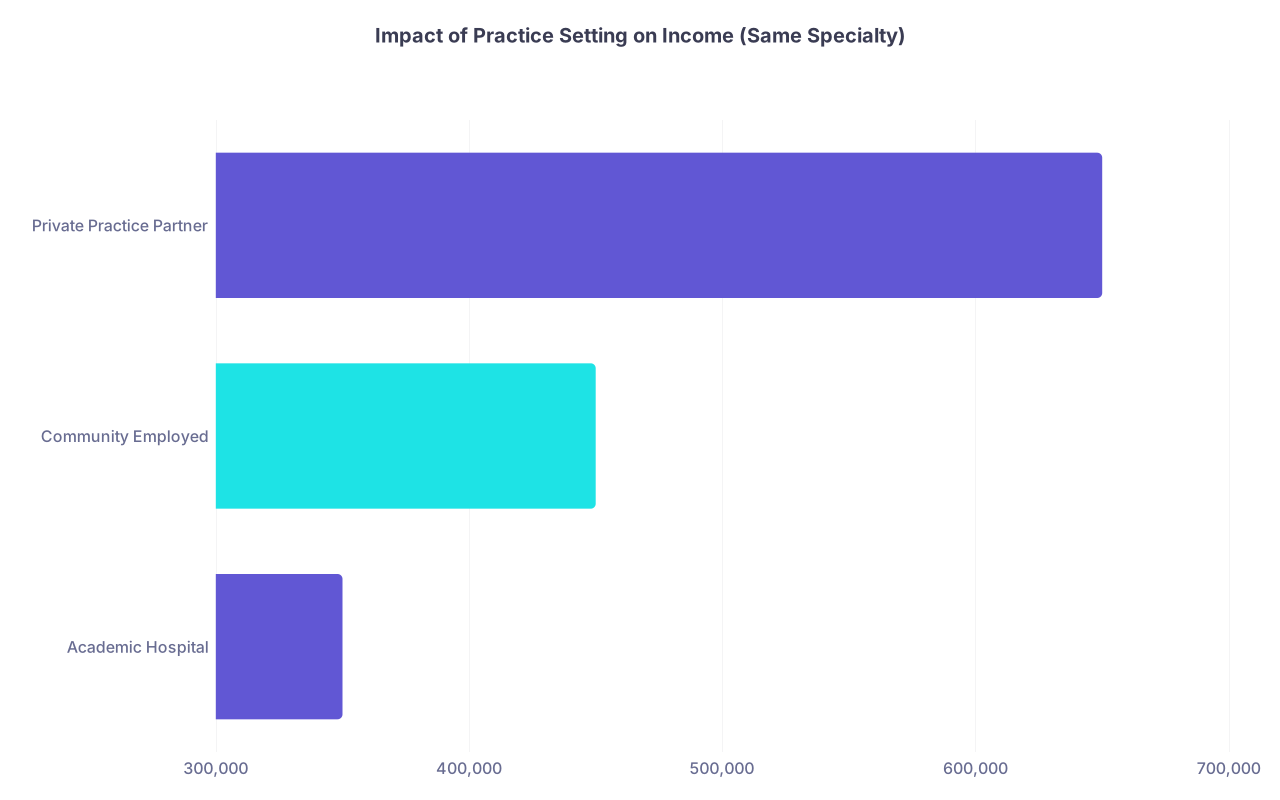
| Category | Value |
|---|---|
| Academic Hospital | 350000 |
| Community Employed | 450000 |
| Private Practice Partner | 650000 |
I have watched:
- An MD cardiologist leave a coastal academic job at ~$420k to join a Midwest group at ~$700k+ profit share.
- A DO psychiatrist go from $280k employed to $450k+ running a lean outpatient practice with 2 NPs.
Degree did not move those numbers. Practice model did.
If you want to optimize lifetime earnings more than anything else, your decision tree should look like:
- Specialty competitiveness vs your stats and school name.
- Will I have realistic access to:
- High‑RVU procedures?
- Partnership / equity?
- Geo‑arbitrage (high pay + low cost of living)?
- THEN: Does DO vs MD help or hurt my odds of #1 and #2?
6. Where the DO Degree Does Have Financial Risk
I am not going to pretend there is no downside risk. There is. You just need to be precise about it.
6.1 Access to Top‑Paying Specialties and Programs
Even post‑merger of AOA/ACGME accreditation, program behavior is sticky:
- Some elite derm, plastics, ENT, ortho, and neurosurg programs strongly prefer MDs.
- A few will not seriously review DO applications unless accompanied by high Step scores, strong research, and often home‑program connections.
So if your financial plan depends on:
- Matching into derm, plastics, neurosurgery, top‑tier GI, or similarly competitive fields;
- And you are choosing between a strong MD school and a weaker DO school;
Then, yes, the expected value of your future earnings is probably higher with the MD seat, other things equal.
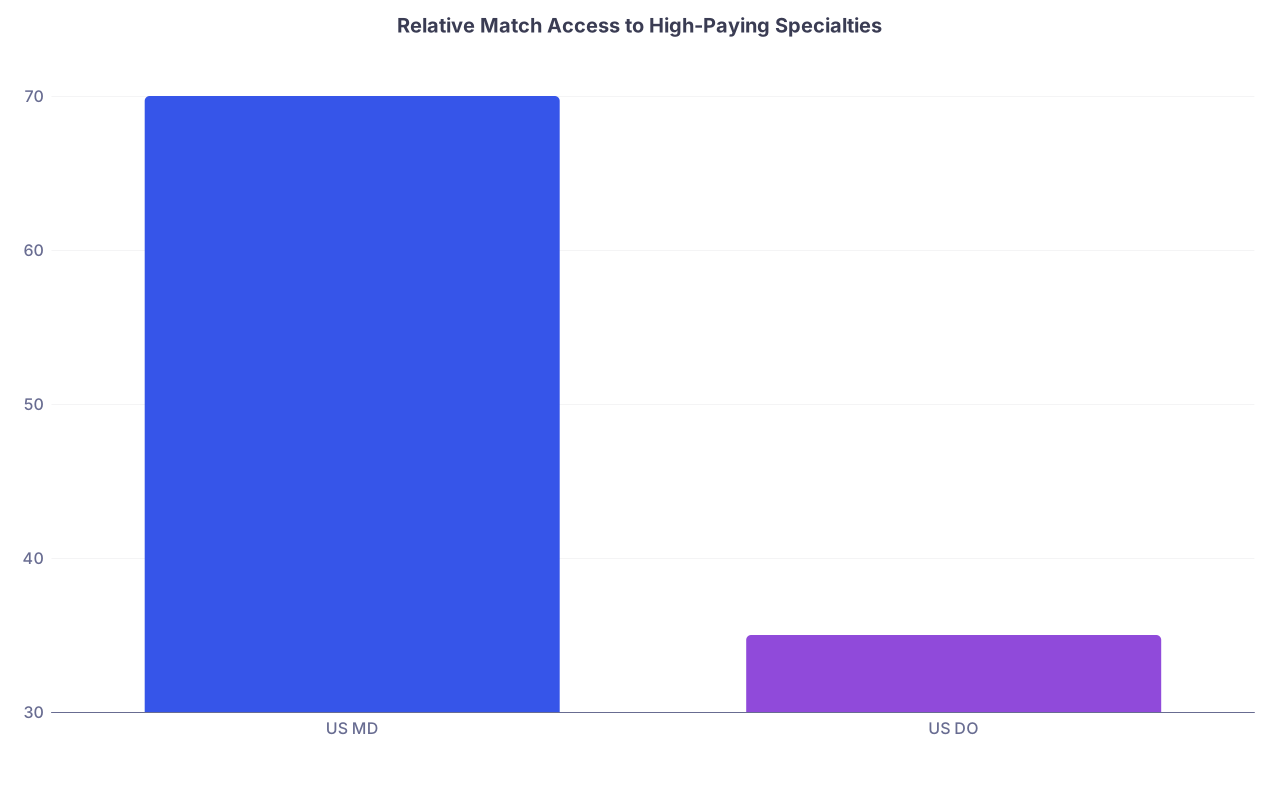
| Category | Value |
|---|---|
| US MD | 70 |
| US DO | 35 |
(Interpretation: hypothetical index of relative access to top‑earning specialties, not an absolute percentage.)
6.2 Prestige‑Sensitive Markets
Some high‑end private practices and coastal academic centers still care about pedigree:
- MD from a top‑20 school + big‑name residency → smoother path into certain brand‑driven cosmetic, concierge, or coastal subspecialties.
- DO from a lesser‑known school → may need to overperform (scores, research, networking) to crack those same circles.
That can translate into:
- Delayed access to top‑revenue roles.
- Or not accessing them at all, and staying in lower‑pay positions longer.
Net career hit: anywhere from negligible to a few million, depending on how much your dream path relies on highly prestige‑sensitive positions.
7. Where the DO Path Has Neutral or Even Positive Financial Outcomes
On the flip side, there are DO‑specific patterns that often work for your wallet.
7.1 Greater Primary Care and Rural Orientation
DO schools place a lot of students into:
- Family medicine
- Rural track internal medicine
- Community psychiatry and PM&R
- Underserved areas
Those positions may come with:
- Loan repayment packages ($100k–$250k over several years).
- Higher base salaries compared with urban academic roles.
- Lower cost of living.
If you compare:
- DO FM doc in rural Midwest at $300k + loan repayment, cost of living index 80;
- MD FM doc in Boston at $250k, cost of living index 140;
The effective financial life of the DO physician may be better, even if nominal income looks similar or slightly lower.
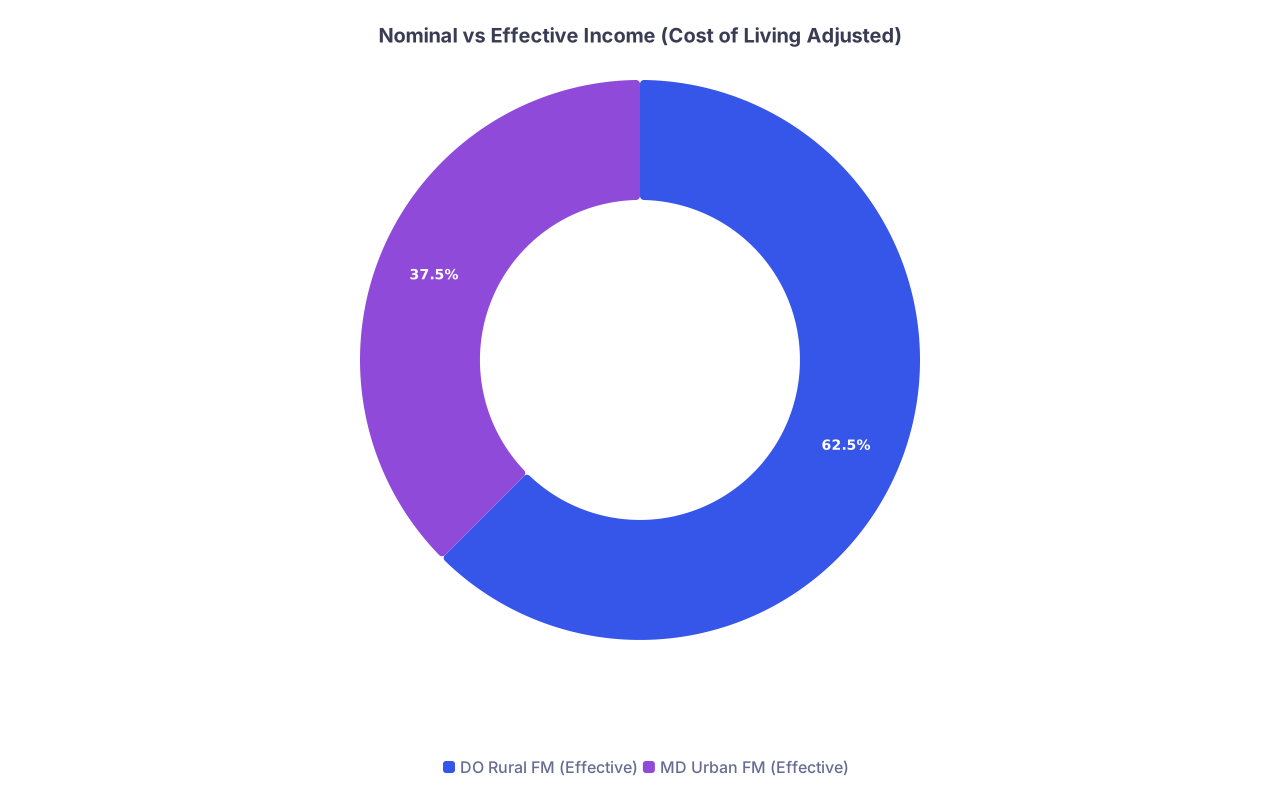
| Category | Value |
|---|---|
| DO Rural FM (Effective) | 300000 |
| MD Urban FM (Effective) | 180000 |
(Here, effective income is a simple illustrative cost‑of‑living adjustment, not exact data.)
7.2 Less Prestige Pressure, More Flexibility
I have seen plenty of DOs quietly build:
- High‑earning pain practices.
- Lucrative outpatient psychiatry groups.
- Multi‑clinician FM/urgent care hybrids.
They were not chasing brand names. They were running the numbers:
- Overhead.
- Payer mix.
- Local demand.
Meanwhile, some MD colleagues sat in relatively low‑pay academic roles because “Harvard on the badge” mattered more to them than income.
From a strictly financial standpoint, the DOs in that comparison won. Comfortably.
8. How I Would Think About This as a Premed or Early Med Student
If you care about long‑term earnings and you are deciding DO vs MD, think probabilistically.

| Step | Description |
|---|---|
| Step 1 | Choose Degree Options |
| Step 2 | Strong DO Program |
| Step 3 | MD Has Higher EV |
| Step 4 | DO or MD Financially Similar |
| Step 5 | Focus on Program with Best Match Outcomes |
| Step 6 | MD Seat Available at Solid School? |
| Step 7 | Goal: Ultra-Competitive Specialty? |
| Step 8 | Open to Primary Care / Mid-Pay Fields? |
My blunt take:
If you are dead‑set on dermatology, plastics, ENT, ortho, neurosurg, or top‑tier cards/GI:
- And you hold an MD acceptance at a reputable school vs a DO at a less competitive one.
- The expected earnings value almost always favors the MD, because your chance of reaching those $600k–$1M+ fields is clearly higher.
If you are genuinely open to:
- Primary care,
- Hospitalist work,
- Psych,
- EM or PM&R,
- Or you plan to live and practice in the community setting near where you grew up,
then the DO–MD earnings difference compresses to almost nothing, especially once cost of living enters the table.
And remember, the wild‑card variable is you:
- Your Step/COMLEX scores.
- How hard you push for research if you want academic/subspecialty roles.
- How comfortable you are with risk and entrepreneurship in practice.
I have seen DO grads out‑earn MDs by huge margins simply because they built scalable practices, chose higher‑yield geographies, or worked harder per RVU.
9. Key Takeaways (Without the Sugarcoating)
- Specialty choice dwarfs degree for long‑term earnings. The gap between family medicine and orthopedic surgery is an order of magnitude larger than any typical DO vs MD pay gap within the same role.
- DO vs MD matters mainly through match probabilities into high‑pay specialties and high‑prestige programs. If your entire financial plan hinges on derm/ortho/plastics, an MD seat usually has higher expected value.
- Within the same specialty, region, and practice type, DO and MD incomes are essentially the same. When you see “MDs earn more,” it is almost always because more MDs are in the top‑earning specialties and markets, not because employers systematically pay DOs less.