
The biggest mistake future doctors make about practicing abroad is this: they start thinking about it after they’ve already locked themselves into the wrong path.
If you even suspect you might want to practice outside the U.S. one day, you plan for that from freshman year. Not during residency. Not after graduation. Now.
Below is your timeline — from high school through early residency — to keep international practice on the table whether you choose DO or MD.
High School to Early College (Years -6 to -3): Planting the Flag Early
At this point you should stop thinking “doctor is doctor everywhere” and start asking a much sharper question: “Doctor where?”
By the end of this phase, you want a provisional country list and a rough sense of how DO vs MD plays in each.
Step 1: Build a short list of target regions
In 11th–12th grade and first year of college, you should:
- Pick 2–3 likely regions you’d consider:
- UK / Ireland
- EU (continental Europe)
- Canada
- Australia / New Zealand
- Middle East (e.g., UAE, Qatar, Saudi)
- Asia (e.g., Singapore, Hong Kong)
- For each region, answer:
- Do they recognize U.S. DO degrees?
- Do they accept U.S. MDs from any accredited school, or only some?
- Do they require local licensing exams?
Right now you’re not going deep, just sorting into:
- Green – Generally open to DO and MD (e.g., many U.S.-style systems, some Middle Eastern systems)
- Yellow – Mostly MD-friendly, DO possible but complicated
- Red – MD maybe, DO effectively blocked
You’ll refine this later. The point now is simple: if all your top-choice countries are red for DO, that matters.
Step 2: Start tracking recognition early
By end of freshman year, you should:
- Look at:
- World Directory of Medical Schools (WDOMS)
- Official sites of:
- GMC (UK)
- MCC (Canada)
- AMC (Australia)
- Check:
- Do they recognize U.S. LCME-accredited MD schools?
- Do they recognize U.S. COCA-accredited DO schools?
- Are there any pilot / special pathways for DOs?
You’ll see a pattern: MD is more universally understood; DO is catching up but still inconsistent. That’s not opinion. That’s reality.
College Years 1–2 (Years -3 to -1): Decide How “International” You Really Mean
At this point you should go from “I might want to work abroad” to specific scenarios:
- “I want optional short-term work in Canada, UK, or Australia.”
- “I might permanently move to the UK or EU.”
- “I want to do global health trips but stay U.S.-based.”
- “I’m considering going back to [home country] to practice.”
Your clarity here will drive whether DO vs MD is a minor or major decision.
Month-by-Month: Freshman Year
Fall, Freshman Year
- Declare (to yourself, not necessarily on paper):
- Am I a “U.S.-only” person who wants optional electives abroad?
- Or am I genuinely considering practicing long-term outside the U.S.?
- If “likely U.S.-only, global health on the side”:
- DO and MD are both fully viable.
- If “maybe long-term abroad”:
- You should lean MD unless you have strong reasons to choose DO.
Spring, Freshman Year
At this point you should:
- Talk to:
- At least one DO and one MD who:
- Did an international elective
- Or worked abroad (even short term)
- At least one DO and one MD who:
- Ask them:
- Were there credentialing issues?
- Any problems with DO recognition?
- Would they choose the same degree again given their goals?
Start a simple log:
| Region/ Country | MD Recognition | DO Recognition | Notes / Comments |
|---|---|---|---|
| UK | Broadly yes | Limited / evolving | GMC rules, may change |
| Canada | Yes, restricted by school | Limited | Provincial variations |
| Australia | Yes | Case-by-case | Check AMC updates |
| EU (general) | Varies by country | Often unclear | Requires deep dive |
Update this once per semester. Policies change. Your timeline adjusts with them.
Summer After Freshman Year
- Shadow:
- At least one osteopathic physician (DO)
- At least one allopathic physician (MD)
- Notice:
- Style? Philosophy? Does OMT interest you?
- If you’re indifferent philosophically but you’re heavy on international goals → that’s a signal toward MD.
College Years 2–3 (Years -2 to -1): Commit to a Direction Before MCAT
By the time you register for the MCAT, you should already have a working DO vs MD preference based on your international appetite, not just admissions odds.
Sophomore Year: Information Deep-Dive
Fall, Sophomore Year
At this point you should:
- Create a country-specific checklist for your top 1–2 target countries.
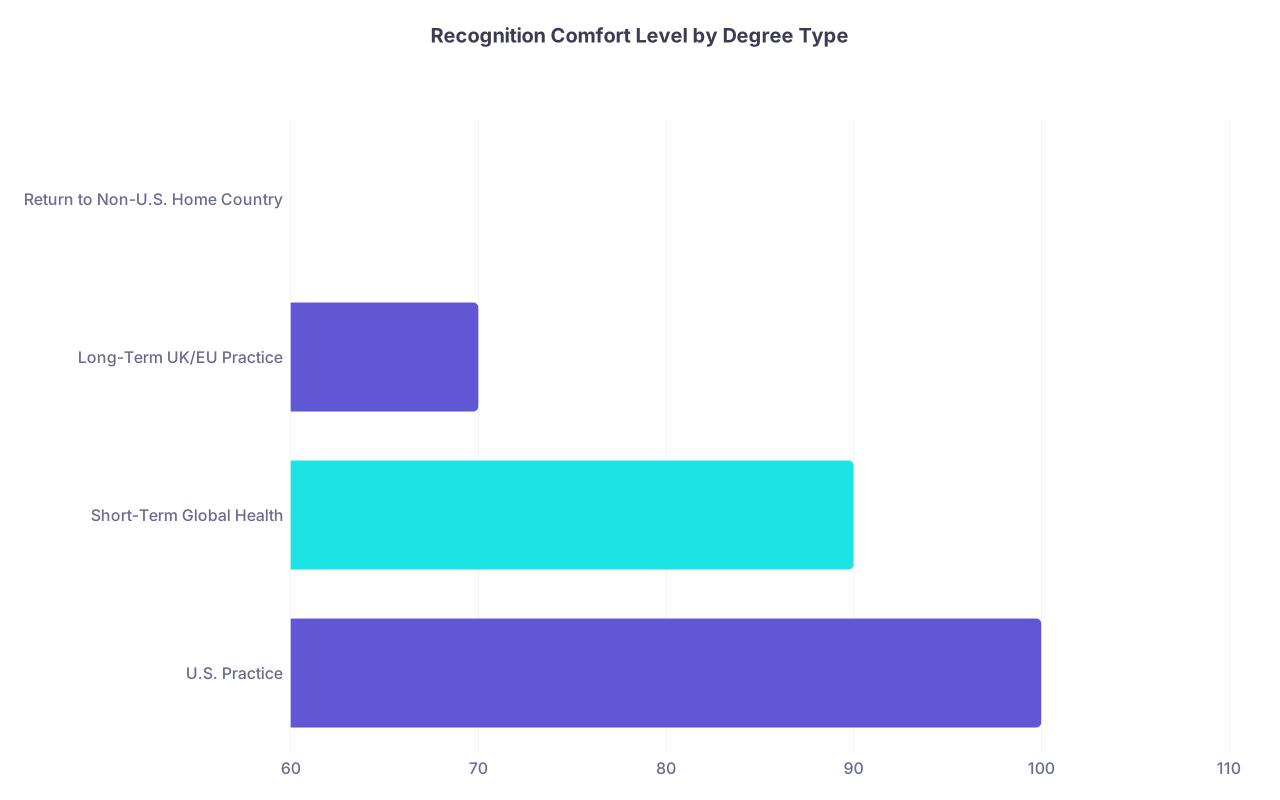
| Category | Value |
|---|---|
| U.S. Practice | 100 |
| Short-Term Global Health | 90 |
| Long-Term UK/EU Practice | 70 |
| Return to Non-U.S. Home Country | 60 |
Interpretation (my view based on current patterns):
- U.S. Practice – DO and MD basically equal (different paths, same licensure).
- Short-Term Global Health – DO and MD both usually fine, often under U.S. umbrella.
- Long-Term UK/EU – MD clearly has smoother recognition overall.
- Return to Non-U.S. Home Country – Often MD is better understood.
Spring, Sophomore Year
At this point you should:
- Decide primary degree target:
- If international is central to your identity/plan → MD as primary target, DO as backup.
- If you strongly buy into the osteopathic philosophy and your target countries are relatively DO-friendly → DO can still be primary.
- Start mapping:
- MCAT timing
- GPA goals
- Extracurriculars that might appeal to global-health-oriented programs (e.g., global health clubs, language study)
Summer After Sophomore Year
- If you’re serious about global practice, use this summer to:
- Do international volunteering or clinical experience (legit, not “mission tourism”)
- Or work with immigrant/refugee populations domestically
- This isn’t just for your CV. It’s a reality check:
Do you like cross-cultural care, or do you just like the idea of it?
Application Year (Year 0): Build an Application That Keeps Doors Open
At this point you should have a declared strategy:
- Path A: MD-focused, with DO as selective backup
- Path B: MD and DO equal preference (U.S.-oriented, global-curious)
- Path C: DO-focused, fully embracing U.S.-centric career with optional global work
Month-by-Month: Application Year
January–March (Before Primary Opens)
You should:
- Research specific schools for:
- Global health tracks
- International electives
- Existing partnerships with hospitals abroad
- Flag:
- MD programs that emphasize global health (e.g., UCSF, Duke, University of Toronto if you’re also looking at Canada)
- DO programs with real, structured global opportunities (these exist; you just have to dig harder)
May–June: Primary Application Submission
At this point you should:
- Finalize school list aligned with your country/region interests:
- If you want the UK, prioritize MD schools with strong reputations and high USMLE Step 2 pass scores.
- If mostly U.S.-centric with side missions, DO schools with established international electives can be as valuable as MD schools.
Think like this:
- Score-stretch MD schools with strong global programs
- Realistic MD schools with solid match outcomes and some international exposure
- Selective DO schools you actually want, not just “any DO”
July–September: Secondary Essays
You should start threading the global angle into your story:
- Mention:
- Cross-cultural care
- Language skills
- Specific regions you’d like to serve
- But be honest:
- Do not write a performative “global health” essay just because it sounds noble. Adcoms have read that same paragraph 10,000 times.
Medical School Years 1–2 (Years +1 to +2): Locking in Flexibility Early
By the midpoint of MS2, your choice of degree (DO vs MD) is fixed. Now the question is: how do you protect or expand your international options within that framework?
MS1: Foundation Year
Fall, MS1
At this point you should:
- Map out:
- USMLE Step 1 / COMLEX Level 1 timing
- If you’re DO, whether your school supports dual-taking USMLE + COMLEX
- For international options, especially major systems (UK, Canada, Australia), taking USMLE generally helps even if not technically required.
Spring, MS1
You should:
- Identify faculty involved in:
- Global health programs
- International electives
- Research with international partners
- Send 1–2 short, clear emails:
- Who you are
- Your degree (DO or MD)
- Your long-term interest in practicing or working abroad
- Ask: “What should I be thinking about now if I might want to practice in [Country/Region] someday?”
You want at least one attending who knows your name and your international interest by the end of MS1.
Medical School Years 2–3 (Years +2 to +3): Exam Strategy and International Reality Check
At this point you should be brutally honest: many international systems do not care that you’re passionate. They care about:
- Exam performance
- Accreditation
- Program reputation
- Clinical training quality
MS2: The Exam Year
Summer Before MS2
You should:
- Decide:
- MD students: USMLE Step 1 (if still offered numerically or pass/fail depending on timing) + strong Step 2 plan
- DO students: COMLEX Level 1 and strongly consider USMLE Step 1/2 if international practice is a real goal
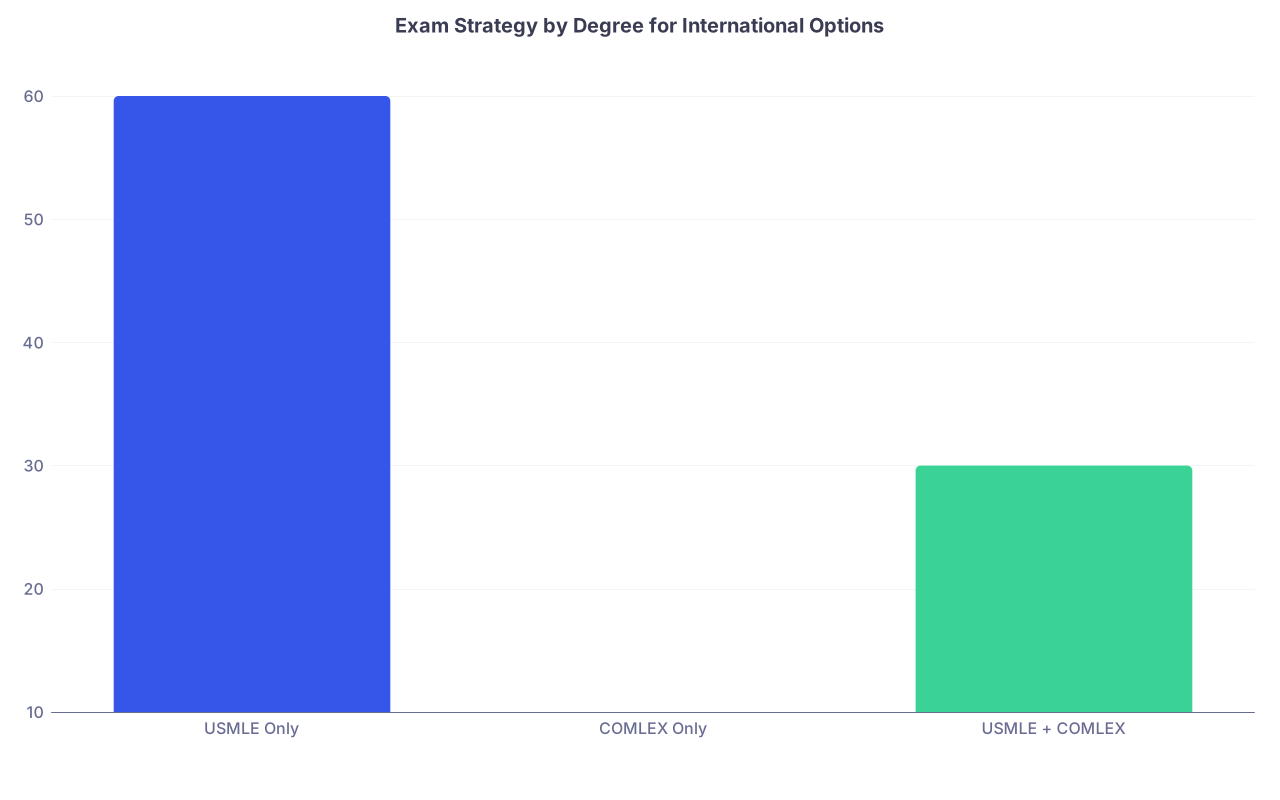
| Category | Value |
|---|---|
| USMLE Only | 60 |
| COMLEX Only | 10 |
| USMLE + COMLEX | 30 |
Interpretation: For maximum flexibility, especially as a DO student, USMLE + COMLEX is often the smarter path. COMLEX-only is a narrower lane.
MS2 Academic Year
You should:
- Treat Step 2 / Level 2 as your flagship score for international credibility, especially with Step 1 pass/fail.
- Aim for:
- Above-average scores for your specialty
- Competitive performance that shows your training is on par with any MD worldwide
MS3: Clinical Reality
At this point you should:
- Use clinical rotations to test your assumptions:
- Do you like working in settings with diverse patient populations?
- How do you function in ambiguous, resource-limited settings (even domestically)?
- Start identifying:
- Residency programs with international tracks or partnerships
- Programs with graduates who’ve gone abroad
Residency Planning (Years +3 to +7): Where DO vs MD Really Hits International Practice
The gatekeeper for many international careers is not just your degree. It’s your residency.
By now, DO vs MD is done. What you control is:
- Where you match
- How recognized your specialty/residency is abroad
- Whether your program has international credibility
MS3–MS4: Selecting a Residency with an International Lens
At this point you should:
- Prefer:
- ACGME-accredited programs with strong reputations
- Programs that already place alumni into fellowships or jobs in your target country / region
- Be wary of:
- Extremely new or weak programs if you’re planning to convince another country to trust your training
Prioritize specialties that tend to travel better (on average):
- Internal Medicine
- Pediatrics
- Psychiatry
- Anesthesiology
- General Surgery (with caveats)
Highly procedure-heavy fields with country-specific training structures (e.g., certain surgical subspecialties) can be much harder to port abroad.
Early Residency (Years +4 to +7): Converting “Maybe Abroad” to Real Options
At this point you’re an MD or DO resident. The degree is no longer theoretical. You’re either hitting friction or not.
This is where the groundwork you laid years ago either pays off or you start paying for shortcuts.
PGY1–PGY2: Verification and Documentation
You should:
- Keep meticulous:
- Procedure logs
- Case logs
- Evaluations
- Board exam results
- Start contacting:
- Licensing bodies or recruiters in your target country
- Ask very specific questions:
- “Do you currently accept U.S.-trained DOs with ACGME residency in [specialty]?”
- “Is there any difference in pathway between U.S. MD and U.S. DO graduates?”
- “What additional exams or supervised practice would be required?”
This is where DO vs MD reality hits:
- Some systems will say “MD only” in their written rules.
- Others will say “U.S. graduates” and handle DOs on a case-by-case basis.
- Some will have no idea what a DO is.
Your job is to find that out early in residency, not in your last month of PGY3.
PGY2–PGY3: Strategic Moves
If you find hard barriers for DO practice in your dream country, you have options:
- Pivot:
- From permanent move → recurring locums / short-term work in more DO-friendly regions
- From direct clinical work → international medical education, telemedicine, or global health via U.S. NGOs
- Or double down:
- Pursue a high-reputation fellowship
- Build a strong research portfolio with international collaborators
This sometimes moves bureaucratic walls, but it’s a long game.
Putting It All Together: A Compressed Visual Timeline
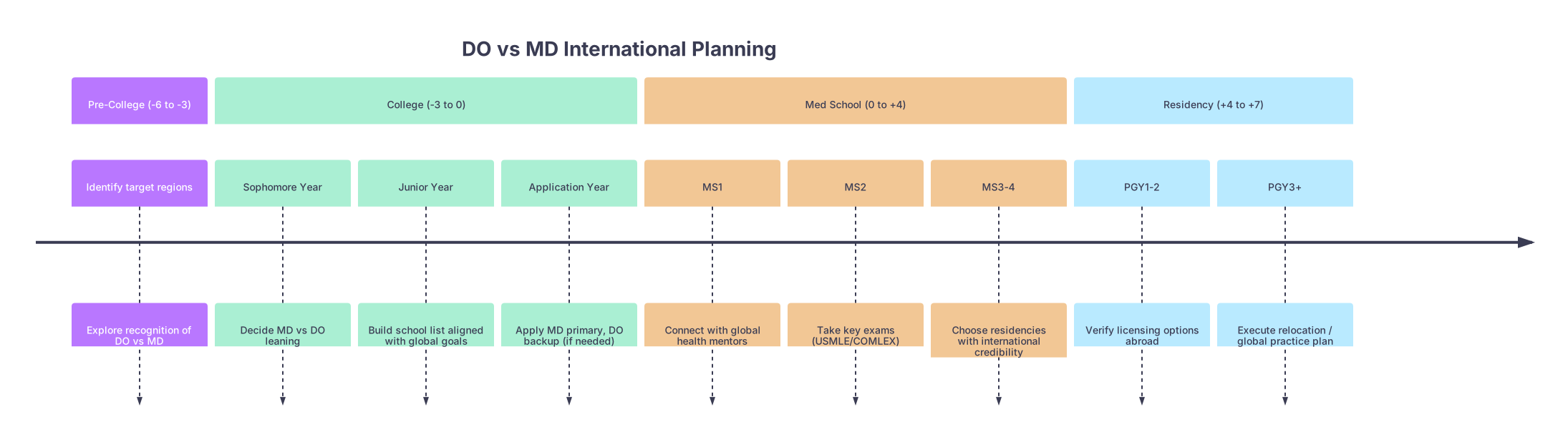
| Period | Event |
|---|---|
| Pre-College (-6 to -3) - Identify target regions | Explore recognition of DO vs MD |
| College (-3 to 0) - Sophomore Year | Decide MD vs DO leaning |
| College (-3 to 0) - Junior Year | Build school list aligned with global goals |
| College (-3 to 0) - Application Year | Apply MD primary, DO backup (if needed) |
| Med School (0 to +4) - MS1 | Connect with global health mentors |
| Med School (0 to +4) - MS2 | Take key exams (USMLE/COMLEX) |
| Med School (0 to +4) - MS3-4 | Choose residencies with international credibility |
| Residency (+4 to +7) - PGY1-2 | Verify licensing options abroad |
| Residency (+4 to +7) - PGY3+ | Execute relocation / global practice plan |
The Blunt Summary
Here’s the reality I’ve seen play out:
- If you are 100% U.S.-focused with maybe some mission trips → DO or MD both work. Choose based on fit and where you can thrive.
- If you honestly might want long-term practice in countries with rigid systems (UK, many EU states, some Asian systems) →
You should treat MD as the default and DO as a calculated risk. - If you already know your home country barely recognizes DO and you intend to return there → picking DO anyway is gambling with loaded dice.
The degree itself is not “better” or “worse” clinically. That’s not the point. The point is recognition. Doors. Bureaucrats who have never heard of osteopathy.
Your job is not to win a DO vs MD culture war. Your job is to line up your training with the countries you might someday call home.
Your Next Step Today
Right now, before you do anything else, open a blank document and create three headings:
- Countries I might want to practice in
- How they treat U.S. MDs
- How they treat U.S. DOs
Spend 30 minutes filling in whatever you can find from official sources.
Once you see that chart in front of you, your DO vs MD decision will stop being abstract — and you’ll finally be planning like someone who actually intends to practice medicine in the real world, not just in their head.