Ever sit in a dingy call room, scroll through yet another flashy “AI in Healthcare” headline, and think: “Cool, but my hospital still uses fax. How am I ever supposed to be part of this?”
If that’s you, this is your playbook.
You’re in a low-resource program. Maybe community-based. No data science lab, no AI faculty, no massive data warehouse. You barely have decent Wi‑Fi on rounds. But you’re interested in AI, and you don’t want to watch the future of medicine happen from the sidelines.
You do not need a famous institution to get started. You need a strategy that fits your actual situation.
Let’s build one.
Step 1: Get Real About Where You Actually Are
Before you “do AI,” you need to understand your environment like a battlefield map. Most people skip this and then wonder why nothing moves.
Ask yourself — and write this out somewhere, not just in your head:
What do I have?
- A decent personal laptop?
- Reliable internet at home (even if not at work)?
- Any faculty who even vaguely care about QI, informatics, or research?
- Access to de-identified EHR data? (Even a small, messy dataset counts.)
- A library subscription to journals or online courses?
What do I not have?
- No biostatistician.
- No data scientist.
- No institutional “AI in medicine” initiative.
- No internal grants.
- Terrible IT support.
What’s your actual time bandwidth?
- Are you an intern drowning in notes?
- A med student with a bit more schedule control?
- A resident with elective time?
If you lie to yourself here, you’ll choose projects you can’t actually finish. I’ve watched residents insist they’ll “build an AI model” with zero protected time and no data access. It dies by month two.
You’re going to build around constraints, not pretend they don’t exist.
Step 2: Learn Just Enough AI to Be Dangerous (Not a Data Scientist)
You don’t need a PhD in machine learning. But you do need to speak “AI” well enough that:
- You’re not impressed by buzzwords.
- You can scope realistic projects.
- You can talk to actual data people when you find them.
Focus on three buckets:
- Conceptual understanding
- Practical tools you can actually run
- Clinical applications and limitations
What to Learn (Concrete, not fluffy)
Make a 3–6 month self-study plan. Nothing fancy. Here’s the core:
Basics of machine learning:
- Supervised vs unsupervised learning
- Classification vs regression
- Overfitting, train/validation/test split
- Sensitivity, specificity, PPV, NPV, ROC, AUC
Common healthcare-relevant models:
- Logistic regression (yes, still counts)
- Random forests / gradient boosting
- Simple neural networks
- NLP basics: bag-of-words, embeddings, large language models (LLMs)
AI in clinical practice:
- Where it works: imaging triage, risk prediction, NLP for notes, clinical decision support
- Where it fails: bias, poor generalizability, garbage in/garbage out
How to Learn Without Any Local Resources
You’re at a low-resource place, so you use the internet like a weapon.
| Type | Resource Name |
|---|---|
| Free Course | Coursera: AI for Medicine |
| Free Course | Fast.ai Practical Deep Learning |
| Textbook | ISLR (Introduction to Statistical Learning, free PDF) |
| Tool | Google Colab (free GPU, Python in browser) |
| Journal | npj Digital Medicine |
Do this:
- Pick 1 structured course and stick with it. Don’t hop around.
- Use Google Colab so you don’t need a powerful local machine.
- Don’t chase every paper. Read one AI-in-healthcare article per week and summarize it in a 1‑paragraph note to yourself. That habit alone will separate you from 95% of your peers.
You’re not trying to become a full-stack ML engineer. You’re becoming the clinician who actually understands what’s under the hood.
Step 3: Choose “Low-Resource-Friendly” AI Projects
If your program is small and under-resourced, don’t try to build a fancy deep learning model from 200,000 imaging studies. You barely have the radiology PACS password.
Instead, you pick projects that:
- Use data you can realistically get.
- Can be done primarily on your personal machine or cloud tools.
- Have clear clinical relevance for your environment.
- Are simple enough to finish in 3–12 months.
Here are four categories that work extremely well at low-resource programs.
1. Predictive Models with Small/Medium Data
Example projects:
- Predict 30-day readmission in your hospital’s CHF patients.
- Predict ED return within 72 hours for discharged patients.
- Predict risk of missed appointments in your clinic.
Workflow:
- Use de-identified CSV exports from your EHR (start small: 500–5,000 patients).
- Clean the data in Python (Pandas) or R.
- Compare logistic regression vs. random forest vs. XGBoost.
- Focus on:
- Model performance (AUC, calibration)
- Interpretability (feature importance, SHAP values)
This isn’t world-changing. But it’s real, it’s publishable at smaller conferences, and it teaches you the full end-to-end pipeline.
2. Natural Language Processing on Notes or Reports
You don’t need millions of notes to do something meaningful.
Examples:
- Extract smoking status from clinic notes.
- Identify unstructured documentation of frailty or social determinants.
- Classify discharge summaries by whether they mention clear follow-up instructions.
You can:
- Start with rule-based NLP and keyword matching (yes, that still counts).
- Move to classical NLP models or use simple transformer-based classifiers with pre-trained models.
- Use open tools like spaCy, scikit-learn, or Hugging Face models.
This is very compatible with low-resources because:
- Text is everywhere.
- You can do it all on de-identified exports.
- It’s lighter on compute than image deep learning (usually).
3. Workflow or Documentation Tools Using LLMs
This is where your low-resource hospital actually gives you an advantage: you’re drowning in inefficiencies.
Examples:
- Prototype a tool that drafts discharge instructions that are then edited by the clinician.
- Create a local script that converts rough bullet notes into structured HPI/ROS (for your own workflow first).
- Build a FAQ assistant for common patient questions in your clinic’s language.
You can:
- Use public LLM APIs (obviously with no PHI).
- Start by building “prompt-based” tools, not full products.
- Run experiments privately: measure time saved, note quality, consistency.
You’re not deploying hospital-wide. You’re demonstrating feasibility and building a portfolio.
4. Implementation & Evaluation of Existing AI Tools
This is seriously under-valued. Everyone wants to “invent” AI. Very few people rigorously evaluate how it works in the real world.
Possible projects:
- Your hospital installs a sepsis alert. You study:
- Alert volume
- Clinician response
- Impact on ordering patterns
- Provider trust and alert fatigue
- Your EHR adds an “AI-powered” risk score. You:
- Audit accuracy on your local population
- Assess bias across demographic groups
You don’t need to build the model. You’re the one who actually checks whether it does what it claims. That’s gold.
Step 4: Extract Data Without Fighting a Multi-Year War
Most people stall here: “Our IT department will never give me data.” They send one vague email, get blocked, and give up.
You need to play this smarter.
Start Tiny and Specific
Don’t email IT: “Can I have all our patient data since 2010 for AI research?”
Instead:
- Pick a micro-cohort: “CHF admissions, 1 year, single hospital.”
- Pick a precise list of variables: age, sex, ICD codes, LOS, readmission, a small set of labs and vitals.
Then structure your ask:
Find an ally:
- A QI director
- A hospitalist with a QI or admin title
- A fellowship director who’s done any outcomes research
Say this, more or less:
- “I’d like to do a small, de-identified retrospective study on readmissions in our CHF patients to see if we can better risk-stratify and maybe target follow-up resources. I only need ~500 patients from the last year and 10–15 variables. Would you be open to being a co-investigator and helping with data access and IRB?”
That’s how you stop being “random trainee asking for big data” and become “junior collaborator on a practical institutional project.”
IRB and Privacy at a Low-Resource Place
Yes, even in small hospitals, you usually need IRB. Good. That makes your work legitimate.
Aim for:
- Retrospective, minimal risk projects.
- Full de-identification before you touch the data.
- Clear data use plan (who has access, where it’s stored).
Offer to write the IRB draft. Most faculty will say yes because they don’t want to.
Step 5: Build an “External Brain Trust” Since Your Program Doesn’t Have One
You’re at a place with no AI faculty. So what. Your mentors don’t all need to be local.
You’re going to assemble a small external network:
- Remote mentors
- Peer collaborators
- Online community footholds
How to Get Remote Mentors Without Being Annoying
Target:
- Clinicians publishing in AI-in-medicine from anywhere.
- People with MD/DO + some data background.
- Early to mid-career faculty are usually more responsive than big names.
The email template I’ve seen work:
Subject: Resident at community program building small AI project – would value 15 min of guidance
Hi Dr. X,
I’m a [PGY-2 IM resident / MS3] at a small community program with an interest in AI in healthcare. I read your recent paper on [very specific detail – one sentence that proves you actually read it].
I’m working on a small, resource-constrained project predicting [outcome] from [data type] at my hospital. We have limited local AI expertise, and I’m trying to avoid obvious methodological mistakes.
Would you be open to a brief 15–20 minute Zoom sometime in the next month? My main questions are about [two specific questions].
If not, totally understood, and thank you for your work – it’s been very helpful as I learn this space.
Best,
[Name, credentials, program]
You’re asking for advice, not a letter, not a job, not immediate collaboration. That’s why this works.
Where to Find Peers
- Slack/Discord communities:
- AI Med-type communities
- Specialty-specific AI groups (radiology, EM, IM, etc.)
- Conferences:
- Submit posters to cheaper, regional or niche meetings.
- Even a small abstract gives you something to talk about online.
Show up consistently. Share progress. Ask intelligent questions. Most “low-resource” isolation today is self-inflicted by not using online communities.
Step 6: Turn Your Work into Actual Career Capital
You’re not doing this for a line on your CV only. You’re building a story: “I was in a low-resource setting and still managed to do X, Y, and Z.”
You want three tangible outputs from your efforts:
- Completed, analyzable project
- Something visible
- Something you can talk about where it changes how people see you
What “Visible” Means in Practice
Think in layers of visibility:
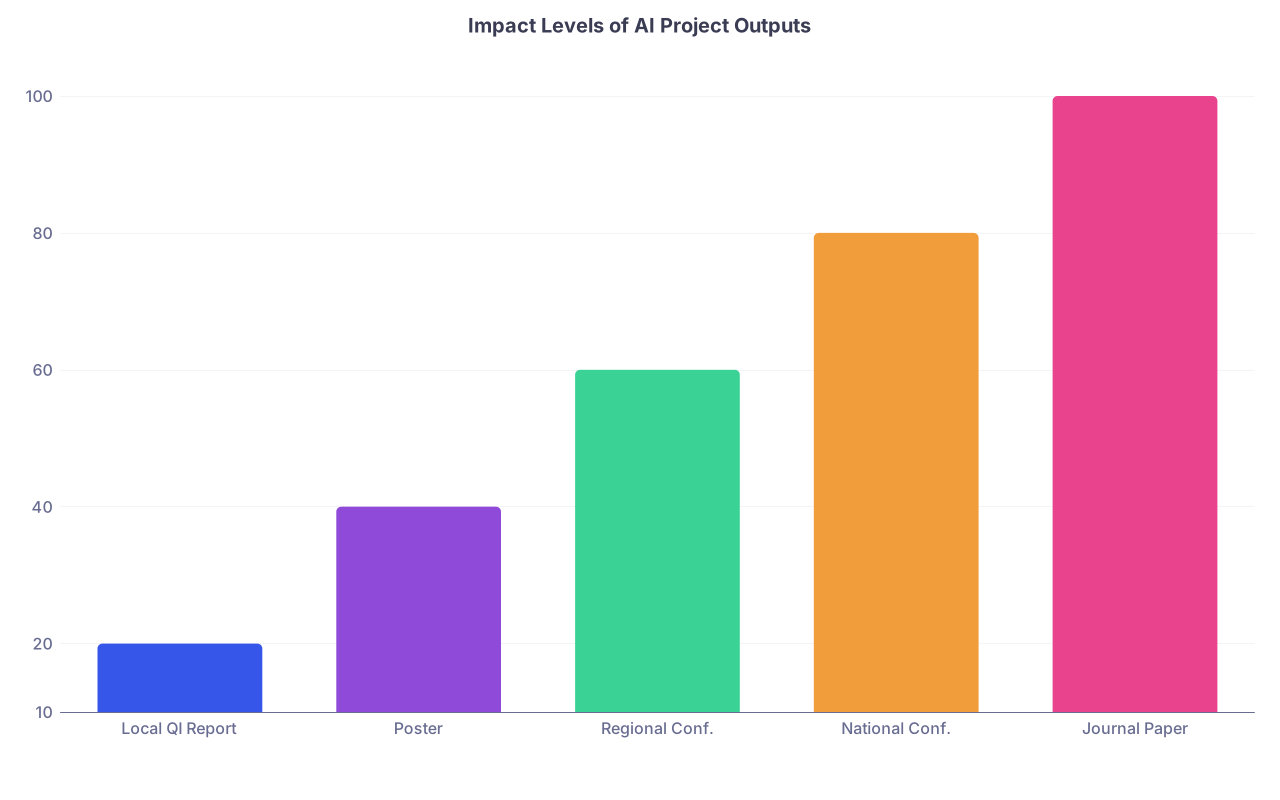
| Category | Value |
|---|---|
| Local QI Report | 20 |
| Poster | 40 |
| Regional Conf. | 60 |
| National Conf. | 80 |
| Journal Paper | 100 |
At minimum:
- Internal QI presentation at your hospital.
- Department or residency research day.
Better:
- Poster at a regional or national conference.
- Preprint or small-journal publication.
Best (over a few years, not overnight):
- Track record across multiple projects.
- Recognized name in a small niche (e.g., “AI for sepsis alerts in community hospitals”).
But here’s the real lever: how you talk about it.
On residency/fellowship interviews or job talks, you should be able to say, clearly:
- “I was at a low-resource community program with no AI infrastructure.”
- “I identified a concrete local problem: [X].”
- “I taught myself the basics of ML, curated a small dataset, and built a simple [model/tool].”
- “We implemented/evaluated it in a limited way and found [result].”
- “That experience taught me how to do AI work even when resources are minimal, and that’s exactly the mindset I’d bring here.”
That’s impressive at almost any program.
Step 7: Use AI in Your Daily Clinical Life (Quietly) to Build Real Intuition
You’re not just “doing projects.” You’re training your brain to think with AI tools.
You can do this even if your hospital has nothing fancy deployed.
Examples:
- Use an LLM (with no PHI) to:
- Simplify patient education materials.
- Draft insurance appeal letters (then heavily edit).
- Generate skeletons for research abstracts.
- Track:
- How often does it help?
- Where does it fail?
- What kind of prompts give you the best output?
You’ll very quickly get a gut sense for:
- Which AI use cases are nonsense.
- Which are actually useful but under-discussed.
- Where the legal/privacy lines are.
This is the “street knowledge” you won’t get from papers alone.
Step 8: Be Honest About What You Cannot (And Should Not) Do
There are things you simply cannot pull off at a low-resource program, especially early on. You’re not going to:
- Build a full production-grade EHR integrated AI system solo.
- Run massive multimodal models on-premises.
- Launch a startup inside your PGY-1 year that solves prior auth with AI.
Trying to do that will just make you frustrated and scattered.
Better to specialize in being:
- The clinician who can scope realistic projects.
- The person who knows how to use public tools and pre-trained models.
- The bridge between “academic AI” and messy real-world clinical workflows.
Lean into that. It’s more valuable than another overfitted Kaggle model no one uses.
Step 9: Sketch a 12–18 Month Action Plan
Let’s put this into a rough sequence so you’re not juggling everything at once.

You won’t execute perfectly. That’s fine. But if you follow even 70% of that timeline, you’ll be way ahead of most people complaining they “don’t have opportunities.”
Step 10: Know When to Use AI Interest as a Lever to Leave
Harsh truth: some programs are dead ends if you want a serious AI-in-medicine career.
Signals you may need to move on after you’ve put in a real effort:
- Zero faculty willing to help even minimally.
- Repeated stonewalling from leadership on any QI/research ideas.
- No conference support, ever.
- An openly hostile attitude toward tech or innovation.
In that case, your low-resource story becomes powerful when you apply out (for fellowship, faculty, or jobs):
- “I was at a place with no AI infrastructure. Here’s what I still managed to do.”
- “Imagine what I could do with actual resources.”
The key: have the receipts. Finished projects, even if small, are what let you say that with credibility.
You’re not going to “catch up” to a Stanford data scientist overnight. Stop comparing yourself to them. Different game.
Your edge is this: if you learn to do meaningful AI work in a low-resource, chaotic, real-world setting, you will be more practical, more grounded, and frankly more useful than a lot of people swimming in data but never touching patients.
Start small. Be ruthless about scope. Finish things.
Today, do one concrete thing: write down three specific clinical problems you see every week that are annoying, costly, or dangerous — and circle the one you’d most like to attack with a simple AI or data-driven tool. That’s your starting point.