

Dealing With Language Barriers Abroad: Practical Workflows That Work
You are standing in a crowded outpatient clinic in rural Guatemala. The line is out the door. The nurse just told you, “She only speaks K’iche’, I speak Spanish, you speak English. Good luck.”
You have a blood pressure of 210/110 in front of you, a worried family watching your every move, and exactly zero shared words with the patient.
This is not the moment to improvise.
You need workflows. Systems you can run almost on autopilot when the language falls apart and the stakes are high. And you need to do it without sliding into “feel-good” mission work that is ethically sloppy and clinically unsafe.
I will walk you through concrete, repeatable workflows that I have seen work in real global health settings. You will get:
- Step-by-step protocols for common clinical scenarios
- How to use ad hoc interpreters without doing harm
- Simple visual tools that work even with low literacy
- What is ethically off-limits, even when you are desperate
- A prep checklist you can execute this week
Let’s build systems so your next trip is safer for patients and less chaotic for you.
Core Principles: What You Never Compromise
Before the workflows, you need a few non‑negotiables. Without these, every “solution” becomes ethically shaky.
Patient safety over convenience.
If you are not sure what the patient is saying, you do not guess. You pause, you escalate, or you limit what you do.Respect for patient autonomy.
Consent through three languages and two cultures is fragile. If you cannot reasonably explain risks/benefits, you scale down interventions, not up.Least‑harm communication.
You choose the method that creates the least distortion. Often that is a trained interpreter. Sometimes that is simple visual tools. Sometimes that is not doing the invasive thing you wanted to do.Know your limits.
If the only way to “get it done” is through a 7‑year‑old child or a random taxi driver, you are probably outside an ethical boundary.
Those principles sit under everything that follows.
Workflow 1: The “Minimum Viable Encounter” Safe-Check
Use this for any new patient when language is weak and time is short. Your goal is not beautiful communication. Your goal is “safe enough to proceed” or “stop and get more help.”
Step 1: Establish the Language Map
In the first 60 seconds, you answer:
- What language(s) does the patient understand?
- What language(s) do you understand at any functional level?
- Who in the room speaks what?
Ask in the local lingua franca if you can (or via staff):
- “What language do you speak at home?”
- “Do you understand [Spanish/French/English/local trade language]?”
Then decide:
- Green – You share a usable language or have a trained interpreter. Proceed to full encounter.
- Yellow – You share a partial language / competent bilingual staff but not trained. Limited encounter with safeguards.
- Red – No shared language, no adequate interpreter. Emergency‑only care or defer.
Step 2: Run the 5 Critical Questions (through best available channel)
You need five data points for almost every encounter:
- Where is the problem? (body location)
- How long has it been going on?
- Is there severe pain, shortness of breath, or bleeding now?
- Any pregnancy or possibility of pregnancy?
- Any medicines or treatments already taken?
If you have:
- Trained interpreter – Use them directly.
- Bilingual staff / volunteer – Use short, literal questions and verify back (see Workflow 2).
- No interpreter – Use visual aids and gestures for what you can, but recognize you are in “emergency‑only” territory (more on that later).
Step 3: Decide the Safety Tier
Based on what you could reliably obtain:
Tier A – Full care
You have adequate language support. Proceed as usual.Tier B – Limited low‑risk care
You lack full clarity but have enough to safely:- Treat obvious uncomplicated issues (e.g., minor skin infections, simple pain management with clear return precautions)
- Refill clearly labeled chronic meds with confirmation
Tier C – Emergency stabilization only
You cannot get adequate history or consent. You:- Stabilize life‑threats (airway, breathing, circulation)
- Manage catastrophic obvious issues (severe hypertension with symptoms, seizing patient, active hemorrhage)
- Arrange transfer / local clinician involvement if possible
Ethically, most of your “heroic” procedures should stay in Tier A. If you are in Tier C, think “stop the patient from dying now,” not “optimize long‑term management.”
Workflow 2: Using Interpreters Without Making a Mess
Interpreters can make or break your care. I have seen both.
Step 1: Decide: Professional, Trained, Ad Hoc, or None
Rank your options:
- Professional (in person or remote) – Gold standard. Use whenever available.
- Trained volunteer / staff interpreter – Acceptable if trained in confidentiality and literal translation.
- Untrained bilingual staff / community member – Only if 1–2 unavailable; you must adjust your technique.
- Family member – Last resort, with strict exclusions:
- Never for intimate partner violence, sexual assault, mental health crises, or high‑stakes consent.
- Avoid minors interpreting for adults, especially about reproductive or stigmatized care.
If you are forced to use a family member, you are in ethically gray terrain. Your job is to limit the scope of that encounter, not pretend it is fine.
Step 2: Pre‑Brief the Interpreter (2 Minutes Well Spent)
Pull the interpreter aside, even for only 90 seconds, and say clearly:
- “I need word‑for‑word interpretation, not summaries.”
- “Please say exactly what I say and everything the patient says.”
- “If you do not understand, tell me, do not guess.”
- “If the patient looks confused, tell me immediately.”
This sounds basic. It is not. Many “interpreters” default to editing, filtering, “helping.” You must reset that expectation.
Step 3: Use Closed‑Loop Communication
You are not just talking to the patient. You are managing a small team.
Concrete rules:
Talk to the patient, not the interpreter. Look at the patient.
Say: “Can you tell me where the pain is?”
Not: “Ask her where the pain is.”Use short segments. One concept per sentence.
Good: “I think this is high blood pressure. It can harm your heart and brain if we do not treat it.”
Bad: A 60‑second monologue the interpreter cannot possibly reproduce accurately.Check understanding in both directions:
- Ask the interpreter: “Please repeat back what you will say to the patient.”
- Ask the patient: “Can you tell me what you understand about the medicine?”
If the patient’s explanation does not match what you intended, you do not move on. You fix it.
Step 4: Debrief For High‑Stakes Encounters
For serious diagnoses, consent for procedures, or bad news, spend 1–2 minutes after:
- “Was there anything you felt the patient did not understand?”
- “Did I use any words that were hard to translate?”
- “Is there a better way to explain this in your language?”
This makes your next conversation with that interpreter better. You are building skill in a real system, not surviving one encounter at a time.
Workflow 3: Visual and Low‑Literacy Tools That Actually Work
This is where a lot of people get lazy. They print cute picture cards off the internet and assume they work everywhere. They do not.
You need context‑specific tools, tested with local staff.
Core Visual Toolkit
Build or adapt a small kit with:
- Body outline diagrams (front/back, male/female) for pain location
- Pain scale faces (with numbers, not just smiles/frowns)
- Icons for:
- Cough, diarrhea, vomiting, fever (thermometer), pregnancy, bleeding
- “Today,” “yesterday,” “many days,” “months,” “years” (simple calendar icons)
- Simple medication instruction cards:
- Sun/Moon icons for morning/evening
- Pills next to meals / bed / waking
- “Stop” symbol for dangerous signs (e.g., stop medicine if rash, difficulty breathing)
How to Use Them in a Repeatable Way
Pain Assessment Workflow
- Give the body outline. Ask the interpreter or staff to say: “Point where it hurts.”
- Use the faces scale. Clarify that “0 is no pain, 10 is the worst pain you can imagine.”
- Mark location and number on your note.
Duration Workflow
- Lay out simple icons:
- A single sun = today
- Sun + moon = one day
- Row of 7 suns = one week
- Small monthly calendar = month
- Ask the patient to point or move their finger from “start” to “now.”
- Lay out simple icons:
Medication Instructions Workflow
- For each prescribed medicine, draw or show:
- A pill next to the symbol for morning, afternoon, evening, or sleep
- A small number of pills per time (1, 2, 3)
- Then physically hand the card or draw the same on their medication bag.
- For each prescribed medicine, draw or show:
You are not relying on verbal memory. You are anchoring instructions in symbols that survive translation.
Workflow 4: High‑Stakes Consent When Language Is Weak
This is the part people get wrong most often. They feel the pressure of “we came all this way to help,” and they slide into doing big procedures with thin consent.
You need a strict internal rule set.
Step 1: Classify the Intervention
Put what you are about to do into one of three bins:
Bin 1 – Life‑saving emergency
Untreated, the patient will likely die or have serious permanent harm in hours to days (e.g., airway obstruction, ruptured ectopic with shock).Bin 2 – Urgent but not immediately life‑saving
Important, but there is time to improve communication (e.g., surgery for non‑ruptured appendicitis, starting long‑term psych meds).Bin 3 – Elective / non‑urgent
Can be safely deferred for better communication or local care (e.g., hernia repair in a stable patient, dental work that is not acute infection).
Consent thresholds change dramatically based on the bin.
Step 2: Match Consent Process to the Bin
Bin 1 – Life‑saving emergency
- Act under implied consent. Most ethical frameworks and local norms accept this.
- You still:
- Explain as simply as possible what is happening and what you are doing.
- Involve any available local staff in the explanation.
- You document clearly: why it was emergent, what language barriers existed, what steps you took.
Bin 2 – Urgent
- Do not proceed without:
- A competent interpreter (professional or trained staff)
- Or local clinician assuming responsibility and leading consent
- If that is not available: stabilize, arrange transfer or delay until communication is adequate.
- Do not proceed without:
Bin 3 – Elective
- If you cannot fully explain risks/benefits and alternatives, you should not be doing it.
Full stop.
- If you cannot fully explain risks/benefits and alternatives, you should not be doing it.
Step 3: Use the “Teach‑Back” Test Through the Interpreter
Even in perfect language matches, consent is often superficial. Across languages and cultures, it is fragile.
After your explanation, you must hear, via interpreter:
- “Can you tell me what you understand about what we will do?”
- “What are the main risks you heard?”
- “What are your other options?”
If the patient cannot explain in their own words, you have not obtained meaningful consent. You repeat or scale back.
Workflow 5: Ethics When You Have No Interpreter (The Hard Line)
There will be days when the “best available interpreter” is nobody. The Wi‑Fi is down, the bilingual nurse went home, and your halting travel‑phrase Spanish does not cover “stroke” or “psychosis.”
Here is the ethical line I draw, and I recommend you do the same.
What You Can Do
Immediate stabilization of obvious life threats:
- Open airway, basic positioning
- Direct pressure on bleeding
- Epinephrine for anaphylaxis when clinically clear
- Seizure management when clear
Very basic symptom relief, when:
- The symptom is visible or unmistakable (cough, visible rash, obvious musculoskeletal pain)
- You use low‑risk, standard-dose medications
- You avoid drugs with serious potential side effects you cannot explain
Referral / transfer:
- Arrange for the patient to see a local clinician or facility where language is not a barrier.
What You Should Not Do
Without an interpreter or local clinician who can communicate with the patient, you do not:
- Start long‑term medications with significant risks (e.g., anticoagulants, antipsychotics)
- Perform invasive procedures that are not immediate life‑saving
- Deliver bad news about cancer, HIV, or other stigmatized conditions
- Collect detailed histories about violence, trauma, or sexual health
Does it feel limiting? Yes. That is the point. This is global health, not “try anything and hope for the best.”
Workflow 6: Preparing Before You Get on the Plane
Most of the chaos I see on trips abroad is predictable. People show up with stethoscopes but no language plan.
Fix that now.
Step 1: Map the Language Landscape
Before your trip, answer:
- What is/are the dominant local languages?
- What percentage of patients will speak the national language vs minority/indigenous languages?
- Who at the site speaks what? (nurses, community health workers, reception staff)
Ask the host site for realistic numbers, not brochure language.
| Role / Group | Primary Language | Secondary Language | Notes |
|---|---|---|---|
| Older rural patients | K’iche’ | Minimal Spanish | Often low literacy |
| Younger adults (20–40) | Spanish | Some English | Usually better health literacy |
| Clinic nurses | Spanish | Basic K’iche’ | Key bridge for communication |
| Community health workers | K’iche’ | Spanish | Crucial for outreach |
| Visiting team | English | Mixed Spanish | Need support for K’iche’ |
Step 2: Build Your Local Phrasebook (Minimal but Targeted)
Forget generic “travel Spanish.” You need clinical micro‑phrases aligned with workflows.
Examples:
- “Show me where it hurts.”
- “How many days?”
- “Any chance you are pregnant?”
- “Do you have trouble breathing now?”
- “This medicine is for pain / infection / blood pressure.”
Put them in a small physical card or offline app. Practice them until they are automatic.
Step 3: Coordinate Interpreter Coverage by Clinic Flow
Work with the local team:
- Which clinic sessions will likely need most interpreter support? (e.g., antenatal clinic, pediatrics)
- Can CHWs or bilingual staff be scheduled as dedicated interpreters, not multitasking?
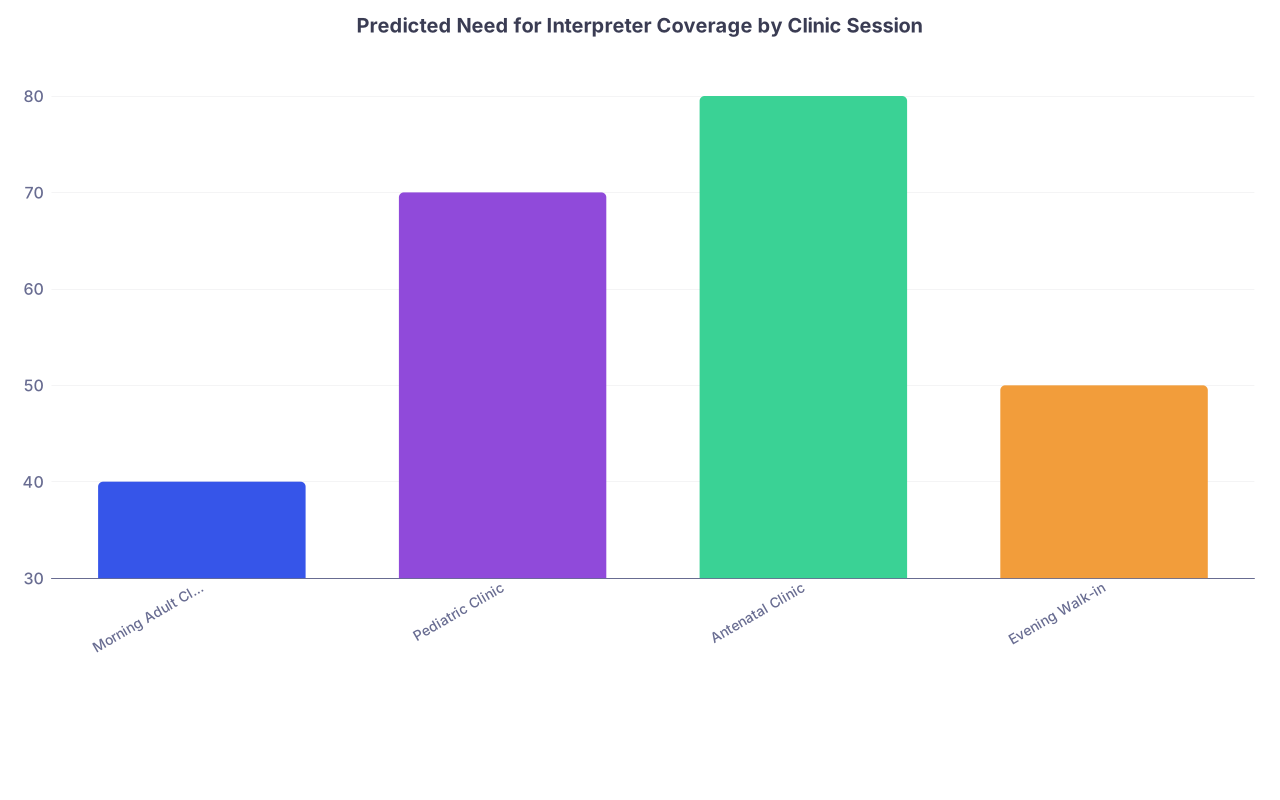
| Category | Value |
|---|---|
| Morning Adult Clinic | 40 |
| Pediatric Clinic | 70 |
| Antenatal Clinic | 80 |
| Evening Walk-in | 50 |
Use that map to plan where you will physically place yourself. Do not hide in the easy‑language sessions.
Step 4: Prepare Your Physical Toolkit
Pack:
- Laminated body diagrams and symptom icons
- Pain scale cards
- Blank index cards and markers for on‑the‑fly visual instructions
- A small notebook with:
- Key phrases in local language
- Phonetic pronunciation notes (from a local or fluent speaker)
This stuff weighs almost nothing. It saves you repeatedly.
Workflow 7: Training Your Team on Day 1 On‑Site
Even if you are “just a student,” you can influence team behavior. What you do not want: every person inventing their own random communication style.
On day 1 or 2, run a short (20–30 minute) huddle with your group and key local staff.
Agenda
Agree on interpreter hierarchy.
- Who are our go‑to interpreters?
- Which situations require only trained interpreters?
Set rules for using family interpreters.
- No children interpreting for adults.
- Not allowed for sexual/reproductive or violence‑related issues.
Demonstrate short‑segment interpreting.
- Role play: one person clinician, one interpreter, one patient.
- Practice cutting down monologues into short pieces.
Introduce visual tools.
- Show how to use the body diagram, pain scale, medication cards.
- Ask local staff if symbols make sense culturally; adjust.

| Step | Description |
|---|---|
| Step 1 | Arrive On Site |
| Step 2 | Meet Local Lead |
| Step 3 | Map Languages |
| Step 4 | Identify Interpreters |
| Step 5 | Team Huddle Training |
| Step 6 | Implement Workflows |
| Step 7 | Daily Debrief |
Run a 5–10 minute language debrief at the end of each day:
- “Where did communication break down today?”
- “What worked well we should repeat tomorrow?”
- “Any phrases or symbols that confused people?”
You improve the system in real time, not in a retrospective reflection months later.
Workflow 8: When Things Go Wrong (Because They Will)
No matter how careful you are, there will be miscommunications.
You tell a patient to take a medication twice a day for 5 days. They hear “until the pills are gone” and triple the dose.
You must have a damage‑control routine.
Step 1: Own It, Do Not Hide It
If you suspect or discover harm from miscommunication:
- Inform the local clinical lead. Immediately.
- Document what was said, how it was said, who interpreted, and what went wrong.
- Do not try to quietly fix it without local knowledge.
Step 2: Learn the Pattern, Not Just the Case
Ask:
- Was it a vocabulary problem? (wrong word used)
- A symbol problem? (icon meant something different locally)
- A process problem? (we rushed and skipped teach‑back)
- A system problem? (no interpreters scheduled for that clinic)
Then you fix that pattern. You tweak the workflow, not just that single encounter.
Step 3: Adjust Patient‑Facing Tools
Maybe your “sun and moon” icons were misread. Or “X” on a pill meant “take” instead of “do not take.”
Update your visual aids. Test them with 3–5 local patients or staff. If 3 people get it wrong, the tool is wrong, not the patients.
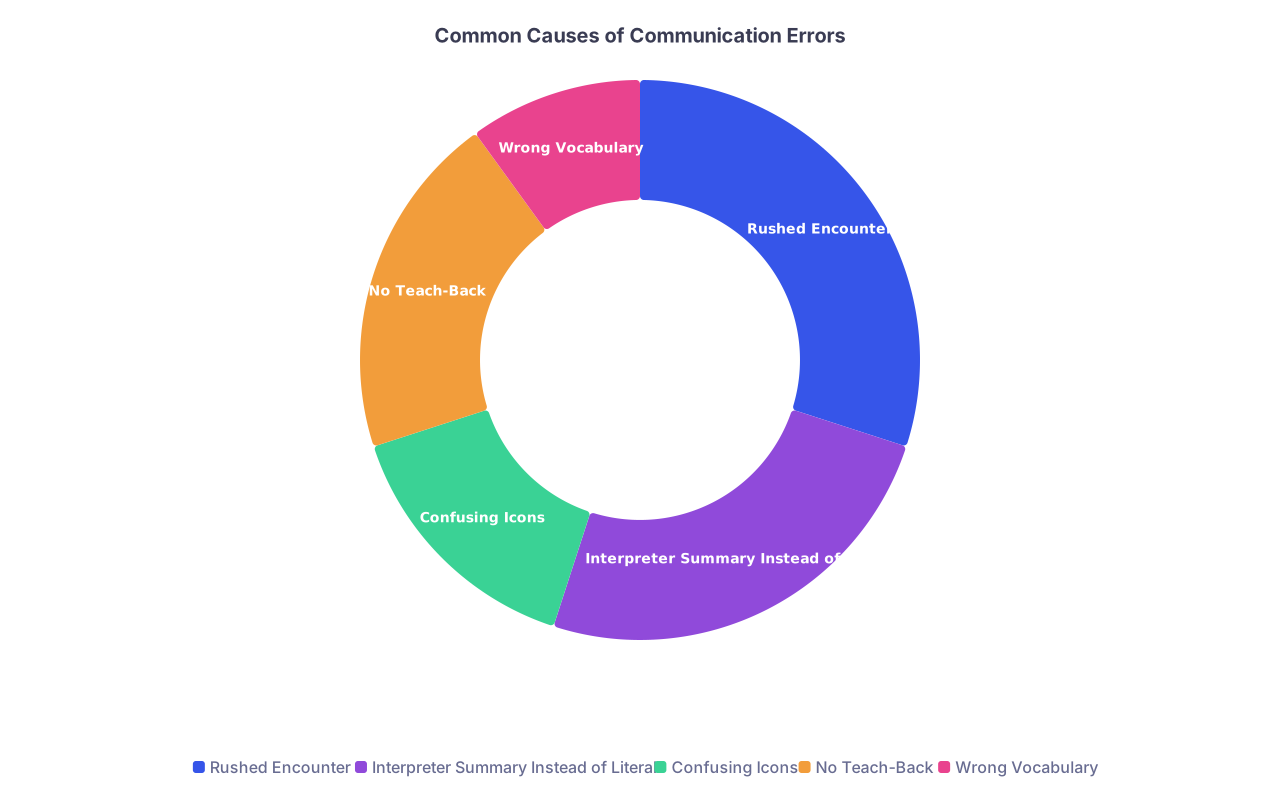
| Category | Value |
|---|---|
| Rushed Encounter | 30 |
| Interpreter Summary Instead of Literal | 25 |
| Confusing Icons | 15 |
| No Teach-Back | 20 |
| Wrong Vocabulary | 10 |
Workflow 9: Personal Development and Ethical Grounding
Language barriers abroad are not just an operational problem. They are a mirror.
They expose your biases about “helping,” your tolerance for uncertainty, and your respect for patients’ autonomy when it slows you down.
A few habits that keep you sane and ethical:
Set personal red lines before you go.
Decide now:- “I will not perform X procedure without Y level of communication.”
- “I will not rely on children as interpreters, even if everyone else is fine with it.”
Keep a communication log. End of each day, jot down:
- One encounter where language went well and why
- One where you felt uneasy and what you will do differently
Ask local colleagues to critique you.
Say directly: “Tell me where my communication style does not work well here.”
Then listen. Do not defend.Align your ‘good intentions’ with local reality.
If your favorite project requires heavy explanation (e.g., starting chronic meds that need monitoring), but you never have reliable interpreters, maybe that project is wrong for this setting. Full stop.
You are not there to prove your usefulness. You are there to provide safe, respectful care within real constraints.
Your Next Step Today
Do one concrete thing now, not “someday.”
Open a document and build a one‑page language prep sheet for your next (or hypothetical) global health trip. Include:
- The likely local languages you will encounter
- A short list (10–15) of clinically critical phrases you want to learn in the local language
- A checklist of physical tools you will bring (body diagram, pain scale, medication icons)
- Your personal red lines for what you will not do without adequate communication
Then, before you close the document, send it to one colleague and say:
“Hold me to this before my next trip.”
That is how you start turning good ethics and good intentions into actual, repeatable practice when language fails you abroad.


