
The biggest barrier to doing global health in residency is not money or opportunity. It is your call schedule.
If you want a protected global health day in a busy residency, you cannot wing it, hint at it, or hope your program “values global health.” You have to treat it like a negotiation with real constraints, real tradeoffs, and clear deliverables.
Here is how to do that without burning bridges or getting labeled “not a team player.”
Step 1: Get Clear On What You Actually Want
Vague asks get vague answers. Or flat “no” answers.
“Protected global health time” means nothing to a scheduler unless you define it. Before you talk to anyone, answer these for yourself on paper:
What exactly is the “day”?
- One full day per month?
- One half-day per week?
- A block day pre‑call? Post‑call?
- A recurring day tied to a longitudinal clinic?
What will you actually do on that day? Be specific:
- Work with the hospital’s refugee clinic
- Regional mobile clinic for migrant farmworkers
- Telehealth consults with a partner site in another country
- Curriculum development or research for the global health track
- Teaching medical students in an underserved clinic with a global health focus
Is this local, virtual, or abroad‑connected work?
- Programs are far more likely to support:
- Local refugee/asylee clinics
- Immigrant health clinics
- Global health research, QI, or curriculum development
- Than: “I will disappear to another continent regularly.”
- Programs are far more likely to support:
How often and for how long?
- Protected days are easier as:
- 1 day per 4‑week block, or
- 1 afternoon weekly during outpatient block
- Saying “I want one protected day per month across the year” is clearer than “I want some time.”
- Protected days are easier as:
Write down: “I am asking for: X hours, Y frequency, doing Z tasks, starting [date].”
If you cannot write that in two sentences, you are not ready to negotiate yet.
Step 2: Understand Your Program’s Real Constraints
You are not just negotiating with your PD. You are negotiating with:
- ACGME requirements
- Service coverage needs
- Call schedules and duty hours
- Outpatient clinic templates and RVU expectations
- The “resident fairness radar” (huge and unforgiving)
You need to know where the landmines are.
Do this homework first
Read your program’s policies:
- Global health track description (if it exists)
- Elective time policies
- Moonlighting / extra duty hour policies (tells you how rigid they can be)
- Wellness days / professional development days policies
Talk to the people who have already pushed the envelope:
- Senior residents who did:
- International electives
- Refugee clinic rotations
- Research blocks with a global focus
- Ask them:
- “What got approved?”
- “What was blocked, and why?”
- “Who actually made it happen—PD, APD, chief, coordinator?”
- “What did you have to give up in exchange?”
- Senior residents who did:
Identify your rotations by “negotiability”
| Rotation Type | Flexibility Level | Notes |
|---|---|---|
| ICU / Nights | Very Low | Avoid asking here |
| Busy Inpatient Wards | Low | Hard to carve out days |
| ED Rotations | Low–Medium | Shift-based but rigid |
| Outpatient Clinic Blocks | High | Best for recurring days |
| Research / Elective Time | Very High | Easiest to protect |
Do not ask for “one global health day a month” on your ICU month. You will lose. Focus your ask on:
- Ambulatory blocks
- Elective blocks
- “Admin / academic half‑day” slots that already exist
Step 3: Build an Ethically Grounded, Program‑Friendly Rationale
If your ask sounds like “I want this because I care,” you will get a soft smile and a hard no.
You must link your request to:
- Program mission
- ACGME milestones / competencies
- Patient care and health equity
- Reputation / recruitment advantage
Frame it like this
You are not saying, “Let me skip work to do my passion project.”
You are saying, “Let us formalize structured global health work that:”
- Improves care for:
- Refugees
- Immigrants
- Under‑insured / language‑barrier patients in our own community
- Fulfills:
- ACGME systems‑based practice
- Practice‑based learning and improvement
- Professionalism and medical ethics
- Helps the program:
- Recruit strong applicants
- Align with institutional DEI and community engagement priorities
- Generate scholarly output (QI, education research, outcomes data)
You also need the ethical part clear in your own head.
Ethical anchor points (that PDs and chairs respect)
- No “voluntourism”: You are not asking them to fund or excuse medical tourism in low‑resource settings.
- Accountable to local partners: Work is ongoing, supervised, and aligned with local needs.
- No displacement of core responsibilities: You are not abandoning your teammates on high‑acuity rotations.
- Structured supervision: There is a faculty sponsor, and you are not practicing beyond scope.
You should be able to say one crisp sentence like:
“This protected global health day is a structured, supervised commitment to our local refugee clinic that advances residents’ competence in cross‑cultural care, addresses health equity in our own catchment area, and produces measurable outcomes we can report to ACGME and the institution.”
That is a sentence PDs can repeat to their DIO or the GME office. Give them that gift.
Step 4: Design a Low‑Friction, High‑Value Proposal
Now you put the pieces together into something a PD can say “yes” to.
Elements of a strong proposal
Clear structure
- Example: “One protected 8‑hour day per 4‑week ambulatory block, for 6 months, starting July.”
- Tied only to ambulatory or elective blocks, not ICU or wards.
Named faculty sponsor
- An attending in:
- Global health
- Infectious disease / HIV
- Refugee / immigrant health
- Community medicine
- Someone who already has credibility with leadership.
- An attending in:
Defined activities (not vague ‘projects’)
- Direct patient care in X clinic
- Translation of guidelines into low‑literacy patient education materials
- Development of protocol for screening / vaccination of new arrivals
- Telehealth case conferences with partner site with documented objectives
Built‑in accountability
- Required brief write‑up each day (what you did, patient volume, issues identified)
- End‑of‑block summary report
- At least one QI or scholarly product per academic year
Zero net loss of coverage
- You propose a coverage plan:
- Shift trades you will make
- Flex clinic sessions you will add
- Pre‑agreed redistribution of a non‑clinical activity
- You propose a coverage plan:
If you walk in and say, “I want this, and here is exactly how coverage and accountability will work,” you are miles ahead of 90% of residents.
Step 5: Quantify the Impact (So It Looks Serious)
Busy PDs respect numbers. Not sentiment.
Put a one‑page summary with small, clean numbers:
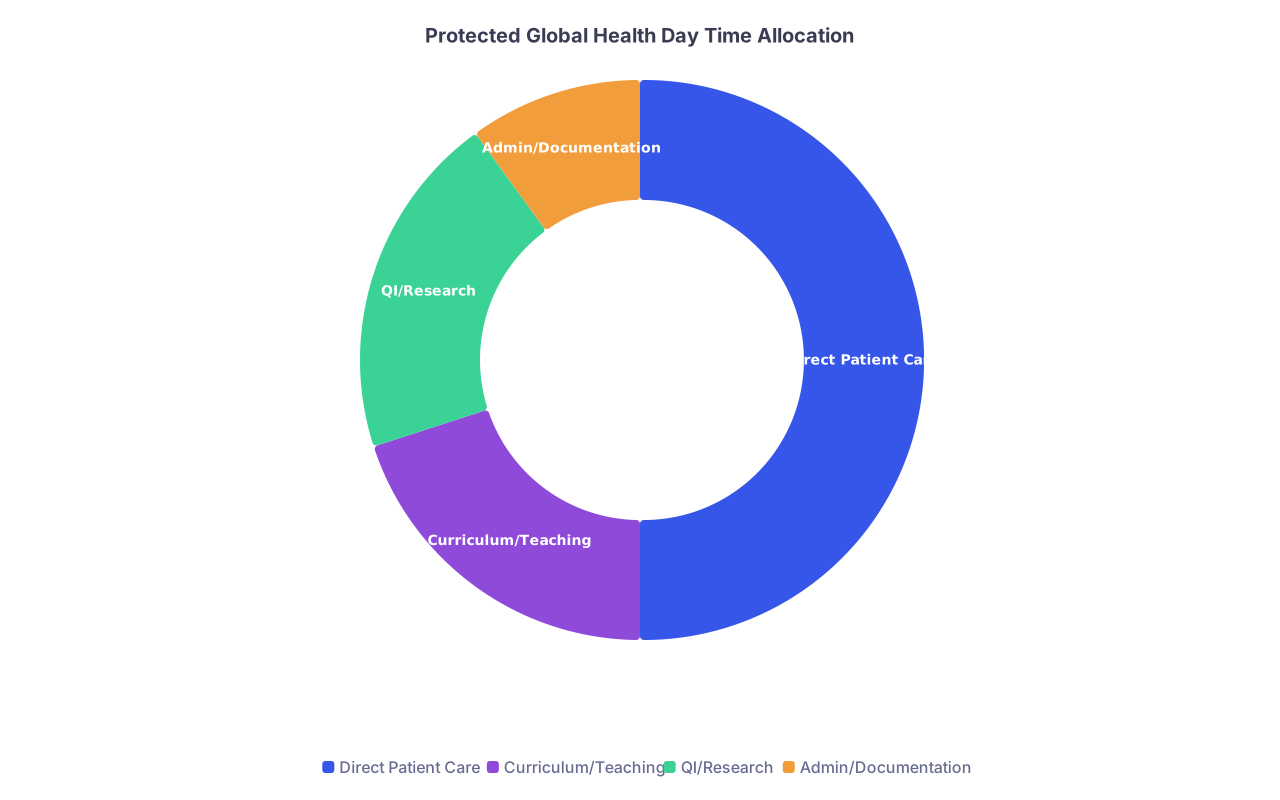
| Category | Value |
|---|---|
| Direct Patient Care | 50 |
| Curriculum/Teaching | 20 |
| QI/Research | 20 |
| Admin/Documentation | 10 |
You can outline targets like:
Per protected day:
- 6–8 patient encounters
- 1 focused learning objective
- 1 systems issue identified (e.g., interpreter access, vaccination gaps)
Per 6 months:
- 1–2 QI interventions trialed
- 1 resident presentation at M&M, grand rounds, or a global health conference
- Documented improvements in:
- Vaccination completion
- Lost‑to‑follow‑up rates
- Screening adherence
You are turning a “nice thing” into a measurable program asset.
Step 6: Choose the Right Timing and the Right People
You can have the best proposal in the world. If you bring it up 2 weeks before the July schedule, you are done.
Timing strategy
Use this rough flow:
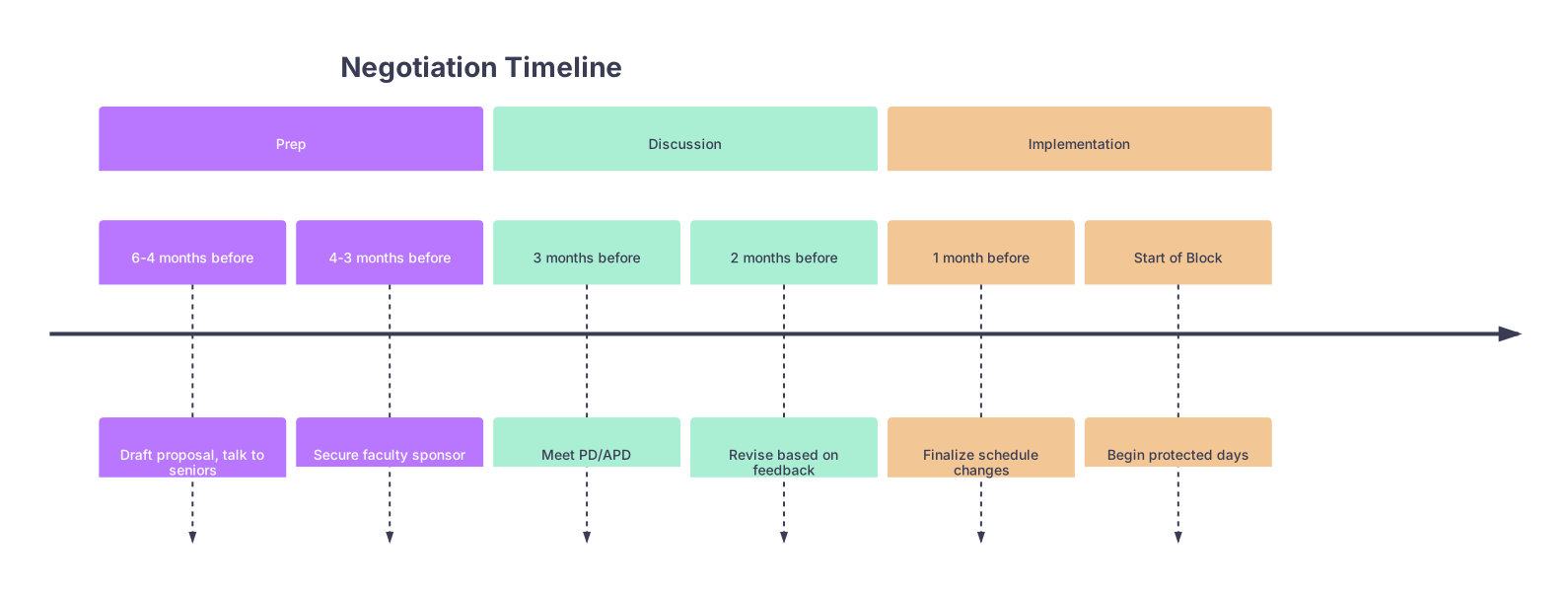
| Period | Event |
|---|---|
| Prep - 6-4 months before | Draft proposal, talk to seniors |
| Prep - 4-3 months before | Secure faculty sponsor |
| Discussion - 3 months before | Meet PD/APD |
| Discussion - 2 months before | Revise based on feedback |
| Implementation - 1 month before | Finalize schedule changes |
| Implementation - Start of Block | Begin protected days |
In practice:
- Start planning 3–6 months before the academic year or block
- Talk informally to:
- Senior residents
- Global health faculty
- Chief resident who manages schedules
- Once you have their input, schedule a formal meeting with:
- PD or APD primarily responsible for curriculum
- Chief resident if they own the schedule
Who to enlist
- Faculty sponsor: Non‑negotiable. They should:
- Co‑sign your proposal
- Agree to supervise or at least oversee
- Chief residents:
- Reality check for coverage
- Allies for schedule implementation
- Program coordinator:
- Helps ensure this actually lands in the schedule
- Often knows hidden constraints
Walk in with allies already briefed and aligned.
Step 7: Run the Actual Conversation Like a Negotiation, Not a Plea
You are not begging. You are proposing a structured pilot.
Go in with:
- Printed one‑page proposal
- Clear ask
- Backup options already thought through
How to frame your opening
Something like:
“I would like to propose a structured, supervised global health day that uses existing ambulatory time to support our local refugee clinic. I have a faculty sponsor, a coverage plan for my other duties, and specific educational and QI objectives. I am asking for one protected day per 4‑week ambulatory block for 6 months as a pilot.”
Then stop talking. Let them respond.
Anticipate and answer the standard objections
Here are the big four you will hear and how to handle them.
| Objection | Your Response Strategy |
|---|---|
| Coverage / fairness | Show specific coverage plan and trades |
| ACGME / duty hour concerns | Show alignment, not extra hours |
| Precedent for other residents | Frame as structured pilot with clear criteria |
| Too complex administratively | Offer to handle logistics and tracking |
1. “Coverage will be a problem.”
Reply along these lines:
- “I agree coverage cannot be compromised. That is why I restricted the ask only to ambulatory blocks and built in a coverage plan:
- I will pick up X additional clinic sessions on Y weeks
- I will trade Z call shifts with residents who prefer those dates (I have already spoken to A and B)
- I am not asking for protected days on ICU, wards, or night float.”
You are demonstrating you understand and respect the service reality.
2. “I cannot justify different treatment for you.”
Do not get defensive. Use this:
- “Completely fair. That is why I framed this as a pilot structure, not a personal perk. If it works, you could:
- Open it to residents who meet specific criteria (e.g., in the global health track, with a defined project and faculty sponsor)
- Use it selectively for those committed to related QI or research.
I am happy to help write criteria that are transparent and fair.”
You are helping them protect fairness while still saying yes.
3. “This sounds like an elective, not a longitudinal day.”
You can pivot:
- “I would be open to re‑packaging this as:
- A mini‑longitudinal elective spread across existing ambulatory time, or
- A combined elective block with an extra half‑day per week in this clinic.
The reason I am asking for recurring days rather than a 2‑week block is the continuity with patients and community partners.”
You show flexibility on form, firmness on function.
4. “The admin work to track this is too much.”
You solve it:
- “I can own the admin load. Specifically:
- I will log each day’s activities in a shared template
- Share a brief monthly summary with you and my faculty sponsor
- Ensure clinic scheduling and EMR templates are coordinated
All I need is your approval for the Schedule X/Y changes and for this to count as structured educational time.”
You make it low‑burden. Harder to say no.
Step 8: Start Small – Ask for a Pilot, Not a Permanent Entitlement
Programs hate locking into something forever.
Your answer: pilot project. 3–6 months. Built‑in review.
Say something like:
“I propose we run this as a 6‑month pilot for me only, evaluate the impact on:
- Coverage and duty hours
- Educational value
- Clinic and patient outcomes
If the impact is negative, we stop. If it is positive, we can consider formalizing it or expanding selectively.”
You lower the risk. PDs like low‑risk experiments.
Step 9: Lock In the Details With Chiefs and Coordinators
Verbal approval is not a schedule.
Once you get the “yes in principle”:
Email a 3–5 sentence summary of what was agreed:
- Frequency
- Rotations it applies to
- Start date
- Faculty sponsor
- Documentation expectations
Loop in:
- Chief resident managing the schedule
- Program coordinator
- Faculty sponsor
Confirm details like:
- How your clinic sessions get unbooked/blocked
- How the global health clinic adds you to their template
- Where this appears in MedHub / New Innovations / evaluation system
If it is not in the schedule, it does not exist.
Step 10: Over‑Deliver During the Pilot
You got what you asked for. Now you have to make it look obviously worth it.
Track data aggressively:
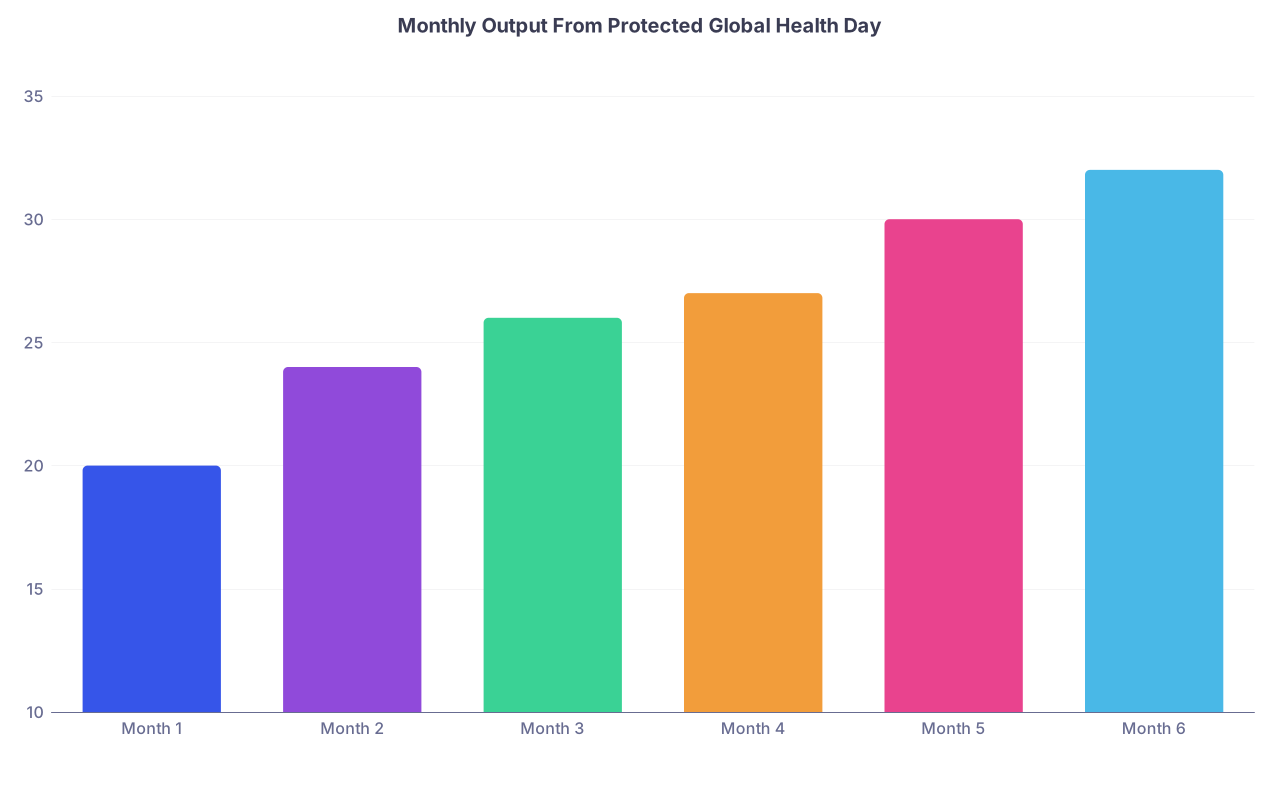
| Category | Value |
|---|---|
| Month 1 | 20 |
| Month 2 | 24 |
| Month 3 | 26 |
| Month 4 | 27 |
| Month 5 | 30 |
| Month 6 | 32 |
You want to be able to say after 6 months:
- “Across 6 protected days, we:
- Saw 150+ patient visits
- Improved vaccination completion from 62% to 81% in new refugee arrivals
- Identified and fixed delays in interpreter access workflow
- Presented our QI project at the regional global health conference
- Involved 2 interns in supervised sessions to expand impact”
Also, hit these behavior points:
- Never miss your protected day due to “being tired.”
- Never allow your protected day to create chaos on the main service.
- Send your PD a 1‑page end‑of‑pilot summary with:
- Key metrics
- Quotes from patients or clinic leads
- One concrete systems improvement
You are writing the justification for future residents to have the same opportunity.
Ethical Guardrails You Need To Keep Front And Center
You are working in “global health” inside a training program. That comes with real ethical expectations.
Do not:
- Use “global health” as an excuse to offload less interesting core duties.
- Displace or undercut local primary care docs or NGOs.
- Provide care beyond your training or supervision level because “these patients are underserved.”
- Ghost the clinic or partners by dropping out once your CV looks good enough.
Do:
- Be consistent. Show up on time, every time.
- Seek feedback from:
- Patients
- Local staff
- Partner organizations
- Explicitly ask your faculty sponsor:
- “Where are the power imbalances here?”
- “How do we measure whether we are actually helping and not just collecting experiences?”
- Integrate what you learn back into your main residency:
- Present on how interpreter use changed your approach on wards
- Share tools for addressing social drivers of health
Global health is not a side hobby. It is deeply about ethics, systems, and how you practice medicine everywhere.
If They Still Say No: Fallback Strategies That Still Work
Sometimes you do everything right and still get blocked. Common reasons:
- Chronic understaffing
- Upcoming RRC/ACGME site visit
- Historic bad experience with a previous “global health” arrangement
You do not quit. You adapt.
Strong fallback options
Convert “day” into a “micro‑rotation”
- 1–2 week focused elective in global / refugee health
- More palatable than a recurring day off the schedule
Fold global health into existing academic half‑days
- Lead a recurring case conference on complex cross‑cultural cases
- Develop a curriculum module that is counted as teaching time
Protected time within existing clinics
- Create a dedicated block of back‑to‑back refugee / immigrant patients in your regular continuity clinic, with:
- Social work
- Interpreter
- Clear learning objectives
- Create a dedicated block of back‑to‑back refugee / immigrant patients in your regular continuity clinic, with:
After‑hours or weekend longitudinal work with comp time
- Some programs will allow:
- Occasional Saturday clinic session
- Then trade for a weekday afternoon off later in the block
- Some programs will allow:
Not ideal, but still moves you toward substantive global health experience and impact.
Quick Visual: Core Steps to Negotiate a Protected Global Health Day

| Step | Description |
|---|---|
| Step 1 | Define Your Ask |
| Step 2 | Map Program Constraints |
| Step 3 | Build Rationale and Ethics |
| Step 4 | Design Structured Proposal |
| Step 5 | Secure Faculty and Chief Allies |
| Step 6 | Formal Meeting With PD |
| Step 7 | Pilot and Over Deliver |
| Step 8 | Adjust Ask or Use Fallbacks |
| Step 9 | Share Outcomes and Scale |
| Step 10 | Approval? |
FAQ (Exactly 4 Questions)
1. Can interns realistically negotiate a protected global health day, or should I wait until PGY‑2/3?
PGY‑1s usually have the least schedule flexibility and the most intense service needs. You can start planning and relationship‑building as an intern (especially with faculty sponsors and chiefs), but most programs are more open to piloting protected days in PGY‑2 or PGY‑3, especially during ambulatory or elective blocks. Use PGY‑1 to clarify your interests, understand program politics, and join existing global health efforts. Then make your formal ask with credibility and context in year two.
2. What if my program has no formal global health track or faculty?
You do not need a fancy branded “Global Health Track” to do ethical, meaningful global health work. Look for nearby resources:
- Refugee resettlement agencies
- FQHCs or migrant health centers
- Academic departments of public health or international health
Find one engaged attending (family medicine, ID, general IM, pediatrics, community medicine) who cares about underserved communities and is willing to be your sponsor. You can frame this as “underserved and immigrant health” if the “global health” label scares people.
3. Will this hurt my reputation as a team player or jeopardize fellowship applications?
Handled poorly, yes. If you sound like you are trying to avoid work, senior faculty will remember that. Handled correctly—clear coverage, high clinical output, strong QI or scholarly products—this makes you look more serious, not less. Fellowship programs in ID, heme/onc, pulm/crit, EM, and FM usually like applicants who can design and execute structured global or underserved work without burning their colleagues.
4. How do I protect myself from being used as free labor for a “global health” project that has no structure or supervision?
Set boundaries early. Insist on:
- A named, accessible supervising attending
- Clear learning objectives and scope of practice
- A schedule that does not violate duty hours or displace required core experiences
If you are being pushed toward unstructured or unsafe work, document your concerns, talk to your PD or an ombudsperson, and be willing to walk away. Ethical global health protects both patients and trainees. If one side of that equation is missing, you should not be the one patching it with your time and license.
Remember the core: Define a specific, structured ask. Align it with your program’s mission and constraints. Start small, pilot it, and over‑deliver. If you do that, a “protected global health day” stops being a fantasy and becomes just another smart part of the residency schedule.


