
On-Call Abroad: Safety Errors That Put You and Local Staff at Risk
It’s 2:30 a.m. in a district hospital three hours from the nearest city. Power just blinked off for the second time in an hour. You’re the visiting trainee “on call,” your supervising consultant went home at 10 p.m., and the nurse just handed you a blood pressure of 70/40 on a postpartum patient.
Everyone in the room is suddenly looking at you.
You’re jet lagged, not fluent in the language, half-familiar with the charting system, and fully aware that in your home hospital, you’d be the least senior person on the code team. Here, somehow, you’re “the doctor from America/UK/Canada.”
This is exactly where people make their worst global health mistakes. Not because they’re bad people. Because they’re tired, flattered, scared of looking incompetent, and completely out of their usual safety net.
Let’s walk through the specific errors that get people – and patients, and local staff – hurt. And how you avoid becoming the visiting liability everyone quietly talks about after you leave.
1. Overstepping Your Competence Just Because You’re “The Visitor”
This is the big one. The career-ruining one. The “I thought I was helping” disaster.
The classic mistake
You’re a third-year med student who’s done two weeks of surgery. Or a PGY-1 who’s seen a handful of intubations. You land in a low-resource hospital and suddenly people are saying:
- “Doctor, you can do the C-section, yes?”
- “You’ve put central lines before, right?”
- “You are from [insert wealthy country], you must know this.”
Your ego and your guilt team up:
- “They have no one else.”
- “This is their only chance.”
- “Back home I’d never be allowed, but here… maybe I should.”
So you say yes. You fumble through a high-risk procedure with inadequate supervision, poor backup, missing equipment, and often no proper consent.
If the patient dies, the local staff carry the long-term consequences. Not you. Not your home institution. Them.
Let me be clear:
Doing things abroad that you’re not allowed to do at home is not “helping.” It’s unethical. It’s unsafe. And it’s not “culturally sensitive” to be reckless because you think low-income patients should tolerate higher risk.
Red flags you’re overstepping
If any of these apply, you’re already in the danger zone:
- You’re about to do a procedure you could not do unsupervised at home.
- You have no clear supervising physician on site who knows your real level.
- You’re thinking, “If this goes bad, I hope nobody finds out.”
- You’re rationalizing with, “They do this all the time with no imaging/monitoring anyway.”
How to avoid this
- Before you go, write down in plain language:
- What you are competent to do alone
- What you are competent to do with direct supervision
- What you should not do at all
- Share that with your host supervisor on day one. Out loud. No vague “I’ve seen that” nonsense.
- Practice saying:
“I’m not trained to do that safely without supervision. Let’s find someone who is.”
If your presence in a “global health” setting requires you to lie about your ability, the placement is broken. Not you. But you’re still responsible for not playing along.
2. Treating Night Call Like It Works the Same Everywhere
Your home hospital has:
- Rapid response teams
- Blood bank on call
- Reliable oxygen
- CT scanner
- Lab turnaround of 30–60 minutes
You fly 8,000 miles away and assume those same invisible systems exist.
They don’t. At least not in the same way.
Common safety assumptions that blow up
“We can always transfer if it gets bad.”
Except the ambulance has no fuel, or the road is flooded, or the tertiary center refuses the patient.“We’ll just get a stat CT.”
Except the CT tech lives 45 minutes away and there’s no fuel for the generator at 3 a.m.“We can call ICU.”
What ICU? There are two monitored beds and they’re both full, with one nurse for 20 patients.
This becomes lethal on call because you think you’re buying time you don’t actually have. You delay basic, low-tech interventions waiting for high-tech solutions that will never arrive.
Ask these questions early, not at 2 a.m.
On your first day, sit with a senior local clinician or experienced nurse. Ask bluntly:
- What services are not available at night?
- What cannot be done on weekends?
- What’s the real response time for:
- Blood
- Operating room access
- Imaging
- Senior help
- Who is the real decision-maker after hours? Often it’s not who you think.
Then adapt.
If you only ask those questions once you’re standing over a crashing patient, you’ve already made the mistake.
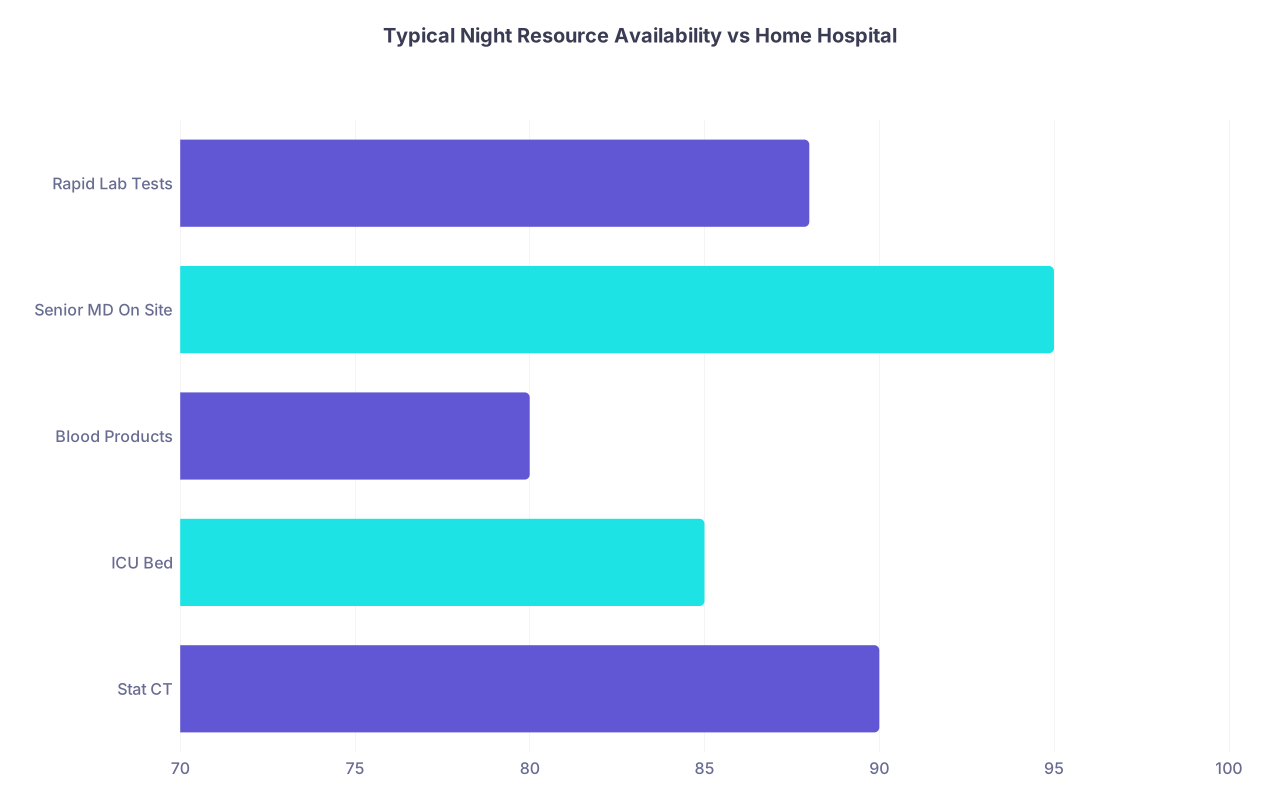
| Category | Value |
|---|---|
| Stat CT | 90 |
| ICU Bed | 85 |
| Blood Products | 80 |
| Senior MD On Site | 95 |
| Rapid Lab Tests | 88 |
(Values here represent approximate percentage availability in a well-resourced home hospital; your host site may be dramatically lower. The point: don’t assume your usual environment.)
3. Ignoring Local Staff When They’re Quietly Telling You “No”
Here’s something I see all the time: visiting trainees who understand the spoken language but are completely deaf to the social language.
The nurse says, “Are you sure, doctor?”
The clinical officer says, “We do not usually do it like that.”
The orderly just looks at you, then at the patient, and doesn’t move.
That’s a wall. A quiet, polite wall.
The mistake
You interpret this as:
- “They’re unsure; I should lead.”
- “They’re not familiar with evidence-based practice.”
- “They’re used to lower standards; I will bring my training to them.”
So you push ahead with your plan, assuming your guidelines from Boston or London automatically trump local experience.
What’s actually happening:
- They know the oxygen concentrator fails randomly.
- They know the surgeon will be furious if you start a case at 3 a.m.
- They know the family will refuse transfusion but you haven’t talked to them.
- They’ve seen this go wrong three times in the last year.
Read the room properly
When local staff:
- Avoid eye contact
- Exchange glances
- Suddenly need to “go check something”
- Speak more softly or slower than usual
They’re not just being “culturally indirect.” They’re telling you you’re off track, but they may not have the social permission to directly contradict “the foreign doctor.”
You bulldozing through that is not leadership. It’s arrogance.
Safer approach
Say:
- “I’m not familiar with how this usually goes here. What would you do?”
- “Is there something I’m missing? Please tell me if this is a bad idea.”
- “What has worked well for similar patients in this hospital?”
And then actually listen. If three people look uneasy, stop. Re-evaluate. If you override them, you own what happens next, ethically and practically.

4. Poor Handover: Dropping Nighttime Bombs on the Morning Team
Nothing makes local colleagues angrier than walking into chaos you created and badly handed off. Or didn’t hand off at all.
Typical scenario:
- You start an infusion with no documentation.
- You change antibiotics with no note and no clear indication.
- You move a patient to a different room without updating the board.
- You get busy, crash into bed at 4 a.m., and skip a real sign-out because “I’m just a visitor.”
Then the 8 a.m. team arrives and spends two hours trying to figure out:
- Why two patients are on the wrong beds
- Why nobody called the surgeon overnight
- Why the high-risk patient who decompensated isn’t in higher acuity care
This isn’t just annoying. It’s unsafe. And it trains local staff to resist ever letting visitors touch anything important.
What you need to hand over
At minimum, every on-call shift abroad, hand over:
- Sickest patients
- Who is most likely to crash today?
- What would be the next step if they worsen (realistic next step, not fantasy medicine)?
- Any changes you made
- Meds changed, stopped, or started
- Procedures done or planned
- Unfinished tasks
- Labs or imaging you ordered
- Families you promised to re-visit
- Outstanding ethical or consent issues
- Disagreements about surgery
- Code status uncertainties (even if “code status” isn’t formally used)
And document. In whatever system they use. Sloppy, half-English notes nobody can decode do not count.
5. Consenting Patients for Things You Don’t Really Understand
Consent in global health work is a mess, and people pretend it’s not because it makes them uncomfortable. I’m not going to sugarcoat it.
Here’s the mistake:
You, the visiting trainee, are asked (or you volunteer) to “explain the surgery” or “get the consent signed” because:
- You speak the patient’s language better than the expat attending.
- The local doctor is busy.
- “They just need to sign; they always agree.”
And you proceed to:
- Use language you barely understand for procedures you’ve only read about.
- Under-explain the very real local risks (no ICU, blood scarcity, high infection risk).
- Overemphasize your home-hospital expectations of benefit.
Yes, the form gets signed. No, that’s not valid consent.
Signs you’re doing consent wrong
- You’ve never seen this operation done in this hospital with these resources.
- You have no idea how often it goes badly here.
- You’re vaguely reassuring because you don’t want to “scare them away.”
- You find yourself saying things like “standard procedure,” “routine,” or “minor” when you know the complication monitoring is anything but.
What you should do instead
You are allowed to say:
- “I can explain some parts, but I’m not the right person to give you the full picture.”
- “Let me bring in the doctor who will actually be responsible for your care.”
- “There are risks I don’t fully understand in this hospital; I don’t want to mislead you.”
If the system is using you as a linguistic prop to rubber-stamp high-risk interventions without proper explanation, the system is wrong. Do not be its willing accessory.
6. Infection Control Complacency: “It’s Different Out Here”
Night call is when people cut corners. Hand hygiene plummets. Sterile technique “sort of” happens.
Abroad, the error is doubled: visitors see lax practices and assume that’s just “how it is,” then lower their own standards even further.
Two bad outcomes:
- Patients get preventable infections.
- Local staff see that foreign visitors don’t take infection control seriously either, reinforcing bad habits long after you’re gone.
Common mistakes I’ve watched:
- Reusing single-use items because “that’s what everyone does” without understanding how they’re reprocessed (or not).
- Skipping proper glove changes between patients because the glove boxes are far away.
- Wearing the same filthy white coat for a 36-hour call and brushing it against open wounds.
- Failing to clean stethoscopes because “we don’t have wipes here.”
What you actually control
You can:
- Wash your hands more frequently than anyone else in the building. Yes, even if the water is cold and the soap is cheap.
- Carry a small bottle of hand sanitizer in every pocket.
- Refuse to perform procedures when you know the contamination risk is unacceptably high, and say so calmly and explicitly.
- Model the same infection control standards you’d use at home, adjusted for reality but not thrown out the window.
Do not be the person who picks up MRSA or multi-drug resistant bugs abroad and brings them home. It happens. And nobody is impressed you got “the exotic strain.”

7. Blurring Professional Boundaries Because “We’re All So Close Here”
On call abroad often looks like this: you sleep in the same building as staff, eat together at odd hours, share rides, share stories, share trauma. The boundaries feel looser than at home.
Here’s where people screw up:
- Romantic or sexual relationships with local staff or other volunteers that leak into professional interactions.
- Sharing patient stories on social media because “nobody will know who this is – it’s in another country.”
- Venting about “how things are done here” in front of junior staff, undermining their trust in their own system.
Specific boundary errors
- Accepting gifts from patients that create an expectation you’ll provide them special treatment.
- Giving out your personal WhatsApp number to families “in case of emergency,” then being on-call unofficially at all hours with no documentation.
- Posting night-shift photos with patients, even if they “agreed,” without understanding local power dynamics or long-term implications.
Remember:
You’re not just you. You’re “the foreign doctor.” You carry outsized weight whether you want to or not.
Behave as if every interaction may be replayed later under a very critical light. Because it might.
8. Not Preparing for Personal Safety and Then Making Panicked Choices
Let’s talk about your own safety. Because if you’re hurt, assaulted, robbed, or burned out to the point of dysfunction, you become a liability, not a helper.
Typical unforced errors
- Walking home from call alone at 2 a.m. because “it’s a small town, it’s fine.”
- Carrying your passport, large amounts of cash, and phone on you at all times in visible pockets.
- Getting into arguments with intoxicated or aggressive family members in the middle of a crowded ward, with no exit plan.
- Refusing to leave an unsafe situation because you “don’t want to abandon the patient.”
What you should have in place before the first night shift
- A clear rule with your host: You will not walk alone at night. Ever.
- Knowledge of:
- Nearest safe room or office that locks from inside
- How to summon security or senior staff quickly
- Where your valuables are stored when you’re working (hint: not in your back pocket)
- An agreement with your program:
If you feel unsafe, you can remove yourself without punishment, even if others would choose to stay.
Do not be the hero who ends up stabbed in a corridor or carjacked on the way home because you thought basic precautions were “overreacting.”
| Checkpoint | If Answer is No… |
|---|---|
| Know how to call security | Do not start call until someone shows you |
| Have safe transport after 8 p.m. | Arrange with host or do not accept call |
| Know where exits are on the ward | Walk the route in daylight |
| Know who backs you up clinically | Clarify chain of command with host lead |
| Have local emergency contact number | Get it in writing and test that it works |
9. Walking In Without a Clear Role, Then Grabbing Power by Default
One more recurring problem: you arrive at a site where nobody has defined what you’re actually supposed to do. So you drift. Then night falls, things get chaotic, and power goes to whoever is loudest or most confident.
Often, that becomes you.
The silent setup
- Your home institution sends you with impressive-sounding letters.
- The host is understaffed and thrilled to have “extra hands.”
- Nobody has sat down and said: “On nights, your scope of practice is X.”
So you start:
- Making admission decisions alone.
- Overruling local trainees because you passed Step 2 with a higher score.
- Writing orders in a system you don’t understand the downstream effects of.
When things go wrong, everyone suddenly remembers you were “just a student” or “just visiting.” You are held responsible enough to feel guilty, but not grounded enough to be protected.
Fix this early
Before your first on-call shift:
- Ask your host supervisor directly:
- “What decisions am I allowed to make myself?”
- “What am I not allowed to do without checking with you or another senior?”
- “If there’s a disagreement, whose word is final?”
- Put it in writing. An email recap is fine. “So I understand correctly, on call I will…”
If they cannot answer clearly, that’s your answer: the environment is not structured for safe visiting practice. Proceed carefully, or don’t proceed.
10. Confusing “Seeing A Lot” With “Learning Well”
There’s a subtle, seductive mistake in global health rotations: you equate danger and chaos with educational value.
Night call abroad feels intense. You see dramatic pathology, you perform more procedures, you “manage” things solo. It’s easy to come home bragging about what you did.
Ask instead: what did you learn that you can defend ethically?
If “what you did abroad” cannot be described in an honest portfolio or logbook without making your home faculty flinch, you probably crossed lines. If you learned to be comfortable with shortcuts that would horrify you at home, that’s not growth. That’s moral erosion.
The sign you’re doing this right is not how many procedures you collected. It’s how many times you said:
- “No, I’m not safe to do that.”
- “We need to involve the senior doc.”
- “Let’s do the boring, basic, low-tech safe thing well.”
That’s the kind of clinician local staff actually trust and want back.
Three Things to Remember
Your scope of practice does not magically expand just because you crossed a border. If you wouldn’t do it solo at home, you probably shouldn’t be doing it solo at 3 a.m. abroad.
Local staff know their system better than you ever will in a few weeks. When their body language says no, stop and listen. Pushing through their quiet resistance is how harm happens.
On-call abroad is not a license for heroic shortcuts. You’re there to strengthen safety, not exploit weakness. If you leave and they’re relieved you’re gone, you did it wrong. If you leave and they’d trust you with their own family next time, you did it right.


