
You’re PGY-2. You finally worked up the courage to ask your PD about doing an elective in Kenya that you’ve been dreaming about since MS2. You have it all: a contact physician at a mission hospital, a draft proposal, even your own funding lined up.
Your PD doesn’t even scroll halfway down your email before saying: “We do not allow overseas rotations. It’s a liability issue. Focus on your ACGME milestones.”
Door shut.
If you’re here, you already know the party line: “Our GME office does not approve international electives.” Or, “You can go after graduation.” Or the especially annoying: “Global health is great, but we need you here.”
So now what? You care about global health, equity, and ethics. You also care about not blowing up your residency, losing vacation time, or getting in trouble with GME.
Here’s how to handle this situation like an adult, protect yourself, and still build real global health experience that counts.
Step 1: Get Clear on What’s Actually Blocked (And What’s Not)
Do not just stop at, “We don’t allow overseas rotations.” That sentence hides a lot of nuance. You need to know exactly what is prohibited and where the wiggle room is.
Ask for specifics in writing. Literally:
- “Is this a program policy or a GME/institutional policy?”
- “Is it a total ban on international rotations, or only on credit-bearing rotations?”
- “Am I allowed to travel and do clinical work abroad on my own time (vacation) if it’s not counted as residency credit?”
- “Are remote or domestic global health electives allowed?”
- “Is there a written policy you can share?”
You’re not being difficult. You’re collecting constraints so you can design around them.
What I’ve seen in real programs:
- Some places ban any international clinical work while you’re under their malpractice coverage.
- Some only ban institutionally-sponsored overseas electives; they quietly look away if you go on vacation and “observe” somewhere.
- Some allow non-clinical overseas experiences (research, education, systems work) but not hands-on patient care.
- Some allow international work only at pre-approved partner sites (often a single site the chair likes in Guatemala).
You need to know which version you’re dealing with.
Because your options change drastically depending on whether the wall is concrete… or just a badly worded email.
Step 2: Decide Your Risk Tolerance Before You Get Creative
There are three buckets of options:
- Fully sanctioned, low-risk, “everyone’s happy” options
- Gray zone, technically allowed but not loved
- Red zone, “you’re on your own and this can blow back on you”
Be honest with yourself:
- Are you OK with doing only what’s 100% blessed by your PD?
- Are you willing to work in the gray (like calling something “observership” when let’s be honest, you’re helping)?
- Do you have any dependents, visa issues, or disciplinary history that makes risk a terrible idea?
Your ethics matter here too. If you’re preaching global health ethics but sneaking off to do unsupervised procedures abroad without coverage, that’s not noble. It’s reckless.
So: decide the line you will not cross now, before you start looking at loopholes.
Step 3: Build Global Health Skills Without Leaving the Country
If your program is truly shut to international rotations, your best play is to reframe what “global health” even means.
Global health is not “getting on a plane and taking cute photos with kids in another country.” It’s working on health equity, systems, and cross-cultural care. A lot of that can happen domestically.
Option A: Global health at home (and yes, it still counts)
Look for:
- FQHCs or safety-net clinics with large immigrant/refugee populations
- TB clinics, HIV clinics, refugee health programs
- Clinics serving undocumented patients or recent arrivals
- Local resettlement organizations (IRC, Catholic Charities, etc.)
You can often:
- Do an elective month there (label it “Refugee/Immigrant Health” or “Community Health and Disparities”)
- Volunteer longitudinally (monthly clinics, asylum evaluations, language-concordant clinics)
- Build a QI or research project around these populations
This isn’t “less than” going abroad. If you’re seeing Congolese, Afghan, or Guatemalan patients in your city, you’re dealing with global health issues—just with better labs and more paperwork.
Option B: Remote global health work that’s surprisingly legit
Remote work bought a lot of flexibility. Things I’ve seen residents do that programs usually tolerate:
- Chart review / data analysis for a research project at a partner hospital abroad
- Curriculum development for trainees in another country (e.g., Zoom teaching for family medicine residents in Malawi)
- Tele-education: Case conferences, journal clubs, or M&M with a global partner site
This can be formally labeled in your schedule as:
- “Global Health Research Elective”
- “Medical Education and Global Health”
- “Population Health and Disparities”
No one’s nervous about malpractice there. Admins love “research” and “education.” Play into that.
Step 4: Redesign Your Ask So It Fits Inside the System
You may have made the classic rookie mistake: asking for “an overseas rotation” like it’s a vacation month.
Try this instead. Translate your dream into a language PDs and GMEs understand:
- Clear educational objectives linked to milestones
- Named on-site supervisor with credentials
- Explicit statement on who covers malpractice (often: not them)
- Formal assessment and feedback plan
Then frame it in ways they care about: accreditation, safety, PR, recruitment, and not creating a precedent that will haunt them.
Here’s how to rebrand:
Instead of:
“I want to do an elective at a hospital in Kenya.”
Try:
“I’m proposing a 4-week Global Health and Systems-Based Practice elective at
Will it still get blocked sometimes? Yes. But you move the conversation from “no” to “under what conditions could this be considered?” That’s where workarounds live.
Step 5: Use Vacation and Elective Time Strategically (Without Being Stupid)
Here’s the maneuver a lot of residents quietly do:
- Use vacation time to go abroad
- Call it non-clinical / observership / research / personal travel to the program
- Actually spend the time in a mix of observing, teaching, maybe light clinical work (depending on your ethics and coverage)
But there are landmines:
Malpractice coverage: Your residency/institutional coverage usually does not extend overseas unless it’s an approved elective. Many mission hospitals expect you to bring your own coverage or rely on theirs (which may be minimal or nonexistent).
Licensure: In most countries, you’re not legally licensed to practice. You may be tolerated as a “visiting doctor” or “volunteer,” but from a legal standpoint, it can be a mess.
Program rules: Some programs literally have clauses: “You may not engage in clinical work while on vacation.” If they find out, that can be a disciplinary issue.
My advice if you go this route:
- If you’re on vacation, treat it as learning and observing first, not as the hero surgeon of the village.
- If you do anything clinical, it should be within your training level, under supervision of someone qualified, and you should know exactly who is legally responsible.
- Do not lie in writing. If your PD asks, “Will you be doing clinical work?” and you reply “No” while planning to do procedures, that’s on you.
If this feels like too much ethical gray for your taste, good. Then stay in the fully sanctioned lane and skip the hero trip. You can build a serious global health career without sneaking around.
Step 6: Lean Into Non-Clinical Roles That Matter More Than You Think
Global health has a dirty little secret: the least ethical part is often the short-term “hands-on” clinical work. The most impactful part is the boring stuff: systems, QI, policy, education.
You can absolutely build a real global health profile through:
Research with an international partner site
- Outcomes: abstracts, papers, conferences, connections
- Good for fellowships (ID, EM, OB, Peds, etc.)
Quality improvement projects with global health angles
- Example: Antibiotic stewardship protocols adapted for low-resource settings
- Or: Tele-mentoring program design for rural clinicians abroad
Curriculum building
- Develop modules on point-of-care ultrasound, maternal mortality, sepsis, etc., for use by trainees abroad
- Co-create materials with local faculty—don’t just export your slides
Policy and advocacy
- Work with NGOs, professional societies, or local advocacy groups on issues like migration health, TB control, or vaccine equity
Residency leadership is often totally fine with you taking an “academic elective” or “research block” to do this work—especially if it leads to posters, publications, or brings your institution prestige.
Global health fellowships don’t just want people who’ve “been to 5 countries.” They want people who can think about power, systems, sustainability, and ethics. You can prove that without stamping your passport.
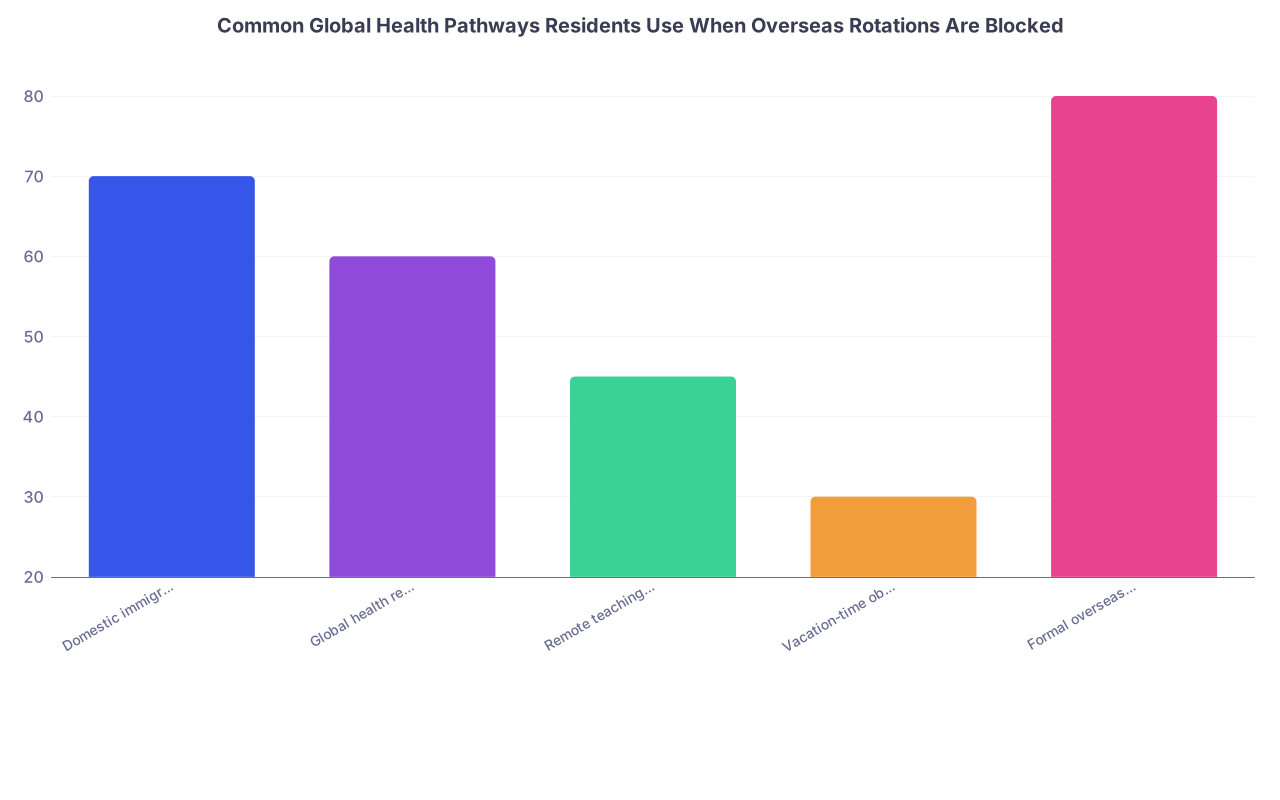
| Category | Value |
|---|---|
| Domestic immigrant health clinic | 70 |
| Global health research | 60 |
| Remote teaching/collaboration | 45 |
| Vacation-time observership abroad | 30 |
| Formal overseas rotations after residency | 80 |
Step 7: Document Everything So It “Counts” Later
You’re probably not just doing this for fun. You want it to matter for:
- Global health fellowships
- Academic jobs
- NGO/WHO/Ministry of Health type roles
- Or just your own sense that you didn’t waste this part of your career
So treat your workaround experiences like real, trackable curricula.
Do these three things:
Create an unofficial “Global Health Track” for yourself
Even if your program doesn’t have one, you can build:- 1–3 electives related to global / immigrant / refugee / underserved health
- At least 1 research or QI project with a global connection
- Longitudinal involvement in one clinic/population/partner organization
- Some form of teaching or curriculum work
Then summarize it later as: “Developed an individualized global health training pathway including X, Y, Z…”
Get evaluations and letters that emphasize global skills
When you do a domestic underserved rotation, ask that attending to comment on:- Cross-cultural communication
- Resource stewardship
- Systems thinking and ethics
These phrases signal global-health-readiness to future readers.
Log your hours and roles
Keep a simple spreadsheet:- What you did
- Where
- With whom
- For how long
- Outcomes (manuscripts, curricula, QI improvements, etc.)
That becomes gold when you’re writing personal statements and answering, “So what have you actually done in global health?”
| Option Type | Risk Level | Counts As On CV? | Typical Label Used |
|---|---|---|---|
| Domestic immigrant/refugee clinic elective | Low | Strong | Community/Refugee Health |
| Global health research block | Low | Strong | Research Elective |
| Remote teaching/case conferences | Low | Moderate–Strong | Medical Education/Global Health |
| Vacation-time observership abroad | Medium–High | Variable | Personal Travel/Observership |
| Formal post-residency overseas work | Low | Very Strong | Global Health Fellow/Consultant |
Step 8: Play the Long Game: Post-Residency Is Wide Open
Your residency has a lot of control over you now. That’s temporary.
Once you hit:
- PGY-3 or PGY-4 with some elective flexibility
- Or especially once you graduate
Your options explode:
- Global health fellowship (ID, EM, FM, OB, Peds all have them)
- One- or two-year posts with NGOs, academic partnerships, or mission hospitals
- Hybrid jobs: 6 months US, 6 months abroad
- Hospitalist gigs with long blocks off that you can use for on-the-ground work
If you can’t get overseas now, your goal in residency is:
- Build skills (language, cross-cultural care, resource-aware practice)
- Build credibility (research, QI, teaching, domestic global health work)
- Build relationships (mentors already active in global health)
So that when the leash comes off after graduation, you’re not starting from zero.
Step 9: Ethics Check – Don’t Let Frustration Push You Into Bad Medicine
You’re in the “Personal Development and Medical Ethics” phase category for a reason. There’s a real temptation here:
“My program is being paternalistic and restrictive, so I’m justified in going rogue.”
No. You’re not. Poorly supervised, under-insured short-term work in another country is exactly the behavior global health has been trying to correct for years.
Use this situation as a values test:
- Are you willing to delay gratification (actual hands-on overseas work) to make sure you can do it right?
- Are you okay investing in “boring” prep work—systems, research, language, cultural humility—before flying somewhere?
- Are you prioritizing the needs and safety of patients and partner institutions over your own desire for adventure?
If the answer is yes, good. You’re already ahead of half the people who treat global health as a medical tourism add-on.
Step 10: How to Talk About This In Interviews and Applications
Later—whether for fellowship, global health jobs, or academic positions—you’ll probably be asked:
“So, what global health experiences did you have in residency?”
Do not whine about your program’s restrictions. Nobody wants to hear a grown physician complain about their PD.
Instead, frame it like this:
- “Our institution did not allow international rotations during my residency for liability reasons, so I focused on building robust global health skills domestically.”
- Then list what you did: rotations, research, remote collaborations, language training, advocacy, etc.
- “I designed an individualized training path that emphasized X, Y, Z…”
That makes you sound resourceful and grounded, not blocked and bitter.
Pulling It Together: Your Playbook From Here
You’re stuck in a system that says “no overseas rotations.” Fine. You still have control over:
- What electives you design
- Which clinics you attach yourself to
- Which research and QI projects you join or start
- Whether you show up as the person who makes things happen anyway
So here’s your concrete next step for today:
Open your email right now and draft a message to one person at your institution who might be even remotely global-health-adjacent (ID attending who did MSF, refugee clinic director, public health faculty, whoever).
Subject line: “Interested in helping with any global or immigrant health projects?”
Ask them for a 20-minute meeting to hear what they’re working on and how you could plug in as a resident—research, QI, teaching, clinic, anything.
Send it.
That email will do more for your global health future than another hour scrolling websites for “overseas electives” your residency will never approve.


