

You’re in a hot, crowded clinic an hour outside a capital city. You’re on your third week with a well-known global health NGO. The line outside is still 40 people deep. Mid-morning, a teen girl comes in with her aunt, clearly terrified, clearly pregnant, clearly not ready. You know the evidence-based options. You also know the NGO policy—no abortion counseling, no referrals, not even mentioning it. You flip through the binder: “Incompatible with organizational values.” Your stomach drops.
Now you’re not just fighting anemia and malaria. You’re fighting your own employer’s policies.
This is where a lot of global health physicians quietly break—ethically, emotionally, sometimes professionally. Let’s go through what to actually do when your NGO’s policies clash with your ethics and your duty to patients.
1. First 24 Hours: What You Do In The Moment
You don’t have a month for theoretical bioethics. You’ve got a patient in front of you and a policy behind you.
You need a mental checklist for these moments:
- What does my duty to this patient require?
- What exactly does the NGO policy say?
- Is there any safe, legal, ethical workaround right now?
- What am I willing to document or say on record?
Here’s how to move through that without freezing.
Step 1: Stabilize the clinical situation first
Your immediate job is always: do not let someone crash while you’re debating policy in your head.
You:
- Assess for immediate danger (hemorrhage, suicidal risk, severe infection, etc.).
- Provide all the care that is clearly allowed and clearly standard of care under local law.
- Make sure pain is addressed, vitals are stable, urgent needs aren’t delayed because you’re emotionally conflicted.
Sometimes the most harmful thing is the “ethics paralysis” where nothing happens.
Step 2: Get very concrete about the policy
Most people argue with policies they haven’t actually read closely.
If you can, step out briefly and:
- Read the exact clause.
- Note: Is this about what you can say, do, prescribe, or document?
- Look for weasel phrases like “as appropriate to local practice” or “to the extent allowed by local law” that may give you ethical breathing room.
I’ve seen this: A physician believed they “couldn’t prescribe contraceptives” because of an NGO rumor. The policy actually restricted distribution of free long-acting methods, not prescribing or counseling. That’s a different fight.
Step 3: Quietly map the legal landscape
You’re not just under NGO rules. You’re bound by:
- Local law
- Medical ethics (often shaped by your home country’s standards)
- Your professional license conditions (if applicable)
Quick actions:
- Ask a trusted local physician: “What’s legally allowed in this setting for X?”
- If you have an in-country medical director, frame it as: “I want to be sure I stay within national guidelines for this situation. Can you confirm what’s standard?”
Do not assume the most restrictive voice in the room equals the law.
Step 4: Protect the patient from obvious harm right now
If the NGO policy blocks what you believe is necessary standard of care, you look for:
- Safe referrals that are legal and accessible
- Supporting the patient to access care elsewhere without violating laws yourself
- Maximizing what you can do: informed consent, empathic counseling, symptom management, safety planning
Concrete example:
- Policy: “No abortion counseling or referrals.”
- Legal context: Abortion is legal under specific circumstances in-country.
- You might:
- Provide full pregnancy options counseling but not make direct referrals, if that’s your compromise.
- Or you might decide your professional ethics require you to give at least basic referral info, knowing you’re in a gray zone with the NGO.
That’s your line to draw. But it should be deliberate, not panicked.
2. Slower Timeframe: Understanding What You’re Actually Up Against
Once you’re not in the middle of a patient encounter, you step back and do some diagnosis—not of the patient, but of the system.
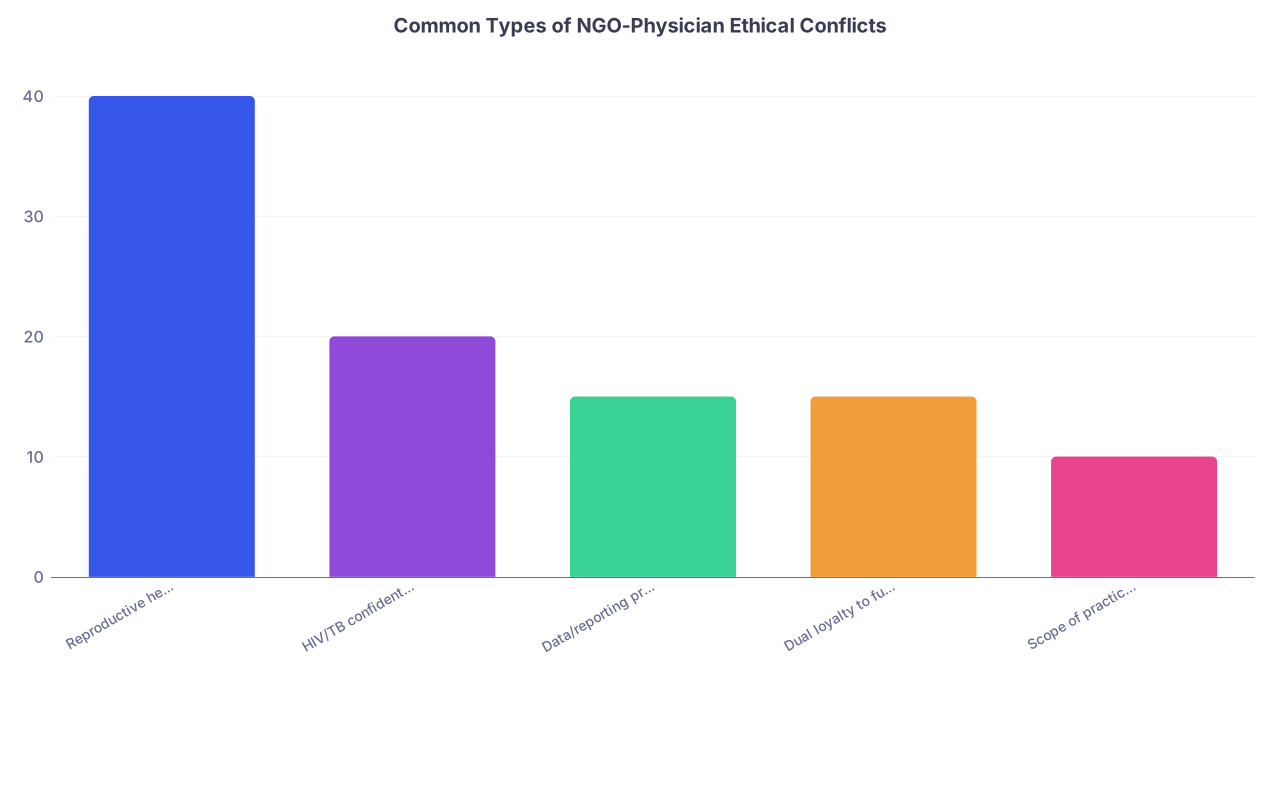
| Category | Value |
|---|---|
| Reproductive health limits | 40 |
| HIV/TB confidentiality conflicts | 20 |
| Data/reporting pressure | 15 |
| Dual loyalty to funders/host gov | 15 |
| Scope of practice pressure | 10 |
These are the five big categories where I see conflict:
Reproductive health restrictions
Abortion, contraception for adolescents, emergency contraception, unmarried women, etc.Confidentiality/Disclosure
Pressure to share HIV/TB status with partners, employers, schools, or government beyond what you think is ethically appropriate.Data and reporting manipulation
Being pushed to “reclassify” patients so program metrics look better. Useless indicators drive this.Dual loyalty conflicts
NGO aligned with government priorities that are ethically shaky—e.g., forced testing, immigration reporting, denying care to certain groups.Scope of practice / unsafe task shifting
Being pressured to sign off on things you know are unsafe: undertrained staff doing procedures, tele-supervision that’s basically a legal fiction.
You handle each slightly differently.

3. Practical Strategies: How To Push Back Without Nuking Everything
You’re not powerless here, even if it feels like it. You have more leverage than you think—if you use it correctly.
Strategy 1: Use “clinical language,” not moral language
NGO admin brains often switch off when they hear “ethics” but perk up when they hear “liability,” “reputation risk,” “clinical outcomes.”
Instead of:
“This is ethically wrong.”
Try:
“This policy is creating preventable harm and exposing us to potential legal and reputational risk. Let me give you concrete examples.”
Then describe:
- A near-miss or adverse event
- A patient who left without appropriate care and what happened
- How this deviates from national or WHO guidelines
Name specific guidelines. “WHO 2015, recommendation X.” That gets more traction than “I feel uncomfortable.”
Strategy 2: Document privately, carefully
You need a record for your own protection and in case this blows up later.
Keep:
- A private file (secure, de-identified) where you log:
- Date/time
- Nature of conflict
- What the policy was
- What you did
- Who you spoke with
- Copies of relevant in-country clinical guidelines and laws (or links, at least)
Do not write your ethical outrage in official patient charts or routine reports. Keep the clinical record clean and factual.
Strategy 3: Build a small local coalition
You don’t fight this alone if you can help it.
Look for:
- The local senior clinician everyone actually trusts
- A nurse who knows how the unwritten rules really work
- A local partner organization that’s more progressive medically
Ask them:
- “How have you seen others handle this?”
- “Is there any flexibility that isn’t obvious on paper?”
- “What would be considered going too far in this setting?”
Sometimes you’ll learn that everybody “technically” follows the policy, but in practice they quietly refer patients to a neighboring clinic that can do what’s needed. That’s not perfect, but it’s a real-world workaround.
4. Deciding Where Your Red Lines Are
At some point, it stops being about “how do I adapt to this NGO” and becomes “can I ethically keep working under these constraints at all?”
You need explicit red lines. If you don’t set them consciously, you’ll drift into compromise you wouldn’t have imagined a year earlier.

| Step | Description |
|---|---|
| Step 1 | Policy conflict arises |
| Step 2 | Patient at risk now? |
| Step 3 | Stabilize and give max allowed care |
| Step 4 | Clarify policy and law |
| Step 5 | Seek workaround or referral |
| Step 6 | Discuss with trusted local clinician |
| Step 7 | Document and continue with caution |
| Step 8 | Escalate to leadership |
| Step 9 | Work to modify policy |
| Step 10 | Decide - stay, whistleblow, or leave |
| Step 11 | Ongoing serious harm? |
| Step 12 | Policy change possible? |
Ask yourself, bluntly:
- What types of harm am I unwilling to be complicit in—regardless of cultural framing or employer pressure?
- What am I willing to quietly workaround vs. openly confront?
- Under what conditions would I resign before obeying?
For many physicians, absolute red lines include:
- Being forced to falsify data or documentation.
- Being ordered to deny emergency care based on identity (ethnicity, religion, migrant status, etc.).
- Being explicitly required to violate local law or core medical ethics (e.g., breach of confidentiality that creates serious harm).
You should write your red lines down. Actually write them. That way when you’re tired, lonely, and on your third 80-hour week, you’re not re-negotiating your ethics from scratch.
5. When To Escalate, When To Walk, When To Blow The Whistle
You’ve tried quiet workarounds. You’ve spoken with local colleagues. The conflict is serious and persistent. Now you’re in the “big moves” territory.
Option A: Internal escalation
You go up the ladder:
- Immediate supervisor
- Country medical director
- Regional/global medical director or ethics committee if one exists
How to do this without getting dismissed instantly:
- Prepare 2–3 concrete cases (de-identified) showing harm or risk.
- Refer to specific guidelines, laws, or published evidence.
- Propose a specific policy revision, not just “fix this.”
Example ask:
“Amend the reproductive health policy to allow neutral, factual information about all legal options, even if we do not provide certain services ourselves.”
This is more likely to get traction than: “We need to be more ethical about abortion.”
Option B: Vote with your feet
Sometimes the honest answer is: this NGO’s values and your ethics are simply incompatible. No amount of clever workaround is going to change the fundamentals.
You leave when:
- You’re routinely forced into actions you consider unethical.
- Leadership has clearly signaled they do not care.
- The system is built around a funding or ideological model that directly opposes your red lines.
Leaving is not failure. It’s triage of your own integrity.
But if you leave, you do two things:
- Write (for yourself) a clear summary of why you left, ethically speaking. It’ll clarify future choices.
- Decide how much you want to say publicly or to future employers. Be factual, not performatively outraged.
Option C: Whistleblowing
This is serious. It can end careers. Sometimes it saves lives or prevents massive harm.
You consider whistleblowing when:
- There is clear, ongoing serious harm or illegal activity.
- Internal routes have been exhausted or are obviously corrupt.
- You’ve documented enough to support claims without breaching patient confidentiality.
You think through:
- Who is the right audience? Donors? Professional licensing body? Reputable journalists? Oversight bodies?
- How to protect patient privacy.
- How to protect your own legal and professional status as best you can.
This is not something you do on a frustrated Friday night. It’s strategic, planned, ideally with legal advice.
6. Preparing Yourself Before You Get On The Plane
Most people wait until they’re knee-deep in conflict to think about this stuff. That’s backwards.
Here’s how you front-load some sanity.
| Area | Questions To Answer Before You Go |
|---|---|
| Medical Scope | What can I legally do? What is expected of my role? |
| Organizational Fit | What are the NGO’s policies on SRHR, data, confidentiality? |
| Legal Context | What’s the law on abortion, HIV disclosure, migrant care? |
| Support | Who is my in-country clinical/ethical sounding board? |
| Red Lines | What would make me resign or refuse an order? |
Do this before you sign:
- Ask for the actual written clinical and ethical policies. If they won’t share them, that’s your first red flag.
- Ask direct questions in your interview:
- “How do you handle abortion counseling in countries where it’s legal?”
- “If I have an ethical conflict with program metrics vs clinical reality, what’s the process?”
- “Has a clinician ever raised an ethics concern here? What happened?”
Listen carefully. Vague answers mean they probably haven’t thought about it—or don’t want you to know.
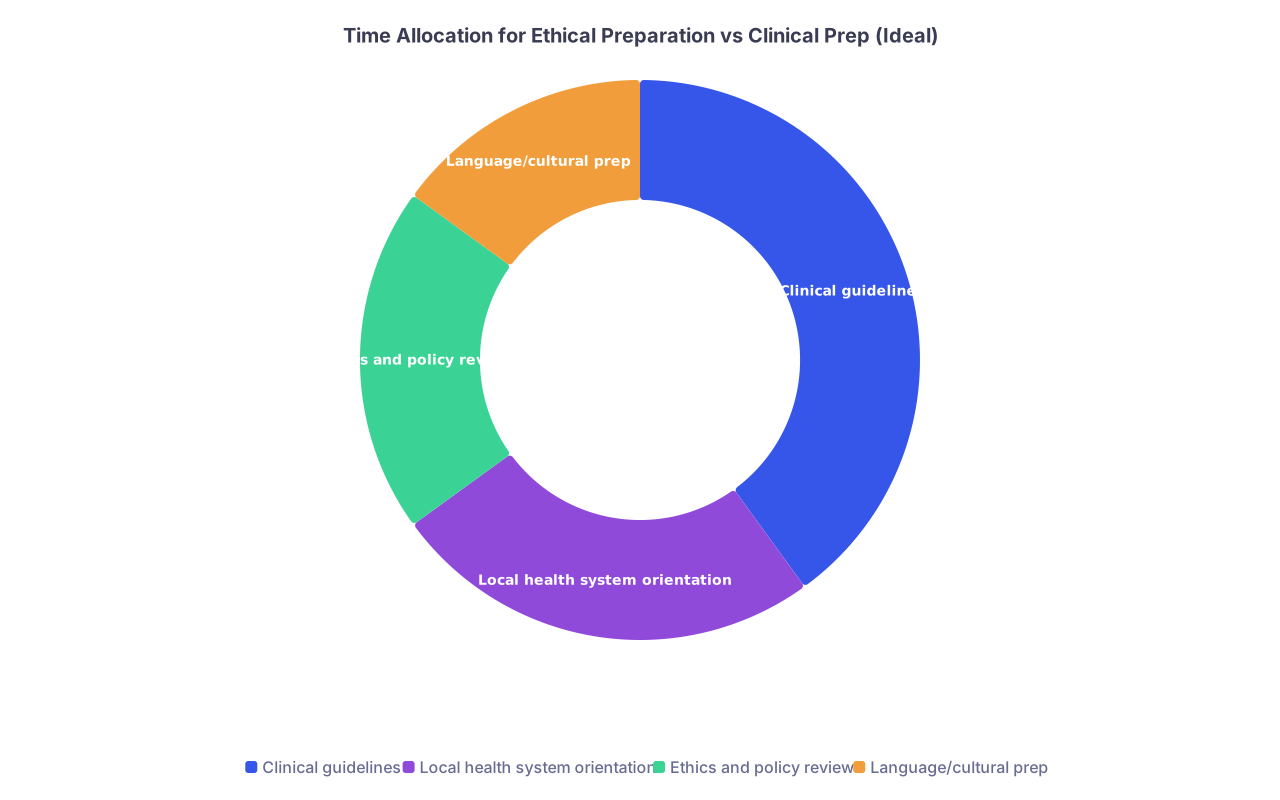
| Category | Value |
|---|---|
| Clinical guidelines | 40 |
| Local health system orientation | 25 |
| Ethics and policy review | 20 |
| Language/cultural prep | 15 |
Most people spend 95% of prep time on tropical medicine lectures and maybe one awkward “cultural competence” session. Ethics and policy review barely gets 5%. That’s how you end up blindsided three weeks in.
Aim more like the chart above—deliberately carve out time to study:
- National clinical guidelines
- NGO policy manuals
- Medical council / licensing board ethical codes (both your home and host country, if possible)
7. Protecting Yourself Emotionally So You Don’t Burn Out Or Go Numb
This kind of conflict doesn’t just make you frustrated. It can make you cynical, detached, or weirdly numb. Especially in chronic, low-grade forms.
You need a few things in place:
- One or two trusted peers (not in your direct chain of command) you can be brutally honest with.
- A simple debrief ritual: once a week, list:
- 1–2 situations where you compromised
- 1–2 where you held the line
- One decision you’re still unsure about
- A plan for what you’ll do if you realize you’ve crossed your own red lines repeatedly. That might mean stepping back, taking leave, or changing roles.

You’re not a robot. Prolonged conflict between what you believe is right and what you’re forced to do will eat you alive if you just “push through.”
8. Remember Why You’re There—Without Using That As an Excuse
A common self-justification I hear:
“If I leave or push too hard, patients will be even worse off. The NGO does a lot of good overall.”
Sometimes that’s true. Sometimes it’s a story we tell ourselves so we don’t have to act.
Use a sharper question:
“Does my participation as it is right now reduce net harm or enable avoidable harm?”
If:
- You’re providing high-quality care within constraints,
- You’re quietly expanding the envelope of what’s possible,
- You’re advocating internally where feasible,
…then staying can be ethically defensible, even under imperfect policies.
If:
- You’re mainly there for your CV, adventure, or photos,
- You’re repeatedly complicit in serious harm you know is wrong,
- You’re telling yourself “this is just how global health works” to avoid hard choices,
…then it’s time to reassess.

FAQ (exactly 5 questions)
1. What if NGO policy conflicts with local law—who do I follow?
You do not knowingly break the law to satisfy an NGO policy. Period. Your first obligation is to stay within local legal boundaries and core medical ethics. If a policy requires you to violate law—say, refusing emergency care that’s legally mandated—that’s a red-line situation. Document the conflict, refuse the illegal action, escalate immediately, and start planning your exit if leadership insists on compliance.
2. Can I quietly tell patients about options my NGO forbids me to provide?
You can, but you need to be honest with yourself about the risks. If the options are legal, evidence-based, and standard of care, there’s a strong ethical case for at least providing neutral information. The risk is organizational retaliation. Decide consciously: is this a hill you’re willing to die on in this job? Many clinicians choose a middle path: full honest counseling, plus general information about available services, without explicit endorsement or direct referrals where that would clearly breach policy.
3. Should I confront unethical policy in front of local staff or patients?
Generally, no. Publicly humiliating your NGO or a local partner in front of patients or junior staff is almost always counterproductive. You erode trust, and the system will close ranks against you. Do the clinical best you can in the moment, then address the policy in private with appropriate leaders. The exceptions are urgent safety issues where immediate, visible correction is needed to prevent direct harm—then you step in, but you still follow up privately afterward.
4. How do I talk about these conflicts in future job or fellowship interviews?
Factually and specifically, without sounding like you just want to complain. Describe one concrete scenario, the conflict, the constraints, what you did, and what you learned. Emphasize that you engaged local colleagues, understood the legal and cultural context, and acted deliberately—not impulsively. Good programs like candidates who have wrestled with real-world ethics and can stay principled under pressure without being reckless.
5. What if local colleagues say, “This is how we do things here—stop imposing your ethics”?
You listen first. Sometimes what looks unethical through your lens is more nuanced in their context. But “different context” is not a free pass for serious rights violations or preventable harm. Anchor yourself in shared standards: local clinical guidelines, national law, WHO recommendations. Frame your concern as: “How do we align our practice with these shared standards?” If you hit a wall where “this is how we do things” means serious, ongoing harm—and no one is interested in change—you’re looking at a system-level problem, not just a cultural difference. That may be your cue to limit your involvement or leave.
You’re in global health, not a philosophy seminar. The conflicts are messy, fast, and personal. With a bit of upfront prep, clear red lines, and a willingness to act—not just agonize—you can stay in this work without losing your ethical spine.
And once you’ve figured out how to stand your ground with one NGO, the next level is bigger: shaping which organizations you choose to align with in the first place, and pushing for better global health structures—not just better individual decisions. But that’s the next chapter in your trajectory.


