
When You Witness Harmful Practices by Other Volunteers: How to Respond
What do you do when the person causing harm to patients is not a corrupt government or a broken system—but the smiling volunteer working next to you in clinic?
I’m not talking about small mistakes. I mean things like:
- A premed “adjusting doses” of meds they don’t understand
- A non‑clinician suturing a wound “because there’s no one else”
- A visiting surgeon pushing a risky procedure on a patient who clearly does not understand the consent
If you do global health long enough, you’ll see this. Bad medicine done with good intentions. And you’ll feel your stomach drop, because you know it’s wrong—but you also know you’re technically a guest, maybe junior, maybe unlicensed in that country, and the person doing it is older, louder, or “in charge.”
This is the playbook for that situation.
Step 1: Get Clear on What You’re Actually Seeing
You can’t respond intelligently if you misread what’s happening. Not every uncomfortable moment is “harmful practice.” Some are just different standards, different resources, or your own inexperience.
Run what you’re seeing through three quick filters:
Is there real or likely harm to the patient?
- Giving meds you’re not trained to prescribe
- Doing procedures outside scope (suturing, I&D, pelvic exams, nerve blocks, etc.)
- Ignoring clear contraindications (e.g., giving NSAIDs to a patient with severe kidney disease)
- Violating consent in an obvious way (pelvic exam without clear explanation or permission, photographing patients without consent)
Is this actually against local clinical standards, not just different from your home institution?
Sometimes you’ll see:- No CT or MRI when you’d use one at home
- Different antibiotic choices because of availability
- Reusing equipment that’s safely sterilized
That can be uncomfortable but not unethical. You need to separate “lower resources” from “lower ethics.”
Who is doing what, under whose authority?
Write this down mentally:- Person: student / nurse / foreign doctor / local doctor / NGO staff
- Role: what they should be doing
- Action: what they actually did or are doing
That clarity will matter later when you report or escalate.
If your internal alarm is going off—“this would get me fired or written up at home”—don’t ignore it. But don’t go full crusader without understanding the context.
Step 2: Protect the Patient in Real Time (Without Blowing Up the Room)
First responsibility is the patient in front of you. If harm is happening now, you deal with now first. You can unpack the politics later.
There are levels here.
Level 1: Micro‑interventions that slow things down
If you’re not the most senior person in the room, your job isn’t to deliver a TED Talk on ethics. Your job is to slow the scene and create space for someone with authority to intervene or reconsider.
Tools you can use:
- The “clarifying question” move
Used quietly, near the volunteer or supervisor.- “Hey, just to be sure—has Dr. ___ approved this med/dose?”
- “Did the attending say we’re okay to suture without local anaesthetic here?”
- “Have we checked if the local nurse or doctor is available to see this patient first?”
You’re not accusing. You’re putting a tiny wedge of doubt in the process. Smart people feel that wedge.
- The “I might be wrong, but I’m worried about…” move
Especially if you’re junior or a student.- “I might be misunderstanding, but I’m worried this dose is high for a child this small.”
- “I might be off here, but I thought only licensed clinicians were allowed to do this procedure in this setting.”
This lets you flag risk without pretending to be an expert.
- The “let’s get backup” move
- “The local doc just stepped out, should we grab her before we do this?”
- “Can we ask the nurse; she usually knows the local protocol for this.”
If this works, you’ve de‑escalated risk quietly and saved face for the other volunteer. Good outcome.
Level 2: Direct stop if you’re witnessing clear harm
Sometimes subtle isn’t enough. If what’s happening is clearly dangerous, you’re allowed to be more direct.
You might say, calmly but firmly:
- “I’m really uncomfortable with us doing this without a local clinician. Can we pause and bring them in?”
- “This feels outside our scope. I think we need to stop until we talk to [local doctor/clinic lead].”
If they push back:
- “I understand you’ve done this before, but I can’t be part of it and I think we need a supervising clinician to sign off.”
Key: you’re naming your boundary, not just attacking theirs. You’re saying, “I won’t participate in this,” which is defensible ethically and professionally.
If that still fails and the patient is at immediate risk, you may have to escalate on the spot:
- Step out and get the local physician or senior supervisor now
- Or, if no one exists, at least remove yourself and document what you saw for follow-up
You’re not required to be a hero who physically blocks the procedure. You are required not to stand there silently enabling it.
Step 3: Anchor Yourself to Local Authority, Not the Loudest Foreign Voice
One of the biggest mistakes visiting volunteers make: acting as if the most confident foreigner is in charge.
In actual global health work, ethical authority usually rests with:
- Local clinicians (doctors, nurses, clinical officers)
- Local health administration (clinic director, hospital chief)
- Approved, structured partnerships with clear roles
If a foreign volunteer is:
- Overruling local clinicians
- Doing unsupervised care that locals would never do
- Making decisions that ignore local protocols
…that’s a red flag.
Your default stance should be: “What do the local team and local standards say?” not “What does this American/European volunteer feel like doing?”
So in the moment, your line becomes:
- “Let’s check with Dr. [Local name]—they know the usual approach here.”
- “I was told local clinicians are the ones who decide on procedures. Can we run this by them?”
If you’re in a setting where:
- There is no real local oversight
- Foreigners are running everything
- Scope of practice is basically “whoever wants to do it does it”
You’re in cowboy‑medicine territory. That’s not global health. That’s medical tourism with scrubs on.
And you need to start mentally planning your exit and your report.
Step 4: Document What You Saw—Like a Professional, Not a Gossip
If you witnessed something harmful, you need a record. Memory fades. Details get blurry. And if you ever need to report it—locally or to your school—you want facts, not vibes.
Right after the event (same day), write down privately:
- Date and approximate time
- Location (clinic name, room, mobile camp, etc.)
- Names and roles of people involved (as best as you know them)
- What specifically happened, in observable terms
- “Volunteer X, who introduced herself as a premed, sutured a scalp laceration without local supervision.”
- “Volunteer Y increased dose of medication Z from A mg to B mg without consulting local staff.”
- Patient details in non-identifying way (adult/child, gender, chief complaint)
- Your direct involvement: what you did or did not do, what you said
- Immediate outcome (if known): patient stable, complication, patient distressed, etc.
Do not put this in group WhatsApp chats, Instagram DMs, or public shared drives. Keep it offline or in a secure personal document. You’re not collecting gossip; you’re preserving a factual account.
Step 5: Choose Where and How to Report
You usually have three reporting pathways. Sometimes you’ll use more than one.
Path 1: Local chain of command
This is the first place to look.
Who locally is actually responsible for patient care and volunteer oversight?
- Clinic medical director
- Senior local physician or nurse in charge
- Hospital administration
You might request a private meeting and say something like:
“I need to share a concern about something I witnessed involving another visiting volunteer that I believe may be outside appropriate clinical practice and potentially harmful to patients. I want to respect local processes and get your guidance.”
Then you walk them through your factual notes. No ranting, no character assassination. Just: here’s what I saw, when, where, why I’m worried.
If they shrug it off:
- It might be lack of power vs. lack of concern
- Or it might reflect a system where foreign NGOs hold too much control
You still did your part. Document that you reported it: to whom, when, what they said.
Path 2: Your sending institution (med school, residency, NGO, university)
Most schools and legit organizations now have:
- A global health office
- An ethics or professionalism office
- An incident reporting line
If you’re a student or trainee, you should use them.
What you send:
- Your written account
- Whether you’ve already raised it locally, and what response you got
- Whether you feel safe for your name to be attached (in most cases, yes—but you can ask about confidentiality)
You’re not “being dramatic.” You’re fulfilling a professional duty to report unsafe practices. In medicine, looking the other way is how bad culture survives.
Path 3: The sponsoring NGO or program leadership
If there’s a specific NGO or mission organization running the project:
- Find out who oversees volunteers medically and ethically
- Bypass the random “trip coordinator” if needed and go higher
Your angle:
“As part of your program, I witnessed activities that seem outside scope and potentially harmful to patients. I’m concerned about safety and about your organization’s liability and reputation.”
That usually gets attention. Organizations hate risk to their brand.
Step 6: Protect Yourself from Retaliation and Politics
You know this part already: sometimes the people causing harm are the darlings of the NGO. Or they’re senior. Or they’ve been coming for ten years and “know the community.” They’re also very practiced at hand-waving away concerns.
So be smart.
Don’t confront alone if you don’t have to.
If others witnessed the same thing and agree it was wrong, consider reporting together. Not a mob—just corroboration.Keep your own behavior clean.
Don’t join in the questionable practice “just this once.” The fastest way to lose credibility is to be complicit and then later complain.Know your non‑negotiables.
If the culture of the site is:- No local oversight
- Students running procedures
- Informed consent treated as a joke
…seriously consider leaving early. You can’t fix a rotten structure from the bottom.
Assume emails can be forwarded.
Write as if everyone involved could read your words. Be factual, not snarky, in official communication.
Step 7: Check Your Own Motivations and Blind Spots
Now the uncomfortable part: sometimes we think we’re seeing harm when we’re just seeing:
- Different but acceptable clinical practice
- Racial or cultural bias (foreigners trusting Western standards over local expertise)
- Our own anxiety or ego
This doesn’t mean you should stay quiet. It does mean you should gut‑check with people you trust.
Before going nuclear, ask:
- A local clinician you respect: “Can I ask about something I saw? I’m worried it was unsafe, but I may be missing context.”
- A trusted mentor at home: “Here’s exactly what I saw—am I overreacting?”
If multiple thoughtful people say, “Yes, that’s a problem,” then you lean in. If one or two say, “That’s actually normal practice here because X, Y, Z,” consider that you might have misjudged.
Still, there are universal red lines: consent violations, outright lying to patients, faking credentials, practicing way outside your scope. Those don’t get excused by “different context.”
Step 8: Decide if This Place Deserves You Long Term
Global health is full of pretty photos and ugly realities. Some organizations are serious. Others run on ego, saviorism, and chaos.
When you’ve seen harmful volunteer practices, use that data. Ask yourself:
- Did leadership take my concern seriously?
- Are there clear scopes of practice for volunteers?
- Do local clinicians actually hold authority, or are they props?
- Is patient dignity consistently respected, or just talked about on the website?
If the answers are bad, the solution isn’t “tough it out.” It’s: do not return. And warn others privately who might be considering the same trip.
You are not obligated to keep feeding a broken system with your time and moral distress just because you already bought a plane ticket once.
A Concrete Scenario Walkthrough
Let’s run one situation start to finish.
You’re a third-year med student from the U.S. on a 4‑week trip with a faith‑based NGO in rural Central America. In clinic, you see:
- A pre‑PA volunteer (no medical license) is writing and handing out prescriptions for antibiotics while the local doctor is in another room. She says, “The doc is always fine with what I pick; we’re slammed and I’ve done this trip five times.”
What you do:
On the spot:
- You walk over and say quietly, “Hey, I’m confused—are we supposed to be prescribing without Dr. [Local] reviewing? At my school that would be considered practicing without a license.”
- She shrugs it off. You say, “I’m uncomfortable with that. I’m going to grab Dr. [Local] so we’re covered.” And you do.
With the local doc:
- You say to him (when you can grab 2 minutes), “I noticed the volunteers are sometimes writing prescriptions independently when you’re in the other room. Is that okay with you, or would you prefer all scripts go through you?”
- If he says, “No, they should not do that,” you’ve just given him information and power.
After shift:
- You write a factual log: names, what you saw, his response.
Reporting:
- You talk to the NGO’s medical director: “Here’s what I witnessed. Local doc said he doesn’t want volunteers prescribing independently. I’m concerned about patient safety and liability.”
- When you get home, you also send a brief report to your school’s global health office.
That’s it. You didn’t have to scream. You didn’t have to be perfect. You made it harder for that pattern to continue in the dark.
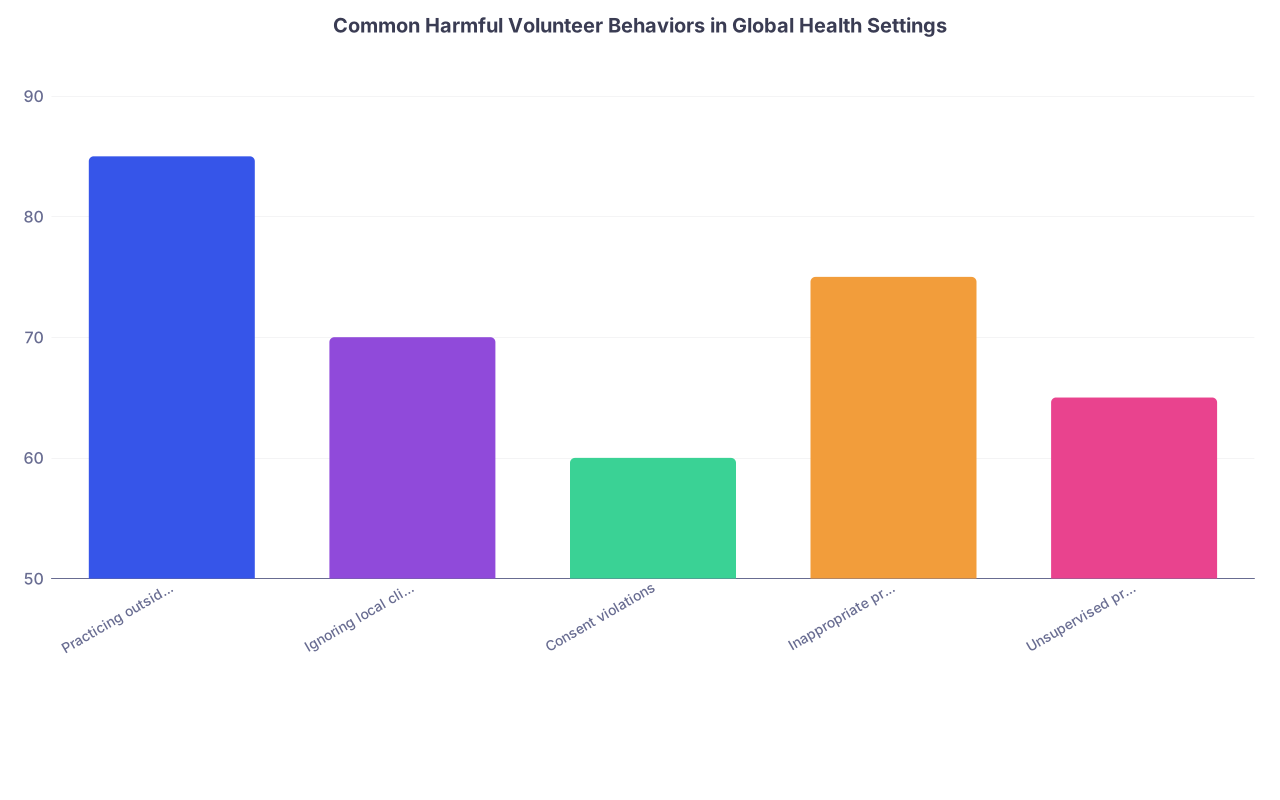
| Category | Value |
|---|---|
| Practicing outside scope | 85 |
| Ignoring local clinicians | 70 |
| Consent violations | 60 |
| Inappropriate prescribing | 75 |
| Unsupervised procedures | 65 |
How to Carry This Forward Without Burning Out
Seeing harm—especially done “in the name of helping”—can sour you on global health entirely. I’ve watched good people walk away for years because of one bad trip.
Here’s how you stay in the game without losing your ethics:
- Treat each bad experience as data, not destiny. That one NGO doesn’t define global health. It defines itself.
- Build a short list of programs with real partnerships and supervision, then stick to them. The bar should be: would I be comfortable having my own family treated there?
- Keep talking about this stuff. To classmates, colleagues, students coming up behind you. The silence is what lets sloppy, harmful “voluntourism” keep branding itself as medicine.
You don’t fix global health overnight. But you absolutely change it each time you refuse to let harm slide just because the person doing it is wearing a volunteer T‑shirt and a stethoscope.

Key Takeaways
- When you see harmful practices by other volunteers, your first job is to slow or stop immediate harm using simple, direct interventions and by pulling in local authority.
- Document what you saw, then report it through local leadership, your sending institution, and the sponsoring NGO as needed—factually, not dramatically.
- Use what you witness to decide which organizations deserve your time in the future; staying aligned with ethical, locally led work will matter far more than any single “heroic” trip.


