

The most dangerous moment in global health work is not when you arrive in a conflict zone. It is when things quietly start to fall apart and you convince yourself you can still “push through.”
If you’re a physician on a mission and security deteriorates mid-deployment, the worst decision you can make is to pretend nothing has changed. The second-worst is to panic and abandon your post without thinking. This guide is about the space in the middle—how you actually decide what to do when the ground shifts under you.
You are not going to solve war, politics, or organized crime. You are responsible for one thing: making defensible, ethical, and practical decisions that keep you, your team, and your patients out of unnecessary harm.
Let’s build that decision-making muscle.
1. First Principle: You Are Not There To Be a Martyr
Here’s the blunt truth that some NGOs still communicate badly: you are not ethically required to die for this work.
The idea that “patients come first” gets twisted in crisis zones into “we must stay no matter what.” That is wrong. Patients come first within the bounds of what is reasonably safe and sustainable. Once security crosses a certain line, continuing care on-site may actually become less ethical because:
- You become a liability (your kidnapping or injury redirects local resources).
- You attract violence to the facility (armed groups see you as valuable).
- You force local partners into risk to protect or hide you.
- You create a false sense of continuity for patients that can collapse suddenly and catastrophically.
So the first frame: your continuing presence is ethically conditional. Not absolute. That matters, because it gives you permission to make hard calls without guilt-paralysis.
2. The Red Flags: How To Know Security Is Actually Deteriorating
You’re not a military intelligence officer. You still need a simple mental checklist. In practice, deterioration shows up as patterns, not one dramatic event.
These are the things I’ve seen repeatedly just before a mission goes sideways:
- Checkpoints: More of them. Less predictable. Manned by younger, jumpier guys with no clear chain of command.
- Rumors: Staff start using phrases like “they say there will be trouble” or “many people are leaving the village this week.”
- Curfews: Official or unofficial. Roads “not recommended” after dark become “nobody uses that road at all now.”
- Communications: WhatsApp groups go quiet; cell networks cut “for maintenance”; NGO security messages increase in frequency and urgency.
- Local staff behavior: Your most seasoned nurse sends her children to relatives “for a while.” The driver asks if you can end clinic early “just for today.”
- Violence pattern: Attacks that used to be sporadic shift closer to you—on the main road you use, in the market you frequent, near other NGOs.
When 2–3 of these shift in the wrong direction within days or a couple of weeks, you are in a deteriorating situation. Not “maybe.” You are.
At that point, you move from “normal program” to “contingency mode.”
3. The 3-Level Response Model: Stay, Scale Back, or Get Out
You need a mental model that’s simple enough to use under stress. Use three levels.
| Level | Situation Snapshot | Default Response |
|---|---|---|
| Green | Stable but tense | Continue with vigilance |
| Amber | Clearly deteriorating, still open | Scale back, prepare exit |
| Red | Immediate or near-certain threat | Suspend and evacuate |
Level Green – “Tense but Working”
You’re aware of risk, but operations are basically functioning:
- Regular clinic hours
- Roads open most of the day
- No direct threats to health facilities or staff
- NGO security still approves movements
Your job here: maintain situational awareness and quietly prepare.
What to do at Green:
- Map essential vs. non-essential activities. Know what you can cut overnight.
- Identify your critical staff and alternates (who can run what if you’re gone).
- Clarify your personal thresholds with your organization: “If X happens, I will not participate in Y movement.”
- Start tightening policies: no solo travel, stricter curfew, always check-in/check-out.
You are basically pre-loading your decisions so you don’t have to invent criteria later when you’re scared and tired.
Level Amber – “Deteriorating but Still Open”
This is where most physicians freeze, because everything still kind of works. That’s the danger.
Amber signs:
- You’ve canceled or rerouted at least one movement in the last week for security reasons.
- Local staff are worried enough to regularly bring up safety.
- You’ve had an incident nearby (shooting, bombing, abduction) on a route you use.
- Another NGO has suspended work or withdrawn non-essential staff.
- Your own security updates now come with phrases like “highly discouraged” or “substantial risk.”
At Amber, you shift to intentional risk management. Not “hope.”
What to do at Amber:
Shrink your footprint.
- Close outreach sites that require risky travel.
- Consolidate services into the safest facility.
- Stop all “nice-to-have” projects (teaching rounds at a distant hospital, community meetings in exposed areas).
Change your presence pattern.
- Fewer travel days, more tele-support if possible.
- Shorten clinic hours to daylight only.
- Move key meetings earlier in the day to leave room for early departure if needed.
Prioritize handover.
- Start active handover of clinical protocols, equipment locations, contact lists, and drug inventory to trusted local staff.
- Train two people for every critical task (C-section coverage, emergency triage, pharmacy key holder).
Clarify your red lines. Write them down.
- Example: “We will suspend all field movements if: an armed group enters a health facility in the district OR road X has an attack within 5 km of our usual checkpoint.”
- Share these lines with your team and HQ. If you keep them in your head, they’re too easy to move later.
Audit your exit options.
- How many hours from “decision to leave” to actual departure?
- What is your safest route? Backup route?
- Who is responsible for greenlighting evacuation—field lead? Country director? Security officer?
If you’re at Amber and not doing these things, you’re essentially gambling and hoping the dice are kind.
Level Red – “Time Is Up”
Red isn’t philosophical. It’s concrete. These are Red conditions:
- Armed actors have directly threatened your facility, staff, or vehicles.
- Fighting/explosions/gunfire are audible or visible from your compound or hospital.
- Government or armed groups explicitly restrict your movement or demand to control your staff, patients, or supplies.
- Your security officer or NGO leadership calls for immediate hibernation or evacuation.
- Roads to your evacuation point are no longer reliably passable, or last safe departure time is now.
At Red, your primary duty is to preserve life—including yours and your team’s. The mission’s continuity becomes secondary.
What to do at Red:
Activate the plan you should have built at Amber.
- If it isn’t built, do a stripped-down version: what’s the fastest route, who’s driving, minimal gear list, who calls who.
Clinical triage of your responsibilities. You cannot do everything before you go. Prioritize:
- Stabilize: make sure the sickest current inpatients are as stable as possible with medications that will last longer than your presence.
- Hand over: brief the most capable local clinician on key patients—short, focused, written if possible.
- Simplify: convert complex regimens to simpler ones where safe (once daily vs twice, oral vs IV if equivalent).
Secure or neutralize sensitive items.
- Lock or disable communications equipment you cannot take.
- Remove or secure controlled medications (opioids, benzodiazepines) to avoid diversion to armed groups.
- Back up critical data if it contains patient records that could be misused.
Leave.
- Not after one more hour. Not after “just three more cases.” Once the red line is crossed and decision made, you move.
Delay is the number one reason evacuations fail.
4. Ethical Balance: Patients, Local Staff, and Your Own Life
This is where the guilt hits. You look at patients in the ward and think, “If I leave, some of them will die.” That might be true. It is still not an automatic argument for staying.
Work through three questions, explicitly:
Am I actually the only person who can do this work right now?
- Often you’re not. There’s at least some local capacity—maybe not as trained as you, but there.
- If there is a local surgeon, general practitioner, or nurse anesthetist who can continue, your obligation shifts to strengthening them, not sacrificing yourself.
Will my continued presence substantially change patient outcomes, or just delay the inevitable?
- If supply chains are broken, power is out, and blood bank is gone, your impact may be more symbolic than clinical.
- If high-risk obstetrics and trauma are your main cases and evacuation routes are cut, your ability to safely manage complications is already degraded.
What is the risk that my presence worsens risk for local staff?
- If armed groups see you as a valuable hostage, your local colleagues become shields and bargaining chips.
- If the facility is targeted because “the foreigners are there,” leaving may actually reduce the risk landscape for local staff and patients.
The ethical standard I use is this: Stay only while your presence is:
- Clinically meaningful
- Not grossly disproportionate in risk to you vs benefit to patients
- Not increasing danger for local staff
The moment two of those three fail, you should be planning exit, not heroic extension.
5. Decision-Making Under Pressure: Who Decides and How
You don’t decide alone. But you also don’t hide behind bureaucracy.
In a decent organization, four actors are involved in major security decisions:
- Field team lead (could be you)
- Country director / mission head
- Security focal point or advisor
- Local partners / senior local staff
When things are moving fast, use a simple, time-limited process. Literally 15–20 minutes, not meetings that drag for hours.
Here’s a concrete flow:

| Step | Description |
|---|---|
| Step 1 | Trigger Event |
| Step 2 | Field Lead Assesses Level |
| Step 3 | Consult Local Staff and Security |
| Step 4 | Propose Suspend or Evacuate |
| Step 5 | Define Actions and Thresholds |
| Step 6 | Country Director Approval |
| Step 7 | Implement Scale Back |
| Step 8 | Execute Evac or Hibernation |
| Step 9 | Level Amber or Red |
Key rules while doing this:
- Time-box the discussion. “We have 20 minutes to decide if we are shifting to Amber or Red actions. Then we act.”
- Let local staff speak first. Their read on risk is usually better than yours.
- One clear decision-maker. If that’s you as field lead, own it. Take input; then decide.
- Document the decision briefly: what you knew, options considered, what you chose, and why. Two paragraphs are enough. This protects you later—legally and psychologically.
If your NGO culture punishes people for being “too cautious,” understand this clearly: you are the one physically there. Your moral obligation is to act according to reality, not to HQ’s fundraising narrative.
6. Preparing Yourself Before Things Go Wrong
Most of your ethical growth happens before you need it. If you’re reading this in a safe place, good. Use it.
Build your personal red lines now
Write down answers to these:
- I will not travel by road if:
- [example] There has been an armed attack on that road in the past 72 hours within 20 km.
- I will not stay in-country if:
- [example] Armed actors enter any health facility in my district while armed.
- I will not accept:
- Working under explicit armed escort inside the hospital.
- Providing care in a setting where patient selection is dictated by armed groups or political actors.
You can adjust these with context, but if you have zero pre-thought boundaries, you’ll likely say yes to things you later regret.
Train your “situational awareness” muscle
Very practical things:
- Every day, ask two local staff: “Any changes? Anything feel different from last week?”
- Keep a simple log: date, incidents heard/seen, road status, NGO movements canceled/allowed.
- Once a week, re-classify your level: Green, Amber, or Red. Do it out loud with your team.
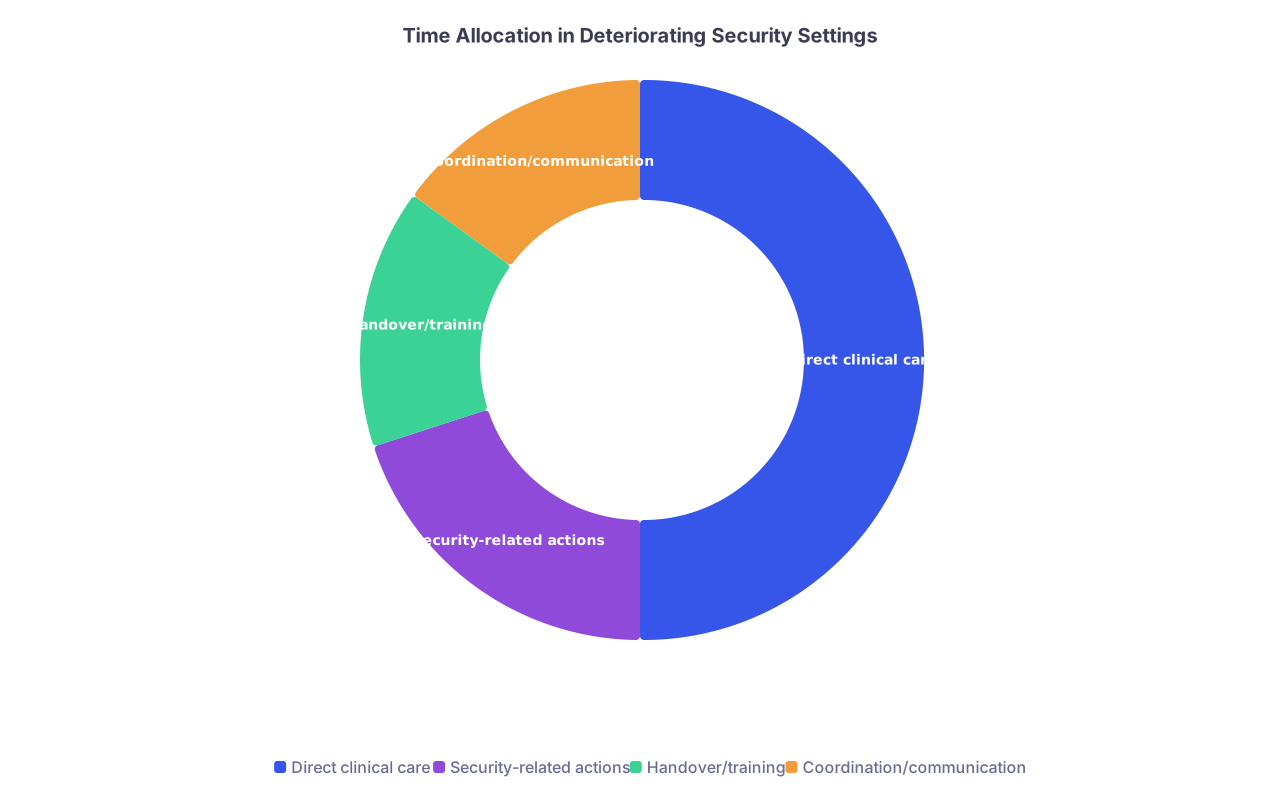
| Category | Value |
|---|---|
| Direct clinical care | 50 |
| Security-related actions | 20 |
| Handover/training | 15 |
| Coordination/communication | 15 |
When things deteriorate, your time naturally shifts. Accept that security, handover, and coordination are part of your ethical job, not a distraction from “real medicine.”
7. After You Leave: Guilt, Criticism, and Debrief
If you do this work long enough, one day you’ll leave a mission under pressure and hear later that people you knew were hurt or killed. Sometimes, no matter what you did, you’ll still feel like you abandoned them.
Three realities to keep in front of you:
You will be judged by people who weren’t there.
- Some will say you left too early. Others will say you left too late.
- Your protection is the process: Did you use clear criteria? Did you seek local input? Was your decision proportionate to what you knew?
Guilt does not equal wrongdoing.
- Feeling terrible after leaving does not necessarily mean you made the wrong call. It means you are a normal human who cares about patients.
You owe your future patients your survival.
- Throwing your life away in one mission reduces the total good you can do. That is not noble; it is wasteful.
Practical after-action steps:
- Demand a structured debrief from your organization: operational, security, and psychological.
- Write down what specific indicators you wish you had taken more seriously, or earlier. Those become your personal triggers next time.
- Talk honestly with peers who have been in similar situations. The only people who really get it are the ones who’ve also had to leave.
FAQs
1. What if my NGO leadership wants us to stay but local staff say it’s too dangerous?
Side with the people who live there. Local staff usually have much better threat perception. You present their assessment clearly to leadership and state your own professional threshold. If leadership still pressures you to stay in conditions you judge as unacceptable, you are morally justified in refusing—and if necessary, resigning or self-evacuating through your embassy or another channel.
2. Should I ever agree to armed escorts to continue medical work?
As a rule, no. Armed escorts inside health structures or visibly attached to your work usually destroy neutrality and make you a military target. Exception cases exist, but they’re rare and typically short-term, with strong community acceptance and alignment from neutral actors (like the ICRC). If you’re not experienced enough to parse those nuances, do not freelance this decision.
3. How do I explain to patients and families that we’re suspending services or leaving?
You keep it simple and honest without feeding panic or politics: “There is increased fighting and we’ve been told it’s no longer safe for us to travel/work here. We are very sorry to stop, and we are sharing all your medical information with [local staff/clinic] who will continue as they can.” Then you focus on a solid handover, not long apologies. Your job is to minimize medical harm, not to resolve every emotional reaction.
Open a blank document today and write your own three personal red lines for security while on mission. If you cannot name them now, under no pressure, you will not magically find them when the gunfire starts.


