

You’re between shifts, scrolling through emails, and you see yet another ad: “Global Health Certificate – 8 weeks – Stand out as a global physician!”
You’ve already done a couple of trips abroad. You care about equity, ethics, not being that visiting-doc disaster story. But you’re also not interested in paying $3,000 for a PDF no one respects.
You’re asking the right question: Which global health certificates actually matter for physicians—and which are just expensive wall décor?
Let’s cut to it.
The core truth: certificates are accessories, not engines
If you remember nothing else, remember this:
Jobs, fellowships, and serious global health work are driven by:
- Your experience (sustained work, not two-week “mission trips”)
- Your mentorship and networks
- Your skills (clinical + systems + research/quality)
- Your reputation (how you behave in partnerships)
Certificates can:
- Signal interest and a baseline of knowledge
- Help you get past an initial HR filter
- Occasionally tip a close decision in your favor
But they rarely transform a weak CV into a strong one.
So the goal isn’t “Which certificate is best?”
It’s “Which certificates add real value to what I’m already building?”
Types of global health certificates physicians chase (and which matter)
Let’s break down the main categories you’ll see and how they actually play in the real world.
1. University-based graduate certificates in global health
These are the “Global Health Certificate” or “Global Health Track” offered by medical schools or schools of public health.
Common examples:
- Harvard FXB Center / HMS global health-focused certificates/tracks
- UCSF, Duke, Hopkins, University of Washington global health pathways
- Many med schools now have a “Global Health Scholarly Concentration” or similar
When they matter:
- You’re applying for:
- Global health fellowships (e.g., HEAL Initiative, UCSF; Global Health Equity fellowships)
- Academic positions with a global health component
- Positions at major NGOs or academic/global consortia
- The certificate is attached to:
- Real coursework (epidemiology, implementation science, health systems)
- Mentored projects in a partner country
- Longitudinal engagement (months to years), not tourist electives
How these are viewed:
- In academic global health circles, a structured, university-based global health track is respected if it involved:
- A capstone or research/practice project
- Long-term partnership with a specific site
- Oversight by faculty who are actually known in the field
- If it was just “two online modules and a reflection essay,” people see through it instantly.
Bottom line:
Worthwhile if tied to genuine training + mentorship + field work.
Not magical on their own, but they signal seriousness when backed by substance.
2. Master’s-level training (MPH / MSc Global Health) vs. “mini-certificates”
You’ll see two very different things marketed:
Full degrees:
- MPH with global health concentration
- MSc in Global Health / Global Health Policy / Tropical Medicine
Short online “certificates” marketed as:
- “Mini-MPH”
- “Global Health Leadership Certificate in 6 weeks”
Let’s be honest.
Full MPH / MSc
- Highly valued for:
- Health systems, policy, implementation research
- Program design, monitoring and evaluation, leadership roles
- Often a de facto requirement for:
- Technical advisor roles at WHO, CDC, major NGOs
- Academic global health positions
- Time and cost heavy, but actually transform how you think and what you can do.
Short, non-degree certificates
- These almost never substitute for a degree in any serious employer’s eyes.
- They’re sometimes useful for:
- Residents wanting structured exposure without extra years
- Clinicians who’ll never do a full MPH but want conceptual grounding
| Option | Typical Length | Real-World Weight | Best Use Case |
|---|---|---|---|
| MPH Global Health | 1–2 years | High | Long-term global health career |
| MSc Global Health | 1–2 years | High | Academic/technical roles |
| Univ. Cert (for credit) | 3–12 months | Moderate | Pathway or building blocks |
| Online short certificate | Weeks–months | Low–moderate | Intro, not a stand-alone signal |
Bottom line:
Degree > for-credit grad certificate > branded short course.
Short “certificates” are fine as learning tools, but don’t expect them to open many doors.
3. Tropical medicine & travel medicine certifications
These are often the first that matter clinically.
Common options:
- CTropMed® / Certificate of Knowledge in Clinical Tropical Medicine and Travelers’ Health (ASTMH)
- Diploma in Tropical Medicine & Hygiene (DTM&H) from:
- London School of Hygiene & Tropical Medicine (LSHTM)
- Liverpool School of Tropical Medicine
- Swiss TPH, Mahidol, etc.
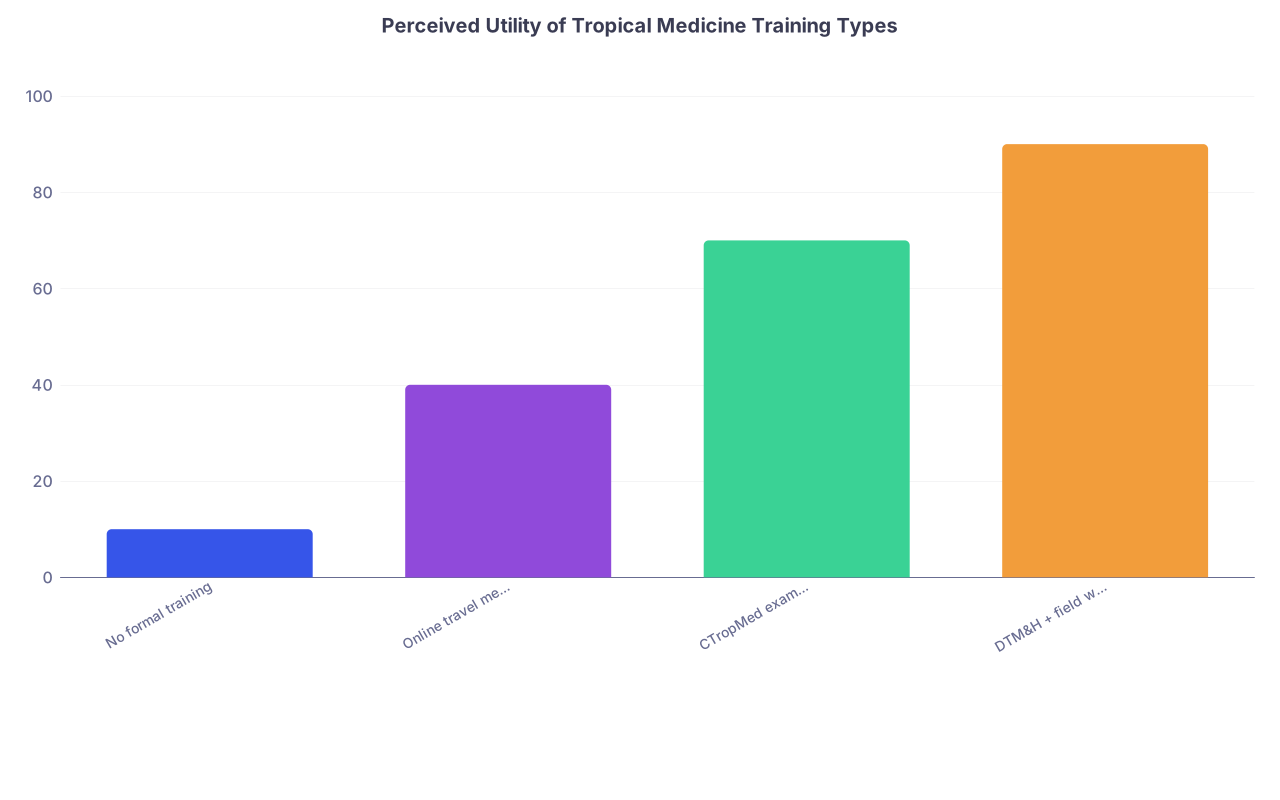
| Category | Value |
|---|---|
| No formal training | 10 |
| Online travel med CME | 40 |
| CTropMed exam only | 70 |
| DTM&H + field work | 90 |
How these are viewed:
- In infectious disease / refugee health / travel clinics / some global health roles:
- DTM&H + CTropMed = a serious signal that you know more than “malaria = fever + Coartem.”
- NGOs, ministries, and UN agencies recognize these because:
- They’re standardized.
- They’re exam-based and clinically oriented.
When they actually help your career:
- You want to:
- Run or staff a travel clinic
- Work in ID with a global or tropical focus
- Be a go-to person for returning travelers, migrants, or refugees
- They can:
- Make your CV stand out for ID fellowships with a global focus
- Help in getting roles in MSF, Partners In Health, etc., where tropical expertise is relevant
Bottom line:
Among “certificates,” DTM&H + CTropMed are some of the few that carry real, widely recognized weight. They’re hard, they’re specific, and they prove something concrete.
4. Humanitarian and NGO-branded certificates
You’ll see a lot of these:
- “Humanitarian Health Certificate”
- “Disaster Response Certificate”
- “Global Surgery Missions Training”
Often from:
- Universities partnering with NGOs
- NGOs themselves or consortium programs (e.g., humanitarian leadership programs)
How these are perceived:
- The organization’s name can matter more than the word “certificate.”
- A structured humanitarian training with MSF, ICRC, Red Cross, or WHO is respected.
- Random nonprofit you’ve never heard of offering a $999 online “Global Missions Certificate”? Less so.
- People look for:
- Does this org actually do real field work at scale?
- Do serious practitioners in humanitarian medicine know this training exists?
Legit examples (as of recent years):
- MSF internal pre-deployment and specialized trainings (not always open to outsiders)
- Some university-based humanitarian health certificates with embedded field practicums (e.g., Johns Hopkins, Harvard FXB + humanitarian work, Geneva-based programs)
Bottom line:
These matter if:
- They plug you into real humanitarian work and mentorship
- They’re anchored to an organization respected in humanitarian medicine
They don’t matter if:
- It’s mainly branding + slides + no field linkage.
5. Global health ethics and “mission trip” certificates
There’s a wave of ethics-focused offerings:
- “Ethical Global Health Engagement Certificate”
- “Short-Term Medical Missions Training”
On paper, this is good. Ethics in global health is not optional.
In reality, quality varies wildly.
When these are actually useful:
- Programs created or endorsed by known global health ethics leaders or serious institutions.
- Courses that:
- Force you to confront power, colonialism, local capacity, and sustainability
- Use real case studies and critical reflection
- Are mandatory or integrated into a larger, long-term program
How selection committees see them:
- As a positive but minor signal: “At least this person knows ethics matter.”
- They don’t replace robust experience or strong mentorship letters describing your behavior and judgment.
Bottom line:
Worth doing for your practice more than your CV. They’re more about making you safer and less harmful than getting you hired.
What actually moves the needle more than a certificate
Here’s the uncomfortable truth: many people chase certificates because they’re easier than doing the hard, slow work that actually builds a global health career.

| Step | Description |
|---|---|
| Step 1 | Interest in Global Health |
| Step 2 | Find long term mentor |
| Step 3 | Commit to one partner site |
| Step 4 | Return repeatedly over years |
| Step 5 | Build specific skills |
| Step 6 | Take targeted certificates or degrees |
| Step 7 | Leadership and impact roles |
If you want to be taken seriously in global health, you need:
Longitudinal engagement with a specific place or system
Not “I went to four countries for 2 weeks each,” but:- “I’ve worked with the same district hospital for 5 years on maternal health quality improvement.”
Mentors who vouch for you in the rooms you care about
- A PI of a global health program who picks up the phone for you
- An ID/global health attending with real partnerships, not just a travel hobby
Actual deliverables
- Program you helped build
- QI project with outcomes
- Papers, protocols, guidelines, training curricula
Skills your partners actually need
- Implementation science
- Health systems strengthening
- Monitoring & evaluation
- Teaching and curriculum design
- Specific clinical areas (HIV, TB, maternal health, emergency care, anesthesia, etc.)
Certificates can support these. They cannot replace them.
How to decide if a specific global health certificate is worth it
Use this as your filter.
| Question | If Mostly Yes → | If Mostly No → |
|---|---|---|
| Led by credible experts/organizations? | Consider | Skip |
| Includes mentored project or field link? | Stronger signal | Lower value |
| Provides skills tied to your goals? | Good investment | Likely fluff |
| Recognized by people in roles you want? | Useful | Cosmetic only |
| Affordable with clear ROI for you? | Reasonable | Probably not worth it |
And be explicit about your goal. Different goal, different answer.
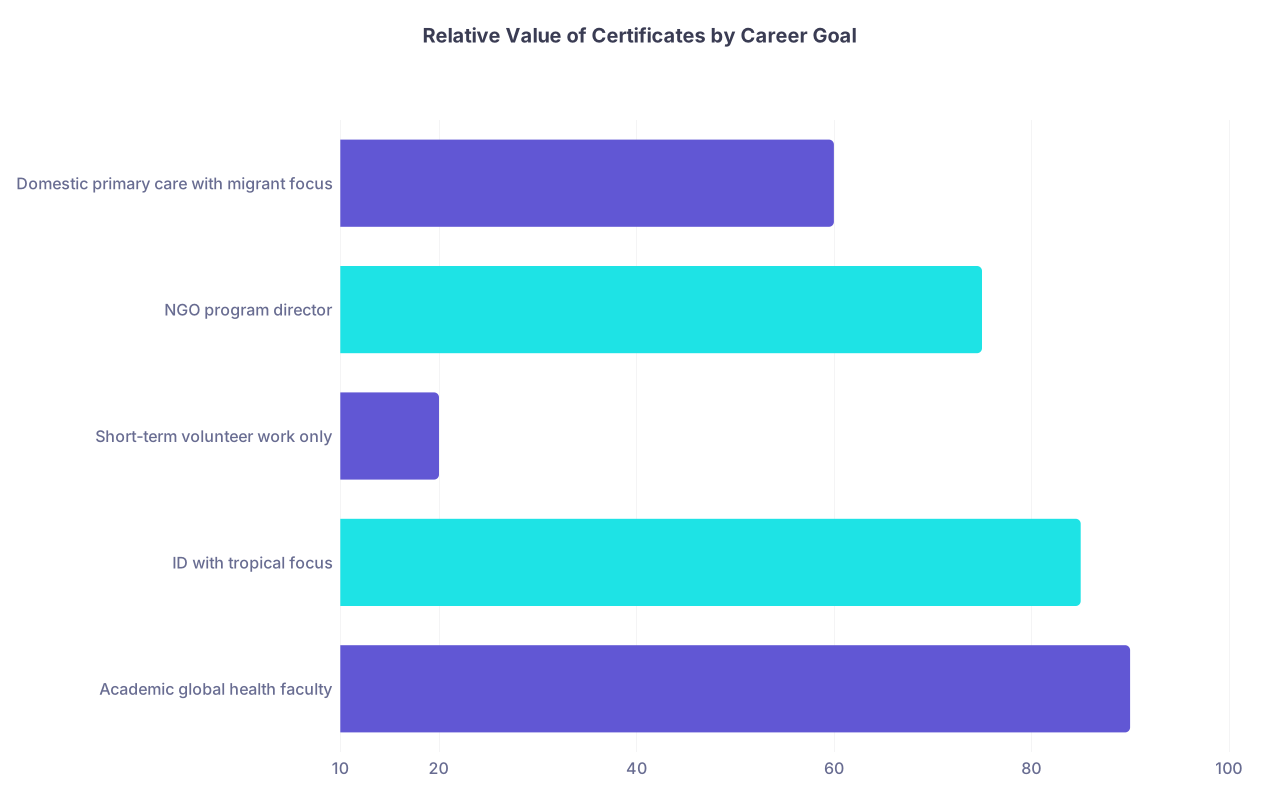
| Category | Value |
|---|---|
| Academic global health faculty | 90 |
| ID with tropical focus | 85 |
| Short-term volunteer work only | 20 |
| NGO program director | 75 |
| Domestic primary care with migrant focus | 60 |
- Want to be academic global health faculty?
→ MPH / MSc + serious university track beats random certificates. - Want to be ID/tropical medicine focused?
→ DTM&H + CTropMed actually carry weight. - Want humanitarian deployment roles?
→ Target training tied to MSF, ICRC, WHO, Red Cross, etc. - Want to just be less harmful on occasional trips?
→ Ethics + short global health primers are fine, but focus on choosing good partner organizations.
Quick recommendations by career stage
Medical student
- Skip expensive, independent online certificates.
- If your school has a serious global health track with mentorship + project, do it.
- Use free/cheap options (Coursera, WHO online courses) for foundation knowledge.
- Focus mostly on finding mentors and getting longitudinal, ethical involvement.
Resident
- If your residency has a global health track with structured curriculum + trips tied to real partnerships, that’s worth more than an external random certificate.
- Consider:
- ASTMH CTropMed prep if you’re ID/tropically inclined
- One solid, respected certificate (e.g., humanitarian health from a legit school) if clearly linked to your planned work
Early attending
- Before paying for anything, get clear:
- Are you aiming for academic promotion via global health?
- Do you want to work part-time for NGOs?
- Do you need credentials for a travel/tropical clinic?
- If yes, strongly consider:
- MPH or MSc (even part-time/online from a reputable institution)
- DTM&H + CTropMed if clinically relevant
FAQs
1. Do hiring committees actually care about global health certificates?
They care some. But they care much more about:
- Your publication record
- Your track record in one or two partner sites
- Your letters from known global health people
A top-tier certificate attached to real work can help. A random online “global health for doctors” badge mostly just pads your CV.
2. Is an MPH overkill if I just want to do a little global health on the side?
Probably, yes. If your goal is:
- “I want to be a good, ethical occasional visiting clinician,”
you don’t need an MPH. You need: - Good mentorship
- The right partners
- Ethical frameworks
If you want to lead programs, design interventions, or hold leadership positions in NGOs or academic global health, an MPH or MSc stops being overkill and starts being baseline.
3. Does the institution offering the certificate really matter that much?
Yes. The name on the certificate signals:
- Academic rigor
- Network quality
- How likely others in the field are to recognize it
A global health certificate from a top public health school with a strong global program is not the same as a no-name online academy you’ve never heard of charging $499 for “Global Doctor Pro.”
4. Are free online courses (Coursera, edX, WHO) worth listing?
List them sparingly and only if:
- They’re directly relevant to your role
- They’re substantial (multi-week, graded)
They’re more valuable for your own knowledge than as CV showpieces. One or two is fine. A giant list screams “padding.”
5. How many global health certificates is too many?
If you’re past 3–4 and don’t have:
- A clear project portfolio
- Long-term field work
- Strong letters in global health
you’re probably hiding behind certificates instead of doing the deeper work. One targeted tropical medicine credential, one serious humanitarian/global health certificate, and a degree if you’re committed long-term—that’s plenty.
6. I can only afford one major training investment. What should I pick?
If your primary identity is:
- Clinical ID / refugee / travel medicine → DTM&H (and CTropMed if possible).
- Academic global health / implementation / policy → MPH/MSc with global health focus.
- Humanitarian deployment (nonacademic) → A rigorous, well-known humanitarian health or crisis response program tied to a major NGO or reputable university.
Do this today:
Open your CV and highlight every line that says “certificate” or “course.” For each one, write in the margin: “What real skill, relationship, or opportunity did this give me?”
If the honest answer is “none,” stop chasing more of those. Then, pick one real step—email a potential mentor, explore a DTM&H program, or map a path to an MPH—that will actually change the work you’re able to do, not just what hangs on your wall.


