
The worst way to start global health as a new attending is to say yes to everything in your first year. You’ll look altruistic for about three months, and then you’ll be empty.
You can absolutely add global health in year one. But you have to treat it like a slow infusion, not a bolus. Here’s the timeline that actually works.
Months 0–3: Before You Say Yes to Anything
At this point you should be doing quiet, unglamorous groundwork. No trips. No big commitments. You’re building the foundation that prevents burnout later.
Step 1 (Weeks 0–4): Reality check your bandwidth
Sit down with three things in front of you:
- Your contract (or offer letter)
- Your call schedule
- Your loan repayment / financial plan
Now answer, in writing:
- How many nights of call per month are you on for the next 12 months?
- What’s your average weekly clinical hours likely to be (including documentation you do at home)?
- What’s your minimum acceptable income this year to meet your financial obligations without anxiety?
You’re building a capacity estimate, not a fantasy.
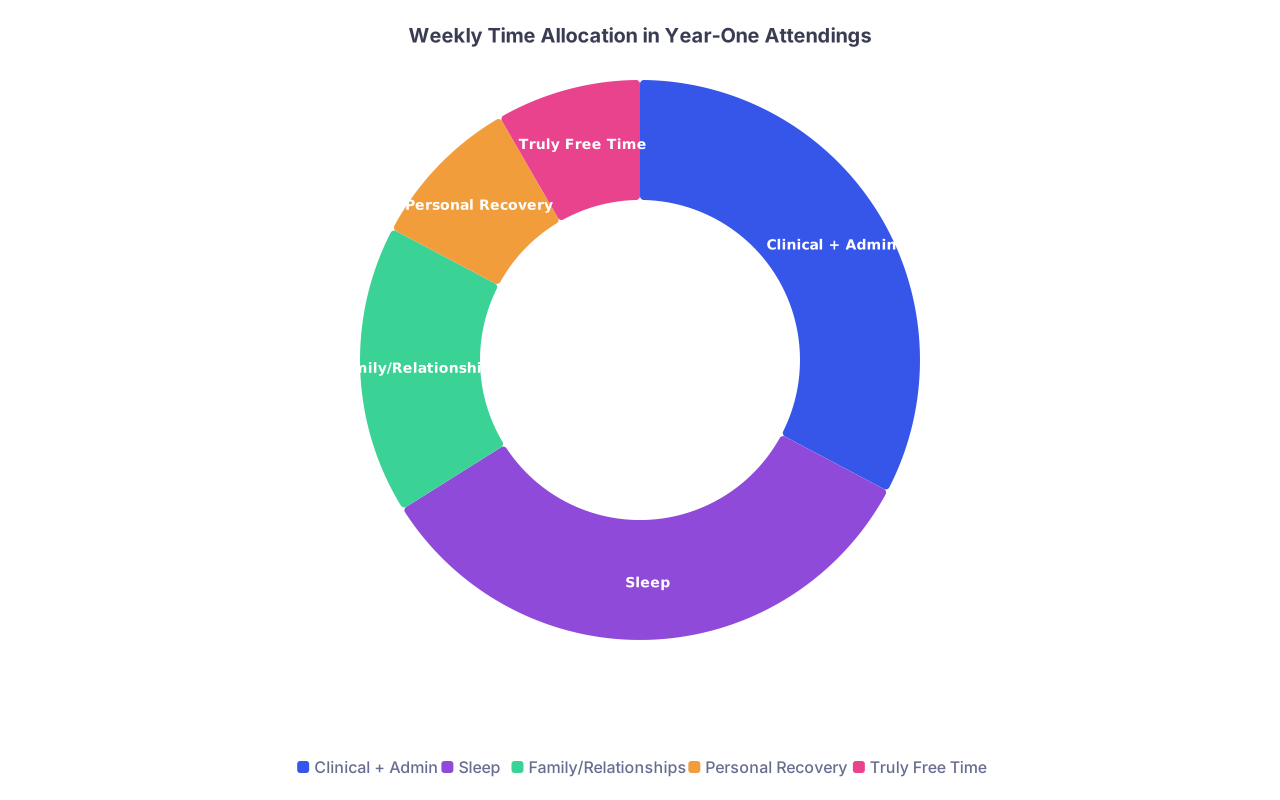
| Category | Value |
|---|---|
| Clinical + Admin | 55 |
| Sleep | 56 |
| Family/Relationships | 28 |
| Personal Recovery | 15 |
| Truly Free Time | 14 |
If you can’t find 5–8 protected hours per week on paper, you’re not ready for anything intensive overseas. You can still start global health, but you’ll start locally and virtually.
Step 2 (Weeks 2–6): Define your “global health lane”
This is where people mess up ethically. They treat “global health” as a personality trait, not a skill set.
Pick one main lane, maybe a minor second:
- Clinical service (e.g., emergency care systems, OB hemorrhage management)
- Education/capacity building (simulation training, curriculum design)
- Research/implementation science
- Health policy / advocacy
- Systems / quality improvement
Wrong move: “I’ll do some research, some short-term trips, maybe start an NGO.”
Right move: “For the first two years, I’ll focus on teaching and capacity building in emergency care.”
Write your lane in one sentence. Commit to it for 18–24 months before expanding.
Step 3 (Weeks 4–8): Ethics and harm reduction checkpoint
At this point you should confront the ethics head-on, before you book a flight.
Ask yourself bluntly:
- Am I planning to do anything abroad I’m not fully trained and credentialed to do at home?
- Am I imagining myself as “the hero” more than “a long-term partner”?
- Do I see this as a career thread or just a “feel-good” side quest?
If you’re not willing to say:
“I’d rather not go than do harm or waste local time,”
you’re not ready to go.
Read at least one of these in this window:
- Paul Farmer – Pathologies of Power
- Madhukar Pai – essays on decolonizing global health
- WHO guidance on ethical short-term medical missions
This is your ethical warm-up. It frames every decision you’ll make this year.
Months 3–6: Build Roots at Home Before You Get on a Plane
At this point you should be anchoring yourself: in your institution, in your home life, and in one global health community.
Step 4 (Month 3): Stabilize your clinical identity
Your first duty is to the patients who see you every day. If your attendingship is chaos, global health will just be extra chaos.
By the end of month 3 you should:
- Know your basic workflow cold (rounding rhythm, notes, handoffs)
- Be out of “I feel like an imposter every single day” mode most of the time
- Have at least one senior colleague you can be brutally honest with
If your day job is still a dumpster fire at month 3, you push back any serious global travel to at least month 9–12. No shame in that. It’s smart.
Step 5 (Months 3–4): Map your institution’s global health ecosystem
Now you look around and figure out what already exists. Not reinventing the wheel is ethical.
Do this, in order:
- Google “<your institution> global health” and find:
- Global health center / office
- International partnerships
- Faculty with country- or region-specific work
- Ask your department chair or division chief:
- “Who in our department is seriously involved in global health?”
- Schedule 3–5 short meetings:
- 1–2 people doing work you admire
- 1 administrator in the global health office
- 1 person who used to do global work and stepped back (they’ll tell you the burnout stories)
Your script for these meetings:
- “I’m a new attending in X. I’m interested in long-term, ethical engagement in Y lane. For year one, I have about Z hours/month and maybe 1–2 weeks I could realistically free up later in the year. How would you suggest I plug in without dropping balls here?”
You’re signaling that you’re not a tourist and that you understand constraints.

Step 6 (Months 4–6): Start local and virtual global health
This is where you actually begin global health—without leaving your city.
Pick 1–2 small, sustainable roles:
- Local immigrant/refugee clinic once a month
- Tele-education sessions with an existing partner site (case discussions, lectures)
- Helping develop protocols, curricula, or QI projects that support an ongoing partnership
- Joining a global health journal club or working group that meets monthly
Your goal for Months 4–6:
- 2–4 hours/month of consistent contribution
- 0 hours/month of “heroic last-minute scrambling for a big trip”
You’re testing your stamina in a low-intensity mode.
Months 6–9: Design a Sustainable, Ethical First Field Engagement
If you’re stable clinically and your life isn’t on fire, this is when you start planning anything involving travel.
At this point you should still not be booking tickets blindly. You’re co-building something.
Step 7 (Month 6): Decide if year one includes travel at all
This is the first hard fork.
Ask four questions:
- Am I consistently ending weeks with some fuel in the tank, or am I crawling into every weekend?
- Has my partner/family explicitly said: “We can handle you being away for a week or two”?
- Is my department willing to support this with real coverage, not favors you’ll repay forever?
- Is there an existing, long-term partnership that:
- Predates you
- Will continue after you
- Has clear needs that match your lane?
If any of those four is a solid “no,” you don’t travel in year one. You double down on virtual and local work and aim for year two. That’s not failure. That’s adult behavior.
Step 8 (Months 6–7): Choose the right kind of first trip
If you do move forward, your first in-person engagement should be:
- Short (5–10 days)
- With a pre-existing partnership
- With someone from your institution who’s been there before
- Focused on listening and learning, not on you running the show
Think:
- Co-facilitating a 3–5 day training that locals requested
- Joining a site visit to deepen a long-term project
- Sitting in on local QI meetings, ward rounds, or teaching sessions
Not:
- You doing a solo “mission trip”
- You setting up a new “program” from scratch
- You performing high-risk procedures without local systems to support follow-up
Months 7–9: Concrete Trip Planning (If You’re Going)
Now the planning becomes granular. This is where burnout prevention is mostly logistics.
Step 9 (Month 7): Block your calendar properly
At this point you should lock in your away dates and your buffer zones.
Bare minimum:
- 2–3 days off clinical before leaving
- 2–3 days off clinical after returning
That means:
- Submit official time-off requests
- Coordinate call swaps now, not 3 weeks out
- Tell your division/clinic schedulers explicitly: “I can’t add clinic the day after I land.”
| Day | Schedule | Purpose |
|---|---|---|
| Fri–Sun (pre) | Off / light admin | Pack, finish notes, sleep |
| Mon–Fri (week 1) | On-site work | Teaching/clinical/system work |
| Sat–Sun | On-site or transit | Travel + decompression |
| Mon–Wed (week 2) | On-site work | Wrap projects, handoff |
| Thu–Fri (post) | Off clinical | Debrief, jet lag, documentation |
If your group can’t tolerate those buffers, either shorten the trip or push it to next year.
Step 10 (Months 7–8): Clarify roles, scope, and ethics in advance
This is the part almost everyone glosses over, and it’s where ethical problems start.
You should have, in writing (even if it’s just an email summary):
- Your specific role
- “Deliver 4 case-based teaching sessions on X”
- “Observe and advise on triage system redesign”
- What you will NOT do
- “I will not provide independent surgical care”
- “I will not change protocols without local leadership approval”
- Expected outputs
- Slides, teaching materials left behind
- A short report or debrief summary
- Data or notes for a QI project (only if already agreed upon and IRB issues are clear)
And from the local partners:
- Their prioritized needs for your visit
- How your presence fits into their long-term plans
- Who on their side “owns” the project after you leave
You’re protecting them from your good intentions, and you’re protecting yourself from scope creep.

| Step | Description |
|---|---|
| Step 1 | Interest in travel |
| Step 2 | Check personal bandwidth |
| Step 3 | Identify existing partnership |
| Step 4 | Delay to year two |
| Step 5 | Clarify role and scope |
| Step 6 | Written agreement with local lead |
| Step 7 | Schedule with buffers |
| Step 8 | Travel and work |
| Step 9 | Debrief and follow up |
Step 11 (Months 8–9): Build your “burnout shield”
Before you go, put protections in place:
Personal:
- One person (friend, partner, mentor) who has permission to ask, “Are you overextended?” and expect an honest answer
- A pre-committed limit: “I’ll only pick up X extra shifts in the month before and after this trip”
- Sleep and exercise basics planned realistically, not aspirationally
Professional:
- Out-of-office messages that are actually firm
- Clear handoff of ongoing projects at home
- Agreement with your boss: “No new committee roles until after I’m back and we’ve debriefed”
The Trip Itself: Day-by-Day Rhythm That Won’t Break You
If you’re traveling in year one, the daily structure is what keeps you sane.
Days 1–2: Land, listen, and under-function
At this point you should be fighting the urge to be “useful” immediately.
Daily goals:
- Learn names and roles of key local staff
- Walk the hospital/clinic and just observe
- Ask: “What do visitors usually do that’s actually not helpful?” and then don’t do those things
You stay in low gear. You’re gathering context.
Days 3–5: Do the work, but stay in teaching and partner mode
Now you lean into what you were invited for.
Daily structure, roughly:
- Morning: Join local team activities (rounds, meetings) as a learner first
- Midday: Deliver planned teaching / contribute to agreed tasks
- Late afternoon: Debrief with local partner
- “What from today was actually useful?”
- “What should we change for tomorrow?”
Every evening, 15 minutes alone:
- Write down: 2 things that were meaningful; 1 thing that felt off ethically
- Ask yourself: “If I never came back, did this week still respect their time?”
That little ethics debrief prevents a lot of self-justifying nonsense later.
Days 6–10: Taper and hand off, not just work until the airport
Last 2–3 days should be handoff-heavy, not “maximize my impact” mode.
You should:
- Consolidate teaching materials and leave editable copies
- Identify one or two local champions for anything you started
- Explicitly ask: “What follow-up from me would actually be useful in the next 3–6 months?”
Wrong: Promising 20 things you’ll never realistically do.
Right: Committing to 1–2 small, achievable follow-ups.
Months 9–12: Debrief, Recalibrate, and Decide What Sticks
The most important global health work you’ll do in year one often happens after you get home.
Step 12 (Weeks 1–2 post-trip): Full stop and debrief
No heroics. At this point you should be protecting the re-entry window.
Do three debriefs:
With yourself
- What energized me vs. drained me?
- Did anything feel ethically wrong, even if “everyone does it”?
- Do I want to return, and if so, why really?
With your local partners
- “What worked? What didn’t? What would you want the same or different next time?”
- “Did my involvement create any burden or problems?”
With your institution
- Short written reflection or presentation to your global health office or dept
- Highlight both wins and ethical gray zones
This is how you turn a one-off trip into learning instead of just a memory.
Step 13 (Months 9–10): Set your ongoing global health “budget”
You now know how this fits into your life. Or doesn’t.
Create two annual budgets:
- Time budget
- X days per year of travel (maybe 0 in some years)
- Y hours per month of remote work (Zoom teaching, project emails, writing)
- Emotional/ethical budget
- Types of situations you will not put yourself in again (unsafe care, chaotic organizations)
- Clear signs for yourself: “If I’m feeling A, B, and C, I need to scale back”
You share the time budget with your chair and your partner/family. Out loud. No secret side hustle.
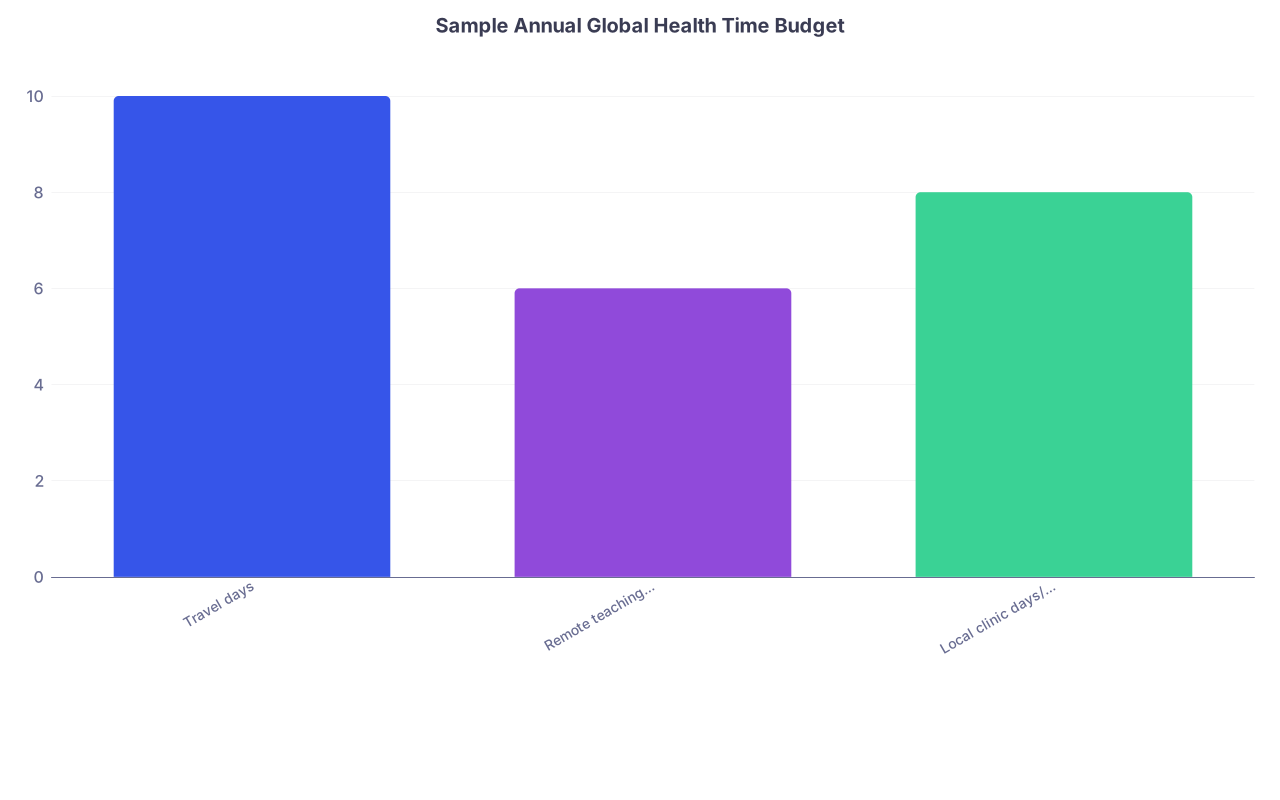
| Category | Value |
|---|---|
| Travel days | 10 |
| Remote teaching hours/month | 6 |
| Local clinic days/year | 8 |
Step 14 (Months 11–12): Decide your year-two posture
By the end of year one, you should not be deciding trip-by-trip. You should be choosing a posture:
- Explorer phase (low intensity)
- No travel or one short trip
- 4–6 hours/month steady engagement
- Builder phase (moderate)
- 1–2 trips per year, 7–10 days each
- Clear, ongoing projects in your lane
- Anchor phase (higher intensity, usually later)
- Leadership roles, grant writing, major program responsibility
- Usually not appropriate in year two unless you’ve been doing this since residency with the same site
For most new attendings, Explorer or very light Builder is sane. Anything more and you start trading off your career stability, your family, or your health.
The Non-Negotiables (So You Don’t Burn Out or Do Harm)
Let me finish bluntly. Over one year, if you want to add global health ethically and stay intact, you must:
Start small and consistent
Monthly, low-intensity commitments beat the flashy two-week blitz every time—for you and for partners.Anchor yourself at home first
If your day job is chaos and your personal life is smoke, global health will not fix that. It will hide it for a bit and then make it worse.Treat ethics as a timeline, not a checkbox
Before, during, and after every engagement, you keep asking:
“Is this still respectful, sustainable, and actually asked for?”
Follow this chronology, and year one won’t break you. It’ll set you up for a decade of real, grounded global health work instead of a string of exhausted, guilty, half-finished projects.


