

The fear that saying “no” will tank your career is exaggerated—and sometimes flat-out wrong.
You can say no to extra shifts as an intern without hurting your career. But you cannot do it carelessly, repeatedly, or with zero awareness of how residency actually works. The trick is understanding when “no” is reasonable, when it starts to look bad, and how to say it in a way that protects your reputation.
Let’s walk through this like an attending who’s seen this play out a hundred times, because I have.
The Real Answer: Yes, You Can Say No — But Not Every Time
Here’s the blunt version:
Residents who never help out are remembered. Residents who reasonably set limits are not punished long-term.
Where interns get into trouble is:
- Saying no all the time
- Saying no in a tone that screams “not my problem”
- Saying no at the worst possible moment (e.g., code blue-level chaos, skeleton crew weekends)
- Saying no while clearly doing something optional (studying at Starbucks, going to a concert)
Programs don’t expect you to be available 24/7 for every extra shift. They do expect:
- Reliability for your assigned shifts.
- Occasional flexibility when the team is truly drowning.
- A baseline sense that you’re a team player, not working-to-rule.
So yes, you can say no. The question is: What’s your pattern, and what’s the situation?
Step One: Know What Counts as “Extra” vs “Required”
Do not confuse “extra” with “required but annoying.”
Here’s the difference:
| Type of Shift | Usually Required | Usually Extra |
|---|---|---|
| Scheduled day/night shifts | ✅ | ❌ |
| Scheduled weekend call | ✅ | ❌ |
| Jeopardy/back-up call (if assigned) | ✅ | ❌ |
| Coming in early for your own team | ✅ | ❌ |
| Covering someone else’s sick call | ❌ | ✅ (unless you are the jeopardy) |
| Voluntary moonlighting (where allowed) | ❌ | ✅ |
If you’re on jeopardy or back-up, being called in is not “extra.” It’s what you signed up for that day. Turning that down will absolutely hurt your reputation.
If your chief texts:
“Hey, can anyone pick up Sunday 7a–7p? We’re short,”
that is an extra shift. You’re allowed to say no—especially if you’ve been working hard and need rest.
Step Two: Learn the “Three-Factor Test” Before You Say No
Here’s the decision framework I wish someone had given interns on day one. Before answering, quickly run through three factors:
- Context – How bad is the situation really?
- Your pattern – Have you helped before, or are you always unavailable?
- Your capacity – Are you genuinely at risk of burnout, error, or ACGME violation?
1. Context: What’s Actually Happening?
These are rough categories:
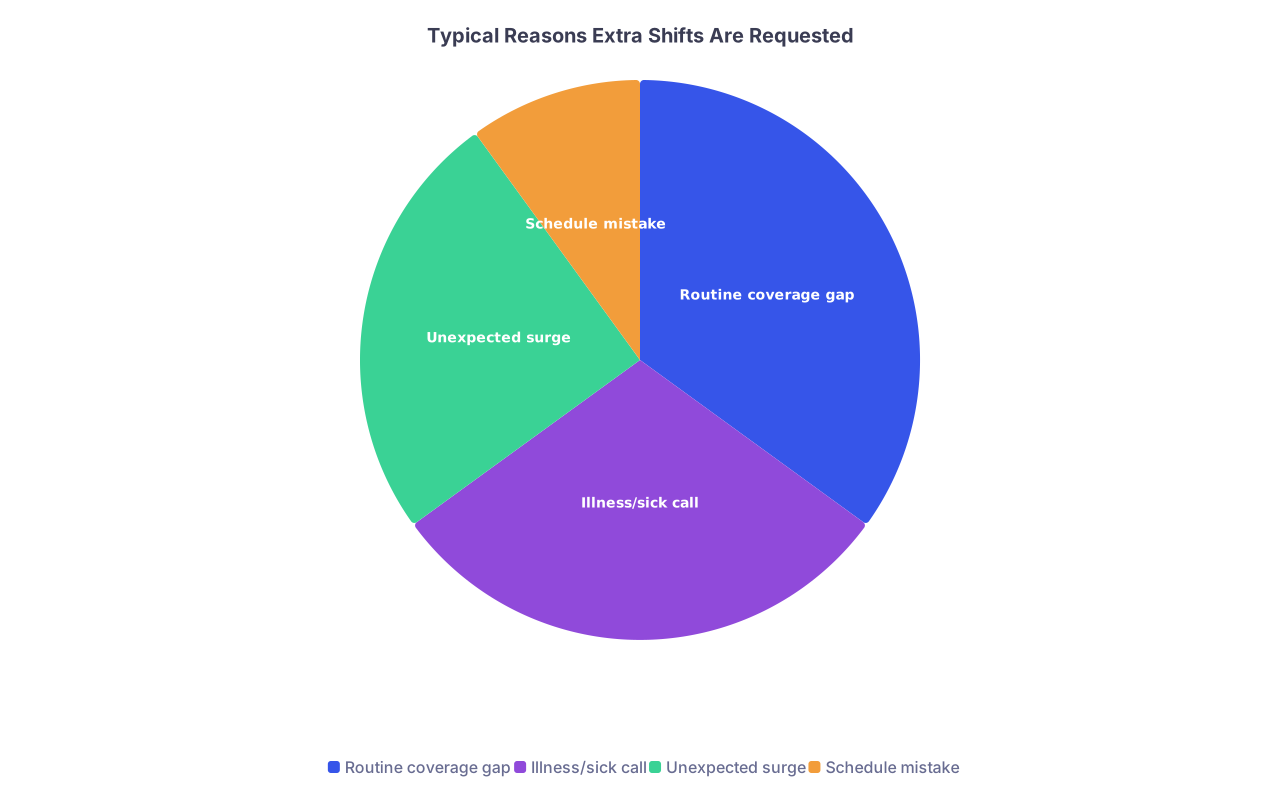
| Category | Value |
|---|---|
| Routine coverage gap | 35 |
| Illness/sick call | 30 |
| Unexpected surge | 25 |
| Schedule mistake | 10 |
Routine coverage gap: Someone graduated, scheduling error, mild census bump.
You’re more free to say no here.Illness / emergency: Co-resident with COVID, family emergency, OR with no coverage.
Saying yes occasionally in these cases is remembered positively.Acute disaster: ED on diversion, 30 admissions overnight, flu/RSV surge.
This is where a hard no—especially in a blunt tone—can make you look bad.
2. Your Pattern: Are You a Helper or a Ghost?
Programs don’t track every “no.” They remember your general vibe.
Roughly:
- If you often say yes (even to a few tough shifts), you can safely say no sometimes.
- If you rarely help and always claim you’re “swamped,” people start talking.
I’ve literally heard chiefs say in June:
“Yeah, we’re not asking X. They never help. Try Y—they’ve bailed us out before.”
Which intern do you want to be?
3. Your Capacity: Can You Safely Work That Shift?
You shouldn’t blow up your health, mental stability, or patient safety to look like a hero.
Red flags where “no” is not only okay but wise:
- You’re post-call and barely functioning.
- You’re in a serious mental health slump—crying in stairwells, panic attacks.
- You’re at or above ACGME duty hour limits.
- You’ve been on a brutal rotation with zero days off in sight.
When you’re at that point, an extra shift is not just difficult. It’s dangerous.
How to Say No Without Burning Bridges
Most interns screw this part up. They either:
- Say yes and resent it.
- Say no in a way that sounds selfish.
Here’s a better approach.
Template for Saying No (Reasonable, Brief, Not Over-Explaining)
To chief or scheduler:
“Hey [Name], I’m not able to pick up that shift. I’ve just finished a heavy stretch and need the day to rest. If something changes I’ll let you know, but for now I have to decline.”
To co-resident:
“I’d help if I could, but I’m already on [X] that weekend and I’m cooked. I have to sit this one out—hope someone else can step in.”
Key elements:
- Clear “no,” not a vague “maybe” that keeps them hanging.
- Short, honest reason focused on capacity, not entitlement.
- Tone: regretful but firm, not apologizing like you committed a crime.
What not to say:
- “No, that’s my only free weekend.” (Reads as “my time matters, yours doesn’t.”)
- “I’ve already done my share.” (Invites argument about who’s done more.)
- Ghosting and then texting the group chat from a brewery. Yes, this happens.
When You Actually Should Try to Say Yes
There are moments when picking up a shift is a good career move—even if it’s painful.
These include:
Your chief or PD explicitly asks:
When leadership says, “We’re in a bind, can anyone help?” and you have reasonable capacity, saying yes occasionally buys you a lot of goodwill.Your close co-resident is truly stuck:
Family funeral, medical emergency, childcare meltdown. People remember who showed up for them.You’re trying to repair a rough reputation:
If you’ve had issues—lateness, poor feedback, tension with the team—strategically helping with coverage can show growth.You actually want more reps:
Certain rotations (ICU, ED, trauma) are worth extra shifts if you’re aiming for a competitive specialty. You’ll see more procedures, more acute cases, more autonomy.
Use your “yes” wisely. You don’t need to be the hero all the time—but you do want a few stories people can tell about you being reliable when it counted.
How This Affects Letters, Fellowship, and Future Jobs
Here’s where people overestimate and underestimate the impact.
What Programs Actually Notice
Consistently helpful/respected intern:
Chiefs and attendings describe you as “solid,” “reliable,” “great team player.” When I’ve written letters, that language often comes from how you behaved day-to-day, not just your test scores.Consistently unavailable intern:
Story sounds like: “Clinically fine, but not someone we relied on in a crunch.” That doesn’t sink your career, but it definitely doesn’t help.
What Almost Never Happens
- Your whole career being derailed because you said no to a shift once.
- A fellowship director grilling you about a declined extra Sunday call in PGY-1.
- Your PD secretly adding you to a blacklist for turning down a voluntary coverage request.
Residency culture has shifted. There’s more awareness of burnout, wellness, and boundaries. Reasonable no’s, especially tied to fatigue or mental health, are not career suicide.
Special Situations: When the Stakes Change
Some scenarios are trickier. Here’s how I’d think through them.
1. You’re Struggling With Mental Health
If you’re asking this question because you’re barely keeping it together, the answer is simple: You’re allowed to protect yourself.
You might say:
“I’m really stretched thin right now and working with [mentor/therapy/PCP] on it. I’m not in a place to safely take on extra shifts.”
You do not need to disclose every detail. But looping in someone you trust (chief, advisor, wellness office) is smarter than silently imploding.
2. You’re in a Malignant Program
In malignant programs, everything is framed as “for the team.” Saying no gets labeled as “unprofessional” even when you’re clearly at risk of burnout.
You still have options:
- Document serious duty hour violations.
- Use GME or ombuds resources if you’re being pressured beyond policy.
- Quietly discuss with trusted seniors who know the politics.
Do not set yourself on fire to keep a toxic culture warm.
3. You’re on a Jeopardy Block
On jeopardy, “no” usually isn’t an option if you’re called in for that day. But if they start turning every day of your month into extra floating shifts beyond policy, you can set a boundary:
“I’m happy to cover when I’m officially on jeopardy, but I’m getting close to my hour limits and need to stay within them.”
Strategy: How to Build a “Safe” Reputation While Protecting Your Time
Think about your whole intern year, not a single shift.
Here’s a simple strategy:
- Aim to say “yes” to some difficult asks when you can handle it.
- Say “no” clearly and respectfully when your tank is empty.
- Be rock-solid on your assigned duties—show up on time, answer pages, own your patients.
- On the days you decline, do not look obviously more available than you claimed.
Over 12 months, people form a story about you. You want that story to be:
“Worked hard, stepped up a few times when we were really in trouble, and wasn’t a martyr about it.”
That’s more than enough to protect your career.

| Step | Description |
|---|---|
| Step 1 | Asked to cover extra shift |
| Step 2 | Generally must say yes |
| Step 3 | Voluntary extra shift |
| Step 4 | Say no clearly |
| Step 5 | Safe to decline this time |
| Step 6 | Consider saying yes to build goodwill |
| Step 7 | Jeopardy or required? |
| Step 8 | Too exhausted or unwell? |
| Step 9 | Pattern of saying yes? |
FAQs
1. Will saying no to an extra shift hurt my evaluations?
Not if it is occasional, reasonable, and you’re otherwise reliable. Evaluations tank when you’re chronically late, disengaged, or never help the team—not because you said no to one or two extra coverage requests.
2. Do I have to explain why I am saying no?
You don’t need a full life story, but a brief reason helps: fatigue, prior commitment, mental health, or being at duty hour limits. One or two sentences is enough. Over-explaining can sound defensive or invite debate.
3. What if my chief makes me feel guilty for saying no?
Guilt is sometimes used as a tool to get coverage. You can acknowledge the bind without caving: “I know it’s a tough situation and I wish I could help, but I really can’t safely take that on right now.” If guilt tactics are constant and extreme, that’s a systems problem, not your personal failure.
4. Can my program retaliate if I refuse extra shifts?
Retaliation for reasonable boundary-setting, especially related to fatigue or wellness, is risky for programs and uncommon in healthier environments. That said, toxic cultures exist. If you suspect unfair treatment, document patterns and consider talking to GME, an ombuds, or a trusted faculty mentor outside the chief structure.
5. How many times is “too many” to say no?
There’s no magic number. Think about balance. If you never help, you get a reputation as unavailable. If you help when you can and decline when you cannot, that pattern is fine. Over a year, saying yes to a handful of requests and no to the rest is completely normal.
6. Should I ever lie about my reason for saying no?
No. Lying about being “sick” or “out of town” when you are not is how you get destroyed if someone sees you out or posts something on social media. A simple “I’m not able to take that on” or “I need the time to rest” is honest and enough.
7. Does saying yes to extra shifts help with fellowship or job applications?
Indirectly, yes—if it builds your reputation as reliable, hardworking, and committed. Chiefs and attendings writing your letters will remember “they stepped up when we were short.” But nobody is counting individual extra shifts; it’s about the overall impression you create during residency.
Bottom line: You absolutely can say no to extra shifts as an intern without wrecking your career. Protect your capacity, say yes strategically when it really matters, and communicate your no with clarity and respect. Do that consistently, and you’ll come out of intern year with both your reputation and your sanity intact.


