
Your first code blue as an intern will expose every gap in your training in about 10 seconds.
Not because you do not know ACLS. Because you do not yet know your role. The chaos is predictable; your reaction is not. That is what we will fix.
I am going to walk through what you actually do as an intern in a code, step by step, from the second your pager screams to the moment you walk out and write the note. You will get three things:
- Clear role expectations (what you should and should not be doing)
- Practical checklists you can mentally run during the code
- Concrete mental scripts you can rehearse now so you do not freeze later
This is not theory. This is the “I am cross-covering nights, I am alone, and the code pager just went off” playbook.
The Moment the Pager Goes Off: Before You Reach the Room
If you blow the first 60 seconds, it follows you into the room. You want an automatic sequence here.
Your pre-arrival checklist (10–30 seconds)
Pager goes off: “CODE BLUE – Room 745”
You immediately run a mental checklist:
- Where am I? How far from the room?
- What do I need with me?
- How am I going to enter the room and find a role?
If you are primary team on that patient (daytime on your own ward), there is an extra piece: very fast chart scan on the way.
Here is the mental mini-checklist that works:
- While walking (do not stand at a computer to do this):
- MRN or name into EMR on your phone or nearest workstation
- Skim for:
- Code status
- Reason for admission
- Major comorbidities (severe COPD, ESRD, EF 10%, recent massive GI bleed)
- Any recent bad labs: K, pH, troponin trend, hemoglobin
- Glance at vitals trend: hypotensive for hours vs sudden collapse
You are not building a full picture. You are arming yourself with 2–3 fact bullets you might need when someone asks “What is the story?” or when deciding on shocks, intubation, and when enough is enough.
If you are not the primary team and it is a random cross-cover code on a patient you have never seen, skip the deep dive. Just check:
- Code status
- Major do-not-do items (DNI, “no chest compressions,” comfort-only)
Then get to the room.
When You Enter the Room: Claim a Role Fast
Walking into a code without a plan is how interns get stuck in dead space: standing by the wall, touching nothing, learning nothing. The first 5 seconds are about finding your lane.

| Step | Description |
|---|---|
| Step 1 | Enter Room |
| Step 2 | Find Open Role |
| Step 3 | Start CPR and Airway Assessment |
| Step 4 | Begin Compressions |
| Step 5 | Assist at Code Cart |
| Step 6 | Time and Events |
| Step 7 | Leader Present |
| Step 8 | What is Needed |
The core roles in a code
On paper there are many people. In reality, there are 4–5 functional roles that matter:
- Team leader (usually senior resident, ICU fellow, ED attending)
- Compressor
- Airway manager (often anesthesia, ICU fellow, or experienced resident)
- Meds/code cart nurse
- Recorder / timer / “loud voice” for times and rhythm checks
As an intern, you are usually one of these three:
- Compressor
- Recorder / timer
- Medication support / line monkey / “runner”
Let me spell them out precisely.
Role 1: The Intern as Compressor – Doing High-Quality CPR Correctly
If you do not know what you are doing yet, default to compressions. It is the most high-yield, lowest-cognitive-load job you can do while you get your bearings.
Compression checklist: what “good” actually means
You have heard this a hundred times in ACLS. On the floor, people still get it wrong.
Your job:
- Depth: about 5–6 cm (2–2.5 inches) in adults
- Rate: 100–120 per minute
- Full chest recoil between compressions
- Minimize interruptions
What you actually do in practice:
- Say out loud: “I am starting compressions.” Then start.
- Lock arms, shoulders over sternum, straight back. You are not wiggling; you are dropping your body weight.
- Count in your head or use the monitor beeps if set to 100 bpm. Some people quietly use a song. Not out loud.
- Watch the monitor waveform and the arterial line if present. Good compressions give a nice arterial line pulsation and high-quality end-tidal CO2.
- Rotate off every 2 minutes when someone calls for a rhythm check. If no one calls, you say loudly at about 1:45: “Next compressor ready? Switching in 15 seconds.”
That last bit is key. A lot of codes do not have a perfect leader right away. If the room is leader-light, you can still keep structure around compressions.
Mental script for claiming this role
As you walk into the room and see chaos, say:
“Is anyone on compressions? If not, I can start.”
If someone is already compressing and looks exhausted:
“How long have you been going? I can take over on the next switch.”
You have now given yourself a clear job and bought time to get oriented.
Role 2: The Intern as Recorder/Timer – Owning the Clock
This is the most underrated intern role and the one that makes you feel like you actually know what is happening.
Your job is not just to scribble. You are the code’s external brain.

What you actually track
You track:
- Start time of arrest / arrival time
- Rhythm checks and what the rhythm was
- Shocks: times and joules
- Meds: epinephrine (most important for timing), amiodarone, others
- Airway: bag-mask, intubation time, tube size, confirmation
- ROSC time if achieved
There is usually a code sheet or electronic flowsheet. Use it. But your real value is saying time out loud.
Mental pattern:
- “We started compressions at 14:08.”
- “First epi at 14:09.”
- “Two minutes up — time for rhythm check.”
- “Second shock at 14:11, 200 J.”
- “Second epi given at 14:13.”
You are not just documenting; you are nudging the team back onto the ACLS clock.
Timer mental checklist
Run this loop in your head, and partially out loud:
- Current minute of the code
- Time since last epi (epi every 3–5 minutes)
- Time since last rhythm check (about every 2 minutes, coordinated with compressions switch)
- Total time of resuscitation (helps guide end-of-code discussions)
You can literally write small timestamps in the margins:
- 14:08 – arrest / CPR
- 14:09 – epi #1
- 14:10 – rhythm check → VF, shock #1 200 J
- 14:11 – CPR resumed
- 14:13 – epi #2
- 14:14 – rhythm check → PEA, no shock
If the leader is distracted, you become the person who says, calmly: “Next epi is due. Last one was at 14:13.”
Role 3: The Intern as Medication / Procedures Support
Sometimes compressions and recording are covered. Then your job is to become the “procedural backbone” for the leader and nurses.
What this role actually looks like
You might:
- Draw up meds at the code cart with the nurse
- Push meds when asked (once you are comfortable and the nurse confirms dose)
- Hang fluids or pressors if ROSC is achieved
- Place an IO (if you are trained and allowed)
- Place lines after ROSC, not during the most chaotic phase
The checklist in your head:
- Is there IV/IO access?
- Are meds being given on time?
- Are we running pressors right after ROSC (not 10 minutes later)?
- Is someone watching for extravasation, infiltration, line issues?
You are not freelancing medications. You respond to explicit orders. But an intern who can calmly say to the leader:
- “We have two IVs, 18 and 20 gauge.”
- “Epi given now.”
- “Do you want amiodarone after this next shock?”
…is worth their weight in gold.
Role 4: The Intern as “Mini-Historian” – If It Is Your Patient
If this is your patient or on your service, you have an extra responsibility: you are the person who actually knows the human in the bed.
While everyone else sees “70-year-old in PEA arrest,” you know:
- They have metastatic pancreatic cancer and were DNR until yesterday.
- Or they are a 35-year-old with myocarditis who was improving.
- Or they had active GI bleeding this morning and are now in arrest.
Your job is to compress this into three sentences when asked:
“Quick story: Mr. Jones is a 68-year-old with severe COPD and HFrEF, admitted two days ago with pneumonia and sepsis. Code status is full code. He was on 4 L nasal cannula, hypotensive but on low-dose norepinephrine in the ICU step-down. He had rising lactate but stable hemoglobin.”
That is it. No novel. Just context.
If you do not know all that yet, say what you know and what you do not:
“I am the intern. I just admitted him last night with decompensated cirrhosis and variceal bleed. Code status is full. I am pulling up more details now.”
Then shut up and let the leader run the code.
The Mental Architecture of a Code: What You Should Be Holding in Your Head
Even as an intern, you are not exempt from thinking. You need a basic framework so you are not just a pair of hands.
Think in three layers:
- Immediate objective: high-quality CPR, early defibrillation
- Reversible causes
- When to stop
1. Immediate objective: compressions + shock if indicated
Your 10-second mental script when you see the patient:
- “Are we doing compressions?”
- “Is there a monitor rhythm?”
- “Is it shockable?”
If VF or pulseless VT on the screen, your mental command is: “Shock fast, then back on the chest.”
You do not argue about exact joules or who will press the button. You let the leader give those specifics, but you should know the pattern:
- Shockable rhythm → shock → immediate CPR → epi after second shock in most algorithms → consider amiodarone after third shock
- Non-shockable rhythm (PEA/asystole) → CPR + epi as soon as possible → rhythm checks q2 min
2. Reversible causes: the Hs and Ts, simplified
No, you are not going to recite all Hs & Ts mid-code. But you should hold a simple version in your head as you look at the chart and bedside:
Hs
- Hypoxia
- Hypovolemia
- Hydrogen ion (acidosis)
- Hyper/hypokalemia
- Hypothermia
Ts
- Tension pneumothorax
- Tamponade
- Thrombosis (MI / PE)
- Toxins
The practical way you use this:
- Sudden arrest after central line placement? Think tension pneumothorax. Check breath sounds.
- Arrest after chest pain with ST elevation earlier? Think coronary thrombosis.
- Dialysis patient with K 7.5 this morning? Think hyperkalemia. Push calcium, insulin, bicarb if appropriate.
- Massive GI bleed with hypotension? Think hypovolemia. Get blood running.
You will not be ordering treatments independently in the first 2 minutes, but you should be quietly asking yourself: “What is the likely reversible cause here?” and feeding that to the leader if useful.
Essential Mental Scripts You Can Rehearse Now
You do not want your first spoken words in a code to be improvised. Scripts help.
Script 1: Walking into the room
You enter, see compressions in progress, leader at foot.
You: “Hi, I am the intern from medicine. How can I help?”
Possible answer: “Take over compressions.” Great. You do it.
Or: “Can you be the timer and recorder?” You grab the sheet and own it.
Or: “This is your patient – give us a 10-second summary.” You give that tiny, prepared “quick story.”
Script 2: Announcing what you are doing
When you do anything in a code, say it out loud.
- “Starting compressions now.”
- “Switching compressors.”
- “Epinephrine 1 mg IV push now.”
- “Rhythm check – pausing compressions… VF, charging to 200 J… shock delivered, back on compressions.”
You are building a shared mental model for the room. It also makes you look like you are not lost, even when your heart rate is 140.
Script 3: Post-ROSC immediate actions
ROSC (return of spontaneous circulation) is when people relax too early and patients re-arrest.
Your internal checklist:
- Airway: secured? ET tube position confirmed?
- Breathing: SpO2, ventilation rate (avoid hyperventilation), ABG if possible
- Circulation: BP, MAP, pressors? 12-lead ECG for MI?
- Glucose: check and treat
- Temperature: are we initiating targeted temperature management if indicated and available?
You can say:
“We have ROSC at 14:17. Blood pressure is 78/40. Do you want to start norepinephrine?”
Or:
“Can I get an ABG and lactate? Also checking a fingerstick glucose now.”
That is the difference between a passive intern and one who is clearly thinking.
The Emotional Reality: Panic, Noise, and Cognitive Bandwidth
Let me be blunt: the first few codes you go to, you will be half-useless for the first minute. That is normal.
Here is what actually undercuts intern performance:
- Noise: shouting, alarms, multiple leaders talking
- Visual overload: tubes, wires, blood, random people entering and leaving
- Role confusion: 3 people trying to lead, nobody timing, nobody owning access
- Fear of being judged: you do not want to look dumb in front of the ICU fellow
Your protection is a small, rigid set of habits.
Habit 1: Always anchor to a role
As soon as you enter: “Which job am I doing?” If no one assigns you one, assign yourself:
- Compressors
- Recorder
- Runner / meds assistant
Standing in the back “observing” is for medical students. You are the doctor now. Touch the patient or touch the code sheet.
Habit 2: Narrow your attention
You cannot process everything. That is fine. Focus on your square of responsibility.
If you are compressing, your world is:
- Depth
- Rate
- Minimal interruptions
- Ready backup when you fatigue
You do not need to track epi timing and whether the tube is at 23 cm. Someone else is doing that. The more you try to see everything, the less effective you are at anything.
Habit 3: Reset your breathing
You will be tachypneic. Everyone is. While you are not actively talking, force a quiet pattern:
- Inhale for 4 seconds
- Hold 1 second
- Exhale for 6 seconds
You will feel silly if you think about it. Do it anyway. It pulls your HR down and clears enough cognitive fog to speak clearly when it matters.
Checklists to Burn into Your Brain
Let me give you compact, repeatable lists. Not theory. Things you can literally run in your head on the elevator to a code.
Pre-code elevator checklist (on your way there)
- Code status?
- Any big obvious cause? (massive PE, GI bleed, STEMI, severe hypoxia)
- Lines / access known? (central line, A-line, dialysis line)
- Any clear ceiling of care or “we should not be here” concerns?
If you do not have the chart yet, the checklist becomes:
- Where is the code cart?
- Who looks like they are leading?
- Which role will I grab on entry?
During code – intern 3-box checklist
Every 60 seconds, ask yourself:
- Am I doing my role well? (compressions, timing, meds)
- Is there a gap nobody owns? (no timer, no one rotating compressors, no one talking)
- Do I know the story enough to answer a direct question?
That is it. You do not need the full ACLS tree in your head to be high-value.
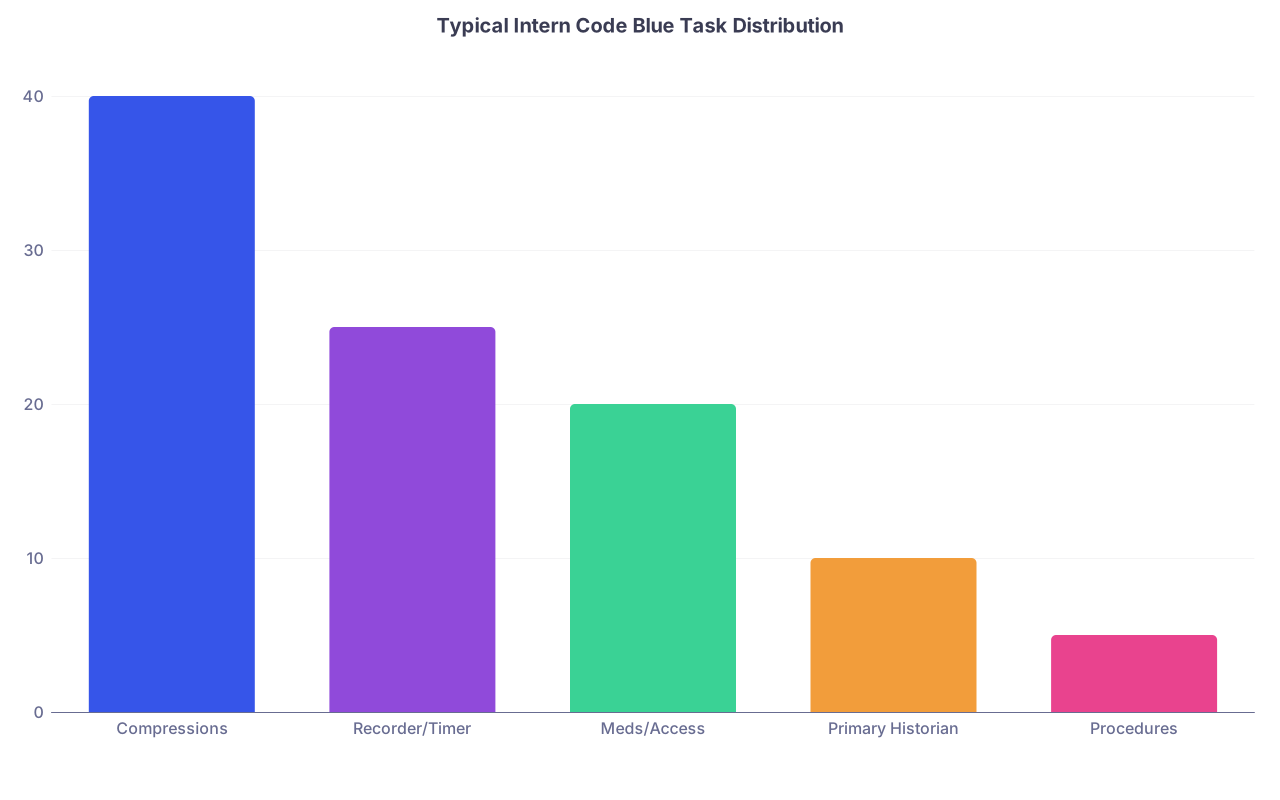
| Category | Value |
|---|---|
| Compressions | 40 |
| Recorder/Timer | 25 |
| Meds/Access | 20 |
| Primary Historian | 10 |
| Procedures | 5 |
After the Code: Debrief, Note, and Mental Reps
What you do after the code matters for learning and for your sanity.
Immediate post-code: your quick internal review
Ask yourself these specific questions:
- What role did I play? Did I stick to it?
- One thing I did well? (you need this, or every code will feel like failure)
- One thing I clearly did not know or froze on?
Examples:
- “I kept compressions going with minimal pauses. Good.”
- “I forgot the epi timing window and someone else had to remind me. Fix that.”
- “When they asked for a quick story, I blanked. Next time, I need a 3-sentence script in my pocket.”
Write those down somewhere. Seriously. The “pattern” of what you keep missing will show up after a few codes.
Documentation: what your code note should actually include
You will eventually be the one writing the code note. Do it accurately. The core elements:
- Time of collapse (if known) and time CPR started
- Initial rhythm
- Sequence of interventions (CPR, shocks, meds, intubation, procedures) with approximate times
- ROSC time, if achieved, and post-ROSC status
- If patient died: time of death, brief statement on likely cause, whether family was notified and by whom
- Any major reversible causes identified and treated
Do not write a novel. Focus on clarity and times. Your code sheet will be your friend here.
Systems-Level Reality: Day vs Night, Floor vs ICU
Codes are not all created equal. The dynamics change by location and time.
| Setting | Who Usually Leads | Intern Typical Role | Chaos Level |
|---|---|---|---|
| Daytime ICU | ICU fellow | Compressor / meds | Moderate |
| Night ICU | Senior resident | Compressor / timer | High |
| Daytime Floor | Rapid response / ICU team | Historian / runner | Moderate |
| Night Floor | Senior resident cross-cover | Compressor / recorder | Very High |
| ED | ED attending | Compressor / meds | High |
On the floor at 3 a.m., the “team” might be:
- You (intern)
- One senior resident covering multiple units
- 2–3 nurses
- Respiratory therapist if you are lucky
In that context, interns often end up doing more than one role at once, which is why having those mental scripts is critical.
In the ICU, codes tend to be more structured; people know each other, roles are pre-assigned, and the leader is usually clear. Your job then is to be efficient and anticipatory within your lane, not reinvent the code.

Practicing Before You Ever See a Code
You do not need a simulation center to get better at this. You need repetition of the mental moves.
Simple solo drills you can do
Watch a code/cartoon ACLS video with the sound off. Pause at random times and ask:
- “What is the rhythm?”
- “Is this shockable?”
- “What is due now: shock, epi, or just compressions?”
Stand in your room and physically practice compressions on a pillow:
- Set a metronome to 110 bpm
- Go hard for 2 minutes straight
- Feel how quickly you fatigue
Script writing:
- Write out your 3-sentence “quick story” for three hypothetical patients:
- 25-year-old with PE
- 75-year-old with metastatic cancer
- 60-year-old post-MI in the ICU
- Practice saying them out loud in under 10 seconds.
- Write out your 3-sentence “quick story” for three hypothetical patients:
Clock drills:
- Set a timer for 5 minutes. Imagine a code. At “time 0,” give epi.
- At each minute mark, say out loud what should be happening (rhythm check, next epi window, etc.).
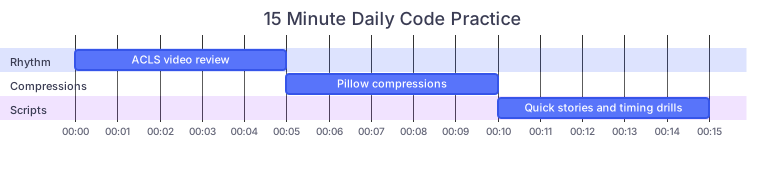
| Task | Details |
|---|---|
| dateFormat HH | mm |
| axisFormat %H | %M |
| Rhythm: ACLS video review | a1, 00:00, 5m |
| Compressions: Pillow compressions | a2, after a1, 5m |
| Scripts: Quick stories and timing drills | a3, after a2, 5m |
When Things Go Badly (And They Will)
You will be at codes where:
- The patient dies despite perfect ACLS
- The team leadership is terrible and disorganized
- A family member is watching and sobbing at the doorway
- Afterwards, someone makes a cutting comment about something you did or did not do
You cannot fix all of that. What you can control:
- You show up fast.
- You claim a role.
- You do that role competently.
- You reflect afterwards and tighten your process.
If you really feel shaken after a code, find the senior or attending you trust and say it straight:
“That code rattled me. Can we debrief what happened and what I could have done better?”
The worst pattern I see is interns avoiding codes after a bad one because they feel useless. The only way out is through. Codes are one of the few places where reps actually matter more than raw intelligence.

Three Things to Carry Into Your Next Code
Let me strip this down to the bare essentials.
Your first task is not to be a hero. It is to own a role.
Compress, record, or support meds/access. No standing at the wall. Touch the patient or touch the code sheet.Run micro-checklists and speak out loud.
Time epi. Announce shocks. Call for compressor switches. Say what you are doing. You stabilize the room just by tracking the clock and narrating.Prepare scripts now, not during your first arrest.
Have your 10-second “quick story.” Have your stock entry line: “I am the intern from medicine – how can I help?” Have your ROSC checklist in your head.
You will still feel your heart rate climb when the pager goes off. That will not change. What changes is this: you will know exactly what you are going to do in the next 30 seconds.