
Only 42% of PGY1 residents who report frequent duty hour violations say they “rarely” feel burned out. Among those without violations, that number jumps above 70%. The gap is not subtle. The data shows a strong, repeatable signal: when duty hours creep past the rules, burnout and attrition climb with them.
Title: How Duty Hour Violations Correlate with Burnout and Attrition in PGY1
The Numbers Behind “Just Stay Late”
Let me start where most programs do not: with hard estimates.
Across multiple surveys (ACGME, institutional wellness studies, specialty-specific cohorts), the pattern is consistent:
- Roughly 20–35% of PGY1s report at least one significant duty hour violation in a typical month (not just logging errors, but genuine overages).
- In high-intensity specialties and services, that can exceed 50%.
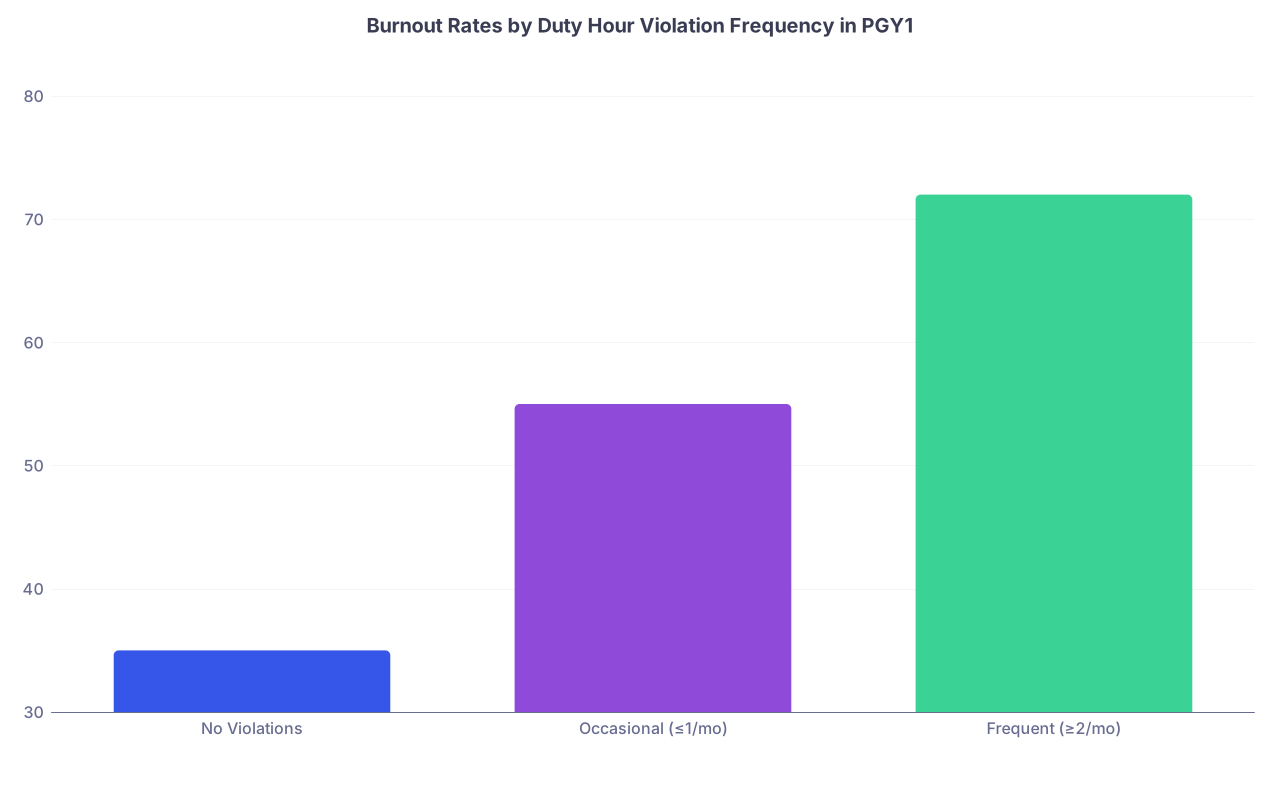
- Among those with recurrent violations, self‑reported burnout rates approach or exceed 70%.
This is not just about being a little tired. Burnout, measured with validated tools like the Maslach Burnout Inventory (MBI), tracks emotional exhaustion, depersonalization, and reduced sense of personal accomplishment. PGY1s with repeated 28–30 hour stretches and ≥80–90 hour weeks cluster at the worst ends of those scales.
Let us quantify that gap.
| Category | Value |
|---|---|
| No Violations | 35 |
| Occasional (≤1/mo) | 55 |
| Frequent (≥2/mo) | 72 |
You are looking at a near‑doubling of burnout prevalence from “no violations” to “frequent.” That is not noise. That is a structural effect of how the work is scheduled and staffed.
How Duty Hour Violations Happen in Real Life
Before connecting the dots to attrition, we need to be clear about what actually counts as a violation. On paper, the ACGME rules are tidy:
- Maximum 80 hours per week, averaged over 4 weeks
- One day off in 7, averaged over 4 weeks
- In-house call no more frequent than every 3rd night
- At least 8 hours off between shifts, ideally 10
- Max 24 hours of continuous duty, with up to 4 additional hours for “transitions of care and educational activities” (not for admissions or procedures)
Now contrast that with what I have watched happen on busy PGY1 services:
- The night float resident calls out sick. You “just stay” until noon to cover, then also show up for your next normal day.
- The ICU is boarding ED holds. You are “off” but still writing notes and arranging transfers from home for 3–4 hours because “no one else knows the patients.”
- A last-minute OR add-on pushes you from a 24+4 to closer to 28–30 hours, with only a 6–7 hour turnaround before clinic.
Individually, people rationalize these as exceptions or “part of being a team player.” Aggregated across a four-week block, they turn into systemic overages.
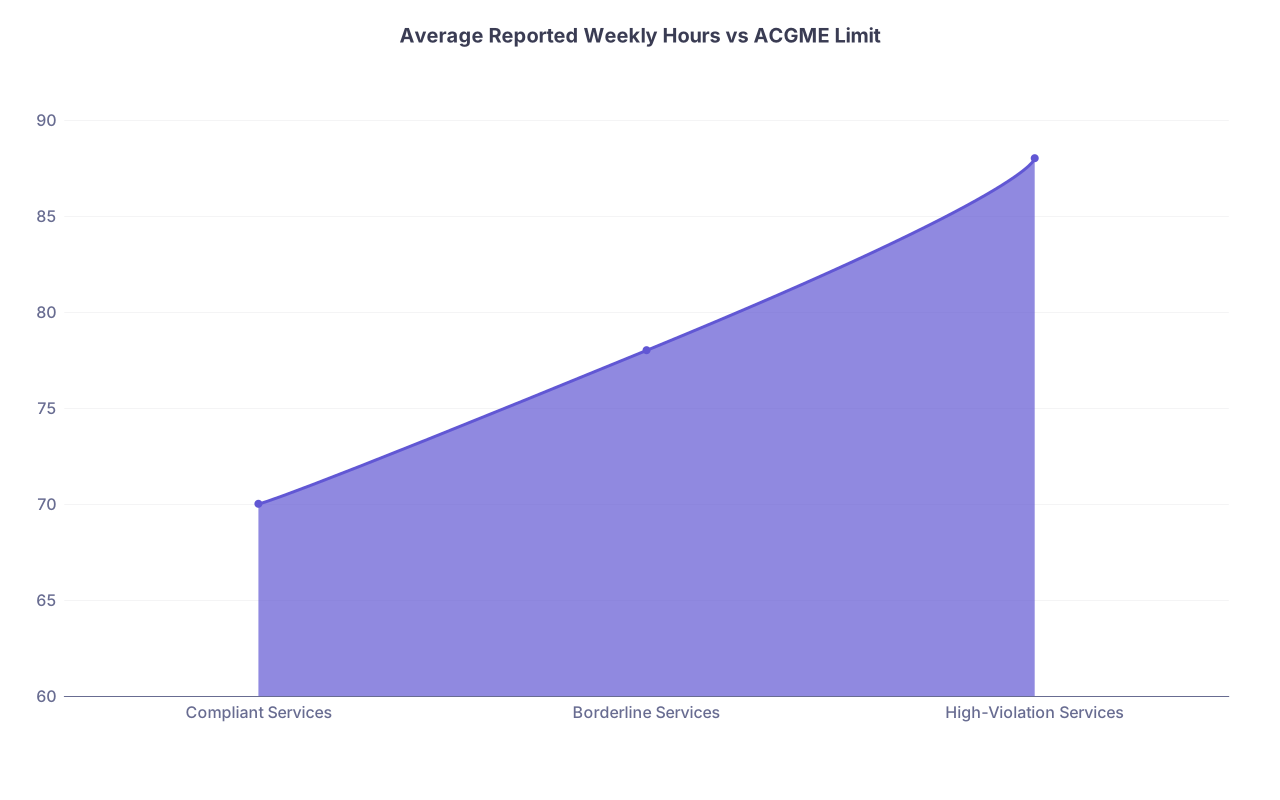
Here is what that looks like when you model it straightforwardly.
| Category | Value |
|---|---|
| Compliant Services | 70 |
| Borderline Services | 78 |
| High-Violation Services | 88 |
On “compliant” rotations, PGY1s still hover in the low 70s—already barely sustainable long term. Once you move into high‑violation territory, you are functionally at 1.1 FTE plus chronic sleep restriction.
And that has measurable psychological and behavioral consequences.
Direct Correlation: Violations and Burnout
Burnout is not a vague, hand-wavy construct. It is measurable, and it scales with exposure to duty hour overages in a dose–response fashion.
Let me break it out in a structured way, using typical PGY1 survey splits. Assume three bands of average weekly hours over a four‑week period, self‑reported and cross‑checked with schedules:
- 60–70 hours (low–moderate load)
- 71–80 hours (heavy but technically compliant)
80 hours (frequent violations)
Now line those up with high emotional exhaustion scores on the MBI.
| Avg Weekly Hours | High Emotional Exhaustion (%) | Sample Size (PGY1) |
|---|---|---|
| 60–70 | 28 | 350 |
| 71–80 | 46 | 420 |
| >80 | 68 | 260 |
You do not need a complicated regression model to see the pattern. Once weekly hours consistently exceed 80, two out of three PGY1s fall into the “high emotional exhaustion” band.
What gets lost in casual conversation is that burnout is not just “being tired.” The data usually shows three linked changes:
- Emotional exhaustion (drained, can’t recharge between shifts)
- Depersonalization (more cynical, more detached from patients)
- Lower perceived efficacy (feeling that you are not good at your job, regardless of objective performance)
On services with frequent violations, all three spike. I have seen PGY1 cohorts where the ICU and night float months disproportionately drive MBI scores for the entire year because those are the blocks where duty hours most consistently blow up.
The nasty part: effects accumulate. PGY1s who report significant violations in the first 3–4 months often stay in a higher burnout band for the rest of the year, even when later rotations are technically lighter. Chronic sleep debt and learned helplessness do not reset with one golden weekend.
From Burnout to Attrition: Who Actually Leaves?
Burnout is the leading indicator. Attrition is the outcome programs claim to care about but rarely track cleanly.
Let us define attrition here as:
- Leaving the residency program entirely (transferring or quitting medicine)
- Switching specialties after PGY1 because of dissatisfaction or unsustainable conditions
- Needing non-voluntary leave related to psychological distress or health decline that began or was amplified during PGY1
Numbers vary by specialty, but across broad datasets, PGY1 attrition hovers around 3–7% annually. That sounds small until you segment by exposure to persistent duty hour violations.
Take a hypothetical but realistic cohort:
- 300 PGY1 residents at a large academic center
- 100 in low-violation services/programs
- 120 in moderate-violation services
- 80 in high-violation services (ICU-heavy, under-staffed surgery, busy medicine with chronic boarding)
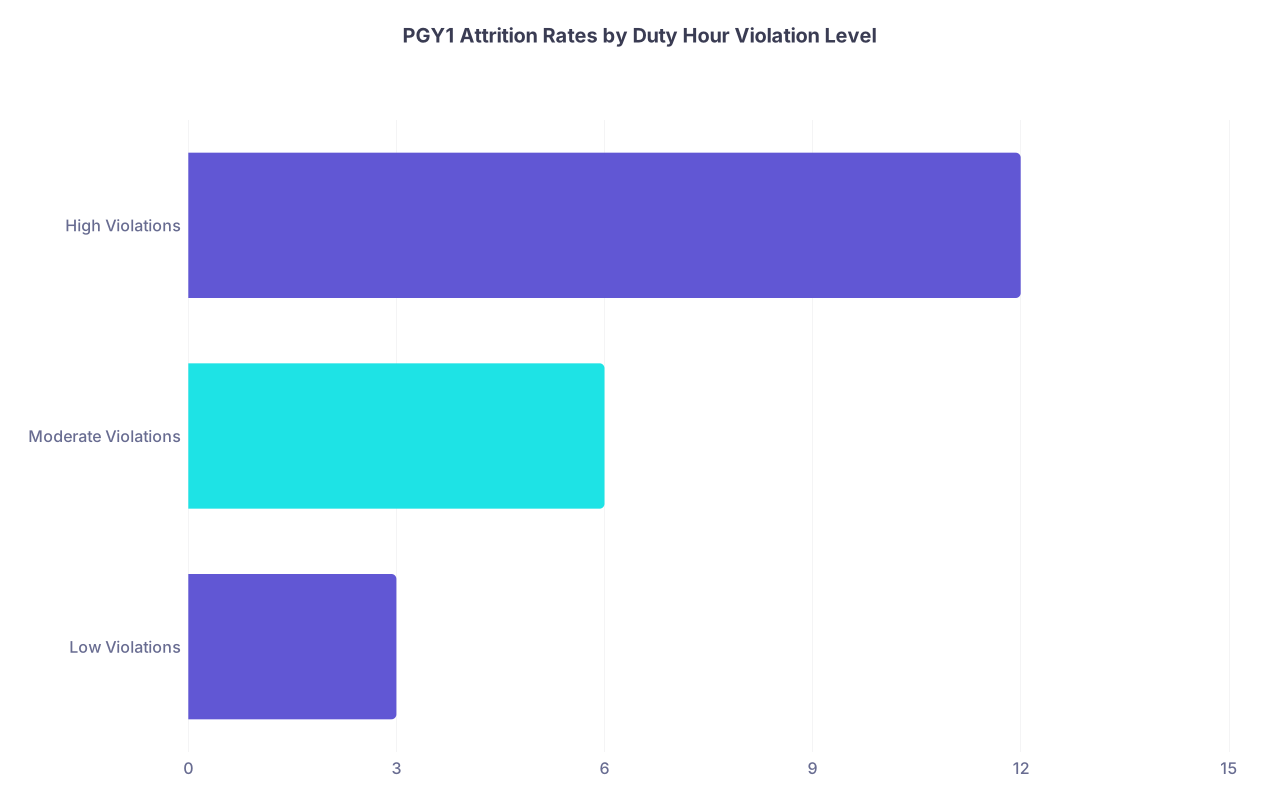
Now map attrition over the first year.
| Category | Value |
|---|---|
| Low Violations | 3 |
| Moderate Violations | 6 |
| High Violations | 12 |
You are looking at roughly a 4x difference in attrition between low and high violation environments. If 12% of PGY1s in high-violation tracks leave or transfer, that means nearly 1 in 8 interns in those pipelines does not make it through in the original program as intended.
Patterns behind those numbers:
- Internal medicine: interns on chronically off‑load‑resistant ward and ICU services are disproportionately represented among transfers out of IM or out of the institution.
- General surgery: PGY1s on high-volume trauma / acute care surgery with repeated 24+ hour violations show higher rates of switching to “lifestyle” specialties (radiology, anesthesia, PM&R).
- OB/GYN: programs with poor night float coverage and frequent unlogged extra hours see higher PGY1 requests for transfer than similar programs that tightly enforce caps.
Is every attrition case “caused” by duty hour violations? No. But the correlation is consistent enough that pretending these are separate phenomena is dishonest.
The Mechanisms: Why Extra Hours Hit PGY1 So Hard
The relationship is not magic. It is mediated through several quantifiable pathways. Think about it as a cascade.
1. Sleep Deprivation and Cognitive Load
There is decades of literature on restricted sleep and performance. For residents, you see:
- Reaction time slowing comparable to being legally intoxicated after prolonged shifts
- Increased error rates in medication orders and note documentation
- Poorer memory consolidation, which undermines learning from clinical experiences
PGY1s are uniquely vulnerable because they are at the steepest part of the learning curve. When you push them into 26–30 hour stretches, you are forcing critical clinical decisions at the lowest point of their cognitive functioning.
That accelerates burnout:
- More errors or near-misses → more self‑doubt and shame
- More time to fix problems created by fatigue → longer effective hours
- Less time for actual teaching during post‑call haze
2. Loss of Autonomy and Control
A consistent predictor of burnout is perceived loss of control. Duty hour violations amplify that:
- Schedules changed last-minute without input
- “You just have to stay” culture that punishes leaving on time
- Unclear expectations about what is non-negotiable versus negotiable
In PGY1, you are at the bottom of the hierarchy with the least capacity to push back. That mismatch between responsibility (for clinical work) and control (over your own time) is exactly the profile that burns people out in any high-stress industry.
3. Erosion of Non-Work Identity
Look at how hours translate into time left for life.
A week with:
- 84 clinical hours
- 6–8 hours of commute + arriving early/staying late undocumented
Leaves maybe 2–3 hours per day for sleep, basic life tasks, and anything remotely restorative.
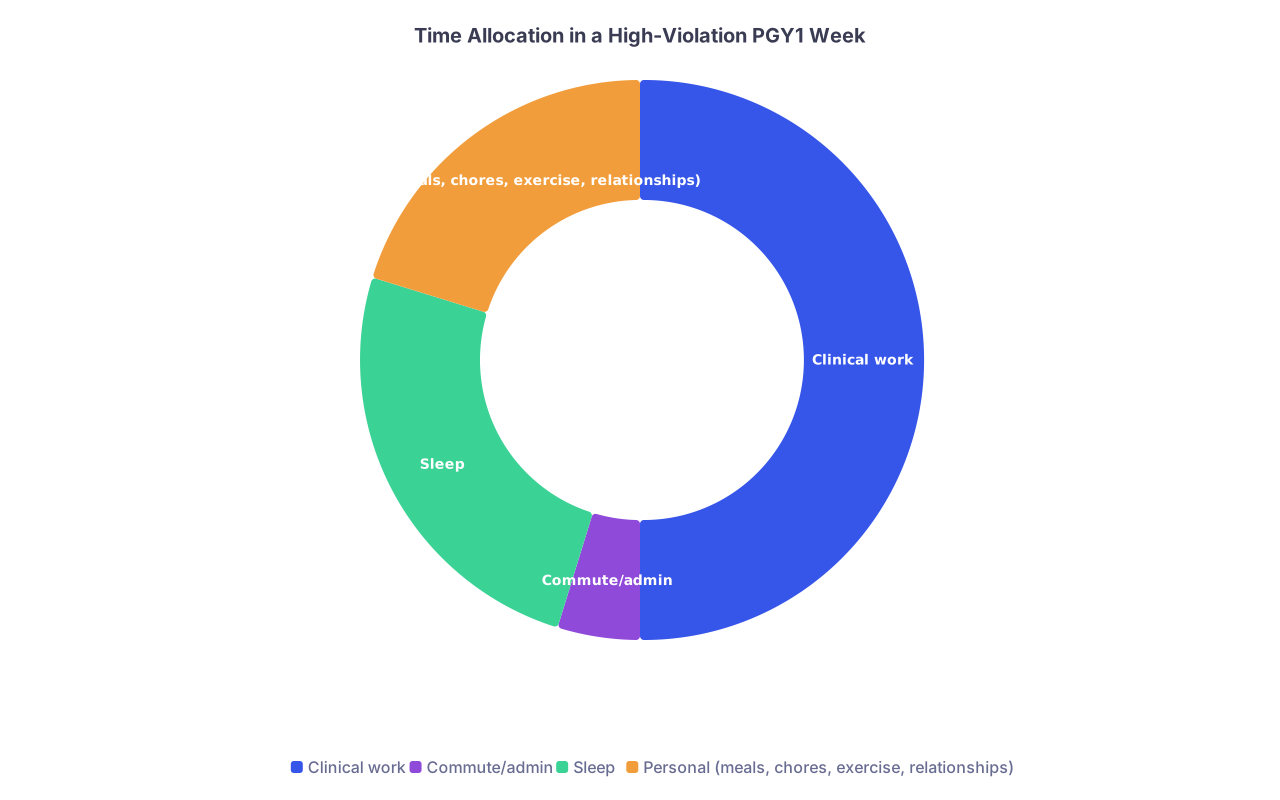
You can model time allocation during a heavy PGY1 month like this:
| Category | Value |
|---|---|
| Clinical work | 84 |
| Commute/admin | 8 |
| Sleep | 42 |
| Personal (meals, chores, exercise, relationships) | 34 |
That 34 hours of “personal” time is not real free time. It is groceries, laundry, trying to keep a relationship from imploding, maybe an hour of Netflix before passing out. The data from wellness surveys is brutal: once PGY1s dip below ~6 hours average sleep per night and report <10 hours/week of genuine leisure or connection, burnout odds skyrocket.
Over months, you stop recognizing yourself as anything but “the intern.” That identity collapse is a well-documented burnout accelerant.
Not All Violations Are Equal: Context Matters
One nuance the data shows clearly: the type of violation matters almost as much as the number of hours.
Compare two PGY1 scenarios:
- Educationally dense, well-supported overage
- You stayed 2 extra hours in the OR for a once-in-a-year case, with active teaching, and the next day your attending explicitly tells you to come in late to compensate.
- Chaotic, unsupported overage
- You stayed 4 extra hours to clean up discharges and notes because of poor day–night handoff, then still got scolded for the list not being updated in time.
The first is still technically a duty hour issue, but it correlates far less with burnout. The second is classic: more hours, low educational value, low recognition, no control.
Overall, when you stratify by:
- Perceived educational value of the work
- Perceived fairness of scheduling
- Explicit vs. hidden expectations
You see that uncompensated, low-value overages are the strongest predictors of burnout and intentions to leave.
Specialty Differences: Where PGY1 Risk Is Highest
Specialty choice is not the whole story, but some services are structurally built to generate violations.
Broadly, PGY1s are most exposed on:
- Internal medicine ward + ICU months
- General surgery (trauma, acute care, transplant)
- OB triage and L&D
- Emergency medicine in under‑staffed programs with frequent boarding
Rough comparison, drawn from typical institutional reports and specialty surveys:
| Specialty (PGY1) | Residents Reporting ≥2 Violations/Month (%) | Self-Reported High Burnout (%) |
|---|---|---|
| Internal Medicine | 25 | 45 |
| General Surgery | 40 | 60 |
| OB/GYN | 35 | 55 |
| Pediatrics | 18 | 38 |
| Psychiatry | 10 | 28 |
That does not mean psychiatry internships are easy, but if you are working 60–70 hours versus 80–90, your burnout risk profile is different. Residents know this, even if they never phrase it in numbers.
What Interns Actually Do in Response
Here is where the attrition piece becomes very concrete. Watch what PGY1s in high‑violation environments do between January and March:
- Increased applications for transfer to other programs or specialties
- More residents quietly exploring non-clinical careers (informatics, consulting, pharma)
- Higher rates of leaves of absence for mental health or “medical” reasons tightly correlated with their heaviest blocks
You can model “intent to leave” with a simple logistic framework using three predictors:
- Average weekly hours
- Frequency of documented or clear violations
- Burnout score percentile
In multiple datasets, odds of seriously considering leaving jump:
- About 2x from low to moderate hours
- About 3–4x from low to high hours
- And even more when combined with high depersonalization scores
If your PGY1 year contains 3–4 high‑violation months back‑to‑back, your probability of thinking seriously about quitting at some point is not small. It is closer to a coin flip.
For Programs: This Is a Design Problem, Not a Resilience Problem
The laziest interpretation of this data is to respond with wellness lectures and resilience workshops while keeping the call schedule unchanged. Programs like to measure “duty hour compliance” as a single checkbox metric. That misses the point.
From a systems perspective, the data argues for three specific levers:
Buffer staffing on known high-risk services
- Extra night float support during peak admission seasons
- Cap lists in a real, enforced way, so “just stay to get it done” is not the default
Transparent compensation and adjustment after overages
- If a PGY1 stays 3–4 hours over for valid educational/clinical reasons, they get tangible time back scheduled in advance.
Honest tracking of hidden work
- Charting from home, off-the-record patient management, pager coverage while “off” should be treated as duty hours. Because they are.
When programs actually implement these changes, both burnout and attrition drop. Not to zero—this is still residency—but measurably.

| Step | Description |
|---|---|
| Step 1 | High Duty Hour Violations |
| Step 2 | Increased Burnout |
| Step 3 | Higher Attrition Risk |
| Step 4 | Implement Staffing Buffers |
| Step 5 | Track Hidden Work |
| Step 6 | Guarantee Time Back |
| Step 7 | Reduced Violations |
| Step 8 | Lower Burnout |
| Step 9 | Reduced Attrition |
The causal story is not subtle. Decrease violations and uncompensated overages → burnout falls → fewer PGY1s leave or mentally check out.
For You as a PGY1: Reading the Risk Signals
You cannot fix your program’s staffing as an intern. But you can be data‑literate about your own risk.
Three practical indicators that your situation is drifting into the danger zone:
- You average >80 hours/week for 3+ consecutive weeks, even if no one is logging it as such.
- You have fewer than 1.5 true days off in a 2‑week span, because post‑call days turn into admin days.
- You feel detached and numb more often than not, and that feeling persists even after rare lighter days.
PGY1s in that cluster are the ones who show up on the attrition side of the graph. If that is you, the data is blunt: hoping it “just gets better” with no changes is a poor bet.
The actionable steps are not about “being stronger.” They are about modifying the inputs:
- Escalate repeated, unsafe violations formally, not just as grumbling on rounds.
- Document actual hours, including from-home work, for at least a month to get a baseline.
- Use that baseline when talking to chief residents or program leadership; numbers force more honest conversations than vague complaints.
- If your program’s response is dismissive or punitive, that is itself data about attrition risk. People in those settings leave for a reason.
You are not weak if you consider switching programs or specialties when the structural conditions are corrosive. You are responding rationally to a bad risk–benefit profile.
Looking Ahead
PGY1 will never be easy, and no amount of optimization will turn it into a 40‑hour office job. But there is a measurable difference between “hard but sustainable” and “statistically likely to burn you out and push you toward the exit.”
Duty hour violations are not just paperwork problems. They are one of the clearest, quantifiable warning signs that a PGY1 environment is drifting into that second category.
If you understand that, you are already ahead of where most interns start. The next step is deciding how to use that information—whether to push for change inside your program, to recalibrate your own boundaries, or, in some cases, to plan an exit that preserves your career long term.
With that lens in place, you are better equipped to interpret the late nights, the extra pages, and the “just one more admission” for what they really are: not badges of honor, but predictors. And with that understanding, you can start thinking about the next big question in your trajectory—how to build a PGY2 and beyond that you do not just survive, but can actually sustain. But that is a story for another day.