

You’re staring at your spreadsheet. GPA, MCAT, activities all lined up. You’ve got tabs open for Caribbean schools, Irish programs, maybe a few in Eastern Europe or Australia. The question hanging over everything:
“How many international medical schools should I actually apply to given my stats?”
Let me give you a straight answer before we get into nuance.
If you’re a U.S. or Canadian applicant looking internationally as a serious path to becoming a practicing physician in North America, the right number is usually:
- Total international schools: 5–12
- “Legit, defensible” schools (good clinicals, reasonable match history): at least 3–5
- Absolute max (before you’re just burning money): ~15
That range tightens a lot once we factor in your actual stats. So let’s do that.
Step 1: Know Which “Tier” You’re In (Stats Reality Check)
I’m going to group you into broad buckets based on GPA and MCAT. Is this oversimplified? Yes. Is it still useful? Also yes.
Use your cGPA/sGPA and MCAT:

Tier A – Strong Stats (realistic U.S./Canada shot)
- GPA: ≥ 3.6
- MCAT: ≥ 510
- At least decent extracurriculars
You should still focus on U.S./Canadian schools first. International schools are your Plan B or specialty-flexibility killer, not your main path. But if you’re dead set on international (or you’re Canadian with limited local seats), it changes the calculus a bit.
Tier B – Middle (borderline in U.S., better shot with DO or intl)
- GPA: 3.3–3.59
- MCAT: 502–509
This is where you start having a genuine conversation about DO + selective international programs, especially if you’re not willing to delay a year to fix your stats.
Tier C – Low (U.S./Canada MD unlikely, DO difficult)
- GPA: < 3.3
- MCAT: < 502
This is the pool that Caribbean and some other offshore schools target heavily. You absolutely can become a doctor from here, but you need to be more strategic and more skeptical than anyone else. This is also where people get burned by applying to way too many programs blindly.
Step 2: Decide Your Strategy – Backup vs Primary Route
Before talking about numbers, you need to decide what international schools are for you:
- Backup / parallel plan to U.S./Canada (most Tier A/B applicants)
- Primary plan because domestic options are realistically closed or extremely unlikely (many Tier C applicants)
Because the recommended number of international schools changes based on that.
Step 3: How Many Schools by Tier (Direct Numbers)
Here’s the blunt version you’re looking for.
| Tier & Situation | Intl Schools to Apply To |
|---|---|
| Tier A – Strong stats, U.S./CAN primary | 2–4 |
| Tier A – Prefers specific intl regions | 4–6 |
| Tier B – Parallel with DO + some MD | 4–8 |
| Tier B – Seriously considering intl | 6–10 |
| Tier C – Primary route is international | 8–12 |
| Tier C – Desperate, no filtering | 0 (fix stats first) |
If you want one key rule:
You don’t fix weak stats by applying to 25 international schools. You fix it by improving your profile or being more selective.
Step 4: Which International Schools Actually Count?
Not all “international medical schools” are equal. You probably know that, but you may not know how extreme the difference is.
For U.S./Canadian practice goals, you want schools that are:
- Recognized by CAAM-HP, GMC (UK), or similar robust accreditation
- Have a real track record of U.S. residency matches (not cherry-picked marketing slides)
- Offer structured, approved clinical rotations in the U.S./UK in teaching hospitals, not random community clinics
Typical groups people look at:
- Caribbean (Big 4-ish): St. George’s (SGU), Ross, AUC, Saba
- Other Caribbean / offshore: huge range, many you should avoid or treat as last-resort only
- Ireland, UK, Australia, Israel, Eastern Europe: often 5–6 year programs, decent for eventual North American practice if the school is reputable and you can handle complex licensing steps
Let’s place them roughly:
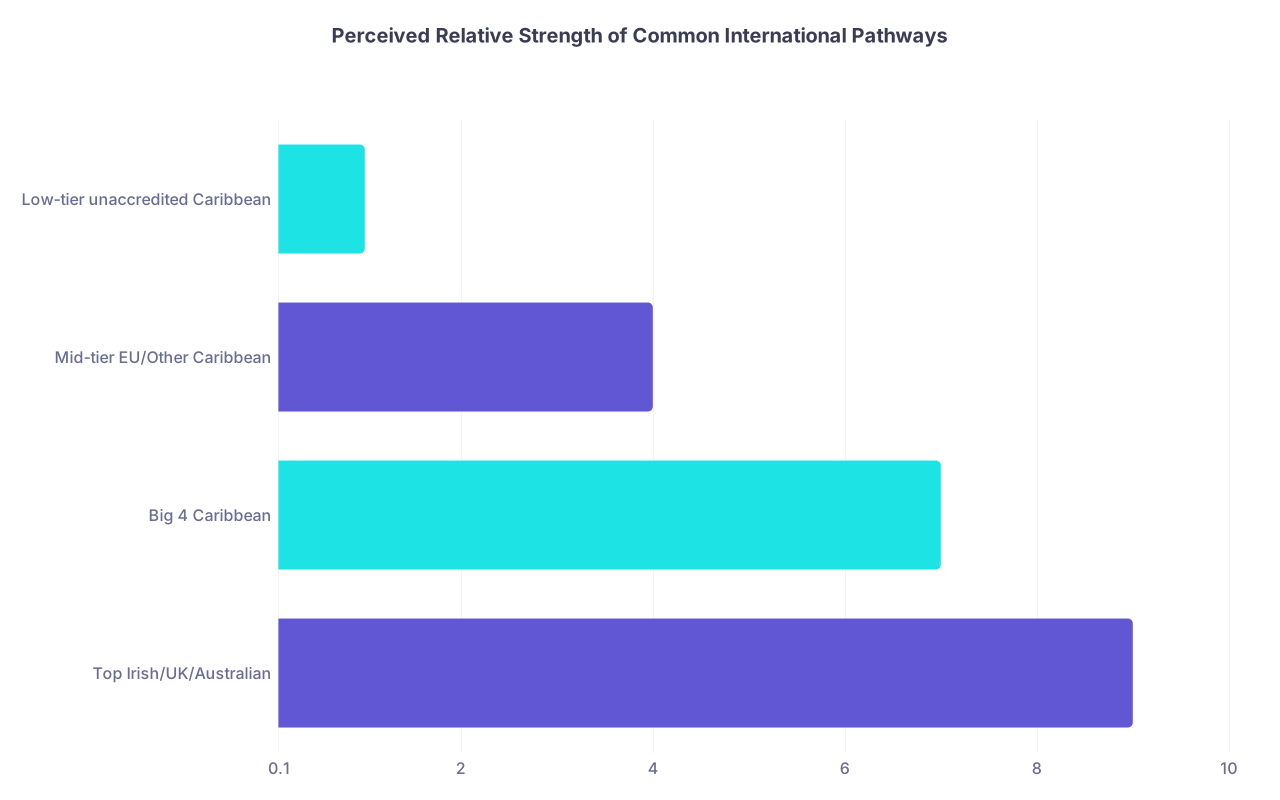
| Category | Value |
|---|---|
| Top Irish/UK/Australian | 9 |
| Big 4 Caribbean | 7 |
| Mid-tier EU/Other Caribbean | 4 |
| Low-tier unaccredited Caribbean | 1 |
Scale 1–10 is my subjective “long-term defensibility for North American practice” rating. Not scientific, but it matches what I’ve seen from actual residents and applicants.
Step 5: Match Your Stats to School Types and Quantity
Now the part you actually need: how to combine your stats + risk tolerance + the number of schools.
If you’re Tier A (strong stats)
You do not need a huge international list.
Typical smart plan:
- 15–25 U.S. MD + 10–15 U.S. DO (if you want backup)
- International: 2–4 targeted, higher-quality programs that match your life goals (e.g., Irish schools if you love Europe, SGU/Ross as hard backup, Australian schools if you’re okay potentially staying there)
Why not more? Because your problem probably isn’t “not enough options.” It’s clarity. You either commit to a path or you keep everything “open” forever and end up nowhere.
Recommended numbers:
- If U.S./Canada is still the goal: 2–4 international schools tops
- If you’re genuinely preferring international (e.g., you want to train in Ireland, then maybe return): 4–6 schools in that region, all higher quality
If you’re Tier B (borderline)
This is the tricky group. You’re not obviously out. You’re not obviously in.
You should build three buckets:
- U.S. MD/Canada: your reaches and “why not” shots
- U.S. DO: realistic core of your application
- International: serious backup or co-primary
For you, the right number of international schools usually lands in the 4–10 range, depending on how urgently you want to start and how willing you are to re-apply.
Good breakdown:
You’re willing to take a glide year, improve stats, and reapply:
International: 4–6 (only reputable programs)You’re not willing to delay, you want a seat somewhere this year:
International: 6–10 (mix of top Caribbean + select EU/other, but still filtered)
If you’re applying to more than 10 international schools at your level, you’re not being strategic. You’re panicking.
If you’re Tier C (low stats, primary route is international)
Here’s where the damage happens if you’re not careful.
I’ve seen students with a 2.9 GPA and 495 MCAT apply to 15+ Caribbean schools, get accepted to almost all of them, and think that means they’re in great shape. It doesn’t. It just means the schools are desperate for your tuition, not that you’re likely to become a board-certified physician.
For Tier C, your first question isn’t “how many international schools should I apply to?”
It’s: “Am I okay with a meaningfully higher risk of never matching into residency, even if I graduate?”
If the honest answer is “yes, I understand and accept that risk,” then:
- Apply to 8–12 international schools, but:
- At least 3–4 should be among the better-known programs with some match track record
- The rest can be mid-tier options, but avoid low-accreditation, opaque programs that cannot show 3–5 years of match data
If the honest answer is “no, I really cannot tolerate failing to match,” then you need to strongly consider:
- Post-bacc or SMP
- MCAT retake
- DO-heavy focus later
And probably 0 international applications this cycle.
Step 6: Cost vs Benefit – When Adding More Schools Stops Helping
Application fees, deposit requests, evaluation transcripts, flights, visas. Costs add up fast.
Rough reality:
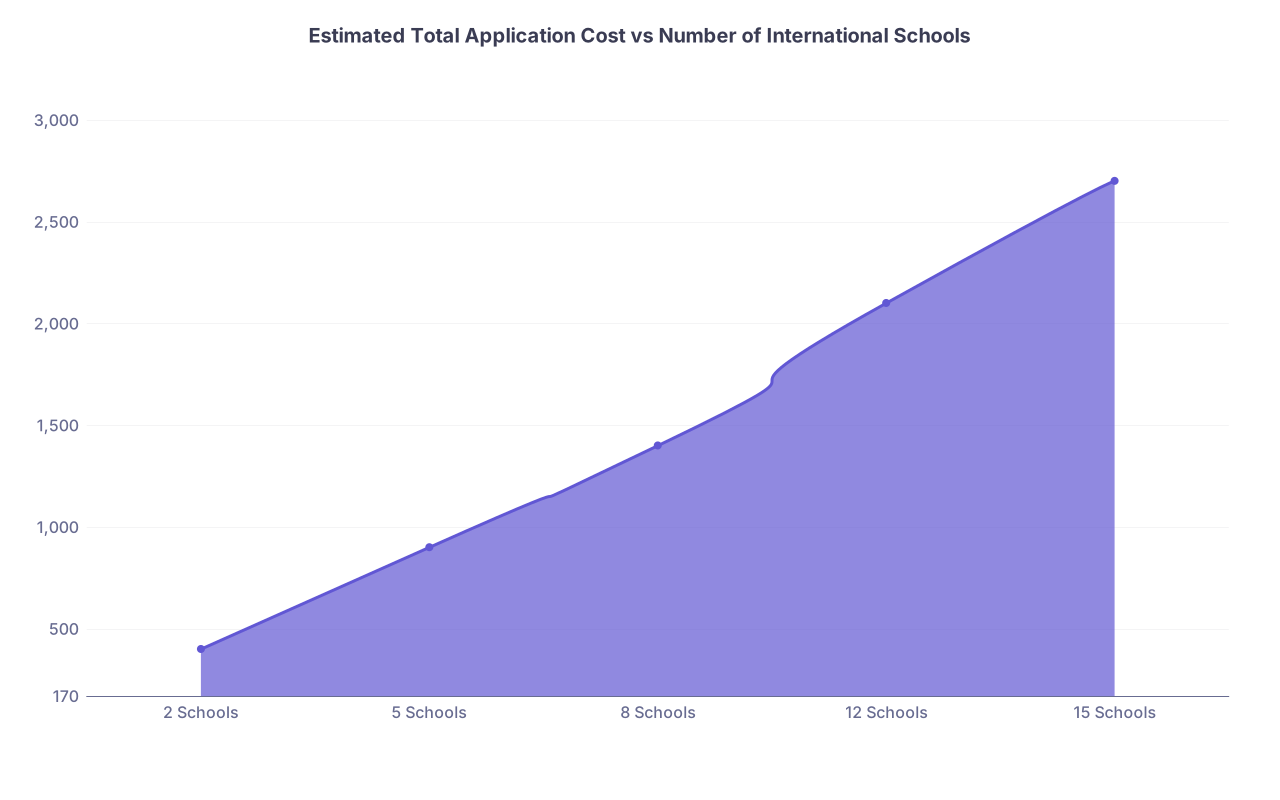
| Category | Value |
|---|---|
| 2 Schools | 400 |
| 5 Schools | 900 |
| 8 Schools | 1400 |
| 12 Schools | 2100 |
| 15 Schools | 2700 |
This is very rough but realistic: application + transcript + misc per school.
Beyond about 8–10 international schools, each extra school usually adds:
- A small bump in chances of an acceptance
- A big bump in confusion and decision fatigue
- Extra risk of getting locked into deposits at weaker programs while still waiting on better ones
You want enough schools that you’re not putting everything on one or two programs.
But not so many that you’re paying thousands just to collect acceptance letters from schools you shouldn’t actually attend.
Step 7: How to Build Your Actual List (Filtering in Practice)
Here’s a simple 5-step filter I’d use if you forced me to design a list with you:

| Step | Description |
|---|---|
| Step 1 | Start |
| Step 2 | List all possible schools |
| Step 3 | Remove schools with poor/hidden match data |
| Step 4 | Remove unaccredited or questionable programs |
| Step 5 | Keep only schools you can afford & live in |
| Step 6 | Rank by match history & clinical quality |
| Step 7 | Pick 5-12 total based on your tier |
If a school cannot:
- Show several years of actual match lists (not “our grads go to these places” marketing fluff)
- Explain their clinical rotation structure clearly with named hospitals
- Provide honest info on USMLE/Residency outcomes
…you don’t put them on your list. I don’t care how low your stats are.
Step 8: Adjust for Country Type
Not all “international” paths function the same way.
- Caribbean 4-year MD (Big 4): Similar length as U.S., heavy U.S.-based rotations, geared toward U.S. residency
- Ireland/UK/Australia 5–6 year programs: You’re basically doing undergrad + med school in one; better if you start earlier or are okay with extra years
- Eastern Europe & others: Huge variability; some good, many marginal; licensing back to U.S./Canada can be more complex
If you’re already a bachelor’s graduate from North America, and you want to minimize complexity:
Most people in your shoes end up focusing on:
- 3–5 of the “Big 4” Caribbean + maybe 1–3 Ireland/UK/Australia or strong EU programs
Example Scenarios (So You Can See Yourself)
Example 1: 3.55 GPA, 507 MCAT, Canadian applicant
- Applying to: Ontario schools, rest of Canada, a few U.S., several DO
- International role: safety net and maybe long-term Ireland dream
Smart international list:
- 2–3 Irish schools (e.g., UCD, RCSI, UCC)
- 2 Caribbean (SGU + AUC or Ross)
Total: 4–5 international schools
Example 2: 3.2 GPA, 500 MCAT, U.S. applicant, wants to start ASAP
- U.S. MD is near-zero
- U.S. DO possible but not ideal odds
Smart international list:
- 2–3 better-known Caribbean (SGU, Ross, AUC, maybe Saba)
- 3–4 mid-tier, but still with published match data
- Keeps DO apps open simultaneously
Total: 6–8 international schools
Example 3: 2.9 GPA, 492 MCAT, repeated attempts, no upward trend
You’re in the danger zone. Any international path has serious risk.
My honest recommendation:
- Take a year or two to fix academics (post-bacc/SMP) and MCAT
- Apply to 0 international schools this cycle
If you absolutely insist:
- 3–4 of the better Caribbean
- 4–6 others, but only those with transparent outcomes
Total: 7–10, but understand: this is a high-risk move.
FAQ (Exactly 7 Questions)
1. Can I just apply to one “dream” international school and see what happens?
You can, but it is a bad risk move. Admission at many international schools is not the bottleneck; matching into residency later is. Restricting yourself to a single school means if you get in, you’ll feel pressure to attend regardless of its quality. Applying to at least 3–5 solid programs gives you choice and leverage.
2. Are more applications always better for international schools, like with U.S. MD?
No. For U.S. MD/DO, casting a wide net sometimes makes sense. For international, after ~8–10 schools, you mostly add weaker programs that may hurt you more than help. You reach a point where additional schools only increase cost and confusion, not meaningful opportunity.
3. Should I prioritize Caribbean or Europe if I want to return to the U.S.?
If your goal is U.S. residency, the more U.S.-integrated programs (especially the Big 4 Caribbean) have a clearer and more direct pathway than many European schools. Some Irish and UK schools place well into U.S. residencies too, but you’ll often have more complex visa and licensing steps. I’d usually favor reputable Caribbean + specific Irish/UK programs with a proven U.S. match record.
4. Do international schools care about MCAT and GPA as much as U.S. schools?
Less, in many cases—but that’s not automatically a good thing. Lower stat thresholds mean more marginal students are accepted, which can drive down Step/USMLE pass rates and residency match outcomes. Getting in is the easy part. Surviving, passing boards, and matching is the hard part. If your stats are very low, you should be more cautious, not less.
5. Is it ever smart to only apply internationally and skip U.S./DO altogether?
Sometimes, yes. Examples: non-traditional applicants who want to live long-term in Ireland or Australia, or people who know they’ll train and practice abroad. But if the goal is specifically “practicing in the U.S. or Canada,” skipping domestic options entirely is usually a mistake unless your stats make those options essentially impossible.
6. How do I know if an international school’s match data is trustworthy?
You look for: full match lists by year, with program names and specialties; board pass rates broken down clearly; and no obvious cherry-picking (e.g., a slide with a few brand-name hospitals but no complete list). If a school won’t provide details or only shares glossy marketing, assume the outcomes are weaker than they want you to think.
7. If I improve my stats, should I still keep international schools on my list?
If your new stats move you into a realistically competitive range for U.S. MD/DO or Canadian schools, international options should shift from “primary plan” to “backup or niche preference.” At that point, 2–4 international applications are enough, focused only on reputable programs that offer something you genuinely want (location, structure, etc.), not just “a seat somewhere.”
Open a blank document or spreadsheet right now. Write three headings: “Definitely Apply,” “Maybe Apply,” “Do Not Apply.” Take your current international school ideas and force each one into a column. If you cannot justify a school under “Definitely Apply” with real reasons—match data, accreditation, fit—remove it. Then count how many are left. If you’re outside the ranges above for your stats tier, fix the list before you spend a dollar.


