
The thing you’re terrified of has already happened. You sent your LOI with the wrong program name.
You’re not overreacting. This is exactly the kind of mistake that makes your stomach drop at 1 a.m. and keeps you scrolling through your sent mail like some forensic investigator.
Let’s walk through what actually happens next. Because your brain is probably telling you, “I’ve ruined my entire career,” and reality is… not that dramatic. Messy, yes. Fatal, no.
First: How Bad Is This Really?
Let me say it bluntly:
Wrong program name in a letter of intent is embarrassing. It is not career-ending.
Admissions and PDs have seen this before. You didn’t invent this mistake. Off the top of my head, I’ve seen:
- “I will be ranking [Program B] highly” in a letter sent to Program A
- Letters with a different specialty entirely (“family medicine” in an IM LOI…)
- Emails addressed “Dear Dr. Smith” when the PD’s name is Dr. Patel
- LOIs that still reference another city (“I’m excited about training in Chicago”) sent to a Boston program
What PDs and coordinators usually think when they see this:
- “They’re mass-mailing.”
- “They didn’t proofread.”
- “We’re probably not their top choice.”
Annoying? Yes. Instant rejection? Usually no. It mostly lowers warm fuzzies, not your entire ranking.
But the real question you’re asking is:
Did I just tell them I don’t care about their program, and will they punish me for it?
No. Not if you handle the aftermath correctly.
Step 1: Figure Out Exactly What You Did
You need data before panic. Pull up the email or uploaded PDF and read it like you’re the PD.
Ask yourself:
- Is it just the wrong program name in one line?
- Or does it mention specific details about another program (different city, different hospital, different tracks)?
- Did you send it by email (fixable), or did ERAS/portal lock it in (less fixable, but still not fatal)?
- Did you send it to multiple places with multiple wrong names, or is this a one-off?
There’s a huge difference between:
“I am writing to express my strong interest in the Internal Medicine Residency Program at University of X.”
Sent to “University of Y” program.
vs.
“I loved my interview at [Big Academic Center in Chicago]—especially your dedicated LGBTQ+ clinic and four+ one schedule.”
Sent to a mid-sized community program in North Carolina that… does not have any of that.
One is a typo-level screw-up. The other screams copy–paste.
You need to know which category you’re in before you decide what to do next.
Step 2: Decide Whether to Send a Correction Email
Here’s the part everyone spirals about:
“Will calling attention to it make it worse?”
Short answer:
- If it’s a clear, obvious, non-trivial mistake (wrong program name, wrong city, obviously different program details): you should send a brief correction.
- If it’s so minor they might not even notice (slightly off phrasing, generic slip): you can probably let it go.
PDs are much more forgiving of, “I made a mistake, I’m sorry,” than of silence that makes you look oblivious or careless.
Template you can actually send
This is what I’d send in most wrong-name situations:
Subject: Correction to Letter of Intent – [Your Name]
Dear Dr. [PD Last Name] and the [Program Name] team,
I realized after sending my recent letter of intent that I mistakenly referred to the wrong program name in the body of the message. I’m genuinely embarrassed by the oversight and wanted to correct it immediately.
To be absolutely clear: your [Correct Program Name, e.g., “University of X Internal Medicine Residency Program”] is the program I was writing about, and it remains my top choice. My interest in your program is sincere and based on [one or two specific things you mentioned that actually apply to their program].
I apologize for the error and any confusion it may have caused, and I appreciate your understanding during this busy season.
Sincerely,
[Your Name], [AAMC/ERAS ID if relevant]
That’s it. No three-paragraph justification. No dramatic apology monologue. Brief, direct, humble.
When NOT to send a correction
You might skip a correction if:
- The letter is extremely generic and doesn’t name any school/program explicitly
- The only mistake is something like “residency” vs “residency program” or a weird slightly-off formatting thing
- You’re not claiming they’re your #1; it was more like a “strong interest” email
In those cases, calling attention to a microscopic error can do more damage than the error itself.
But wrong program name? 90% of the time, I’d own it and correct.
Step 3: Understand What They Actually Infer From This
Explore worst-case thinking for a second, because that’s where your brain already is:
You’re scared they’ll think:
- “They’re lying about us being #1.”
- “They don’t care about details; I don’t want them writing notes in my EMR.”
- “Trash the application.”
Here’s the more realistic reaction I’ve heard from faculty/cos:
- Eye roll.
- Maybe a joke: “We’re the wrong program, I guess.”
- Then: “Whatever, add it to the pile.”
What matters more than the error itself is the pattern:
| Situation | Likely Interpretation |
|---|---|
| One wrong name, quick apology | Careless but honest |
| Multiple conflicting LOIs floating around | Not trustworthy |
| Repeated sloppy communication | Poor attention to detail |
| Genuine interest shown elsewhere (interview day, communication) | Mistake likely forgiven |
One wrong-name LOI doesn’t usually tank your ranking. Ten small signals of sloppiness might.
If the rest of your contact with them has been normal, on time, polite, and you seemed engaged on interview day? This goes into the “ugh, but fine” bucket.
Step 4: Should You Send a New LOI to the Program You Accidentally Named?
Here’s where it gets morally gray and stressful.
Scenario:
You meant to send an LOI to Program A, but wrote Program B’s name by accident in the body. Program A gets the email, reads “Program B,” and now you’re panicking that A thinks B is your top choice.
You’re wondering: do I now send B an LOI so at least someone believes me?
My take:
Do not escalate this into a web of LOIs just to fix your ego.
- If Program B already received a separate LOI from you claiming they’re #1 and now you’re contradicting yourself → that’s a bigger problem than one wrong name.
- If Program B didn’t even get anything from you and was never realistically your top choice, don’t drag them into this. You’re not obligated to send them a retroactive “actually, you’re my favorite too.” That just compounds the dishonesty.
Fix the email with Program A.
Let Program B live in peace.
And if you did accidentally send conflicting LOIs? I won’t sugarcoat it: that’s bad. Programs hate being told they’re #1 when they’re not. You can’t un-send what’s done. Best you can do is stop digging:
- Do not send more “clarifying” LOIs
- Do not play favorites in follow-up messages that clearly contradict prior claims
- Accept that some damage is done and focus on programs where your communication has been clean
Step 5: How This Actually Affects Your Rank List (Theirs And Yours)
Reality check: a lot of programs don’t take LOIs super seriously anyway.
- You’re already in a “maybe” cluster
- They believe you’re truly likely to match there if ranked decently
- Your message aligns with what they remember from your interview
They usually don’t:
- Take a random LOI from a mediocre interview and catapult you to #1
- Overhaul their list based on one typo
- Run some blacklist report: “wrong name, instant disqualification”
So impact-wise:
- If you were already high on their list, this probably nudges you down a hair emotionally, but likely not structurally.
- If you were on the bubble, a well-handled apology might net out neutral.
- If you were already low, this doesn’t matter; the interview performance mattered more.
Your rank list shouldn’t change because of their reaction to your mistake. Rank programs where you actually want to train, in the real order of your preference. Don’t play 4D chess over one screwed-up email.
Step 6: Preventing This From Happening Again (Because Your Nerves Can’t Take Another One)
Yes, you’re already done with the worst part, but your brain won’t relax until you control something. So here’s what I’d do for future communications, especially if you’re still emailing about updates, couples match, etc.
Simple rules:
One master template, but never send it “as is.”
Force yourself to rewrite at least 1–2 program-specific sentences each time. If you can’t think of anything unique, that’s a sign you probably shouldn’t send a strong-interest email to that place.Use a “staging” doc.
Write your LOI in a Word/Google doc with placeholder text:- [PROGRAM NAME]
- [CITY]
- [SPECIFIC THING FROM INTERVIEW]
Then do a search for “ [ ” or “[PROGRAM” to make sure nothing is left generic.
Last check: read the email out loud.
Yes, actually out loud. “I am excited about [Program A]” → if your brain stumbles, you’ll catch it.Send from a laptop if at all possible.
Mobile + high anxiety + copy–paste is basically a trap.
What If They Never Reply?
Another anxiety trigger: you send your apology / corrected LOI… and then silence.
You start thinking:
- “They’re ignoring me because I’m doomed.”
- “They showed it in a group chat and are laughing about me.”
- “They forwarded it to every program in the country.”
Slow down.
Programs are drowning in:
- Applicant emails
- Committee meetings
- Service, teaching, clinical work
- Admin chaos
They don’t reply to most LOIs. They don’t reply to most apologies. Silence is normal. It doesn’t equal “we hate you.”
Measure your success by what you can control:
- You identified the error.
- You owned it quickly.
- You clarified your honest preference without exaggerating.
That’s it. That’s a win in this messed-up process.
The “Absolute Worst-Case” You’re Afraid Of
Let’s spell it out, because your brain already has:
Worst-case realistic scenario:
- The PD or coordinator notices the wrong name.
- They feel mildly annoyed and think you’re not detail-oriented.
- If you were borderline, maybe you lose a tiny edge to someone similar who didn’t mess up.
- They still rank you, maybe a little lower than you might’ve been otherwise.
That’s the realistic bottom.
They are not:
- Calling other PDs to “warn” them about you
- Blocking you from future fellowships
- Putting your LOI on a projector for conference comedy hour
Most likely, this is a 10/10 anxiety situation for you… and maybe a 2/10 blip in their actual day.
You’re not the worst applicant they’ve seen this season. Not even close.
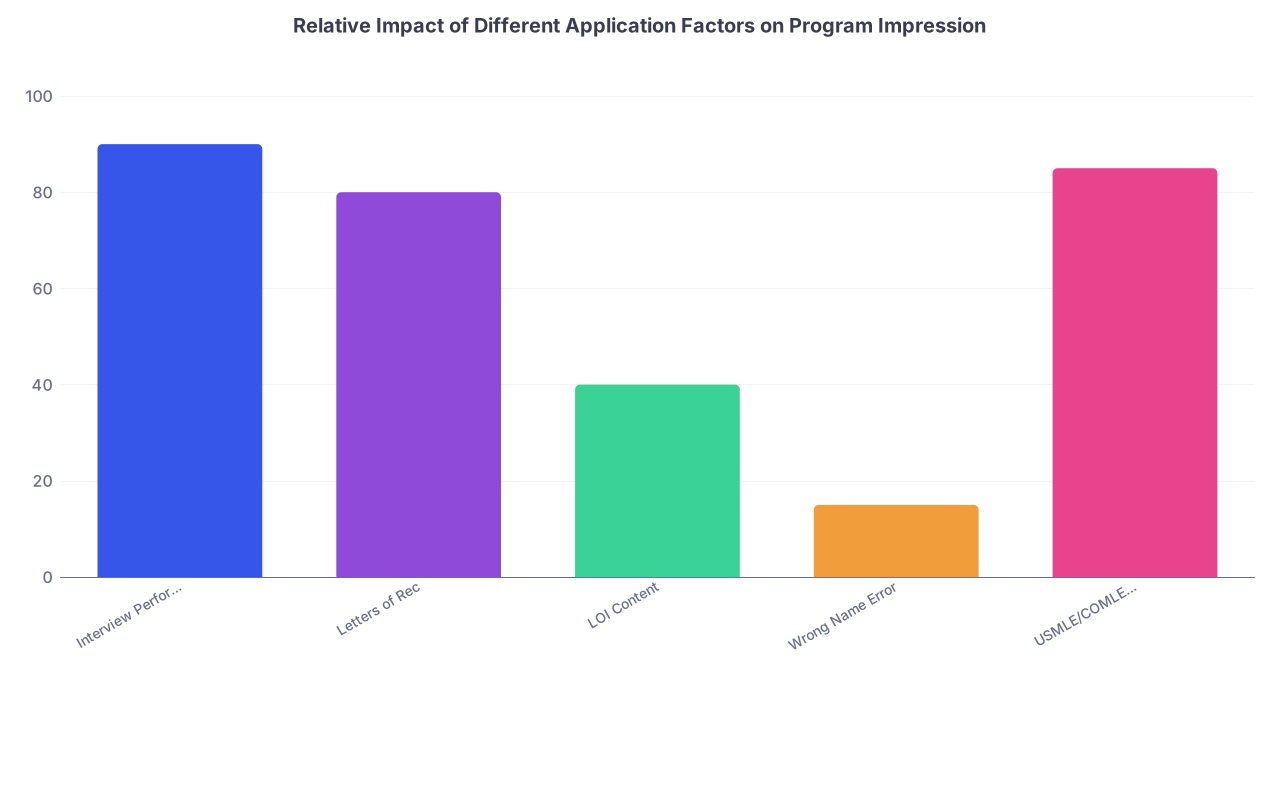
| Category | Value |
|---|---|
| Interview Performance | 90 |
| Letters of Rec | 80 |
| LOI Content | 40 |
| Wrong Name Error | 15 |
| USMLE/COMLEX Scores | 85 |

| Step | Description |
|---|---|
| Step 1 | Realize mistake |
| Step 2 | Reopen email or LOI |
| Step 3 | Send short correction email |
| Step 4 | Do not send correction |
| Step 5 | Stop sending extra LOIs |
| Step 6 | Rank programs honestly |
| Step 7 | Wrong name or minor typo |

FAQs: LOI Disaster Edition
1. Should I resend the entire LOI as a clean, new email?
No. Don’t create extra noise. A short correction referencing the original email is enough. Resending the whole thing can look like you’re trying to bury the mistake or spam their inbox. You want, “I noticed, I’m sorry, this is what I meant,” not, “Here’s another long monologue.”
2. Is it better not to send any LOI at all if I’m this anxious about messing up?
Honestly? For some people, yes. If sending LOIs pushes you into paralysis and you can’t keep track of what you promised to whom, it’s safer to skip “#1” declarations and just send short, honest “strong interest” updates (or nothing at all). You will absolutely still match without a single LOI.
3. Will they think I’m unprofessional and not want me as a resident?
They might think you were careless once. That’s different from “unprofessional.” Residents screw up small things constantly—what PDs care about is whether you own mistakes, fix them, and don’t repeat them. Your quick correction actually shows a trait they respect more than fake perfection: accountability.
4. Could this cause them to move me down their rank list on purpose?
It could nudge you down psychologically if they were deciding between two almost-equal applicants. But programs don’t usually go hunting through LOIs when building their list. They mostly rely on interview impressions, letters, and internal notes. This mistake is unlikely to be the reason you don’t match somewhere.
5. What if I already sent multiple LOIs saying “you’re my top choice” to different programs?
That’s the scenario programs hate the most. You can’t fully undo it. Don’t send any more “top choice” LOIs. From here on, stick to “very strong interest” or specific, honest reasons you’d fit well without ranking claims. And next cycle (if there is one), commit to the rule: one true #1 LOI maximum, or none at all.
Bottom line:
You made a real mistake. It feels huge. In their world, it’s a minor annoyance at worst. Own it once, fix what you can, then stop picking at the scab. Your match outcome will hinge on a lot of things. This email is almost certainly not the one that decides your fate.