It’s January. You’re staring at your email drafts. One is open: “Dear Program Director…”
Your stomach drops because you know the hard part is not saying you’re interested. It’s explaining why you spent two years saying you wanted one specialty… and now you’re trying to convince a different specialty that you’re genuinely committed.
You switched late. Maybe very late. After your Sub-I. After ERAS. Maybe after interviews. Now you’re trying to write a letter of intent that doesn’t sound flaky, panicked, or dishonest.
This is exactly fixable. But only if you’re brutally clear about where you are, what you’re asking for, and what your story is.
Let’s walk through what to do.
First: Be Honest About Your Actual Situation
Before you start writing, you need to know which of these you are. Do not skip this step.

Broadly, late switchers fall into a few buckets:
- You switched specialties before ERAS submission, but your application is thin in the new field (few rotations, few letters).
- You applied to Specialty A, then mid-season realized you want Specialty B, and now you’re applying SOAP or reapplying.
- You dual-applied and clearly leaned one way in your primary app, but now you want to commit to the “secondary” specialty.
- You’re in a prelim/TY year and switching into a categorical position in a different field.
Your letter has to match your reality. Program directors can smell generic nonsense. They’ve seen every flavor of “I discovered my true passion is actually your field” with zero evidence.
Decide which of these is closest, then you customize the core structure I’ll give you to that context.
What Program Directors Actually Worry About When You Switch Late
If you want to write a good letter, you need to know what they’re nervous about.
They’re not just thinking: “Is this applicant interested?”
They’re thinking:
- Will this person bolt again in 1–2 years?
- Are they just running away from another specialty?
- Are they using us as a backup because their original plan failed?
- Will they actually fit our day-to-day work and culture?
- Do their actions match their story, or is this just a last-minute pivot?
Your letter of intent has one job: reduce those concerns.
Not with poetry. With evidence and clear thinking.
The Core Structure Your Letter Needs
Here’s the skeleton that works for almost every “late switch” letter of intent. You’ll adjust tone and emphasis, but the bones stay the same.
- Clear statement of intent (first paragraph)
- Brief, sane explanation of your path (including the switch)
- Evidence that you actually understand and fit the new specialty
- Concrete alignment with that specific program
- Reassurance about commitment and follow-through
- Professional close, no neediness
Let’s go piece by piece.
1. Open With a Clear, Direct Statement
Do not warm up for three paragraphs about “since childhood” or “ever since anatomy lab.”
You are writing a letter of intent. Say what you intend.
Example opening for someone switching into Internal Medicine:
Dear Dr. Smith and the Internal Medicine Residency Selection Committee,
I am writing to express my strong interest in joining the XYZ Internal Medicine Residency Program and to state clearly that, if offered a position, your program is my top choice.
That’s it. No drama. No early justifications.
You want the PD to know:
- Why you’re writing.
- How serious you are.
If you’re not comfortable saying “top choice,” adjust honestly:
“…and to express my strong interest in training at XYZ Internal Medicine Residency Program.”
Don’t lie about ranking. But don’t be vague either.
2. Explain the Switch Once — Briefly, Like an Adult
This is the part people screw up the most. They either over-explain (three paragraphs of emotional processing) or under-explain (“I later discovered a passion for X”) with zero credibility.
You need 4 things in this explanation:
- Acknowledge where you started.
- Name the turning point(s) specifically.
- State why the new specialty fits better.
- Avoid trashing the old specialty or sounding like you failed out.
Here’s a template you can adapt:
During the early part of my clinical training, I anticipated pursuing [Original Specialty], and my initial application reflects that focus. I genuinely valued the experiences I had in [Original Specialty], particularly [1–2 concrete things].
However, during my [rotation/sub-I/elective] in [New Specialty] at [Institution], I recognized that the aspects of medicine that most engaged me — [e.g., longitudinal patient relationships, complex diagnostic reasoning, procedural work with immediate feedback] — aligned more strongly with [New Specialty]. The day-to-day work felt like a better match for how I think, communicate with patients, and want to grow as a physician.
Notice what this does:
- It doesn’t pretend the original path never existed.
- It shows respect for the old field (that matters).
- It names specific features of the new field, not vague “passion.”
If you obviously pivoted late (like after submitting ERAS), you add one more sentence owning the timing:
I came to this realization after submitting my initial residency applications, which is why my ERAS materials and letters are weighted toward [Original Specialty]. Since then, I have focused my efforts on confirming my fit for [New Specialty] and preparing myself to contribute meaningfully as a resident.
That’s the level of candor they expect. Not a confessional.
3. Show You Actually Understand the New Specialty
This is where a lot of late switchers sound fake. They use buzzwords. “Holistic care.” “Team-based environment.” “Life-long learning.” Every PD has seen this 1000 times.
You need concrete exposure and behaviors that back up your story.

| Step | Description |
|---|---|
| Step 1 | Realize new specialty fit |
| Step 2 | Seek additional rotation |
| Step 3 | Request mentorship in new field |
| Step 4 | Adjust electives or research |
| Step 5 | Draft targeted letter of intent |
| Step 6 | Communicate clearly with programs |
You do not need years of experience. You do need to show that since realizing the fit, you did something.
Use something like this:
Since recognizing that [New Specialty] is the field in which I want to build my career, I have taken several steps to deepen my understanding and prepare for residency. On my [rotation/sub-I] at [Institution], I worked closely with [Attending/Program/Service], where I especially valued [specific patient population, type of cases, workflow].
I have sought mentorship from [Name/Role if appropriate], who has advised me on [curriculum focus, research opportunities, career paths within the specialty]. These experiences have reinforced that I am most engaged when [describe specific tasks you enjoy that are actually core to the specialty’s daily life].
Make it grounded:
- “Running the list on morning rounds and tracking subtle changes in our patients’ status.”
- “Having repeated, honest conversations with patients and families about treatment goals and trade-offs.”
- “Managing a high volume of acute presentations in a structured, protocol-driven environment.”
- “Working with my hands while making real-time decisions in the OR.”
If you can’t describe those specifics, your problem isn’t the letter. It’s that your switch is not yet credible. You need more exposure before a letter will work.
4. Align Yourself With This Program, Not “Any” Program
A late switcher already looks like they might be OK with “anywhere that will take me.” Your job is to prove the opposite.
You need to make the PD think: “They’ve actually thought about us, not just our specialty.”
That means naming details that are:
- Real
- Current
- Not pulled off the first line of the website
Here’s how to structure that paragraph:
I am particularly drawn to the XYZ program because of [2–3 specific things], which align closely with how I hope to train. During [my rotation/virtual open house/conversation with Dr. ___/review of your curriculum], I was struck by [concrete feature: e.g., your emphasis on resident autonomy on night float, your dedicated clinic tracks for underserved populations, the structured coaching for board preparation, or the opportunity to work at both the academic center and community sites].
Don’t list ten things. Two or three real ones are enough. Examples of real details:
- “your dedicated addiction medicine consult service”
- “the resident-led QI curriculum with protected time”
- “the early exposure to ICU rotations in PGY-1”
- “the close integration with your VA site”
- “your strong track record of graduates matching into cardiology fellowships”
Then tie it back to you:
These features fit well with my goals to [e.g., develop as a clinician-educator, build a foundation for a career in cardiology, work with medically complex underserved populations], and with how I learn best — through [e.g., graded responsibility, frequent feedback, longitudinal patient care].
If your late switch included actually rotating there, say it:
During my [Sub-I/elective] at XYZ, I was struck by how [senior residents taught on rounds, attendings encouraged independent decisions, the program values collegiality even on busy services]. The environment felt like one in which I could both contribute and grow.
That’s convincing. Generic “reputation for excellence” is not.
5. Reassure Them About Commitment (Without Sounding Desperate)
They’re thinking: “Will this person leave, or spend PGY-1 regretting their decision?”
You defuse that directly but calmly.
You do not say:
- “I promise I will never switch again.”
- “I will work harder than anyone.”
- “I am begging for a chance.”
You say something that shows you made a considered decision, not a panic move.
Although my decision to change specialties occurred later in the application cycle, it has been thoughtful and deliberate. The process of reevaluating my path has clarified what I am seeking in a career: [1–2 core elements]. I am confident that [New Specialty] is where I can contribute most and sustain a long, satisfying career.
I understand the demands of residency and the expectations of your program, and I welcome them. My experiences in [Original Specialty] have prepared me well for [workload, acuity, procedural skills, communication challenges], and I am eager to bring that foundation to your [New Specialty] team.
If you’re in a prelim/TY or changing after starting another field, add something like:
My preliminary year in [Field] has strengthened my clinical skills, resilience, and appreciation for team-based care, and has confirmed that my long-term home is in [New Specialty]. I am not seeking another trial; I am seeking the place where I will complete my training and build my career.
That’s the tone: calm, adult, forward-looking.
6. Watch Out for These Landmines
Late switch letters go wrong in predictable ways. Avoid them.
Trashing your old specialty.
“I realized I didn’t like the lifestyle/procedural intensity/culture of X.”
That reads as: this person might talk like this about us in a year. Instead: focus on what you are seeking, not what you ran from.Over-emotional confessionals.
You don’t need three paragraphs about “identity crisis.” One or two sentences about honest reflection is fine. Keep the tone steady.Blaming others or circumstances.
“My advisor pushed me into surgery.” “My school only had exposure to OB/GYN late.” You can describe structural realities, but don’t make excuses. Own your choice now.No evidence of follow-through.
If you claim you “fell in love with psychiatry” but have zero psych rotations, no psych mentors, nothing — it’s a red flag. Get at least some tangible connection you can mention.Writing a generic mass-sent letter.
PDs share things. If six programs get the same “you are my top choice” letter, it will get around. Customize. And if you say “top choice,” mean it.
Example Snippet: Putting It All Together
Let me give you a composite example. Say you applied to General Surgery, realized late you want Emergency Medicine, and you’re writing a letter of intent to an EM program where you did an away.
You’d pull the earlier pieces into something like:
Dear Dr. Lee and the Emergency Medicine Residency Selection Committee,
I am writing to express my strong interest in the ABC Emergency Medicine Residency Program and to state clearly that, if offered a position, I would rank your program first.
Earlier in medical school, I anticipated pursuing General Surgery, and my initial application reflects that path. I remain grateful for my surgical training, particularly the opportunity to care for critically ill patients and to develop procedural skills in high-stakes settings.
During my fourth-year emergency medicine rotation at ABC, however, I recognized that the aspects of clinical care that most energize me — rapid assessment, managing undifferentiated complaints, and coordinating care across multiple teams — align more closely with emergency medicine. I found that I was most engaged when leading initial resuscitations, synthesizing limited information quickly, and communicating clearly with patients and families under pressure.
Since that rotation, I have sought mentorship from Dr. Patel in your department, who has helped me better understand the scope of EM practice and the realities of a career in the field. I have also pursued additional shifts in our home ED, focusing on improving my efficiency, ED documentation, and collaboration with nursing and ancillary staff. These experiences have confirmed that emergency medicine is the field in which I can contribute most and build a sustainable career.
I am particularly drawn to ABC’s program structure, including your longitudinal pediatric EM experience, the early exposure to critical care through the dedicated PGY-1 ICU month, and the strong emphasis on ultrasound, which I experienced firsthand during my rotation. The culture of the department — especially the way residents debriefed challenging cases and supported each other on busy nights — is the environment in which I know I will both learn and contribute.
Although my decision to change specialties occurred later in the cycle, it has been thoughtful and deliberate. My surgical background has prepared me well for the procedural demands and acuity of emergency medicine, while my experiences in your ED have clarified that this is the right field for me. I am eager to bring my work ethic, team orientation, and prior clinical experience to your residency.
Thank you for considering my application. I would be honored to train at ABC Emergency Medicine.
Sincerely,
[Name]
Steal structure, not sentences. Plug in your details.
When Your Application Materials Don’t Match Your Story
Big problem for late switchers: your ERAS app, letters, and personal statement scream “I love [Original Specialty].”
You can’t rewrite those now. But your letter can reframe them.
You explicitly explain the mismatch, briefly:
Because my decision to pursue [New Specialty] crystallized after my initial application, many of my letters and experiences are oriented toward [Original Specialty]. I understand this may raise questions. I hope that my more recent rotations, mentorship in [New Specialty], and this letter clarify my current commitment and the reasoning behind my decision.
Then emphasize how your old path is an asset:
| Original Specialty Skill | How You Frame It for New Specialty |
|---|---|
| Surgical rotation | Comfort with acuity, procedures, OR teamwork |
| OB/GYN experience | Reproductive health, women’s health, counseling |
| Psychiatry | Communication, complex behavioral health, de-escalation |
| Pediatrics | Family-centered care, development, preventive medicine |
| Radiology exposure | Imaging literacy, diagnostic reasoning, pattern recognition |
Spell that out in a sentence or two in the body of the letter.
Timing, Logistics, and Who to Send This To
You’re not writing a novel for yourself. You’re trying to affect real decisions in real time.
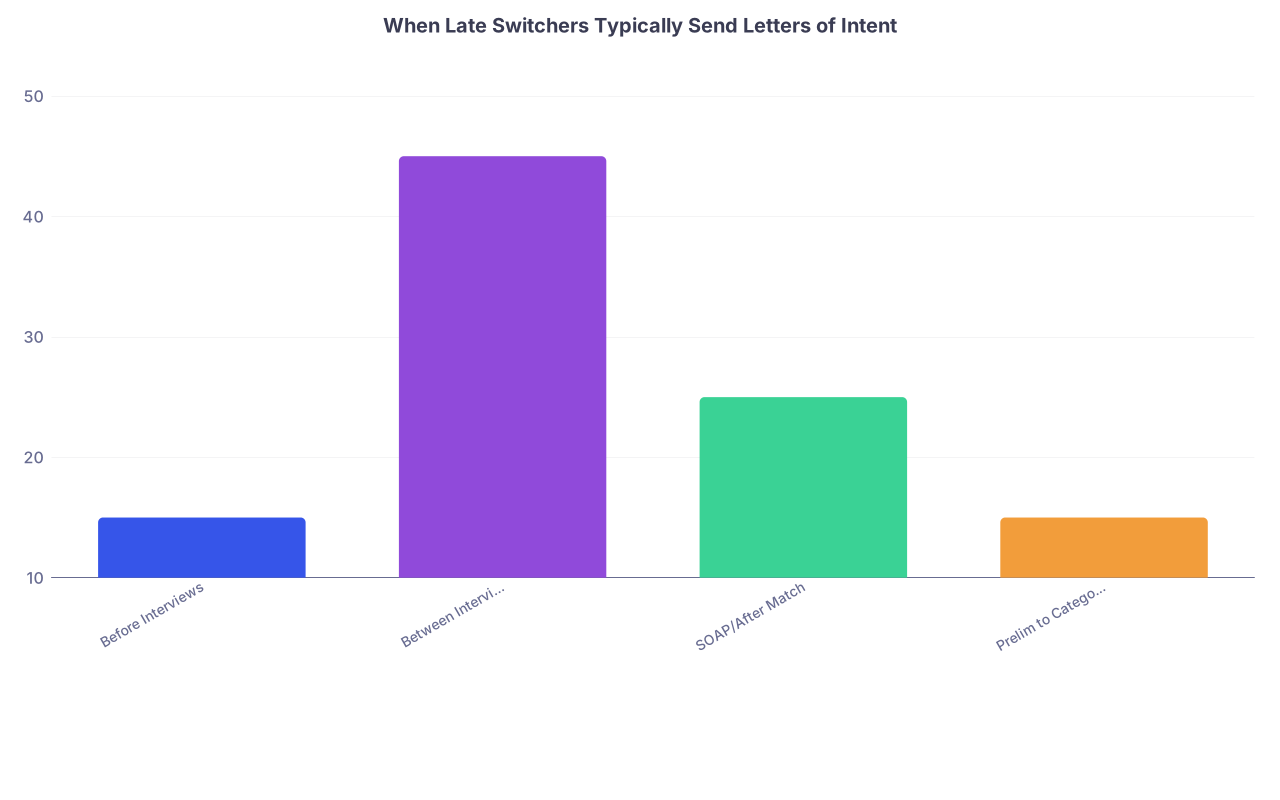
| Category | Value |
|---|---|
| Before Interviews | 15 |
| Between Interviews & Rank List | 45 |
| SOAP/After Match | 25 |
| Prelim to Categorical Switch | 15 |
A few practical rules:
- To whom: Address the PD by name if you can. CC the program’s generic email if that’s how they prefer communication. Don’t shotgun the same “top choice” message to multiple programs.
- When:
- If this is for SOAP or a post-Match scramble: send as soon as positions are posted and programs open channels.
- If it’s before rank list finalization: late January to mid-February is typical.
- For an in-training switch (prelim/TY): follow your GME office’s timeline, but earlier is always better.
- How long: ¾ to 1 page. Single-spaced. Anything more and they’ll skim, badly.
How This Feeds Into the “Future of Medicine” Part
You’re applying in an era where careers are less linear. People pivot. Programs know this.
The problem isn’t that you changed your mind. The problem is when you look scattered or non-committal.
What PDs want, especially now:
- Residents who can reflect on their choices.
- People who align their skills with a real niche in medicine.
- Trainees who can adapt without flailing.
Your letter is an early test of those skills. It shows whether you can:
- Synthesize your own story.
- Communicate change without drama.
- Align your personal arc with a program’s actual needs.
Do that, and being a “late switch” stops being an automatic liability. It becomes a story of intentionality.

Final Pass Checklist Before You Send
Read your draft once out loud and ask yourself:
- Did I state my intent clearly in the first paragraph?
- Did I explain the switch in under two short paragraphs, without drama or blame?
- Did I name specific aspects of the new specialty and this program that fit me?
- Did I show concrete actions I’ve taken since deciding to switch?
- Does this sound like one focused person, not someone flailing for a backup?
If the answer to any of those is “no,” fix that part before you hit send.

Key Points to Walk Away With
- Own the late switch directly, but briefly, and without drama. One clear paragraph, then move on.
- Back up your new interest with specific experiences, actions, and details about that specialty and that program.
- Reassure them you’re not flailing: show thoughtful reflection, clear goals, and how your prior path is now an asset, not a contradiction.