
It’s late January. You just finished your last interview. Your inbox is quiet, your friends are trading rumors in the group chat, and you’re staring at a half-written letter of intent to your supposed top program.
You’ve typed:
“I will be ranking your program very highly and remain extremely interested in matching there.”
You read it back. Sounds safe. Non-committal. Polite.
And that’s exactly the problem.
Programs have seen that sentence a thousand times. It does not reassure them. It makes them suspicious. It screams: “You are not my clear #1, but I want to keep you on the hook.” That kind of vague commitment language in a LOI is one of the fastest ways to make a PD (or coordinator, or APD) roll their eyes and mentally discount your “interest.”
Let me walk you through the mistakes people keep repeating—and how not to be one of them.
Why Programs Get Nervous About Vague LOIs
There’s a basic reality you absolutely cannot ignore:
Programs know applicants lie.
Or, to be generous, they “stretch the truth.”
They’ve seen:
- Letters promising “top choice” that clearly went to several programs.
- Identical “I love your culture” paragraphs copy–pasted across institutions.
- Soft, squishy phrases that mean nothing but try to sound committed.
So they’ve adapted. PDs and selection committees have developed a radar for vague, hedged language. That radar is brutal.
When they see fuzzy LOI language, they assume one of three things:
- You’re not ranking them first.
- You’re afraid of committing and want to play every side.
- You do not understand how LOIs are viewed and your strategy is immature.
None of those help you.
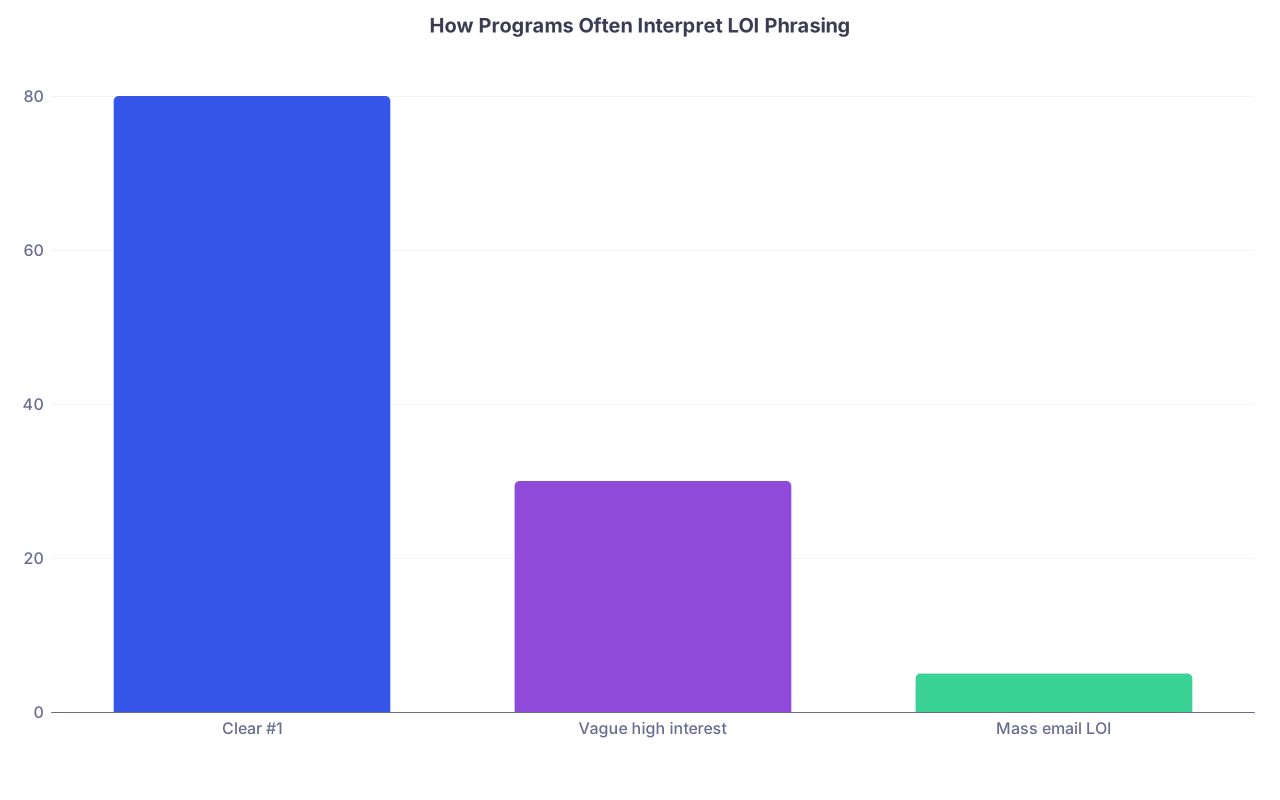
| Category | Value |
|---|---|
| Clear #1 | 80 |
| Vague high interest | 30 |
| Mass email LOI | 5 |
Interpretation here is simple: strong, honest clarity gets taken seriously; mushy “interest” gets discounted; obvious mass LOIs are almost totally ignored.
If your LOI sounds like it was drafted by a politician trying not to offend anyone, you are undermining yourself.
The Phrases That Set Off Program Alarm Bells
Programs are not parsing your letter with a literary lens. They’re scanning for a few key questions:
- Are we your clear #1?
- Are you truly likely to match here if we rank you high enough?
- Do you understand how Match communication works—or are you guessing?
Certain phrases make them immediately doubt your seriousness.
The “High” But Hollow Language
These lines sound strong if you’ve never been on the other side. To PDs, they sound weak.
Red flags:
- “I will be ranking your program very highly.”
- “Your program will be among my top choices.”
- “I am strongly considering ranking your program high on my list.”
- “I plan to rank your program near the top of my list.”
That “high,” “among,” “near,” “strongly considering” language is not subtle. It’s code for: “I’m not ready to commit to you.”
Programs hear that and think: Then why should we commit to you?
If you’re trying not to “burn bridges” with other programs, I understand the instinct. But what you’re actually doing is watering down your credibility with all of them. Nobody feels chosen. Everyone feels used.
The Over-Enthusiastic But Empty Praise
Then there’s the “I love everything, everywhere, equally” approach.
Lines like:
- “I was impressed by every aspect of your program.”
- “Your program offers everything I’m looking for in residency training.”
- “The culture, research, and clinical exposure are all perfect for me.”
- “I could see myself being very happy at your program.”
Sounds nice. Programs don’t buy it.
Why? Because anyone can write that about any decent program. It’s generic. It doesn’t show you understand that program’s specific strengths or how you fit.
I’ve watched PDs read this type of LOI and say something like, “This could have gone to 20 places. Pass.”
The Non-Commitment Disguised as Commitment
This one is subtle, but deadly. You think you’re being assertive, but you’re hedging.
Examples:
- “I am confident I would thrive at your program and am strongly leaning toward ranking it highly.”
- “Your program stands out to me as a top-tier option on my list.”
- “I have serious intentions of ranking your program very highly.”
Notice the pattern? Strong adjectives, weak ranking language. Programs care more about the second half of those sentences than the first.
If your LOI sounds like a dating text that says, “I really like you, you’re definitely in my top few people,” don’t be surprised when no one feels special.
The Legal Fear Myth: “I Can’t Say #1”
Let’s kill a myth that drives a lot of this vague nonsense.
You’re not going to jail for telling a program they’re your number one.
You’re not breaking NRMP rules by sending a true, honest LOI that says: “I will be ranking your program #1.”
NRMP rules forbid programs from asking you where you’ll rank them or requiring commitments.
They do not forbid you from voluntarily expressing your own intentions—as long as you’re not coercing, colluding, or lying.
The mistake is not “saying too much.”
The mistake is lying or being slippery.
Here’s the breakdown:
- Saying “I will rank you #1” to one program when it’s true → Strong, acceptable, commonly done.
- Saying that to multiple programs → Unethical and dumb. They talk. People notice.
- Being so terrified of saying anything concrete that you send soft, mushy language to everyone → You look naïve and unstrategic.
If you genuinely don’t have a true #1 yet, then fine—do not manufacture certainty you don’t feel. But stop pretending that writing “I will rank you very highly” is some kind of clever compliance with the rules.
It’s not clever. It’s transparent. Programs recognize the hedging instantly.
The Single Worst Pattern: Mass LOIs With Vague Commitment
Here’s where people really shoot themselves in the foot.
They write one LOI template. Then:
- They change the program name.
- They swap 1–2 sentences about something superficial from the interview day.
- They keep the same vague, non-committal ranking language.
- They blast this out to 5, 10, 15 programs.
I’ve seen this go wrong so many times:
- APD at Program A and faculty at Program B did residency together. They compare LOIs at a conference. Same letter; two programs both told they’re “top choices.”
- A coordinator forwards your LOI to multiple people at the institution. Someone realizes you used the exact same text their friend at different institution got from you.
- You reapply or later apply for fellowship and your pattern of “I’m very interested” fluff becomes obvious across cycles.
| LOI Style | Program Reaction |
|---|---|
| Clear single #1, specific reasons | Taken very seriously |
| Vague “rank you highly” language | Discounted or ignored |
| Mass generic LOI to many programs | Viewed as insincere |
| No LOI at all | Neutral in most programs |
So let me be blunt. A generic LOI with vague commitment is often worse than no LOI.
With no letter, you’re a neutral data point. With a bad LOI, you’re the applicant who tried to play the game and failed at it.
How to Express Interest Without Sounding Squishy or Dishonest
You might be thinking:
“Okay, but what if I truly do not have a single clear #1 yet? Or I don’t feel comfortable promising #1 to anyone?”
That’s actually fine. You don’t have to promise #1. But you do have to stop with the empty, hedge-heavy language.
Here’s the safer, more adult way to frame it.
1. If You Have a True #1
Then say it. Clearly. Once.
Something like:
“After completing my interviews, your program is my clear first choice, and I will be ranking [Program Name] #1 on my rank list.”
That’s it. Simple. Clean. No “very highly,” no “near the top.”
Then back it up with specific reasons that fit you:
- A particular track (global health, clinician-educator, research)
- Their patient population
- Culture you saw on interview day
- Geography for personal/family reasons
- Specific residents or faculty you clicked with
Specific is believable. Generic is not.
2. If You Don’t Have a True #1 (Yet)
Don’t fake a #1. Don’t lie.
But also don’t send this:
“I will rank you very highly” — it’s meaningless.
Instead, you can:
- Emphasize genuine enthusiasm and fit.
- Avoid ranking talk entirely if you can’t be honest about it.
- Or say something honest but bounded.
For example:
“I left my interview day at [Program] feeling that it would be an outstanding place for my residency training. The combination of [X, Y, Z] makes your program one of the very few I am seriously considering at the top of my list.”
That’s still not thrilling to them, but at least it’s not slimy. No false precision, no fake #1, no weird hedging. You’re allowed to have a small group of top-tier choices.
Just do not write that same “very few” line to 15 programs. If your “few” includes everyone, it’s not a few.
The Subtle Red Flags in Tone and Structure
It’s not just the obvious phrases that bother programs. There are tonal things that signal immaturity or lack of judgment.
1. LOIs That Sound Like Legal Disclaimers
Some applicants go so far in trying to “not break any rules” that the letter sounds like a contract.
I’ve seen:
- “While I understand the Match process prohibits explicit commitments, I would like to express strong interest…”
- “Without intending to imply a binding agreement, I want you to know…”
- “This letter should not be interpreted as an enforceable promise…”
This makes you look anxious and over-literal. Programs don’t want a future resident who writes like a risk officer every time they have to say something honest.
Skip the pseudo-legal disclaimers. Just tell the truth in normal human language.
2. Letters That Are 80% Fluff, 20% Substance
If your LOI is three paragraphs of “thank you so much for interviewing me, I enjoyed speaking with everyone, the city is beautiful, the lunch was great” and one vague line about where you’ll rank them—you’ve wasted the opportunity.
Programs care about:
- Fit.
- Commitment level.
- How well you understood their strengths.
Everything else is background noise.
A leaner, more serious LOI with 1–2 tight paragraphs is much better than a page of fluff plus one weak “ranked highly” line buried at the bottom.
3. Dramatic Emotional Language With No Concrete Content
Watch for this tendency:
- “I fell in love with your program from the first moment.”
- “I cannot imagine training anywhere else.”
- “Your program felt like home in a way no other did.”
If that’s paired with:
“I will be ranking your program very highly” — you’ve just created a contradiction.
If you “cannot imagine training anywhere else” then why are they only “near the top”?
Programs see that mismatch and mentally file you under “trying too hard” or “not honest with themselves (or us).”

Specialty Differences: Where Vagueness Hurts Most
Not every specialty cares about LOIs to the same degree, but vague commitment language is more damaging in some contexts than others.
Think about these rough categories:
| Specialty Type | Effect of Vague LOI |
|---|---|
| Ultra-competitive (Derm) | Actively harms credibility |
| Competitive (Ortho, ENT) | Noticeably negative |
| Mid-competitive (IM, EM) | Mildly negative / ignored |
| Less competitive | Mostly ignored |
In very competitive fields, programs are used to being courted. They know they don’t have to chase you. So a vague LOI doesn’t just fail to help—it reminds them they have options.
In less competitive fields, they may not care that much about LOIs. But here’s the catch: if they do bother to read them, hedged language still doesn’t win you any points.
Your safest default: if you’re going to send a LOI at all, send something that’s either clearly committed (for your one true #1) or clearly honest without pathetic hedging.
When You Should Not Send a LOI At All
Sometimes the best way to avoid vague commitment language is to… not put yourself in the situation.
You should seriously consider skipping the LOI if:
- You have no single #1 and genuinely feel torn among many.
- You know you’re a long shot at a big-name program and think a soft LOI will magically fix that.
- You’re tempted to send the same half-generic, half-specific LOI to six places.
An honest, well-crafted LOI to one true #1 can help.
A vague LOI to ten programs usually does nothing, and can hurt.
If you cannot write something specific, sincere, and either clearly committed (for your #1) or straightforwardly enthusiastic (for a small top group) without rankings talk, then do yourself a favor and don’t send anything.
Programs do not sit around asking: “Why didn’t this applicant send a LOI?”
They do roll their eyes at obvious attempt-to-game-the-system LOIs.

| Step | Description |
|---|---|
| Step 1 | Finished Interviews |
| Step 2 | Send 1 clear #1 LOI |
| Step 3 | Optional - send honest interest letters without rank promises |
| Step 4 | Do not send LOIs |
| Step 5 | Do you have a clear #1? |
| Step 6 | Small top group only? |
How to Self-Check Your LOI Before Sending
Before you hit send, do a quick ruthless audit. I mean ruthless. Pretend you’re the PD reading hundreds of these.
Ask yourself:
Does this letter say anything I would feel embarrassed about if it got forwarded to another program?
If yes, fix it. That includes fake #1 promises.Did I use phrases like “very highly,” “among my top,” “near the top,” “strongly considering”?
If yes, either commit honestly or strip the ranking language entirely and focus on fit and enthusiasm.Could I change the program name and send this to 10 other places without it looking out of place?
If yes, it’s generic. Add specific, concrete details that tie your goals to their program.Is there any emotional language that contradicts my ranking language?
Don’t say “no other program compares” and then “rank you highly.” That’s nonsense.Does this letter sound like a normal resident talking, or like an anxious applicant overcompensating?
Aim for straightforward, slightly formal but human. Not melodramatic. Not robotic.
If you fail this audit in more than one category, rewrite. Or don’t send it.
Key Takeaways
- Vague commitment language—“very highly,” “near the top,” “among my top choices”—doesn’t reassure programs; it signals hedging and weakens your credibility.
- One clear, honest LOI to a true #1 with specific reasons helps; generic, mass LOIs with soft promises often hurt more than sending nothing.
- When in doubt, choose honest enthusiasm and concrete fit over fake ranking talk. If you can’t commit cleanly, don’t hide behind fuzzy phrases that programs have already learned to ignore.