
The MCAT will break you if you treat it like every other exam you’ve taken outside the U.S.
Let me be very direct: as an international premed, your biggest MCAT problem usually isn’t content. It’s exam style. You’ve probably done well on knowledge-heavy, calculation-heavy, or short-answer exams. The MCAT is a different animal: long, passage-based, inference-heavy, punishing on stamina, and brutally specific about how it wants you to think.
If you’re an international premed taking the MCAT, you’re not just learning science. You’re learning “U.S. standardized test culture.” That’s the adaptation that separates the people who stall in the 505–508 range from the ones who break 515+.
Here’s how to handle your exact situation.
Step 1: Accept That Your Usual Study Style Won’t Be Enough
Most international students I’ve worked with make the same mistake: they start by asking, “What MCAT books should I use?” but not, “How does this exam behave?”
You grew up with some version of:
- Memorize the book.
- Do past papers.
- Walk into the exam and dump knowledge.
The MCAT does not reward that pattern. It rewards:
- Applying foundational concepts in unfamiliar scenarios.
- Reading dense passages quickly and extracting what actually matters.
- Interpreting graphs and experiments rather than recalling every pathway.
You need to deliberately abandon a few habits:
- Stop trying to memorize every detail from physiology/biochem like it’s a final exam.
- Stop solving every calculation in full when estimation is enough.
- Stop assuming “I know the content” = “I can answer MCAT-style questions.”
New rule: You don’t “know” a topic until you can answer AAMC-style questions about it under time pressure.
Step 2: Understand the MCAT as a U.S.-Style Standardized Test
Think of the MCAT as:
- 7.5 hours long.
- Almost all passage-based.
- Multiple choice only.
- Very rigid in structure.
| Section | Style Focus |
|---|---|
| Chem/Phys | Data-heavy, multi-step reasoning |
| CARS | Dense, abstract reading, no outside knowledge |
| Bio/Biochem | Experimental design + concept application |
| Psych/Soc | Definitions + subtle conceptual nuances |
Big cultural difference you need to internalize: U.S. standardized tests love predictable structure and testable patterns. That is good for you—once you see the patterns, you can exploit them.
Example pattern you must adjust to:
- In many systems, the question stem may be ambiguous and you argue your answer.
- On the MCAT, ambiguity is controlled; there is always a best answer, and your job is to track AAMC’s logic, not your professor’s or your own.
Your mindset has to shift from: “What do I think is right?”
To: “How would the AAMC justify this answer using only what’s in front of me?”
Step 3: Bridge the Language & Reading-Speed Gap (Even If You’re Fluent)
If English is not your first language—even if you’re “fluent”—this exam will expose every weakness in:
- Reading speed
- Reading stamina
- Nuance comprehension (tone, implication, “best supported” vs “directly stated”)
CARS is usually where this hurts most.
CARS: Treat It Like Learning a New Dialect of English
CARS is not about vocabulary. It’s about:
- Following an argument’s structure.
- Detecting the author’s attitude (approval, skepticism, neutrality).
- Identifying what is implied rather than directly stated.
If your home education emphasized memorization and direct questions, CARS will feel almost hostile at first. That’s normal. Here’s what to do:
Start reading 30–45 minutes per day of:
- The Economist
- The Atlantic
- Aeon essays
- Philosophy or social science essays online
For each article, force yourself to answer:
- What’s the main argument?
- What would the author disagree with?
- Is the author enthusiastic, cautious, critical, or neutral?
Do CARS practice untimed first, focusing on:
- Accuracy and understanding the passage.
- Why each wrong answer is wrong in AAMC’s eyes.
Progressively add time:
- Start: 12–13 minutes per passage.
- Work down to 9–10 minutes per passage.
Do not skip CARS in your study schedule just because “it’s not science.” That’s how international students sabotage otherwise strong applications.
Step 4: Rewire How You Study Science Content
Most non-U.S. systems are heavy on:
- Deep derivations
- Formal proofs
- Heavy calculations
- Detailed memorization of pathways and minutiae
The MCAT wants:
- Conceptual understanding > derivations
- Interpretation of graphs/tables > raw calculation
- Using a few key formulas flexibly > knowing every formula in the book
- Reasoning through experiments > memorizing every enzyme
Practical adaptations you should make:
When you study a topic (say, cardiac physiology):
- Don’t just read and highlight.
- Draw your own diagrams.
- Explain the mechanism out loud in plain language.
- Then pull up practice questions immediately on that topic.
For equations (e.g., kinematics, circuits, acid-base):
- Practice estimation, rearranging them quickly, unit analysis.
- On MCAT-style questions, ask: “Can I ballpark this instead of computing exactly?”
For biochem pathways:
- Focus on inputs, outputs, regulation points, and big-picture purposes.
- Don’t obsess over every intermediate unless repeatedly tested.
If your current system rewards perfectionist detail, you need to consciously fight that urge. The MCAT punishes spending 3 minutes on a single question to get it “perfect.”
Step 5: Learn the U.S. Exam Rhythm: Timing, Breaks, and Stamina
You probably haven’t taken many exams that:
- Last 7.5 hours
- Require consistent performance across four long sections
- Allow limited, structured breaks
International students often underestimate this and crash on test day—not from ignorance, but from fatigue.
You have to train for:
- Mental stamina
- Time management
- Recovery between sections
Here’s the rough section timing reality:
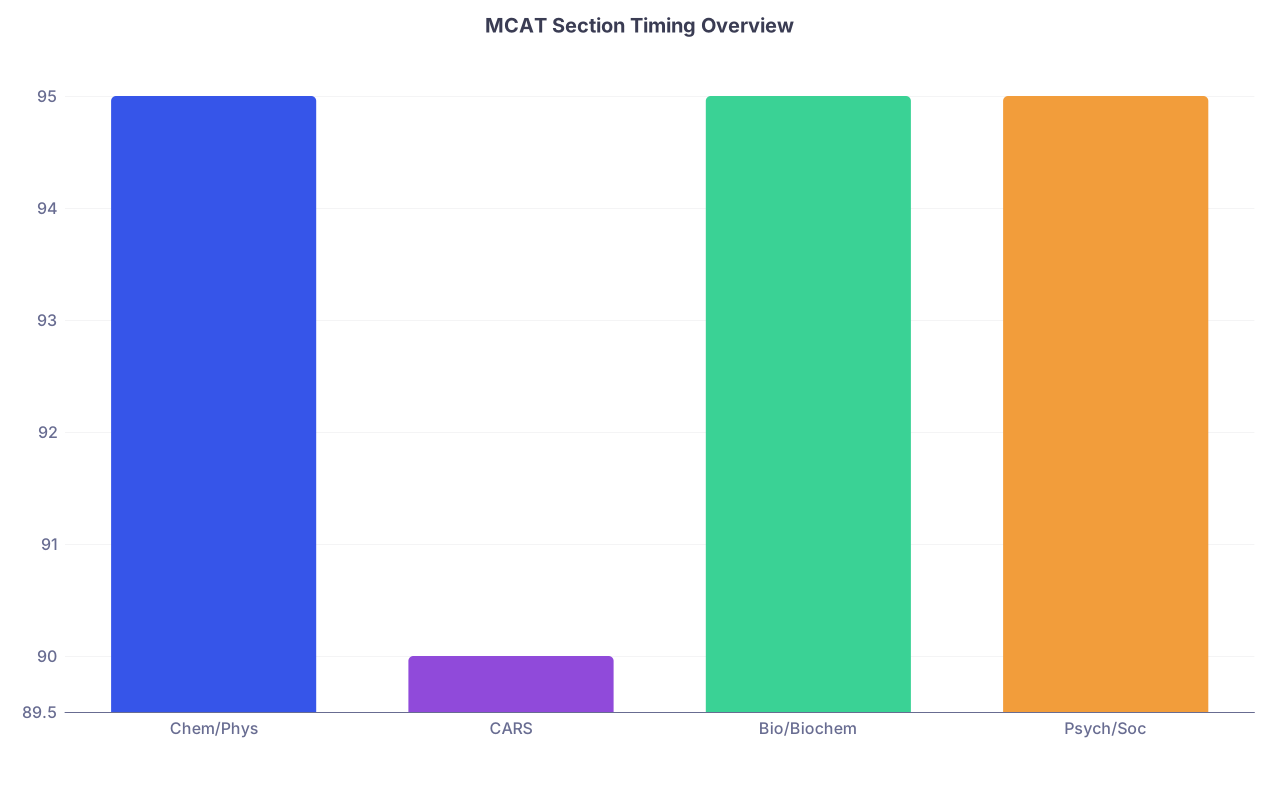
| Category | Value |
|---|---|
| Chem/Phys | 95 |
| CARS | 90 |
| Bio/Biochem | 95 |
| Psych/Soc | 95 |
You should:
- Simulate full-length test days, not just question sets.
- Use official AAMC practice exams under strict conditions:
- Same start time as your real exam.
- Same breaks.
- No phone, no extra snacks beyond what you’ll actually bring.
If your home university exams are 2–3 hours, this is a different sport. Your brain needs conditioning—like training for a marathon, not a sprint.
Step 6: Decode U.S.-Style Multiple-Choice Logic
This is a big one. Many international students know the right concept but miss the question because they don’t understand how U.S. MCQs are built.
Here’s the basic pattern:
- One clearly correct answer (according to AAMC logic).
- One attractive trap using a partially correct idea.
- One irrelevant-but-sounds-scientific option.
- One clearly wrong option.
Your job isn’t just “pick what’s right.” It’s “eliminate what AAMC will not pick.”
Train yourself to:
Predict the answer before reading the choices when possible.
Cross out options aggressively:
- Off-topic?
- Contradicts passage data?
- Adds outside information not in passage?
Think like the test writer:
- “What is this question really testing?”
- “What mistake are they trying to bait me into?”
If you come from a system where you can argue multiple interpretations, forget that on the MCAT. You’re not debating. You’re reverse-engineering a standardized logic.
Step 7: Adapt Your Practice Strategy to U.S. Test Prep Norms
In many countries, “doing past papers” is enough to predict exam style. For the MCAT, the only true past papers are:
- AAMC Question Packs
- AAMC Section Banks
- AAMC Practice Exams
Third-party materials (Kaplan, Princeton Review, UWorld, Blueprint, etc.) are for skill-building, not for final score prediction.
Here’s how I’d structure practice if you’re international:
Phase 1: Foundation + Light MCAT-Style Practice (6–10 weeks)
- Learn/review content with any major prep book or video series.
- For each chapter:
- Do end-of-chapter questions.
- THEN do a small set of MCAT-style questions on that topic (e.g., UWorld or Blueprint).
Goal: Never let content exist in your head without attaching it to questions.
Phase 2: Heavy Practice + Section Work (4–6 weeks)
- Start doing:
- Full CARS practice sets (3–4 passages at a time).
- Chem/Phys and Bio/Biochem discrete sets + short passage sets.
- Use third-party Qbanks heavily here for volume.
Phase 3: AAMC-Dominant + Full-Lengths (4–6 weeks)
- Switch to mostly or exclusively AAMC materials.
- Take:
- All available AAMC practice exams.
- Section banks (especially Bio/Biochem and Chem/Phys).
- Review each exam ruthlessly:
- Why did I choose my wrong answer?
- What did AAMC want me to notice?
- Is this a content gap, or a reasoning/reading problem?
Step 8: Address International Logistics Early (Not at the Last Minute)
Your situation is messier logistically than a U.S. student’s. If you don’t handle this early, it will absolutely bleed into your performance.
Common issues:
- Limited testing centers in your country.
- Flights and visas if you must test in another country.
- Time zone differences if your test environment feels unfamiliar.
- Stress over reporting scores to U.S. schools.
Handle this months in advance:
Register for a test date early.
Don’t wait. International seats fill fast.If traveling:
- Arrive at least 2 days before the exam.
- Account for jet lag and local food/water differences.
- Do a light practice set the day before, but no full exam.
Prepare documents:
- Valid passport (not expiring soon).
- MCAT registration confirmation.
- Exact address and route to the test center.
Understand score reporting:
- All schools will see all your MCAT scores.
- Most U.S. schools are fine if you improved significantly, but don’t treat the first exam as a “throwaway practice.”
Step 9: Adjust for Educational Culture Shock
This part is subtle but real.
Some differences you may feel:
- In your home system, teachers might spoon-feed what’s “on the exam.”
- On the MCAT, no one is telling you which experiments or passages are coming.
- You might be used to partial credit and showing work; the MCAT gives none of that.
- You might feel pressure as “the international” who needs to “prove they belong.”
You need to actively manage that mental load.
Practical things that help:
- Study with U.S.-based MCAT prep communities (Discord, Reddit r/MCAT, etc.) to see how domestic students talk about the exam.
- Use American English resources for science review (Khan Academy, U.S.-authored MCAT books) to get used to terminology and phrasing.
- If possible, get at least one mock exam reviewed by someone familiar with U.S. test-taking norms (tutor, mentor, or peer who scored well).
You’re not just learning content; you’re learning how this system thinks about testing and evidence.
Step 10: Build a Realistic Score Goal Based on Your Situation
A lot of international students aim for “520 or bust” because they feel they must be exceptional to overcome being non-U.S. trained.
Reality:
You should aim for the best score that’s consistent with your practice performance and timeline, but obsessing over an arbitrary number will wreck you.
Use this approach:
- After 2–3 AAMC full-lengths under real conditions:
- Take the average of your last two.
- That’s realistically near your testing range, assuming continued study and targeted review.
Then consider:
- Your target schools (DO vs MD, public vs private).
- Your GPA (converted, if needed).
- Your visa status and residency plans.
You absolutely should be competitive, but don’t let perfectionism drive you into endless delay and burnout. A 512–515 with a strong story and solid experiences can beat a 521 with no clinical exposure or context.
Example Weekly Plan for an International Premed (10–12 Weeks Out)
Here’s a concrete structure you can steal and adapt:

| Step | Description |
|---|---|
| Step 1 | Mon |
| Step 2 | Chem/Phys review + 20 Qs |
| Step 3 | Tue: CARS 4 passages + Psych/Soc |
| Step 4 | Wed: Bio/Biochem + 20 Qs |
| Step 5 | Thu: CARS 4 passages + Chem/Phys |
| Step 6 | Fri: Psych/Soc + CARS 3 passages |
| Step 7 | Sat: Half-length practice test |
| Step 8 | Sun: Review + light reading |
Non-negotiables here if you’re international:
- CARS at least 3–4 days a week, every week.
- One block of long, dense reading (non-MCAT) at least 3x/week.
- Frequent exposure to graphs, experimental setups, and U.S.-style question stems.
What International Students Typically Underestimate (And How You Won’t)
Based on what I’ve actually seen:
Most international students underestimate:
- CARS difficulty and cultural style.
- The impact of reading speed on all sections.
- The fatigue of a 7.5-hour test.
- How differently MCQ traps are written.
- The logistics of testing abroad or in an unfamiliar environment.
You’re going to do the opposite:
- Start CARS training early and consistently.
- Incorporate English argumentative reading into your daily routine.
- Simulate full test days, not just discrete practice.
- Learn test-writer logic, not just science content.
- Lock in logistics months ahead so test day is “just another full-length.”
Quick Snapshot: Key Adaptations For International Premeds
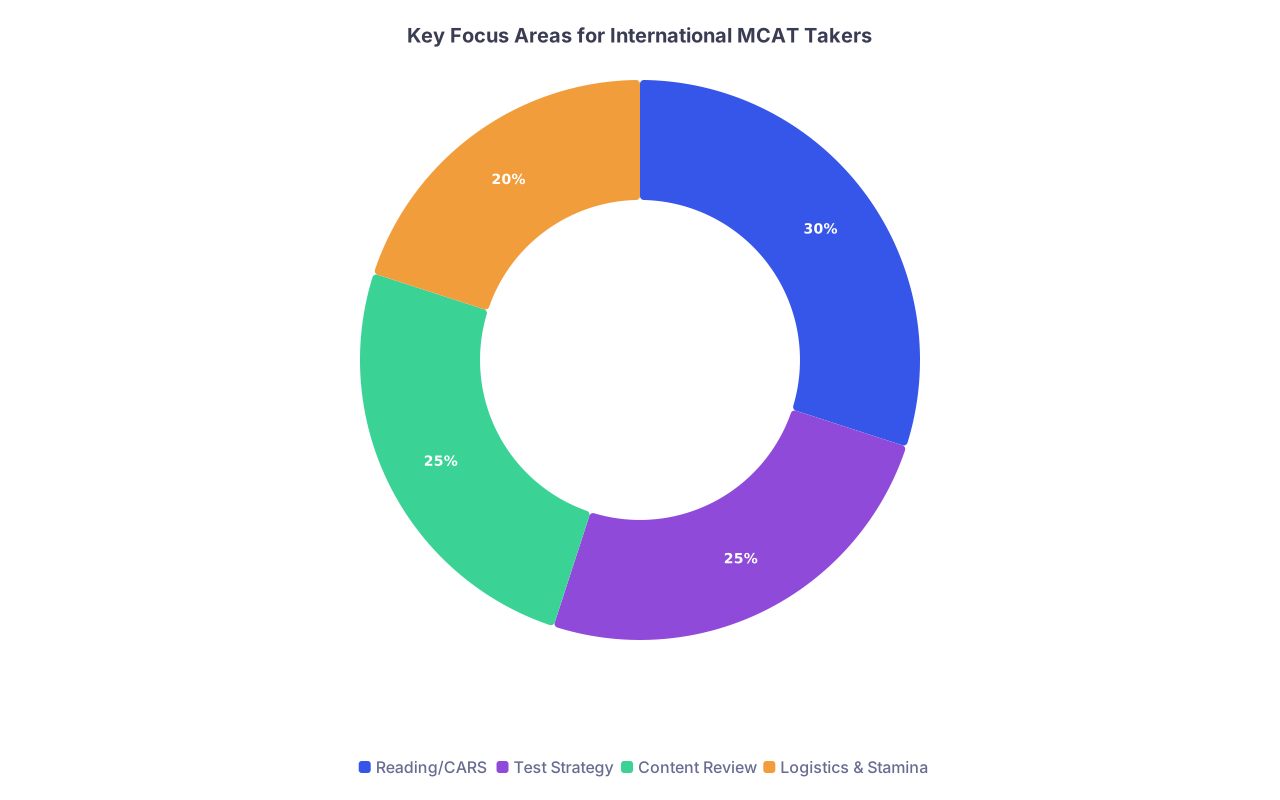
| Category | Value |
|---|---|
| Reading/CARS | 30 |
| Test Strategy | 25 |
| Content Review | 25 |
| Logistics & Stamina | 20 |
You’re not starting behind because you’re international. You’re just playing a game designed around a different educational culture. Once you recognize that, you can train in a targeted way instead of blindly grinding.
FAQ (Exactly 3 Questions)
1. Should I delay my MCAT until my English is “perfect”?
No. You do not need perfect English. You need functional, fast, and precise English for academic reading. If you can:
- Read an Economist article without translating.
- Summarize its argument in your own words.
- Understand ~80–90% of TV shows without subtitles.
Then you’re close enough. Focus on MCAT-style reading and reasoning rather than chasing theoretical perfection.
2. Are U.S. medical schools biased against international students’ MCAT scores?
They aren’t biased against the MCAT score; they’re cautious about:
- Visa issues.
- Funding.
- Uncertainty about your prior academic system.
A strong MCAT (relative to their average), plus solid experiences and clear plans, can absolutely make you competitive. Your job is to remove doubt: strong score, clear communication, and evidence you understand U.S. medicine and medical education.
3. Is it worth taking a prep course as an international student, or can I self-study?
If you’re disciplined and willing to dig into U.S.-style resources (AAMC, Khan Academy, good prep books, online communities), you can absolutely self-study. A course helps if:
- You want structure and accountability.
- You want guided explanations of U.S. exam logic.
- You lack peers who are also studying for the MCAT.
If money is tight, I’d prioritize:
- AAMC materials
- One solid Qbank (e.g., UWorld)
- Good books or free videos
over an expensive course.
Open your calendar right now and block off one “MCAT simulation day” in the next 2 weeks—full-length exam, U.S.-style conditions, no shortcuts. That single decision will show you exactly how far you are from being adapted to the U.S. exam style.