
The story medical schools tell about wellness is incomplete. The data on attrition, leaves of absence (LOAs), and mental health by year shows a very different picture than the glossy “we support you” brochures.
The baseline: how many med students actually leave?
Let’s anchor this with hard numbers first.
Across U.S. MD schools, LCME data over the last decade show a relatively low ultimate attrition rate: roughly 3–5% of matriculants do not eventually graduate from their original school. That sounds reassuring—until you drill down by year and reason.
Patterns that show up again and again:
- True dismissals or permanent withdrawals for academic reasons: 1–2%
- Leaves of absence at some point: often 10–20% of a class over the full course of training (though most return)
- Mental-health-related disruptions: consistently underreported, but survey data indicate that the symptom burden is much higher than the official LOA numbers.
The real signal emerges when you split things out by MS1, MS2, MS3, MS4 and line that up with mental health prevalence and board exam pressure.
Year-by-year risk: where the numbers spike
I will be blunt. The risk is not evenly distributed. The data show clear hotspots.
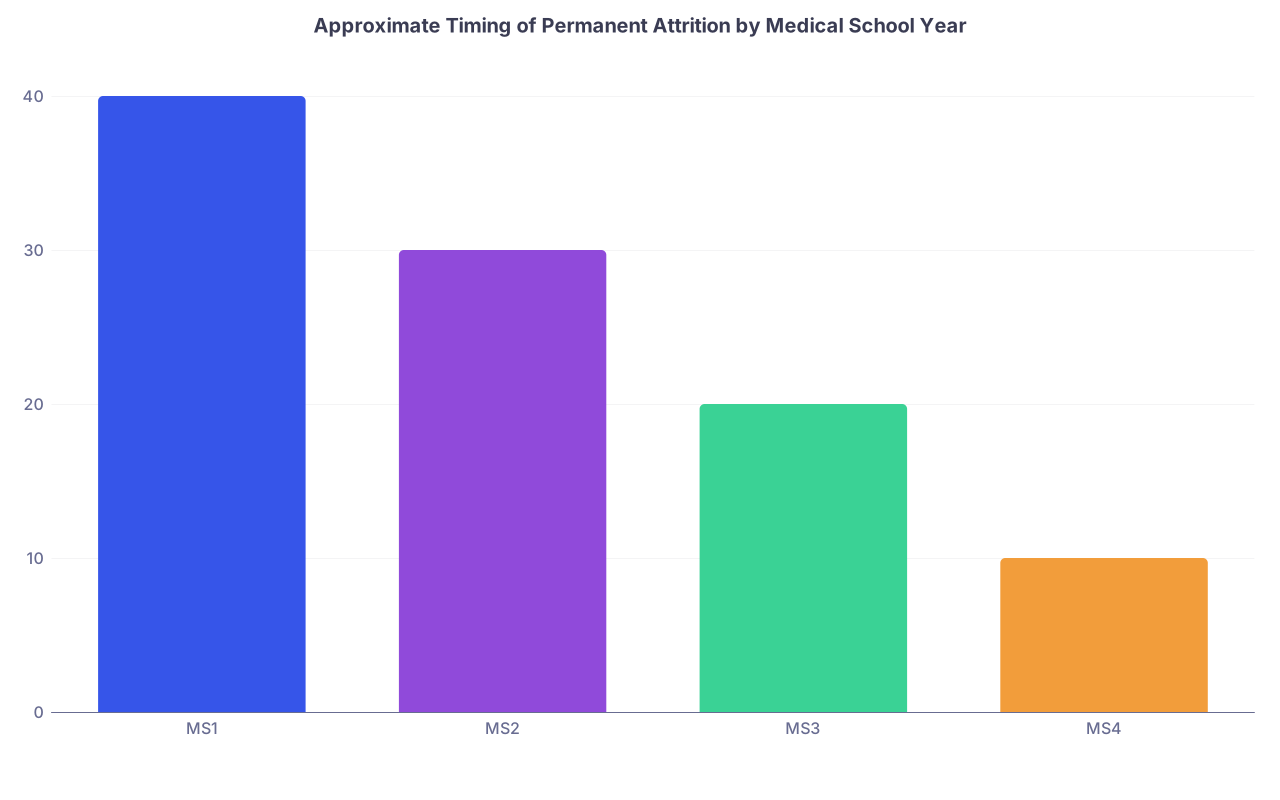
| Category | Value |
|---|---|
| MS1 | 40 |
| MS2 | 30 |
| MS3 | 20 |
| MS4 | 10 |
Interpretation of that chart:
Those are proportions of permanent attrition events, not total students. In many schools, around 70% of permanent withdrawals or dismissals occur in the pre-clinical years (MS1–MS2), even though the mental health burden arguably peaks during clinical rotations.
Why?
Because structure and stakes shift dramatically by year.
MS1: Shock to the system
First-year is where I see the largest cluster of early exits and the first wave of LOAs.
Key data points from multi-school surveys and internal reports:
- Depressive symptom prevalence among MS1s is often around 25–30%.
- Clinically significant anxiety runs near or above 30–40%.
- Early academic failure (remediation or repeat of at least one course/block) often hits 5–15% of a class depending on grading rigor.
Now combine that with this:
| Metric | Approximate Value |
|---|---|
| Any course failure/remediation | 5–15% |
| Self-reported moderate–severe depression | 25–30% |
| Any counseling/therapy contact | 20–30% |
| Permanent withdrawal/dismissal | 0.5–1.5% |
The story the numbers tell:
- Most permanent attrition cases in MS1 involve a convergence of academic difficulty and unaddressed mental health issues.
- LOAs at this stage tend to be coded as “personal” or “health-related” without explicit documentation of depression, anxiety, or adjustment disorders. In reality, mental health is usually in the top two drivers.
There is also a subtle structural factor: MS1 is the first time many high-performing students ever “fail” at anything. That identity shock is not just emotional. It strongly predicts who will consider withdrawal or LOA after one or more failed blocks.
MS2: The Step 1 (or Level 1) pressure cooker
MS2 is where board exam culture bites hardest.
Even with USMLE Step 1 now pass/fail, schools’ internal data show:
- A large spike in stress, sleep disruption, and anxiety during the 6–9 months preceding the exam.
- LOA rates related to exam failure or inability to sit for the exam on time.
Pre-pass/fail Step 1 data are clear: students below certain practice test thresholds were more likely to:
- Delay Step 1 (effectively a short LOA).
- Fail Step 1 and require a formal LOA or extended time.
- Later end up in the small subset of permanent attrition.
The transition to pass/fail has shifted the pattern but not eliminated it. What changed:
- Absolute failure rates remain low, but:
- The pressure has migrated toward Step 2 CK and away rotations.
- MS2 remains a high-risk year for mental health downturns, even if outright dismissal numbers have dipped.
From counseling center data at multiple medical schools, it is common to see:
- Utilization of mental health services peak or significantly rise in late MS2.
- Presenting problems: performance anxiety, panic attacks tied to practice exam scores, burnout, and hopelessness about residency competitiveness.
So while attrition in MS2 might numerically be lower than MS1, the mental health load is very high, and LOAs driven by exam-related anxiety and depression are common behind the scenes.
MS3: Clinical year, quiet crisis
MS3 is where the documentation underestimates the damage.
On paper:
- Permanent attrition drops. Very few students outright leave in MS3.
- LOAs shift from “academic difficulty” to “health/personal/other.”
In reality, you see a pattern like this across multiple schools:
- Self-reported burnout jumps to 50–65% of MS3s.
- Depression and anxiety scores rise or remain high, not low.
- Call schedules, night shifts, constant evaluation, and clerkship grading systems intensify distress.
- Bullying or mistreatment exposure is non-trivial (10–20%+ in some surveys).
Why do not the attrition numbers spike?
Three reasons.
- Sunk cost. Students are deep in debt and halfway in. Leaving feels impossible.
- Cultural pressure. Taking an LOA for mental health in clinical years is often perceived as “program-damaging,” even if officially supported.
- Documentation. Many MS3s power through episodes that would justify an LOA if they were in any other profession.
I have sat in committees where an MS3 who clearly had severe depression, working 70–80 hour weeks, explicitly said, “I will not risk delaying graduation.” That is what the numbers cannot show directly—but you see its shadow in survey data and informal leave coding.
MS4: Tail end, hidden Step 2 and Match stress
MS4 looks deceptively calm in raw attrition reports.
Most students graduate. Permanent withdrawals are rare. On paper, it is a “lighter” year.
Except:
- Step 2 CK has assumed a larger role as a de facto numerical filter after Step 1 went pass/fail.
- For students who struggled earlier, delayed boards, or took an LOA, MS4 becomes a compressed high-stakes year.
- Match-related anxiety peaks mid-MS4, especially for those in competitive specialties or with any academic “blemish.”
The numbers:
- Very low outright dismissal in MS4.
- But a non-trivial subset (≈3–8% at some schools) require extended graduation beyond the traditional 4 years, often due to:
- Exam retakes.
- Rotation or credit deficiencies.
- Aftermath of earlier LOAs.
Many of these extensions have a mental health dimension even when officially coded as academic.
LOAs: who takes them, when, and why
Schools rarely publish LOA statistics clearly, but internal review data and accreditation self-studies usually show:
- 10–20% of a given class will be off-cycle at some point (LOA, deceleration, repeat year).
- LOAs cluster at transition points:
- End of MS1 after repeated failures.
- Late MS2 / pre-boards.
- Between MS2–MS3 for students who failed or delayed Step 1/Level 1.
- The proportion explicitly coded as “mental health” is almost certainly an underestimate.
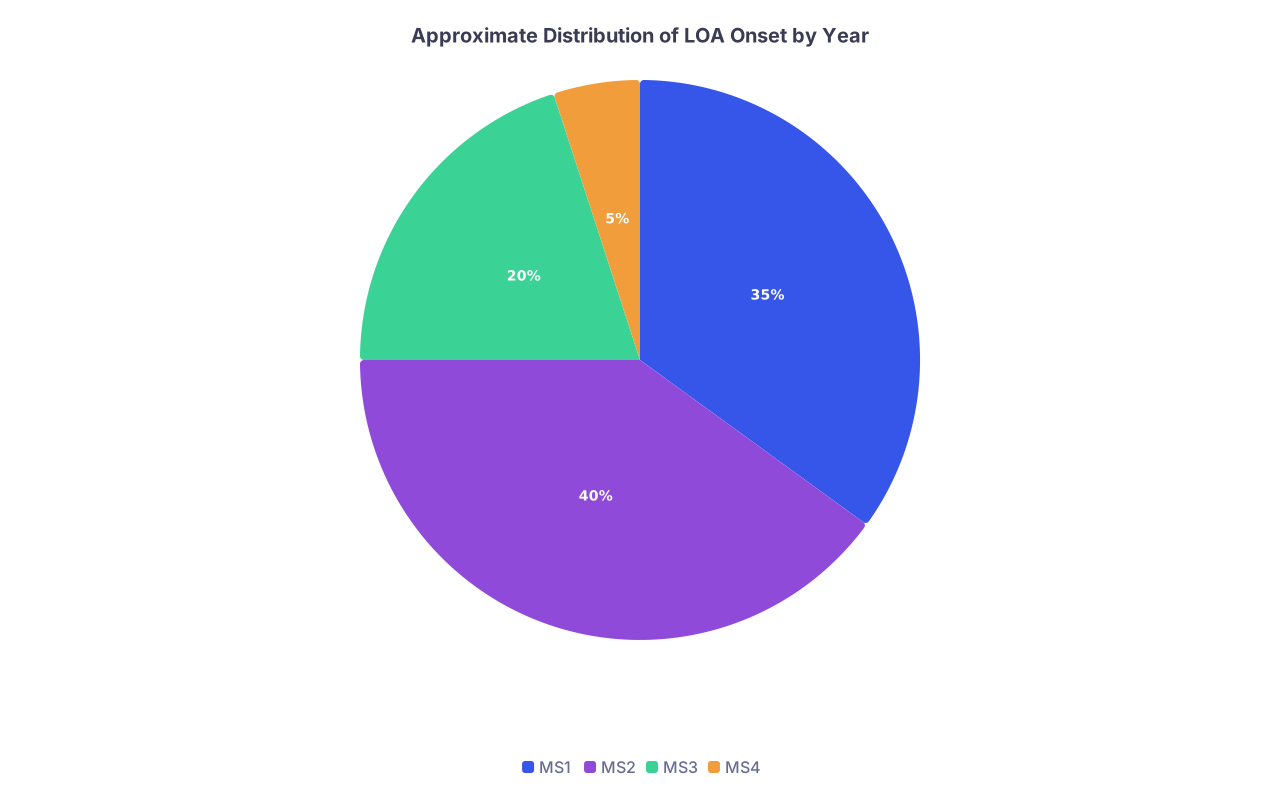
| Category | Value |
|---|---|
| MS1 | 35 |
| MS2 | 40 |
| MS3 | 20 |
| MS4 | 5 |
Those percentages are not universal but they match patterns at multiple institutions:
- Around 75% of LOAs start by the end of MS2.
- A smaller but important subset emerge in MS3, often after a major acute event (hospitalization, family crisis, severe burnout).
The disconnection worth highlighting: mental health symptom prevalence is high in every year, but LOAs materialize when either:
- Academic performance crosses a red line (multiple failures, board exam failure), or
- Symptoms reach crisis level (suicidality, hospitalization, absolute functional collapse).
Translation: the system is reactive, not preventive. The data show that clearly.
Mental health prevalence: numbers that do not match the official story
Meta-analyses and multi-country surveys of medical students consistently show:
- Depression (moderate to severe): ≈25–30%.
- Anxiety (moderate to severe): often 30–40%.
- Burnout: around 45–60% depending on definition.
- Suicidal ideation at some point in training: often 10–15%.
These are not fringe outliers. They are repeated across different cohorts, regions, and curricula.
Now compare that with how many students actually:
- Take a mental-health-labeled LOA: usually under 5% in any given year.
- Are formally documented as having mental health disabilities or accommodations: often single-digit counts per class.
This gap is enormous. It means one thing: most distressed students are still functioning on paper.
To make it concrete, for a class of 150:
- ~40–50 may have clinically significant depressive symptoms at any given time.
- ~60 may have clinically significant anxiety.
- Maybe 5–10 will ever be on an LOA documented as “mental health.”
- Only a fraction of those will appear anywhere near official attrition numbers.
The rest are simply gritting through.
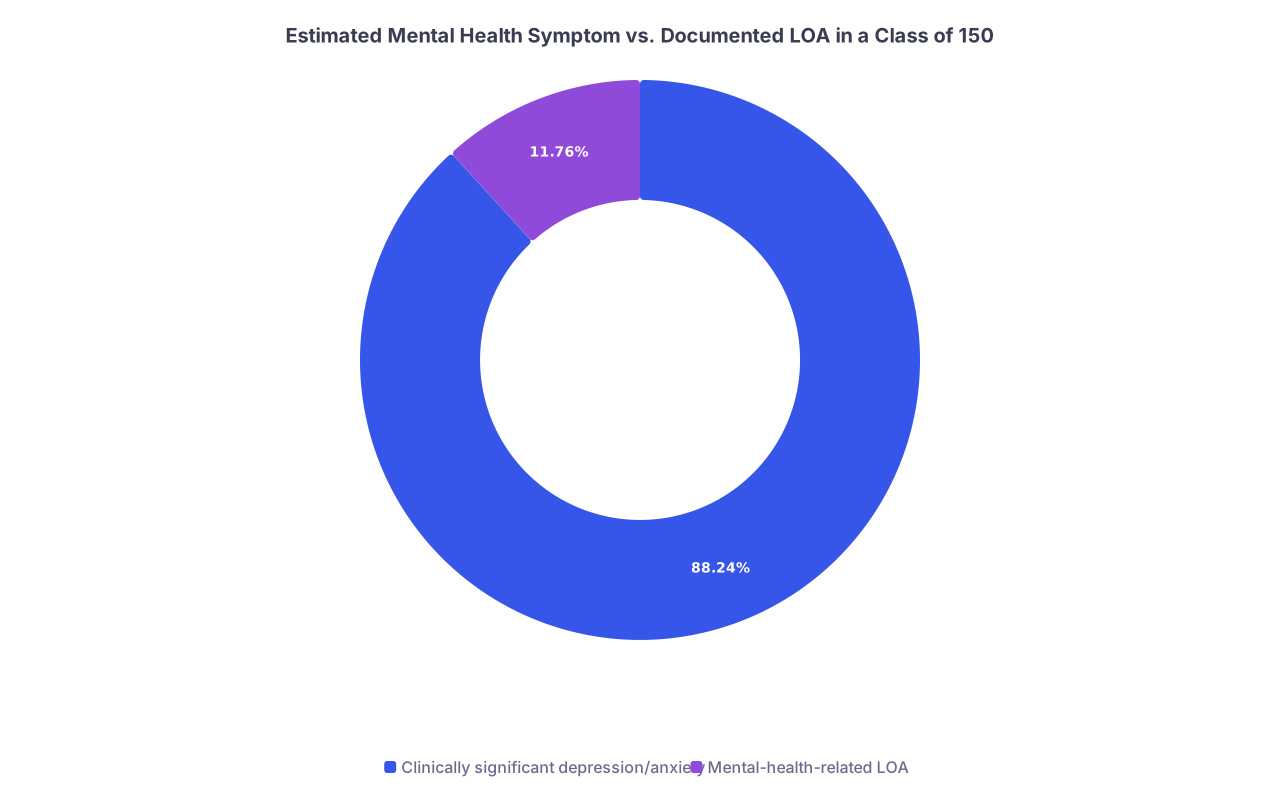
| Category | Value |
|---|---|
| Clinically significant depression/anxiety | 60 |
| Mental-health-related LOA | 8 |
No, that chart is not exact. But it is directionally accurate across many programs: huge symptomatic population; small documented subset.
What actually predicts risk?
If you are looking at this like a data analyst—and you should—the question becomes: who is actually at risk of LOA or attrition, and when?
Patterns that repeatedly predict higher risk:
Early academic difficulties
- Failing multiple blocks or courses in MS1.
- Especially if performance is inconsistent rather than uniformly weak.
- Often a marker for underlying mental distress, sleep disruption, or ADHD/learning issues.
Board exam performance and timing
- Step/Level practice scores well below borderline thresholds, coupled with escalating anxiety.
- Multiple delays or retakes of boards.
- This combination is overrepresented among LOA cases at the MS2–MS3 boundary.
Compounding stressors
- Family illness, caregiving responsibilities, financial strain.
- International students coping with immigration pressures and isolation.
- Students underrepresented in medicine facing chronic microaggressions and lack of support.
-
- Paradoxically, students who do access services early may be more likely to take a preventive LOA—but less likely to end up in catastrophic, forced attrition.
- The “red flag” is not using counseling; it is deterioration in functioning with zero documented support.
From a quantitative perspective, the strongest early warning cluster I have seen is:
- Poor MS1 grades + escalating absenteeism + self-reported sleep disruption and hopelessness.
Those students are heavily overrepresented in later LOAs or permanent withdrawals.
Misalignment: wellness rhetoric vs measurable outcomes
Let me be clear: wellness initiatives have grown. You see more:
- Resilience workshops
- Mindfulness apps
- “Wellness weeks”
But when you look at actual outcomes—LOAs, attrition, mental health symptom scores—the trend is underwhelming.
At many schools:
- Utilization of mental health services is up (which is good and partly due to destigmatization).
- Self-reported distress is flat or increasing.
- Time pressure, evaluation intensity, and competitiveness have not meaningfully decreased.
- Structural drivers (curriculum overload, grading policies, hidden curriculum) show minimal change.
So instead of pretending wellness posters fix this, the data suggest a different approach: treat LOAs, attrition, and mental health metrics as hard quality indicators, the same way you treat board pass rates.
How this plays out by year in real life
To ground this, here is the kind of pattern I have repeatedly seen in cohort data and student trajectories.
- End of MS1: 10% of the class is in serious academic trouble. Behind those numbers, over half have significant depression or anxiety. A subset takes a LOA. One or two withdraw permanently.
- MS2: Some of the struggling group stabilizes. Others spiral under Step 1 pressure. A wave of LOAs or decelerations cluster near exam season. Morale drops sharply.
- MS3: Official crisis numbers dip. Students look “under control” on spreadsheets. But all you have to do is read an anonymized burnout survey to know half the class is not okay. Very few LOAs, but a lot of quiet suffering.
- MS4: Board scores and Match lists dominate. One or two students miss the Match or need to scramble or SOAP. Extensions appear for those who delayed exams or rotations. Long-term mental health stories show up later, not in the graduation statistics.
You can pretend it is all fine because 95–97% graduate. Or you can admit that the process extracts a measurable, often preventable toll.

| Step | Description |
|---|---|
| Step 1 | MS1 Start |
| Step 2 | MS1 Academic Stress |
| Step 3 | MS2 Coursework |
| Step 4 | Remediation/LOA Risk |
| Step 5 | Board Exam Pressure |
| Step 6 | MS3 Clinical Year |
| Step 7 | High Burnout, Low Attrition |
| Step 8 | MS4 + Match |
| Step 9 | Graduate |
| Step 10 | Permanent Attrition |
| Step 11 | Fail Courses? |
| Step 12 | Board Pass? |
| Step 13 | Return? |
That flowchart is simplified, but the choke points—MS1 failures and board exam trouble—are absolutely real in the numbers.
If you are a student: what to actually do with this
You are not going to fix the system by yourself. But you can use the data to make sharper decisions.
Here is the practical takeaway by year:
MS1: Treat recurrent academic struggle as a combined academic and mental health problem, not just a “study strategy” issue.
- If you are repeatedly failing blocks, the probability that this is only about study methods is low.
- Early evaluation for depression, anxiety, ADHD, or sleep disorders pays off. I have seen students who waited a full year and lost ground they never fully regained.
MS2: Do not let Step 1/Level 1 or Step 2 CK creep into a private catastrophe.
- If practice scores are low and your anxiety is spiraling, that is exactly when to involve both academic advising and mental health services.
- Forced LOAs after a failed attempt are much costlier (emotionally and logistically) than a planned, preventive delay with support.
MS3: Do not interpret “everyone is suffering” as evidence you should not seek help.
- High burnout is normal in the statistical sense; it is not benign.
- Even a short-term leave or schedule adjustment can prevent a multi-year downward spiral.
MS4: Watch for overconcentration of stress in a small window (Step 2, aways, applications in the same 3–4 months).
- The handful of students I have seen completely crash in MS4 were almost always overcompressed on timeline.
There is a recurring pattern: students who use LOAs strategically and early frequently recover and graduate on a slightly extended timeline. Students who delay until absolute crisis are much more likely to end up in the permanent attrition group.
What the numbers really say
Stripping away the euphemisms, you end up with three blunt conclusions.
The vast majority graduate, but the path is rougher than the brochures admit.
Attrition is low on paper, but symptom burdens and quiet suffering are high in every year, especially MS2–MS3.Risk is front-loaded and exam-centered.
Early academic trouble in MS1 and board exam stress in MS2 are the big quantitative predictors of LOAs and eventual withdrawal.Mental health issues are widespread; documented LOAs are the tip of the iceberg.
At any given time, a large fraction of your class is struggling at a level that would justify support or even temporary leave, but only a small minority show up in the official records.
If you are in the thick of it, you are not an outlier. You are in the majority that the statistics quietly describe.
Use that information to act earlier, not later.