
The dirty secret of med school is this: a lot more people regret choosing medicine than will ever say it out loud.
If you’re halfway through med school and thinking “I made a huge mistake,” you’re not broken, and you’re not alone. You’re just in a brutal system that gives you almost no space to question it.
Let’s treat this like a real clinical problem, not a vague existential crisis. You have symptoms (dread, regret, burnout). We need a differential (Is this medicine itself? Burnout? Depression? Wrong specialty? Wrong environment?). Then we come up with a management plan with actual options, not Instagram-therapy slogans.
This is the situation handler version: if you are mid–med school and seriously regretting medicine, here’s what to do next.
Step 1: Separate “I Hate Medicine” From “I’m Not Okay”
Most students skip this step and jump straight to “I need to quit.” That’s like jumping to surgery without labs or imaging.
You need to distinguish between:
- Hating medicine as a career
- Being burned out, depressed, or anxious
- Hating your current environment or phase (pre-clinical, clerkships, specific rotation)
Those feel similar on a bad night at 2 a.m., but they have very different solutions.
Here’s a rough screen I use with students who come to me saying they “regret medicine”:

Ask yourself:
If I had a guaranteed chill, supportive training environment, less debt, and 60-hour weeks max, would I still not want to be a doctor?
- If yes, still no: this might be a real mismatch with the profession.
- If no, I might actually like it: you are probably reacting to the conditions, not the core job.
Do I feel numb, hopeless, or detached from everything I used to enjoy, not just medicine?
- If yes, I start thinking less “wrong career” and more “mental health crisis layered over everything.”
Is there any part of medicine that still feels meaningful or interesting?
- A specific patient moment, a subject, a procedure, an intellectual puzzle. If there’s nothing, that’s significant. If there’s a spark anywhere, we can work with that.
How long have I felt this way?
- Weeks → could be acute stress, a bad rotation, Step/COMLEX, relationship drama.
- 6–12+ months consistently → this is more like a pattern than a phase.
Before you make any career decisions, you need a mental health check that’s more than a nameless wellness module.
If you can access one, set up:
- An appointment with a therapist or counselor who is not grading you or evaluating you.
- A primary care visit to screen for depression, anxiety, sleep issues, substance use, and basic medical problems that can wreck mood (thyroid, anemia, etc.).
If that sounds overkill, ask yourself: if your future patient felt like you do right now, would you tell them “just push through and see what happens”? No. You’d get basic labs and referral.
You deserve at least that level of care before deciding the next 40 years of your life.
Step 2: Run a Clear “Quit vs Stay” Risk–Benefit Analysis
Medicine trains you to do structured thinking for patients, then guilts you into emotional chaos for your own life. Let’s use your clinical brain on yourself.
Here’s the honest landscape for a mid–med school regret crisis.
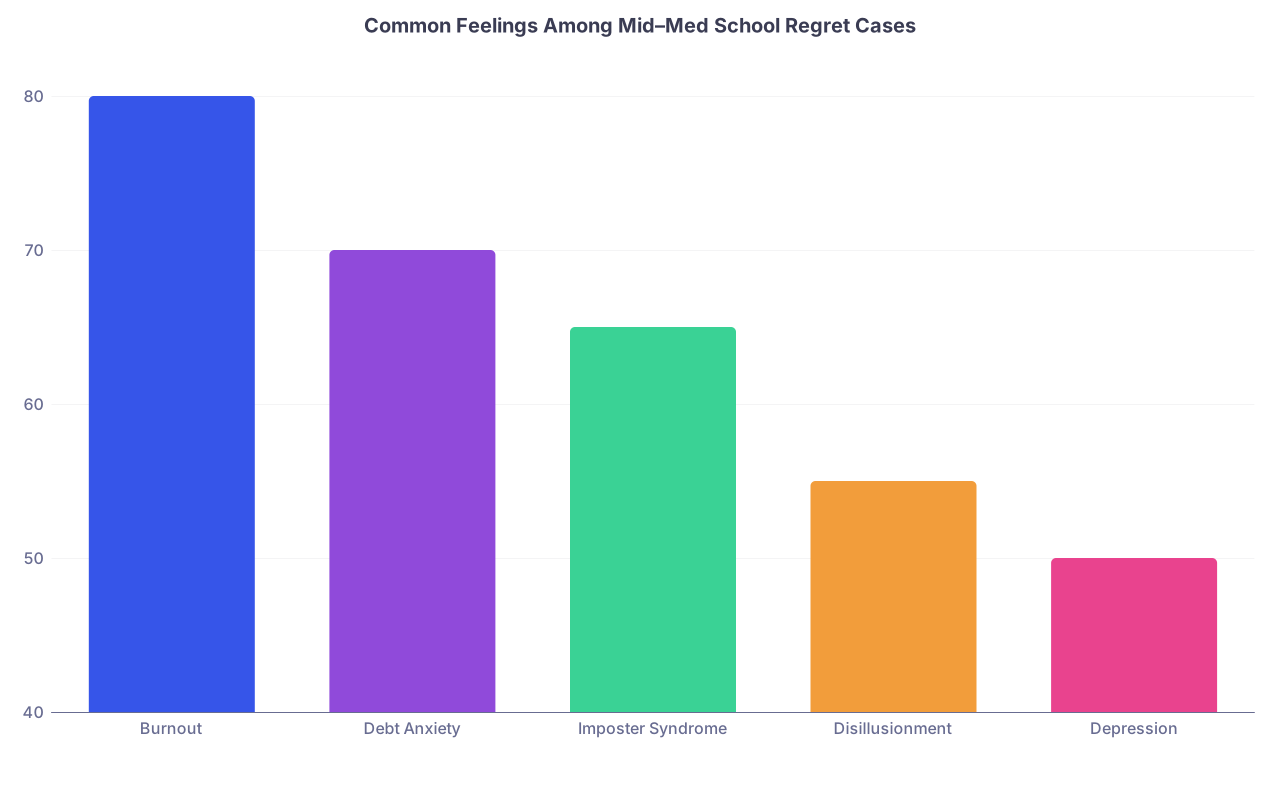
| Category | Value |
|---|---|
| Burnout | 80 |
| Debt Anxiety | 70 |
| Imposter Syndrome | 65 |
| Disillusionment | 55 |
| Depression | 50 |
The real costs of walking away mid–med school
I’m not trying to scare you. I’m trying to make the invisible visible:
- You’ll likely still owe the loans you’ve already taken. They do not disappear because you changed your mind.
- You lose sunk time: 1–3 years already invested.
- You may have to explain this pivot to future employers / grad programs. It’s doable, but it takes thought.
- Family pressures, cultural expectations, perceived “failure” — emotionally brutal, especially in some communities.
Now the flip side, which most students underestimate:
The real costs of staying in something you deeply regret
- Burnout that calcifies into cynicism. I’ve seen attendings who clearly hated medicine by their PGY-2 year. They stayed for money or pride. They’re miserable, and patients feel it.
- Increased risk of serious depression, self-harm, or substance misuse if you stay purely from obligation.
- You may end up locked into a specialty you picked for survival (less call, easier match) rather than fit, then you repeat the same problem at the next level.
This is not “quit = bad, stay = good” or the reverse. Both have real risks. You’re choosing between imperfect paths.
Here’s a simple but helpful frame I use with students:
| Factor | Stay in Medicine | Leave Medicine Mid-School |
|---|---|---|
| Financial | Finish degree, higher ceiling | Keep existing debt, new path costs |
| Mental Health (short) | Often worse before it’s better | Anxiety spike, then potential relief |
| Mental Health (long) | Depends on fit & specialty | Depends on landing place |
| Identity/Family | Social approval, less conflict | Possible conflict, but authentic |
| Flexibility | Narrow path but many niches | Broad, but must rebuild from scratch |
Your job is not to find the “perfect" option. It’s to choose the path whose pain you’re more willing to live with, and whose upside actually matters to you.
Step 3: Clarify What Exactly You Regret
Saying “I regret choosing medicine” is like a patient saying “I feel sick.” True, but not actionable.
You need a more precise sentence. Try to fill in these:
- “I regret the kind of life medicine leads to because __________.”
- “I regret the daily work of medicine because __________.”
- “I regret the culture of medicine because __________.”
- “I regret how medicine limits my other goals like __________.”
I’ll give you a few common “regret profiles” I see, because your options differ based on which one is you.
Profile A: “I like medicine. I hate this version of it.”
Example:
You liked anatomy, path, clinical skills. But you’re at a toxic school with malignant attendings, shaming culture, endless pimping, and no support. You’re crumbling.
Options for this profile are different from “I hate being around sick people.” Hang on to that.
Profile B: “I like science and helping people, but not patients and not hospitals.”
You’re fine in a lab, with data, or thinking through systems. But the messy, emotional, unpredictable part of direct patient care drains you. Chronic illness follow-up? Makes you dread your life.
This is not rare. It’s just taboo to say.
Profile C: “I don’t really like medicine at all. I got here from pressure / prestige / momentum.”
This is the “I never really chose this; it just happened” group. Maybe you were the “smart kid,” maybe family pushed, maybe in your country it was “doctor or engineer.”
By M2 or M3, the story stops working, and the real you starts protesting.
Profile D: “I’m too depressed or burned out to know what I feel about medicine.”
This is the hardest one to self-diagnose. Everything feels pointless, including other careers. You can’t imagine liking anything, not just medicine.
If you’re in D, career decisions should wait until treatment starts to work, because you’re essentially trying to choose your life path from inside a burning building.
Figure out which profile (or combo) you are. Then we talk real options.
Step 4: If You’re Leaning Toward Staying, Change the Game
You might decide, “I’m not ready to quit, but I can’t keep doing it like this.” Good. That’s actually the most common outcome when people think seriously about quitting.
Here’s what changing the game looks like in practical terms.
1. Protect your mental health like it’s a required course
Because it is. Med schools pretend it’s important, then schedule you 80 hours a week.
Minimum non-negotiables if you stay:
- A recurring therapy or counseling appointment — weekly or biweekly. Not “when things get bad.” A standing slot.
- Sleep with a floor: aim for 7 hours, but pick an absolute bare minimum (e.g., 6) where if you cross it more than a couple nights in a row, something else gives (notes, social time, extra questions).
- One thing weekly that has nothing to do with medicine that you do even if you’re behind. Yes, you’ll feel guilty. Do it anyway.
If you think you don’t have time for this, you’re wrong. You don’t have time not to, if you plan to survive multiple more years of this.
2. Start targeting a version of medicine that fits you better
This is where students suddenly feel hope for the first time in months, once they realize “doctor” is not one job.
Some examples:
- You hate call, chaos, and codes, but like thinking and talking: look at outpatient-heavy fields like psychiatry, rheumatology, allergy/immunology, outpatient IM, or derm.
- You like procedures and working with your hands, but hate long-term follow-up: EM, anesthesiology, some surgical subs.
- You like systems, not individuals: hospital administration, quality improvement, health policy, informatics, public health attached to clinical work.
Your job over the next 1–2 years is not “ace everything for its own sake.” It’s to scout. To collect real data on: “Which days feel less like dying?” “Which rotations drain me vs give me energy, even when I’m tired?”
Start tracking rotations like this:
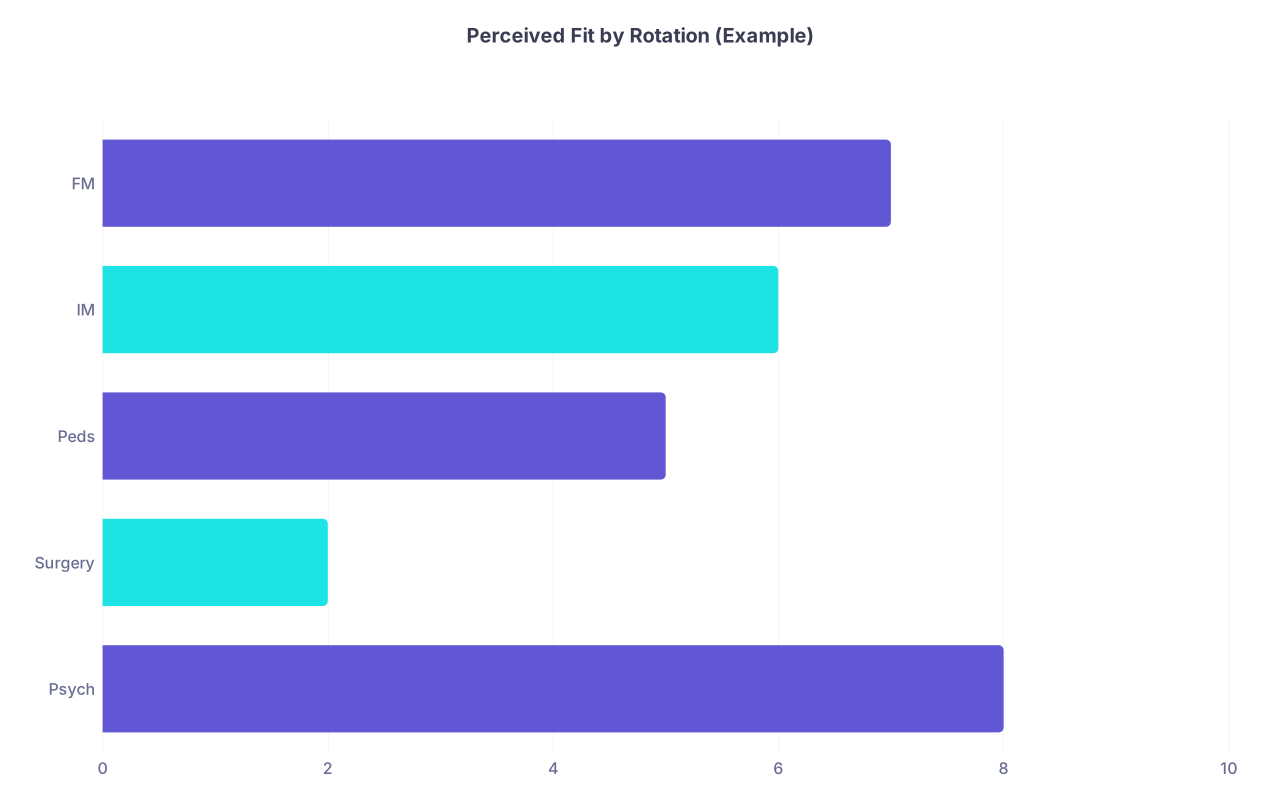
| Category | Value |
|---|---|
| Psych | 8 |
| Surgery | 2 |
| Peds | 5 |
| IM | 6 |
| FM | 7 |
Simple 1–10 rating in a notes app after each week:
- 1 = I would quit medicine before doing this forever
- 10 = If the job looked like this long-term, I’d be okay or even happy
Patterns matter more than any single week.
3. Adjust your standards strategically
If you’re staying only under the condition that you match derm at MGH with perfect scores, you’re setting yourself up for pain.
Maybe you don’t need honors in every clerkship. Maybe pass is fine in a field you’ll never touch again. Don’t blow your last reserves of mental health for a grade that will not change your actual life.
Step 5: If You’re Seriously Considering Leaving, Do It Like a Professional
Walking away from medicine isn’t a tantrum move; it’s a strategic decision that needs a real plan. If you are 50/50 or leaning toward leaving, here’s how to do this in an adult, structured way.
1. Stop thinking “all or nothing right now”
You don’t have to:
- Decide this week.
- Either stay forever or drop out tomorrow.
You have intermediate options:
Temporary leave of absence (LOA).
Many schools allow 6–12 months (sometimes more) of LOA for personal or medical reasons. You can use that time to work, travel, try another field, get therapy, or just breathe.Finish the year, then reassess with a decision deadline.
Example: “I will complete M2, take Step 1, then I give myself permission to re-evaluate with my therapist, my advisor, and a clear head.”

| Step | Description |
|---|---|
| Step 1 | Overwhelmed & Regretting Medicine |
| Step 2 | Seek urgent mental health care |
| Step 3 | Start therapy & basic medical check |
| Step 4 | Adjust specialty/life design, stay in medicine |
| Step 5 | Explore alternatives & finances |
| Step 6 | Take LOA, test other paths |
| Step 7 | Plan structured exit or conditional stay |
| Step 8 | Acute safety issue? |
| Step 9 | Still regret after 3-6 months? |
| Step 10 | Leave of absence possible? |
2. Talk to the right people, in the right order
There are people you talk to early, and people you talk to later.
Start with:
- A therapist or counselor (confidential).
- One trusted physician or senior student who isn’t directly grading you and has some perspective.
Only after you’re clearer on what you want:
- Contact your school’s student affairs / dean’s office carefully. Ask about policies first in general terms: LOAs, withdrawals, return policies. You don’t have to lead with “I’m thinking of dropping out” before you know your options.
Documentation matters. If your distress is substantial, getting it documented (by a therapist or physician) can help you qualify for medical LOA rather than “I just left.”
3. Run a real financial & career pivot analysis
If you leave, what then? Don’t gloss this.
You need:
- A basic budget: current debt, living expenses, any family support, realistic income in the next 12–24 months.
- A short list of possible next paths. Not “my dream life,” but “3–5 plausible next steps.”
Common pivots I’ve seen from mid–med school exits:
- Public health (MPH → health policy, NGOs, epidemiology)
- Consulting or healthcare strategy roles (they actually like people with partial medical training sometimes)
- Tech / health tech (product, UX, operations, often with a short additional course or bootcamp)
- Research coordination or clinical trials work
- Teaching, especially in biology / science education
- Writing / medical communication / health journalism
None of these are “doctor money” right away. But they’re not flipping burgers either. You can build a real career.
Step 6: If You Feel Trapped by Debt or Family Pressure
This deserves its own section because it traps a lot of people in quietly miserable careers.
Debt reality check
Debt keeps many people in medicine who otherwise would leave. Sometimes that’s acceptable. Sometimes it’s a cage.
A few grounded points:
- The earning power of an MD, even in a “lower paying” specialty, is still very high long term. From a purely financial perspective, finishing and practicing for 5–10 years usually beats walking away.
- But that assumes you can make it there without destroying your mental health or life. Not a small assumption.
You don’t have to figure all the math yourself. You can talk to:
- Your school’s financial aid office about consequences of LOA, withdrawal, repayment timelines.
- A fee-only financial planner who has worked with physicians-in-training (they exist).
Family and cultural expectations
I’ve watched students from South Asian, East Asian, African, Middle Eastern, and Caribbean families almost break under this one. Medicine isn’t just a job; it’s the family’s identity project.
You have a few tactical options:
Delay the fight while you gather info.
You don’t need to tell your entire extended family about your doubts while you’re still in week 1 of your crisis. Start by stabilizing yourself.Reframe from “giving up” to “choosing a sustainable life.”
Many families respond slightly better to: “I’m realizing I won’t be a safe or good doctor if I stay in this path as I am. I need to step back and look at options that I can actually succeed in long term.”Use external voices.
Sometimes a therapist, dean, religious leader, or older family friend can say things your parents can’t hear from you. That’s not weakness; it’s strategy.
No script will magically fix this. But you’re allowed to put your sanity above someone else’s fantasy of your life.
Step 7: Red Flags That Mean “Pause Decisions, Get Help Now”
There’s a point where this stops being only a career question and becomes a safety issue.
Hard stop signs:
- You’re having regular thoughts like “They’d be better off if I weren’t here” or you’re picturing specific ways to end your life.
- You’re using alcohol, benzos, stimulants, or other substances just to get through basic days and you’ve lost control over it.
- You’ve stopped going to class/clinical entirely, are lying to people about it, and you can’t see a way to restart.
If you’re here, your only priority is getting emergency-level mental health help. That might mean:
- Calling your country’s crisis line or going to an ER.
- Reaching out to your school’s emergency mental health service that day.
- Telling one trusted person in real life what’s actually going on — roommate, partner, friend — and letting them help you access care.
Career decisions wait. Safety first, always.
Step 8: What “Next Week” Should Actually Look Like
Let’s get very practical. If you’ve read this far, your brain is probably buzzing. So here’s what the next 7–14 days could look like in concrete moves.
Make one appointment: therapist, counselor, or primary care. Book it. Even if the slot is a month out. You can always move or cancel; the key is getting yourself into a pipeline of care.
Start a 2-minute daily log:
At the end of each day, write:- Energy (0–10)
- Regret level about medicine (0–10)
- Anything that didn’t feel awful today
Patterns over a few weeks tell you more than your 3 a.m. spiral.
Tell exactly one safe person the full truth.
Not the “I’m a bit stressed” version. The “I’m seriously thinking I chose the wrong life” version. Shame thrives on secrecy; it shrinks when spoken.Decide if you need an immediate schedule adjustment.
If you’re on a murderous rotation (e.g., malignant surgery month) and on the edge, ask about:- Switching to a different elective next block
- Temporary reduction or reshuffling
You’re allowed to protect yourself. You’re not a machine.
Write out three possible paths in brief:
- Path A: Stay, finish med school, aim toward [X specialty or kind of practice], with these changes: ________.
- Path B: Take LOA after [M2/M3/this year], explore [fields], reassess with a decision deadline of [date].
- Path C: Plan structured exit after [finishing this year / this exam], pivot toward [top 2–3 alternative fields].
You do not have to like any of these. They’re starting points for real thinking.
The Bottom Line
If you regret choosing medicine mid–med school:
- Don’t trust the version of your brain that only thinks at 2 a.m. Get your mental health and physical basics checked before making final calls.
- Be precise about what you actually regret. The profession? The training environment? The current phase? That specificity unlocks real options.
- If you stay, change how you’re staying. If you leave, do it with a plan, not in freefall. Either way, you’re allowed to build a life you can stand to live.
You are not the first person to feel this way, and you will not be the last. The question isn’t “Am I allowed to regret this?” The question is: now that you do, what’s the most honest and sustainable move you can make next?