
What do you do when a research project that was supposed to “help your CV” is the exact thing making you dread waking up?
Here’s the answer you’re actually looking for:
Yes, it can absolutely be okay to drop a research project for your mental health—and sometimes, it is the smartest, most mature move you can make as a medical student.
But not every “this sucks” moment is a reason to quit, and not every project is easily left. You’re balancing your sanity, your reputation, and your future applications. That’s the real tension.
Let’s cut through the noise and walk through this the way a blunt but fair advisor would.
The Core Question: Is It Actually Okay to Quit?
If your mental health is taking a clear hit from a research project—sleep wrecked, anxiety through the roof, dreading every email from your PI—then yes, it’s okay to consider stepping away.
There are two big truths here:
No residency program is worth a nervous breakdown.
A poster at a mid-tier conference is not worth you spiraling into major depression, panic attacks, or failing your coursework or exams.Quitting badly can hurt you; quitting well usually does not.
The problem isn’t “stopping research.” The problem is ghosting, blowing deadlines, and leaving others with a mess.
You’re not choosing between “be a good applicant” and “protect your brain.” You’re choosing between:
- Continue this specific project at this cost
- Adjust your role
- Exit in a way that’s clean, honest, and professional
That’s the real decision.
A Simple Decision Framework: Should You Stay or Should You Go?
Use this like a checklist, not a philosophical exercise.
Step 1: Identify what’s actually harming you
Ask yourself:
- Is it the project itself (too complex, poorly defined)?
- The PI or team (toxic, dismissive, unpredictable)?
- The timing (clashing with exams, clinicals, personal stuff)?
- Or your role (you’re doing endless grunt work with no end in sight)?
If the main problem is timing or scope, you may not need to quit entirely—just renegotiate. If the core issue is a toxic environment or repeated boundary violations, walking away becomes a lot more reasonable.
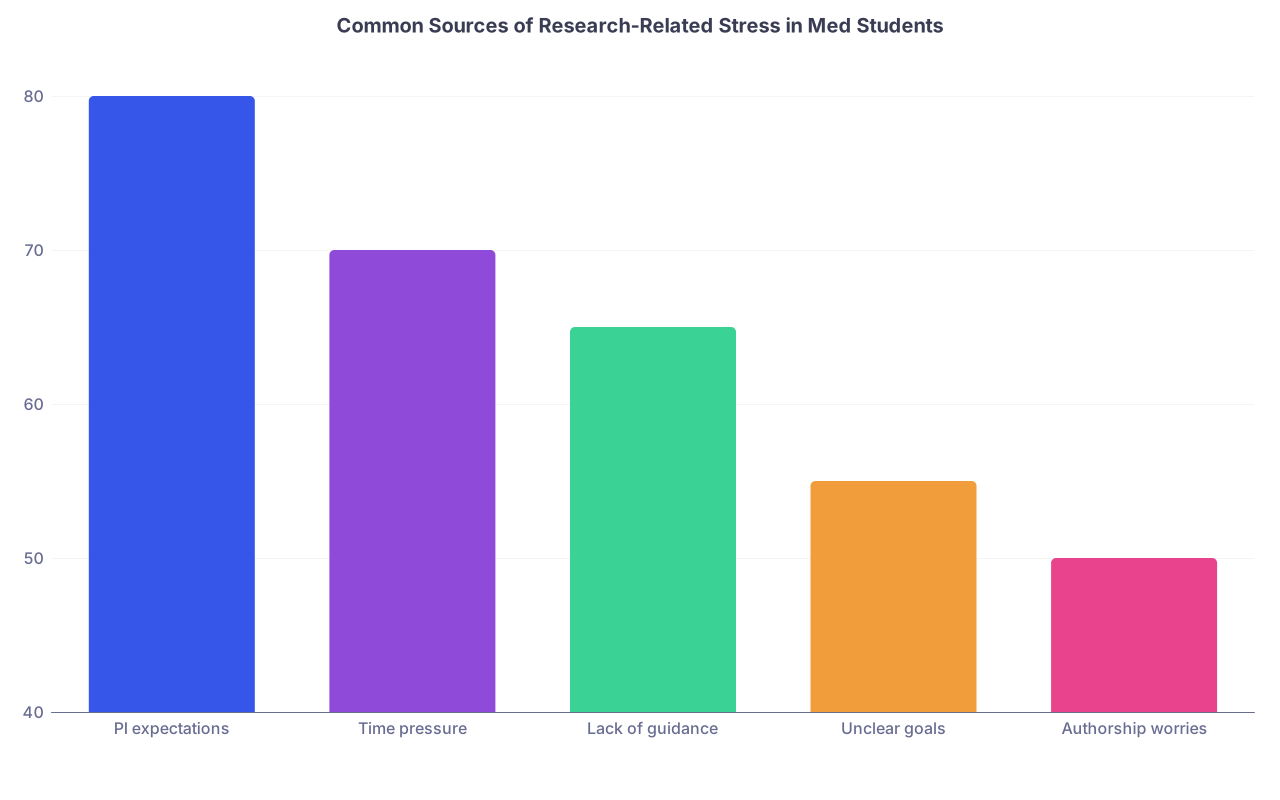
| Category | Value |
|---|---|
| PI expectations | 80 |
| Time pressure | 70 |
| Lack of guidance | 65 |
| Unclear goals | 55 |
| Authorship worries | 50 |
Step 2: Check your red flags
These are situations where I’m comfortable saying: you’re justified in strongly considering leaving.
- You’re losing significant sleep consistently because of research demands
- Your anxiety or depression has clearly worsened since starting
- You’ve started to fall behind in coursework or Step/Level prep
- You feel dread or panic every time you see your PI’s name in your inbox
- You’ve tried to set boundaries and they’ve been ignored or steamrolled
If two or more of those are true and have been going on for a while, this is not just “med school is hard.” This is a problem.
Step 3: Consider the actual career impact (not the fear version)
Students wildly overestimate how much one research project matters.
Residency programs generally care about:
- Pattern of scholarly activity, not a single project
- Follow-through and professionalism
- Not failing school or boards
- Not having giant unexplained gaps
What they don’t do: pull your CV and say, “Why did this person only have 2 abstracts instead of 3?”
If you’re applying to something extremely competitive (derm, plastics, ortho, neurosurg), yes, research has more weight. But even in those fields, people step away from toxic or failing projects all the time. The key is what your story looks like later:
- Did you still engage in some scholarly work over time?
- Can you speak about what you learned and how you handle limits?
You don’t need a perfect record. You need a believable trajectory.
How to Decide: A Practical 4-Box Approach
Here’s the blunt framework I use with students:
| Project Impact on Career | Impact on Mental Health | Recommended Action |
|---|---|---|
| High | Low | Stay and push through |
| High | High | Try to modify role; consider time-limited push or exit plan |
| Low | High | Strongly consider exiting cleanly |
| Low | Moderate | Either scale back or end; low downside |
If your project is:
- Low impact (no clear timeline, not close to publishable, weak mentorship)
- High cost to your mental health
You’re not being “weak” by leaving. You’re being rational.
How to Step Back Without Burning Bridges
If you decide you need out—or at least need less—don’t just vanish.
Here’s the professional sequence that actually works:
1. Get clear on what you want
Before you talk to your PI, decide:
- Do you want to completely leave the project?
- Or just reduce your role / shift your responsibilities?
- Is a delayed timeline acceptable to you?
Know your bottom line before you walk in.
2. Script your conversation
You do not need to overshare your mental health details. You also don’t need to invent a fake excuse.
A simple, honest, low-drama script works:
“Dr. Smith, thank you again for the opportunity to work on this project. I’ve realized that between coursework, upcoming exams, and some health-related issues, I’m not able to give this project the time and focus it deserves. I don’t want to hold the team back. I’d like to discuss either significantly reducing my role or transitioning off the project in a way that’s least disruptive for you and the group.”
Then stop talking. Don’t apologize 10 times. Don’t defend your right to breathe.
Expect one of three reactions:
- Understanding and supportive (best case)
- Mildly disappointed but accepting (common)
- Guilt-tripping or dismissive (says more about them than you)
3. Offer concrete transition help
This is how you protect your reputation:
- Offer to summarize your work in a handoff document
- Organize files, datasets, codebooks, or survey links clearly
- Create a short “status update” email or doc: what’s done, what’s pending, what’s next
You’re signaling: “I’m stepping back, but I’m not abandoning you.”
4. Clarify authorship expectations
If you’ve already contributed real work, you deserve clarity on potential authorship, but you should be realistic.
You can say:
“Given what I’ve contributed so far—data collection on X patients and initial literature review—would it still make sense for me to be included as an author if the project gets published, assuming I’m available to review the manuscript?”
Some PIs will say yes. Some will say no. Both happen. Don’t bank your entire sanity on this.

| Step | Description |
|---|---|
| Step 1 | Recognize mental health strain |
| Step 2 | Decide reduce or exit |
| Step 3 | Review commitments and progress |
| Step 4 | Plan discussion with PI |
| Step 5 | Have honest conversation |
| Step 6 | Arrange handoff and documentation |
| Step 7 | Clarify authorship if appropriate |
| Step 8 | Shift focus to health and core responsibilities |
How This Plays in Residency Applications
People overcomplicate this.
Here’s how this usually looks in reality:
- On your CV, the project just never appears if it didn’t lead to anything presentable. No one knows it existed.
- If asked in an interview about research gaps, a simple line works:
“I started a project early in med school that ended up not being a great fit with my schedule and long-term interests, so I stepped back and later joined a project in [X area] that aligned better.”
That’s it. No one needs your psychiatric history. No one needs a detailed justification.
What does hurt you:
- Failing courses or Step because you tried to “muscle through” everything
- Getting a reputation at your school as unreliable or flaky because you ghost on multiple commitments
- Burning bridges with a well-connected PI by disappearing without explanation
Quit badly, and yes, it can bite you. Quit cleanly and professionally, and you’re usually fine.
When You Should Probably Try to Stay (For Now)
Let me flip the script. There are times where I’d tell a student: “I think you should try to push through a bit more.”
You may want to seriously consider staying if:
- You’re 70–80% done with something that’s about to become a poster or paper
- Your mental distress is moderate frustration, not full-on burnout or breakdown
- The PI is respectful and willing to adjust expectations
- This is your only meaningful research experience and you’re aiming for a very competitive specialty
In those cases, it might be smarter to:
- Request clearer timelines
- Negotiate a scaled-back role
- Set a hard time limit (“I can commit until X date, then I have to focus on boards”)
You’re not a machine. But you also don’t want to throw away near-finished work if you still have some gas in the tank.
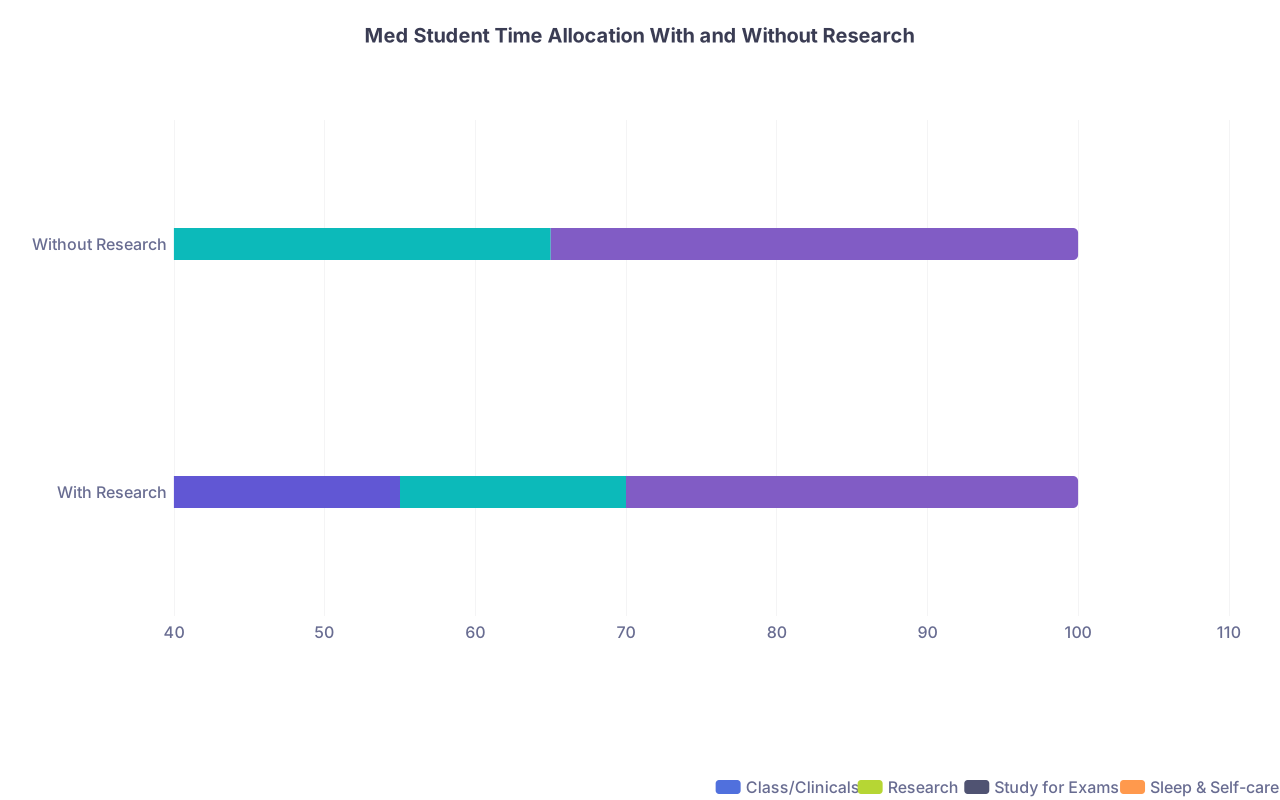
| Category | Class/Clinicals | Research | Study for Exams | Sleep & Self-care |
|---|---|---|---|---|
| With Research | 40 | 15 | 15 | 30 |
| Without Research | 40 | 0 | 25 | 35 |
How to Protect Your Mental Health Going Forward
Whether you quit or stay, you should not repeat the same mistake.
Some guardrails that actually work:
Ask the uncomfortable questions before joining next time.
Things like:- “What’s the realistic timeline to presentation or publication?”
- “What are the weekly time expectations?”
- “How often do you meet with students?”
Start with smaller, time-limited projects.
Chart reviews, case reports, defined QI projects. Less glamorous than an R01, far better for your sanity.Cap your total research load.
One serious project or two small ones is usually plenty during pre-clinicals. During boards or heavy rotations, it might be zero. That’s fine.Watch your early warning signs.
- You start ignoring your email because you’re scared of seeing research messages
- You procrastinate even opening the data file
- You’re snapping at people or withdrawing because you “don’t have time”
That’s when you intervene early. Not six months into misery.

What Mental Health Professionals Actually Say About This
Every school has that psychiatrist or counselor who’s seen hundreds of med students in the same situation. The theme is always the same when they talk off the record:
- Students sacrifice sleep, relationships, and therapy to keep research afloat
- The “I can’t quit, it’ll ruin my career” story is almost always exaggerated
- Untreated anxiety/depression absolutely hurts performance more than a missing poster abstract
Therapists are not impressed when you destroy your functioning to protect a “maybe” line on your CV.
If you’re at the point where you’re asking whether a project is harming your mental health, it’s worth at least one confidential chat with a therapist, dean of students, or wellness office. They’ve seen the pattern before.

The Bottom Line
Let me make this very clear.
- Yes, it is okay to drop a research project for your mental health.
- It’s not okay to destroy yourself to protect an optional line on a CV.
- The key is to exit (or scale back) in a way that’s honest, professional, and doesn’t leave others cleaning up a disaster you created.
You get one brain. You can always find another project later. You cannot always easily repair a full burnout or a failed exam.

FAQ: Dropping a Research Project and Mental Health
1. Will dropping a research project ruin my chances at a competitive residency?
No. One dropped project, handled professionally, will not ruin your chances. Programs care about your overall trajectory—consistent academic performance, some evidence of scholarly activity over time, and professionalism. They do not have access to a secret list of “projects you quit.” They see what you actually completed.
2. Do I have to tell residency programs I quit a project?
Not unless they specifically ask about gaps or early experiences. If a project never led to a poster, presentation, or paper, it typically does not appear on your CV. If asked about research during interviews, you can simply focus on the projects you completed. If someone presses about a timeline gap, a brief statement like, “I started a project that turned out not to be a good fit with my schedule and interests, so I transitioned off and later joined another project,” is sufficient.
3. What if my PI reacts badly or tries to guilt-trip me?
That’s a reflection of them, not you. Stay calm and repeat your boundary: you don’t have the capacity to continue at the current level. Offer a clean handoff and thank them for the opportunity. You’re not obligated to stay in an unhealthy situation because someone is disappointed or manipulative. If things get ugly, loop in your school’s research office, a mentor, or a dean for backup.
4. How do I know it’s my mental health and not just normal discomfort with hard work?
Normal challenge feels tiring and sometimes frustrating, but you can still sleep, still laugh, still function in other areas. When it’s a mental health issue, you see patterns: persistent insomnia, ongoing dread, panic around emails or meetings, grades slipping, withdrawing from friends, or thoughts like “If this doesn’t stop, I don’t see how I can keep going.” If you’re unsure, that’s a strong reason to talk to a mental health professional and get an outside opinion.
5. What should I say to my PI if I want to reduce my role instead of quitting completely?
Try something like: “I value working with you and want to stay involved if possible, but I’ve realized I can’t continue at my current workload. Would it be possible to narrow my responsibilities to [specific tasks] so I can realistically follow through?” Be concrete about what you can do and by when. This shows commitment without sacrificing your mental health to vague, open-ended expectations.
Key takeaways:
- It is absolutely acceptable—and sometimes necessary—to leave a research project to protect your mental health.
- The damage comes from quitting badly, not from setting limits. Exit cleanly, communicate clearly, and hand off responsibly.
- Your brain, your exams, and your long‑term functioning matter more than squeezing in one more “productive” bullet point.