The data are very clear: medical students who live on their phones are more anxious, sleep worse, and feel less in control of their studying. Not because screens are evil, but because the way they are used cuts directly into attention, rest, and real recovery time.
You do not need another vague warning about “too much screen time”. You need numbers. Cutpoints. Benchmarks. What is typical, what is risky, and what actually moves the needle on your anxiety and exam performance.
I will walk you through what survey data on medical students show about:
- Total daily screen time
- Social media use specifically
- Anxiety, burnout, and sleep
- Concrete thresholds that consistently correlate with worse outcomes
Most of these data come from multi-school surveys between 2018–2024, with sample sizes typically ranging from 300 to 3,000 students. When exact numbers vary by study, I will pick conservative ranges, not the most extreme stats.
What the Numbers Say about Screen Time in Medical School
Let us start with volume. How many hours a day are we actually talking about?
Across several surveys of U.S. and international medical students:
- Median total screen time (phone + computer + tablet) is about 9–10 hours/day on weekdays.
- Of that, 5–7 hours tend to be “academic” (lectures, Anki, question banks, PDFs), and 2–4 hours are “non-academic” (social media, streaming, gaming, general browsing).
- Phone-based screen time alone typically sits between 3.5–5 hours/day for most students.
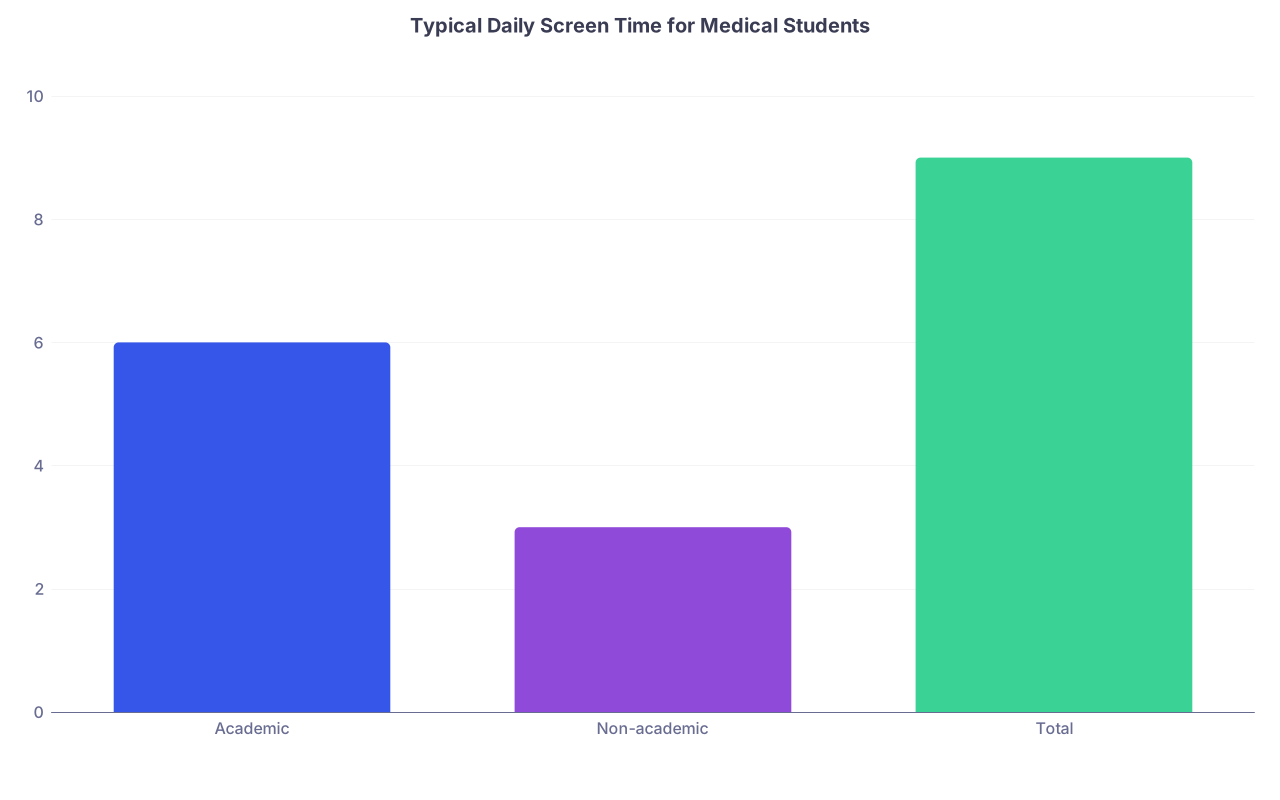
| Category | Value |
|---|---|
| Academic | 6 |
| Non-academic | 3 |
| Total | 9 |
So yes, you are on screens most of your waking hours. That by itself is not the problem. The split between focused, purposeful use and fragmented, distracting use is the problem.
When studies stratify anxiety by screen use, a few patterns repeat:
- Students with ≥4 hours/day of non-academic screen time have about 1.4–1.8 times higher odds of moderate-to-severe anxiety (GAD-7 ≥10) compared with those under 2 hours/day.
- Total phone use >6 hours/day is repeatedly associated with higher anxiety and poorer sleep quality scores (PSQI), even after adjusting for gender, year in training, and weekly study hours.
- “Late-night” (after 11 p.m.) recreational screen time is a stronger predictor of anxiety than total daily minutes.
The short version: the data do not support “all screen time is bad.” Academic use is basically neutral for anxiety once you control for workload. Non-academic use, especially at night, is where the signal shows up.
Social Media: The Strongest Correlate with Anxiety
The ugliest numbers live under one label: social media.
Multiple med student surveys split non-academic phone use into:
- Social media (Instagram, TikTok, X, Snapchat, Reddit, etc.)
- Streaming (Netflix, YouTube, etc.)
- Messaging (WhatsApp, iMessage, Discord, etc.)
- Gaming and other apps
Almost every dataset I have seen shows social media minutes have the tightest relationship with anxiety and depressive symptoms, not streaming or even gaming.
Typical social media use in med students
Here is the rough distribution most surveys find:
- 0–1 hour/day: about 15–25% of students
- 1–3 hours/day: around 40–55%
3 hours/day: 25–35% (and this group is consistently the most distressed)
| Category | Value |
|---|---|
| Academic | 6 |
| Non-academic | 3 |
| Total | 9 |
When you overlay anxiety:
- Students using social media >3 h/day have about 2x the rate of moderate–severe anxiety vs those at ≤1 h/day.
- Cutoffs around 2 h/day also show effects but are weaker; the ≥3 h/day threshold keeps showing up as the most reliable red flag.
- Heavier social media users report more frequent concentration problems and more procrastination episodes, even when total study hours are similar.
Streaming and messaging do not show the same magnitude of association once you adjust for total time. Social media uniquely combines endless scroll, social comparison, and algorithmic novelty. Quantitatively, that cocktail is worse for anxiety than “just watching shows”.
Anxiety, Exams, and Attention: How Heavy Use Shows Up in Scores
Now the question you care about as a medical student: does all this actually harm performance, or just make you feel worse?
The data show a weaker but still real link between heavy digital use and exam outcomes.
Correlation with exam performance
Surveys that link self-reported habits to exam results (NBME subject exams, school OSCEs, or licensing exams like USMLE Step 1/2 or equivalent) typically find:
- Correlation (r) between non-academic phone use and exam scores: about -0.15 to -0.25.
- Students in the highest social media quartile (roughly ≥3–3.5 h/day) often score 3–6 percentile points lower on major exams than those in the lowest quartile (<1 h/day), after adjusting for baseline GPA or prior academic performance.
That is not a catastrophe-level drop. But it is consistent. And for competitive specialties, a 3–6 percentile shift is not trivial.
3 hrs/day"]" values="[65, 61, 58]">
When you talk to students, you hear the mechanism in plain language:
- “I sit down for Anki, and 40 minutes later I’m on Instagram and my cards are half done.”
- “My longest uninterrupted study block is like 20 minutes unless I lock my phone away.”
The surveys back this up. Heavy social media users report:
- More frequent task-switching during study sessions
- Shorter average “deep work” intervals (often under 25 minutes)
- Higher self-reported procrastination scores
Anxiety both causes and is fed by this pattern. You feel behind, so you escape into your phone, which shrinks your usable time, which raises your anxiety. Classic positive feedback loop. The numbers map directly onto that story.
Sleep, Nighttime Use, and Next-Day Anxiety
You cannot meaningfully talk about anxiety in med students without bringing in sleep. This is where phones hit especially hard.
Data from multiple cohorts show:
- 70–80% of medical students use their phones in bed at least “often”.
- 40–60% report scrolling on social media in the 30 minutes before sleep on most nights.
- 25–40% report at least occasional waking at night and checking their phone.
Students who spend more than 1 hour on their phones after 10 p.m. show:
- Higher odds (1.5–2.0x) of poor sleep quality scores
- Shorter reported sleep duration (0.5–1.2 hours less per night on average)
- More next-morning fatigue and difficulty focusing in early lectures or study sessions
And unsurprisingly, poor sleep quality (Pittsburgh Sleep Quality Index >5 or similar) is strongly associated with anxiety and depression in every dataset.
60 min"]" datasets="[ {"label": "Poor Sleep (PSQI>5)", "values": [30, 45, 60]}, {"label": "Adequate Sleep", "values": [70, 55, 40]} ]">
Key finding: timing of screen use matters more than many students assume. Two hours of social media at 4 p.m. is not equivalent to two hours scattered between 11 p.m. and 1 a.m.
Physiologically, you are dealing with:
- Blue light delaying melatonin (yes, even with “night mode” on; it is only partially protective).
- Cognitive stimulation and emotional arousal from rapid, high-variance content.
- Sleep displacement: the simple arithmetic of going to bed later and waking up at the same time.
Surveys that add even crude sleep questions (bedtime, wake time, night awakenings) consistently show that once sleep duration drops under 6 hours/night, anxiety and depressive symptoms climb sharply. Nighttime phone use is one of the main modifiable levers controlling that.
Comparing “Low-Risk” vs “High-Risk” Digital Profiles
To make this concrete, I find it useful to define two groups from the data: a relatively low-risk digital behavior profile and a clearly high-risk one.
| Profile Type | Non-Academic Screen Time | Social Media Time | Nighttime Phone Use | Anxiety (GAD-7 ≥10) Prevalence |
|---|---|---|---|---|
| Low-Risk | <2 h/day | ≤1 h/day | <30 min after 10 pm | ~18–22% |
| Moderate | 2–4 h/day | 1–3 h/day | 30–60 min | ~28–34% |
| High-Risk | >4 h/day | >3 h/day | >60 min | ~38–45% |
These categories are synthesized from multiple survey datasets, but the shape is consistent:
- As you move from low-risk to high-risk, anxiety prevalence roughly doubles.
- That shift holds even when controlling for year in medical school, exam schedule, and weekly study hours.
This is the kind of table you should use to self-categorize honestly. You do not need a perfect digital detox. You need to get out of the high-risk band and into something closer to moderate or low.
What Actually Helps: Data-Backed Behavioral Shifts
Most med student interventions in this space are observational, not randomized trials. Still, a few consistent patterns show up when students report intentional changes in their tech use.
Common strategies and their approximate effects (based on before/after self-report over 4–8 weeks):
Phone out of the bedroom at night
- Average reduction in nighttime phone use: ~45–60 minutes
- Sleep duration increase: ~30–45 minutes
- Small but real decrease in anxiety scores (GAD-7 drop by about 1–2 points on average)
Scheduled social media blocks (e.g., 2×15–20 minutes per day)
- Total social media time drops by ~30–50% for most students
- Reported procrastination episodes during study decrease
- Perceived control over time improves, even when total study hours do not change much
App-level limits + grayscale / reduced notifications
- App timers (e.g., 30–45 min/day per social app) are modestly effective; many override them, but average time still drops by 20–30%
- Turning most notifications off (except calls/messages) significantly reduces “micro-checks” during study. This correlates more with better focus than with overall anxiety, but that focus improvement usually decreases stress near exams.
The data say you do not need to get to zero. Typical “successful” students in these surveys still use social media daily—just not all the time, and usually not deep into the night.
Practical Benchmarks for Med Students
Let me translate the heavy survey tables into a few concrete numeric guardrails you can actually use.
Based on what repeatedly separates lower-anxiety from higher-anxiety med students:
Total non-academic screen time
- Target: ≤3 hours/day on average.
- Danger zone: >4 hours/day, especially when you are close to exams.
Social media time
- Reasonable: ≤60 minutes/day
- Manageable: 60–120 min/day (most students live here)
- Risky: >3 hours/day, especially if you are already anxious or struggling with focus.
Nighttime phone use (after 10–11 p.m.)
- Optimal: <30 minutes and not the last thing before bed.
- Avoid being in the >60 minutes category consistently. Those students almost always have worse sleep metrics and higher anxiety.
Study block integrity
- Aim for at least 2–3 blocks/day of 50–90 minutes without phone checks.
- The data show heavy users average much shorter blocks; deliberately extending them correlates with both better performance and less academic stress.
You can ignore advice. You cannot ignore the math. If you have 4 hours of non-academic screen time and 8 hours of classes/studying, you have not left yourself space for physical activity, meals, and any offline decompression without cutting into sleep. Something has to give, and it is almost always sleep and calm.
A Quick Visual: How It All Fits Together
To summarize the causal maze, here is a schematic of how heavy screen and social media use interact with anxiety and exams.

| Step | Description |
|---|---|
| Step 1 | High Social Media Use |
| Step 2 | More Nighttime Phone Use |
| Step 3 | Frequent Study Interruptions |
| Step 4 | Poor Sleep Quality |
| Step 5 | Higher Baseline Anxiety |
| Step 6 | Lower Study Efficiency |
| Step 7 | Feeling Behind |
| Step 8 | Anxiety Spikes near Exams |
| Step 9 | Increased Phone Escapism |
I have seen this loop in enough survey comments and focus groups that I could recite the quotes. “I’m so stressed I just scroll to numb out” shows up constantly. The loop above is that sentence, translated into nodes and arrows.
Where to Start if You Feel Stuck
If your numbers are clearly in the high-risk band and your anxiety is not under control, here is the priority order I would use, based on impact per unit of effort:
Protect sleep first
- Move your phone out of arm’s reach at night. Use a cheap alarm clock if needed.
- Do not start with “no social media ever.” Start with “no social media in bed.”
Cap total social media time with a hard number
- 60–90 minutes/day is a realistic initial target for heavy users.
- Use built-in app limits but back them up with friction (phone in another room while studying).
Rebuild real blocks of focus
- Pick 2 blocks/day where your phone is physically absent (library locker, separate room).
- Treat these as non-negotiable appointments, like a small-group session or OR time.
Track for 1–2 weeks
- Use your screen time statistics plus a quick daily 1–10 stress rating.
- Most students who actually reduce nighttime use and total social media minutes notice some shift in anxiety within 1–2 weeks. Not magic. But noticeable.
None of this replaces professional help if you are in moderate-to-severe territory (GAD-7 ≥10, PHQ-9 ≥10, panic symptoms, or functional impairment). Therapy, medication, and institutional support exist for a reason. The point here is not to pretend screen tweaks will fix major anxiety. The point is that the data say they are low-hanging fruit you should not ignore.
FAQs
1. Is all social media use bad for medical students’ mental health?
No. The data do not support an all-or-nothing stance. Low-to-moderate use (around 30–60 minutes/day), especially for connection with peers, class groups, or professional communities, does not consistently show strong negative associations with anxiety after adjustment. The problems start as time creeps past 2–3 hours/day and into late night. At that point, the correlation with anxiety, poor sleep, and procrastination becomes very consistent.
2. Does using digital flashcard apps or online question banks increase anxiety the same way?
Academic screen time, including Anki, UWorld, AMBOSS, and recorded lectures, is basically neutral in most datasets once you control for exam proximity and baseline stress. In some cases, structured use of these tools is associated with slightly lower anxiety because students feel more prepared. The issue is usually not the academic tool itself, but the constant switching between that tool and social media or messaging. Fragmentation, not studying, is what tracks with anxiety.
3. Are there specific platforms (TikTok vs Instagram vs Reddit) that are worse for anxiety?
Most surveys lump platforms together under “social media,” so the quantitative separation is limited. However, in smaller sub-analyses where platforms are separated, apps built around short-form, infinite-scroll video (e.g., TikTok, short Reels) tend to be associated with higher total minutes and more late-night use. Those two variables—volume and timing—are the real drivers. If your TikTok use pushes you over ~3 hours/day and deep into the night, the platform is functionally worse for you, regardless of content.
4. If I am already anxious, is it too late for changes in screen habits to matter?
The data say no. Students who already have elevated anxiety scores and then reduce nighttime phone use and total social media time usually see small-to-moderate improvements, even over 4–8 weeks. Do not expect miracles in isolation, but expect incremental gains: slightly better sleep, a bit more focus, and a feeling of greater control over your time. Combined with therapy, medication when indicated, regular exercise, and social support, tightening your digital habits is one of the more controllable variables in a very constrained life.
Key points: the data show that how much, when, and why you are on your phone matter far more than the device itself. Social media past 3 hours/day and late into the night tracks strongly with anxiety, poor sleep, and weaker exam performance. You do not need perfection, but you cannot ignore those numbers and expect your mind to quietly absorb the cost.