

The idea that you must tolerate any behavior because “the patient comes first” is wrong.
The Short Answer: No, You’re Not Obligated to Be a Punching Bag
Here’s the core truth: you have strong ethical duties to care for patients, but you are not ethically or legally required to accept abuse, threats, or violence.
A practical rule of thumb:
You’re obligated to treat emergent medical needs.
You are not obligated to personally continue care in the face of serious abuse, provided:
- the patient is stable or safely transferred, and
- you follow your institution’s policies and professional standards.
So the real question isn’t “Am I obligated to treat abusive patients?”
It’s: “Under what conditions can I step away, and how do I do it safely and ethically?”
Let’s break that down.
1. Ethical Baseline: Duty to Care vs. Duty to Yourself
You’re trained to think: “Patient first, always.” That’s incomplete.
Medical ethics actually sits on two competing truths:
- You have a duty of care to patients (beneficence, non-maleficence, justice).
- You have a right to personal safety and dignity (and so do staff and other patients).
Boards, specialty societies, and courts almost never say: “You must remain in the room with someone who might assault you.” They say some version of:
- Don’t abandon a patient in medical danger.
- Don’t discriminate based on protected characteristics.
- Don’t retaliate or let personal feelings affect clinical judgment.
But protecting yourself from harm? That’s allowed. In fact, it’s expected.
A clean mental model:
Red line 1 – Immediate danger
If you feel physically unsafe (threats, object in hand, blocking door), you may and should leave the room immediately and get help. That’s not abandonment. That’s survival.Red line 2 – Violence
If you’re assaulted or there’s a credible threat (“I’m going to hurt you,” “I know where you park”), you’re not obligated to keep personally treating that patient. The system still has obligations; you as an individual can step back.Gray zone – Verbal abuse, slurs, manipulation
This is where most of the moral discomfort lives. Ethically, you should try to set boundaries, de-escalate, and preserve the therapeutic relationship—but with limits.
The key is this: being a physician doesn’t void your basic right not to be abused at work.
2. Legal Reality: Abandonment, EMTALA, and Your Actual Risk
People throw around “abandonment” like it’s a spell that forces you to stay in the room. Let’s be precise.
What counts as “abandonment”?
In most jurisdictions, patient abandonment is:
- Unilateral termination of the doctor–patient relationship
- Without reasonable notice or arrangements
- At a time when the patient still needs ongoing medical attention
So you’re at risk legally if:
- You walk out and never come back
- The patient is unstable, in distress, or mid-treatment
- No one else is covering, and no plan is arranged
You’re not at risk of abandonment if:
- You leave a room for safety, call security, and ask a colleague to assume care
- You terminate a long-term relationship with notice, documentation, and options for follow-up elsewhere
- You end a telehealth visit when a patient is repeatedly obscene or threatening, after warning and offering rescheduling/transfer
EMTALA and the ED reality
If you’re in the US ED, EMTALA (the emergency medicine gospel) adds extra layers:
- You must provide a medical screening exam to determine if an emergency medical condition exists.
- If there is one, you must provide stabilizing treatment or an appropriate transfer.
None of that says you, personally, must continue while being assaulted.
In practice:
- If a patient is violent but unstable, the hospital still has obligations: security, restraints (when appropriate and lawful), meds, sitter, monitored bed.
- You can step out and have another clinician step in, or return only when safety is reasonably restored.
EMTALA binds the institution and ED, not your individual body as a human shield.
3. Practical Framework: What To Do in the Moment
You don’t have time for philosophy when someone is screaming at you for opioids. You need a script and a sequence.
Here’s a simple 4-step framework I’ve seen work on the ground.

| Step | Description |
|---|---|
| Step 1 | Abusive behavior starts |
| Step 2 | Leave room and call security |
| Step 3 | Set clear verbal boundary |
| Step 4 | Continue care with documentation |
| Step 5 | Pause visit or transfer care |
| Step 6 | Document and inform team |
| Step 7 | Immediate threat? |
| Step 8 | Behavior improves? |
Step 1: Immediate safety check
Ask yourself quickly: “Am I physically safe right now?”
If no:
- Leave. Right away.
- Say something like: “I’m leaving now for safety. Security will be here shortly.”
- Hit the panic button, call security, or use your institutional process.
You do not owe a calm, perfectly worded speech in that moment. You owe yourself safety.
Step 2: Set a clear, behavioral boundary
If there’s no immediate danger but the behavior is abusive (yelling, insults, slurs, sexual comments), you respond once, clearly.
Example scripts that actually work:
- “I want to help you. I can’t do that while you’re yelling and calling me names. If this continues, I’ll have to leave and come back later or have another provider see you.”
- “Racist/sexist comments are not acceptable. We can continue this visit if you stop that language. If it continues, I’ll end the visit.”
Notice:
- You’re naming the behavior.
- You’re stating a condition.
- You’re stating a consequence.
You’re not apologizing for having boundaries.
Step 3: Follow through if abuse continues
If they keep going after that clear warning, you follow through on what you said.
Options:
- Pause: “I’m ending this visit for now. We can try again later when you’re able to speak respectfully.”
- Transfer: “A different provider will continue your medical care. I won’t be returning to this room today.”
- Security/supervisor involvement: Call charge nurse, attending, security, or administrator on call.
The wrong move is empty threats. If your boundary has no teeth, patients learn fast that yelling still gets them what they want.
Step 4: Document like a pro
Documentation is your legal shield.
You don’t write, “Patient is crazy and rude.” You write:
- “Patient repeatedly shouted profanity and personal insults despite verbal request to stop.”
- “Explicit threat: ‘If you don’t give me meds, I’ll find you in the parking lot.’ Security notified; care transferred to Dr. X.”
- “Informed patient: ‘If yelling continues, I’ll leave and we’ll resume later.’ Patient continued yelling; encounter ended after ensuring no acute emergency.”
Keep it behavioral and factual. No editorializing. No diagnoses of “manipulative.”
4. When You MUST Continue Care (Even If You’d Rather Not)
There are moments where you’re stuck, because the patient’s condition ties your hands.
In general, you’re still obligated to ensure care continues when:
- The patient is acutely unstable (chest pain with EKG changes, sepsis, airway issues, post-op bleed).
- There’s no reasonable handoff option (small rural ED at 3 a.m., you are the only doc).
- Ending the relationship right now would clearly harm the patient (e.g., stopping essential meds suddenly with no coverage).
In those cases:
- Maximize safety (security present, door open, ally in room, personal distance).
- Use restraints or meds only if clinically and legally indicated, not as punishment.
- Get help early—attending, consultant, charge nurse.
You still can:
- Shorten interactions.
- Stick strictly to medical essentials.
- Avoid personal disclosure and prolonged discussion.
- Arrange for future care with someone else once the acute danger passes.
5. When You Can Ethically Withdraw or Transfer Care
There are many situations where it’s ethically and legally fine to step away once the patient is safe. Examples:
| Scenario | Ethically Reasonable Action |
|---|---|
| Stable outpatient repeatedly sends abusive portal messages | Terminate relationship with written notice and alternative options |
| Inpatient repeatedly uses racist slurs toward you | Request transfer to another attending once patient is stable |
| ED patient medically cleared but verbally abusive and refusing discharge | Involve security, provide written instructions, end encounter |
| Telehealth visit with repeated sexual comments | End visit after warning; note behavioral policy; offer reschedule with different clinician |
| Chronic pain patient demanding opioids, threatening complaints | Decline inappropriate prescription; continue non-opioid care or transfer care per policy |
The common denominators:
- Medical safety is addressed.
- Continuity of care is offered where reasonable (another clinician, clinic list, community resources).
- Behavior-based, not identity-based decisions (you’re reacting to abuse, not to who they are).
This protects you from both abandonment accusations and discrimination claims.
6. Special Cases: Capacity, Mental Illness, and Intoxication
Here’s the messy part: a lot of abusive behavior comes from patients who are:
- Psychotic
- Intoxicated
- Delirious
- Demented
- In severe pain or withdrawal
That doesn’t magically make the abuse okay. But it does change how you interpret and respond.
In practice:
- You typically still treat, because their condition often causes the behavior.
- You rely more on:
- Security presence
- Restraints (per policy and law)
- Sedation when indicated
- Team-based care
You can still:
- Leave the room if you’re unsafe.
- Ask for another provider to lead if you’re too triggered to be objective.
- Debrief afterward—this stuff adds up.
Just remember: capacity issues often strengthen the duty to care, but they never erase your right to safety.
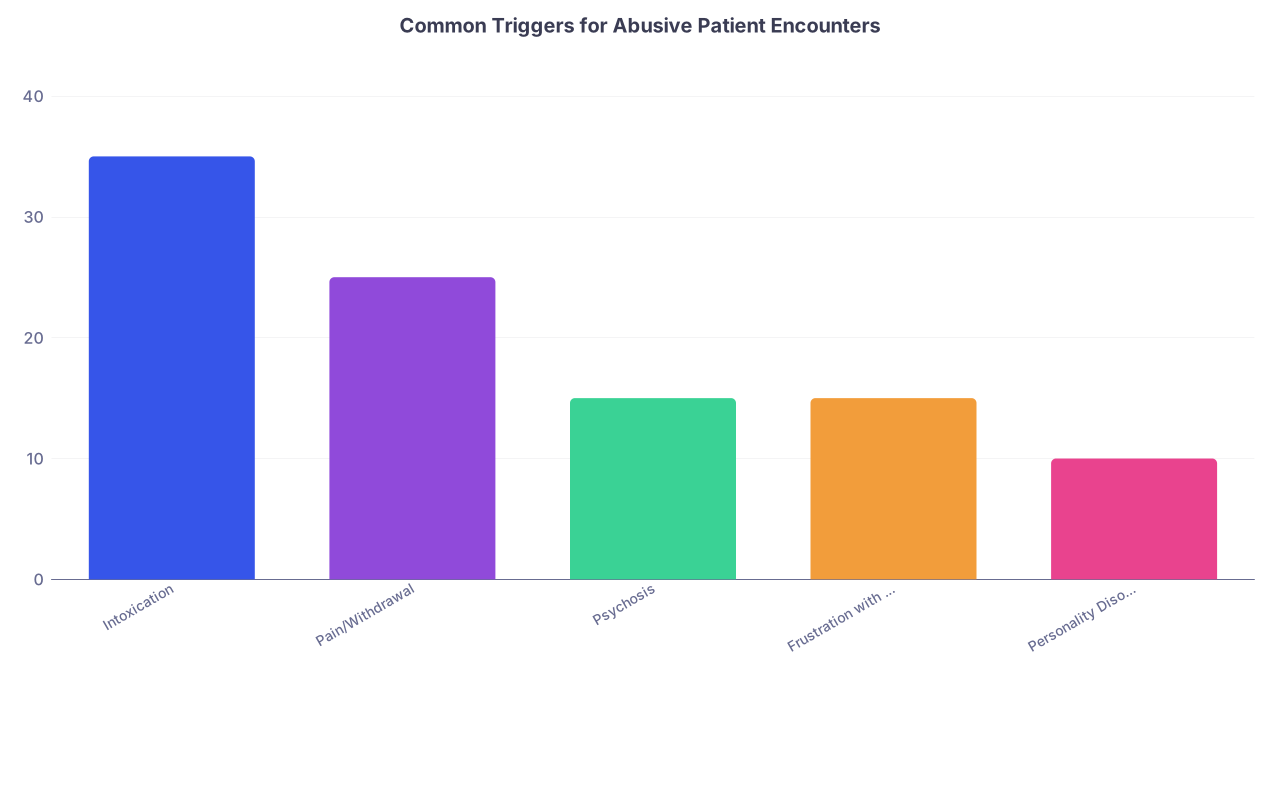
| Category | Value |
|---|---|
| Intoxication | 35 |
| Pain/Withdrawal | 25 |
| Psychosis | 15 |
| Frustration with System | 15 |
| Personality Disorder | 10 |
7. Real-World Strategy: Protecting Yourself Long-Term
If you’re training or early in practice, here’s what actually helps you survive this without burning out or becoming cynical.
Learn your institution’s policies cold.
Workplace violence, zero-tolerance statements, restraint policies, termination of care policies. Use their language in your notes and conversations.Use the team.
Don’t be a hero alone in the room. Nurses, techs, security, social work, supervisors—they’re part of the safety net.Set early boundaries.
The first time someone is mildly abusive is your best window to set a line. Waiting until you’re furious usually leads to a bad interaction.Don’t bargain with threats.
If patients learn “threats get me opioids / admit / special favors,” you’ve just trained them to escalate. Protect the line: your medical judgment is not negotiable.Debrief and document.
After a bad encounter, talk to someone you trust and write a clean, factual note. It offloads some of the emotional and legal weight.
FAQ: Abusive Patients, Ethics, and the Law
Can I refuse to see a patient who has previously threatened me?
Often, yes—especially if there’s a documented threat and alternative providers are available. You should:- Notify your supervisor or medical director.
- Document the prior incident and your concerns.
- Ensure the patient still has a path to care (different clinician, different clinic, telehealth with security on site, etc.).
If you’re the only provider (remote areas, call coverage), you may still have to participate in emergent care but with extra safety measures.
What if a patient uses racist or sexist slurs toward me—do I have to continue?
No, you don’t have to silently accept hate speech. Ethically, you should:- Name the behavior and set a boundary once: “Those comments are not acceptable here. If they continue, I’ll end this visit.”
- Follow through if it continues—pause or transfer care when safe.
- Ensure ongoing necessary care is arranged, preferably with institutional backing.
Many hospitals now have explicit policies allowing staff to decline non-emergent care for persistently discriminatory patients.
Is it abandonment if I walk out of the room during a violent outburst?
Walking out for safety is not abandonment. Abandonment is about ongoing, unaddressed medical need, not momentary physical distance. If you leave the room because it’s unsafe, call security, inform the team, and return or hand off care when safe conditions are restored, you’re doing the right thing, both ethically and legally.Can I fire an outpatient from my practice for abusive behavior?
Usually yes, if you do it correctly:- Send a formal termination letter with a clear reason (behavior-based).
- Provide reasonable notice (30 days is common) and emergency coverage in that period.
- Offer referral options or a list of other local providers.
- Document the pattern of abuse and your attempts to address it.
Check your state law and institutional/insurer policies; some specify exact steps and timelines.
What if the abusive patient clearly has mental illness or dementia?
You still deserve safety, but your ethical lens shifts. Their behavior may be driven by disease, which generally increases your duty to treat, not decreases it. You:- Maximize safety (extra staff, security, restraints, meds when indicated).
- Approach with more clinical neutrality and less personal interpretation.
- Can still ask for another provider or limit your own exposure if you’re not able to remain objective or calm.
Am I allowed to involve security even if it feels like “overreacting”?
Yes. Under-using security is far more common than over-using it. If you feel unsafe, intimidated, blocked from leaving, or threatened, security is appropriate. Many institutions explicitly encourage early involvement to prevent escalation. You’re not required to be a bouncer on top of being a clinician.How do I document abusive behavior without sounding biased or unprofessional?
Stick to behaviors, quotes, and consequences:- “Patient stated, ‘I will hurt you if you don’t give me what I want.’”
- “Patient repeatedly yelled profanity despite two verbal requests to stop.”
- “Due to escalating threats, security present at bedside. Care transferred to Dr. Y.”
Avoid labels like “aggressive” or “noncompliant” without description. Describe what was seen and heard; let the reader draw conclusions.
Bottom line:
You have a real duty to care for people, even when they’re difficult, mentally ill, or scared.
You do not have a duty to tolerate threats, harassment, or violence, or to keep personally treating someone who repeatedly abuses you once they’re medically safe and covered.
Use boundaries, institutional policies, and your team to hold both truths at the same time: protect patients—and protect yourself.


