

The biggest lie residents tell each other is, “Just do what the family wants and you’ll be safe.”
You know that’s not true. I know that’s not true. And the law definitely doesn’t say that.
You’re asking the question every halfway-conscious future doctor is afraid to say out loud: “Can I get in trouble for not doing everything when the family is screaming ‘Do everything!’?” Like… sued, reported, lose-my-license trouble. Or dragged in front of an ethics committee, whispered about as “the one who let that patient die.”
Let’s walk straight into the nightmare scenario you’re picturing and untangle it instead of pretending it doesn’t exist.
The Core Truth You’re Scared To Believe
Here’s the blunt answer: You’re not legally or ethically required to “do everything” just because the family demands it. In fact, you can absolutely get in more trouble—ethically and sometimes legally—for doing harmful, non-beneficial interventions because the family insisted.
That’s the part no one tells you when they say, “Just keep them happy.”
In law and ethics, three ideas matter way more than “do everything”:
- The patient’s own wishes (if known)
- The patient’s best interests (if wishes are unknown)
- The standard of care and medical judgment about what’s beneficial vs. futile
Families don’t get a veto power over those three. They’re important. They’re not in charge of your license.
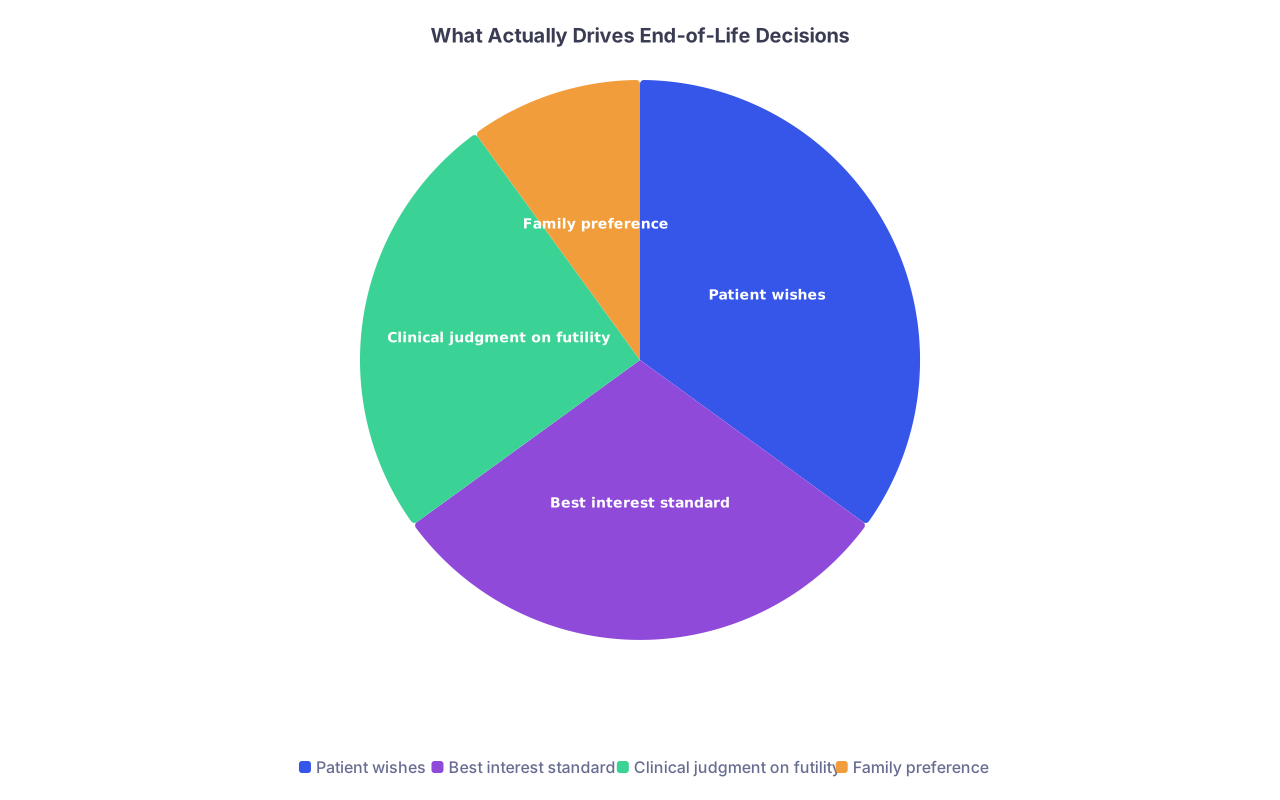
| Category | Value |
|---|---|
| Patient wishes | 35 |
| Best interest standard | 30 |
| Clinical judgment on futility | 25 |
| Family preference | 10 |
Look at that split as a mental model, not a precise statistic: family preference is one piece, not the whole decision.
So why does it feel like they control everything? Because in real life, they’re crying in front of you, and the ethics committee isn’t. The lawsuit threat isn’t. Your state medical board isn’t.
But they’re still there. Quietly.
What “Do Everything” Really Means (And Why It’s a Trap Phrase)
Here’s the ugly secret: “Do everything” is medically meaningless. No physician documentation should ever say, “Plan: do everything.”
When a family says it, they usually mean one of three things:
- “Don’t abandon my loved one.”
- “I can’t emotionally tolerate their death yet.”
- “I don’t trust that you’ve really tried.”
None of that is a code status. None of that tells you whether it makes sense to crack an 88-year-old’s ribs in a failed CPR attempt, or to dialyze a dying septic patient whose organs are shutting down one by one.
You can get into trouble in three different ways around “do everything,” and this is what you’re probably spinning out about at 2 a.m.:

- Trouble for doing too much (futile, harmful care)
- Trouble for doing too little (alleged abandonment or negligence)
- Trouble for communicating badly (which is what actually leads to complaints)
Let me be really direct: If your clinical judgment says an intervention is medically non-beneficial, you are not obligated to provide it. That’s not “killing the patient.” That’s not “giving up.” That’s refusing to perform a medically inappropriate procedure.
Courts and ethics bodies generally recognize that physicians are not vending machines for treatments. “I want it” isn’t enough.
When Are You Actually At Risk?
You’re not going to get in trouble for every disagreement with a family. You get in trouble when there’s a combination of these:
- There’s poor documentation of the medical reasoning and conversations.
- There’s no clear record of the patient’s wishes being considered.
- There’s sloppy or absent informed consent / informed refusal process.
- You ignore hospital policies about conflict resolution (ethics consult, second opinions, futility policies).
- You act unilaterally and come across as cold, dismissive, or rushed.
It’s usually not: “Doctor refused to do everything.”
It’s: “Doctor didn’t explain. Doctor didn’t listen. Doctor made decisions without us. Doctor seemed like they were trying to get my mom off the ventilator to free the bed.”
Those narratives destroy you in complaint letters and chart reviews.
| Scenario | Actual Risk Level |
|---|---|
| Withholding clearly futile CPR, well documented | Low |
| Stopping pressors after ethics consult | Low |
| Ignoring family, poor documentation | High |
| Doing harmful procedures to appease family | Moderate–High |
| Overriding clear patient expressed wishes | Very High |
So yes, you can get in trouble for overriding a patient’s own wishes. That’s where the real danger is. If the patient said “no CPR,” and their daughter at 3 a.m. says “do everything,” and you side with the daughter, that’s ethically indefensible.
But you asked the opposite. You’re worried about not doing everything the family wants. And that’s where you actually have more protection than you think—as long as you don’t cut corners.
Futility, Law, and “I Don’t Want To Be Sued”
Here’s the twisted part: a lot of physicians “do everything” not because they think it’s right, but out of pure fear-of-lawsuit self-defense. “No one gets sued for doing too much,” they say.
False. They do. Just less often, and usually framed differently: battery, lack of informed consent, prolonged suffering, ignoring advance directives.
States and hospitals vary, but most systems accept a basic principle: Physicians are not required to offer treatments that are outside the standard of care or medically futile.
That includes:
- CPR with essentially zero chance of success in a terminal situation
- Major invasive interventions where the burdens grossly outweigh any benefit
- Continuing life support when the brain has irreversibly died (families still sometimes demand it)

| Step | Description |
|---|---|
| Step 1 | Identify conflict with family |
| Step 2 | Review patient wishes |
| Step 3 | Follow patient wishes |
| Step 4 | Assess best interest and futility |
| Step 5 | Document reasoning |
| Step 6 | Family meeting and explanation |
| Step 7 | Ethics consult and second opinion |
| Step 8 | Implement plan |
| Step 9 | Final medical decision |
| Step 10 | Clear patient directives? |
| Step 11 | Still disagreement? |
If you follow something like that flow—patient wishes → clinical judgment → documentation → communication → ethics/second opinion when needed—you are not walking out of bounds.
Worst-case scenario in your head is probably:
Family sues, hospital throws you under the bus, license gone, Google filled with your name and “denied care” in headlines.
Realistic worst cases in these situations:
- A complaint to the hospital → internal review → “document better next time”
- An angry letter → risk management review → maybe an educational note
- Rarely, a lawsuit that usually targets the hospital, not you personally, and is fought on standards of care and documentation
You know what lowers your risk more than any “just do everything” panic?
- Clear charting of medical futility and prognosis
- Multiple documented family meetings
- Ethics or palliative care consult involvement
- Respectful, consistent messaging across the team
What Ethically Strong (And Legally Safer) Practice Looks Like
Let’s say you’re the intern in the ICU. Patient: multi-organ failure, metastatic cancer, on maximum pressors, vent, kidneys gone. Prognosis: essentially zero chance of meaningful recovery. Family: “Do everything. Mom is a fighter. You’re not giving up.”
Your brain’s screaming: If I don’t keep escalating, I’m going to get blamed for ‘killing’ her.
Here’s the kind of approach that actually protects you:
You recognize medical futility.
The team agrees: more interventions will not change the outcome.You anchor to the patient’s values—not the family’s emotions alone.
“Did she ever say what she’d want if she were this sick? Did she ever talk about machines, ICU, or being kept alive if there was no chance of recovery?”
If there’s an advance directive, you actually read it. And you quote it in your note.You use language that draws a line without sounding like you’re “giving up.”
“We will do everything to keep her comfortable and to keep her from suffering. There are now treatments that will only prolong dying, not prolong living. Those are things we will not do, because they would be harmful.”You say “we” not “I.”
“Our medical team agrees that more pressors, more lines, or CPR would not help her recover. They would only add trauma to her last hours.”You document like a paranoid person who assumes the chart will be read out loud in court.
Time-stamp the meetings. List who was present. Document questions asked and answers given. Document that you explained prognosis, risks, and benefits, and that the family was given time and support.You use hospital structures.
Ethics consult. Palliative care consult. Chaplain or social work. You show this was not one rogue physician deciding to “pull the plug.”
That’s not you “overriding” the family. That’s you honoring the patient and the standard of care, despite the family’s distress.
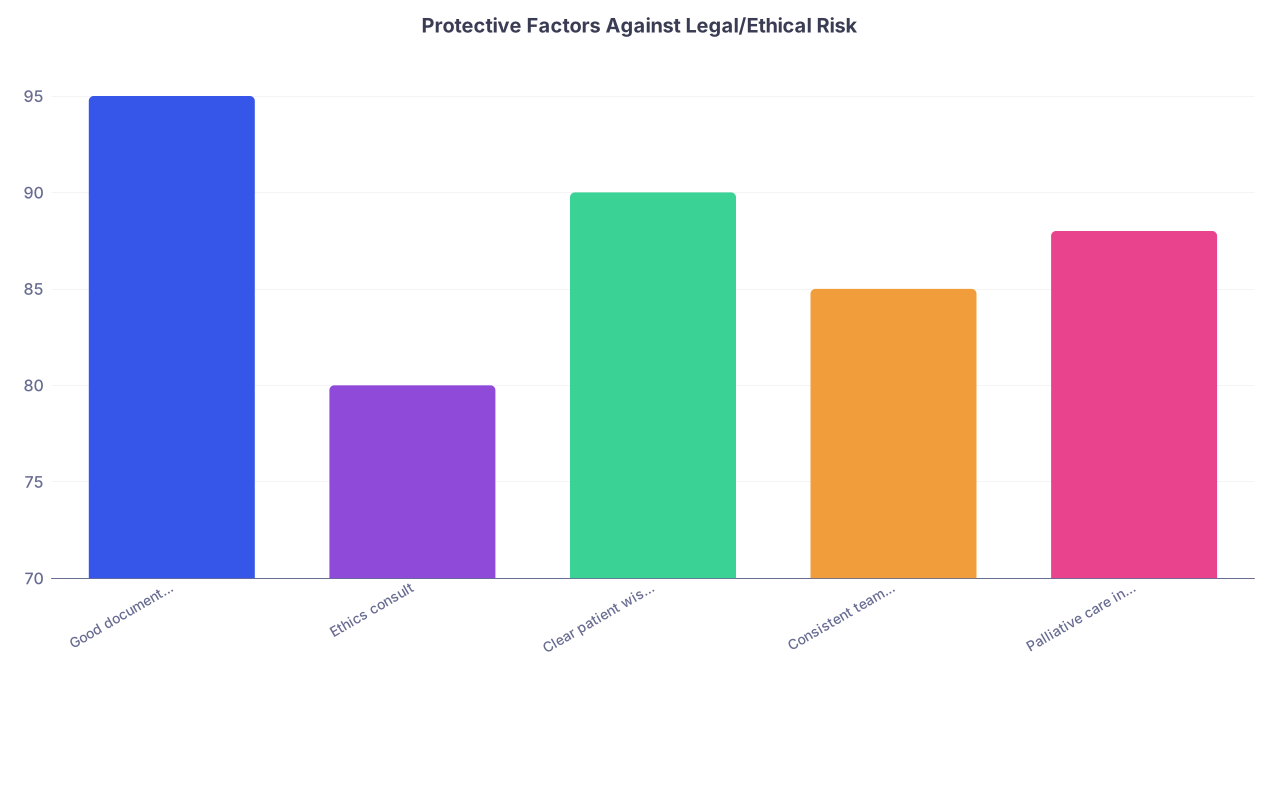
| Category | Value |
|---|---|
| Good documentation | 95 |
| Ethics consult | 80 |
| Clear patient wishes | 90 |
| Consistent team messaging | 85 |
| Palliative care involvement | 88 |
The Part You’re Actually Afraid Of: The Emotional Fallout
Let’s be honest. You’re not just scared of lawsuits. You’re scared of this line:
“You killed my mom.”
Or: “You’re giving up on him because he’s old/poor/disabled.”
That hits a part of you that law books don’t cover.
You will have cases where you walk out of a room and feel physically sick, because you held the boundary: no more CPR, no more shocks, no more surgeries that will only prolong torture. You’ll hear the crying. You’ll second guess yourself at 2 a.m.: “What if I’m wrong?”
You will almost never get absolute certainty. You will get probabilities and judgment calls and gray zones.
But that doesn’t mean the answer is: “Fine, I’ll just do everything until it’s physically impossible.”
Clinically, that just means more rib fractures, more blood draws, more delirium, more time strapped to beds.
Legally, it doesn’t magically “protect” you.
Ethically, it erodes you.
Over time, the physicians who cope best are the ones who:
- Learn to tolerate being blamed in the short term.
- Anchor to the patient’s known or likely values, not family demands alone.
- Use colleagues, ethics consults, and palliative care as backup and reality checks.
- Accept that moral distress is part of the job and get support for it.
You, right now as a pre-med or early trainee, are trying to solve this by finding some magic rule that guarantees no trouble. That rule doesn’t exist.
What does exist is a way to be able to look at your own reflection and say: “I didn’t abandon this patient. I also didn’t torture them to make myself feel safer.”
FAQ – The Stuff You’re Still Worried About
1. Can I get sued personally for refusing to “do everything” if the patient dies?
Yes, technically anyone can sue anyone for almost anything. But lawsuits that succeed usually hinge on deviation from standard of care, not “the family wanted X and doctor said no.” If your care matches what reasonable physicians would do in that situation, and you documented your reasoning and communication, your actual legal risk is much lower than your anxiety is telling you.
2. What if the patient doesn’t have an advance directive and the family is divided?
This is where you lean on best interest standards, ethics consults, and second opinions. You do not have to—and should not—simply follow the most vocal relative. Document the disagreement, your medical assessment, and the process used to reach a decision. Courts and committees look very favorably on a careful process, even when there was no perfect consensus.
3. Could I lose my license for not following a family’s “do everything” demand?
Losing your license over this alone would be extremely rare and would typically require much more: gross negligence, abandonment, or ignoring clear patient directives. Medical boards care about patterns of unsafe or unethical behavior, not a single well-documented, ethically supported decision that upset a family.
4. Are there cases where I must follow the family’s wishes, even if I disagree?
You’re obligated to respect a legally authorized surrogate when the patient lacks capacity, but only within the bounds of reasonable medical care. You’re not required to perform non-beneficial or harmful treatments. Your obligation is to involve them, inform them, and factor their perspective into a decision that still respects medical standards and the patient’s values.
5. What if my attending tells me, “Just do what the family wants so we don’t get in trouble”?
You’re stuck in the hierarchy, so you can’t just overrule your attending—but you can learn from what they do and notice when it conflicts with good ethics. Quietly ask questions: “Can we loop in ethics?” “Should we document the futility discussion more clearly?” You’re developing your own ethical spine. You’ll need it when you are the attending.
6. What can I start doing now, as a pre-med or early trainee, to be less terrified of this?
Learn the basics: advance directives, DNR/DNI, substituted judgment, best interest, medical futility, and how your local hospitals structure ethics consults. Read a few real cases. Practice phrases that set boundaries kindly: “We won’t do treatments that only prolong suffering, but we will do everything to support comfort and dignity.” The more familiar those concepts and words feel, the less you’ll freeze when you’re actually at the bedside.
Open a blank document right now and write out, in your own words, how you’d explain to a family why you won’t perform a futile, harmful intervention—then revise it until you could say it out loud without your voice shaking. That’s the skill that will protect you far more than “doing everything” ever will.


