

Texting patients on your personal phone is usually a bad idea. Using WhatsApp without safeguards is worse.
Let me be blunt: if you’re casually texting patients from your personal number or dropping clinical info into a WhatsApp group, you’re one privacy complaint away from a career headache. Not always illegal. But very often sloppy, risky, and hard to defend.
Here’s the real rule: it’s not about which app you use; it’s about how you protect identifiable health information and whether you follow your institution’s policies and the law.
Let’s break it down in plain language.
1. The Core Question: Is It Ever OK to Text Patients?
Yes, it can be OK to text patients. But only under specific conditions:
- Your organization allows it and has a policy.
- You’re using a secure, approved messaging platform (not just regular SMS).
- You limit what you put in writing.
- The patient understands the risks and agrees.
If you skip any of those, you’re exposed.
Here’s the key mental model: any time you send or receive personally identifiable medical information over an electronic channel, you’ve created a potential privacy risk and a discoverable record. Law, hospital policy, and common sense all care about that.
So if your question is “Can I just text this patient real quick from my phone?” the default answer should be: No, unless I’m using an approved secure app and following policy.
2. WhatsApp, iMessage, SMS: What’s Actually the Problem?
I’ve watched this play out on rounds: residents making ad hoc WhatsApp groups to coordinate care, interns texting photos of rashes to attendings, consultants sending plans via iMessage. Everyone knows it’s a gray zone. Some attendings shrug and say, “Everybody does it.”
Let’s be clear on what’s risky about common messaging apps.
The real risks
- Messages are stored on personal devices you don’t control.
- Backups might go to personal cloud accounts.
- Screens can be seen by others (family, friends, strangers).
- Devices get lost, stolen, sold, or repaired.
- Data might cross borders (GDPR and other regulations nightmare).
- You leave the institution, but the patient info stays in your phone forever.
End-to-end encryption (like WhatsApp provides) helps, but it’s not a magic shield. The data is still accessible on your unlocked device and in backups. Regulators care about that.
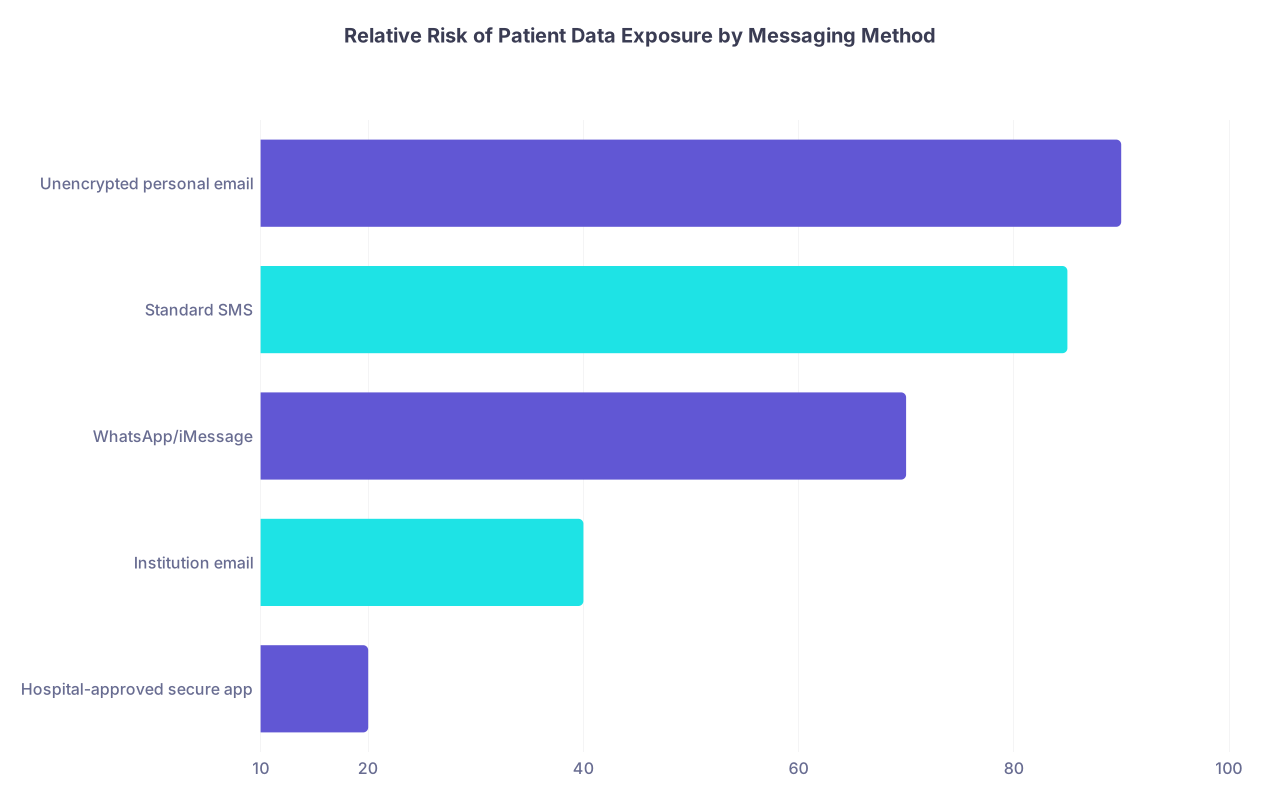
| Category | Value |
|---|---|
| Hospital-approved secure app | 20 |
| Institution email | 40 |
| WhatsApp/iMessage | 70 |
| Standard SMS | 85 |
| Unencrypted personal email | 90 |
Those numbers aren’t from a specific study; they just illustrate the obvious: once you’re outside controlled, institutional systems, risk skyrockets.
Why WhatsApp feels “safe” – and isn’t
People say:
- “But it’s encrypted end-to-end.”
- “We don’t put names, only initials and room numbers.”
- “Patients like it. It’s convenient.”
Encryption protects messages in transit. It does not solve:
- Who can access your phone.
- What happens when you leave it in a taxi.
- What your cloud backups store.
- How you prove you followed institutional policy.
And “we don’t use names” usually lasts until someone is in a rush, tired, or stressed at 3 a.m.
3. Legal and Regulatory Basics (HIPAA, GDPR, etc.)
You don’t need to be a lawyer, but you do need the headlines.
If you’re in the US (HIPAA)
HIPAA cares about Protected Health Information (PHI). That’s any health-related data linked to an identifiable person.
HIPAA doesn’t say “you may never text.” It says:
- You must protect PHI.
- You must limit unnecessary sharing.
- You must ensure reasonable safeguards (encryption, access controls, etc.).
- Your organization must have Business Associate Agreements (BAAs) with any vendor that stores or transmits PHI on its behalf.
WhatsApp, iMessage, and standard SMS are not HIPAA-compliant in the way hospitals need: there’s no BAA, no institutional control, and no guaranteed audit trail.
Using them for PHI is very hard to defend if there’s a breach or complaint.
If you’re in Europe/UK (GDPR and equivalents)
GDPR is stricter on:
- Data minimization.
- Data leaving the EU.
- Data subject rights (access, deletion, etc.).
- Legal basis for processing.
Sticking patient info into consumer messaging apps that route data via servers abroad and store content outside your control? That’s asking for trouble.
Everywhere else
Almost every jurisdiction now has:
- Some form of medical confidentiality law.
- Professional guidelines about digital communication.
- Data protection, cyber, or privacy legislation that applies to patient info.
If your defense ever has to be “but everyone uses WhatsApp,” that won’t go well in front of a regulator, hospital committee, or disciplinary board.
4. Safer Alternatives: What You Should Be Using
Good news: there are better options. Almost every hospital or clinic now has one or more of these:
- Patient portals (through the EMR).
- Institution-approved secure messaging apps (e.g., TigerConnect, Vocera, Spok, or local equivalents).
- Secure email through the institution account.
- Integrated telehealth platforms with built-in messaging.
These systems typically provide:
- Encryption.
- Access controls.
- Audit logs.
- Integration with the medical record.
- Institutional ownership and policies.

Quick comparison
| Method | Typical Status | Good For |
|---|---|---|
| Patient portal | Preferred | Results, questions, advice |
| Hospital secure messaging | Preferred for clinicians | Team communication, handoffs |
| Institutional email | Acceptable with care | Non-urgent, limited details |
| WhatsApp / iMessage | Generally discouraged | Only de-identified, if allowed |
| Standard SMS | High risk | Simple logistics only |
If your institution has a secure portal or app, that’s your default answer: “Let’s message through the portal; it’s safer for your information.”
5. Practical Rules: When Texting Might Be Acceptable
Sometimes you’re stuck. Rural setting, limited tech, chaotic clinic, or a patient who simply cannot access portals or apps. This is reality.
Here’s a defensible approach in those edge cases. Check this against local laws and policies, obviously.
1. Know your institution’s policy
Read it. If your hospital explicitly bans patient communication on WhatsApp or SMS, that’s the end of the story. Follow it.
If they allow “limited use of SMS”:
- They probably restrict it to logistical communication:
- Appointment reminders.
- “Your prescription is ready.”
- “Please call the clinic about your test results.”
- Not:
- Detailed test results.
- Diagnoses.
- Medication changes.
- Sensitive topics (HIV, abortion, mental health, STIs, etc.).
2. Get informed consent for less-secure channels
If you truly must use SMS or similar:
- Explain briefly that it’s not fully secure.
- Offer the more secure option (portal, app, phone call).
- Document their preference in the chart.
Something like: “Discussed communication options. Patient prefers text despite privacy limitations. Will limit to basic info and ask patient to call for clinical discussions.”

| Step | Description |
|---|---|
| Step 1 | Need to contact patient |
| Step 2 | Use portal or phone call |
| Step 3 | Use brief text for logistics |
| Step 4 | Document in chart as needed |
| Step 5 | Institution policy allows SMS/WhatsApp? |
| Step 6 | Is info clinical/sensitive? |
3. Keep content minimal
If you absolutely must use WhatsApp or SMS:
- No diagnosis details.
- No complex clinical advice.
- No attachments with lab reports or images.
- No other patient identifiers beyond what’s unavoidable.
Examples of borderline acceptable text:
- “This is Dr. Lee from the clinic. Please call us at 555-123-4567 about your recent visit.”
- “Just a reminder: your appointment is tomorrow at 2 pm at the main clinic.”
Examples of not acceptable text:
- “Your CT scan shows a new mass. We need to discuss treatment options.”
- “Increase your insulin dose to 20 units twice daily and send me your sugars by WhatsApp daily.”
- “Your HIV test is positive, call me.”
If you wouldn’t be comfortable seeing the exact text as a screenshot in a complaint file, that’s your red flag.
6. Special Scenario: Patients Texting You First
This happens constantly. Patients get your personal number through the office line forwarding, a business card, or sometimes because someone on the team gave it out loosely.
Patient: “Can I just WhatsApp you my blood sugars?”
You: wondering how to say no without sounding uncaring.
Here’s a script that balances humanity and professionalism:
“I’m glad you’re keeping such close track. For your privacy and to keep everything properly documented, I’m not allowed to manage care through WhatsApp or my personal phone. The safest way is through the patient portal or by calling the clinic, where everything is recorded in your chart. If you’re having an emergency, go to the ER or call emergency services.”
Then:
- Do not start a pattern of care on WhatsApp.
- Redirect them every time.
- If they send clinically important info, acknowledge once, move it to the record, and shift the conversation to an approved channel.
7. Group Chats, Photos, and “Quick Consults”
This is where people create the ugliest messes.
WhatsApp groups for clinical teams
Common problems:
- Roster includes students or externs who shouldn’t see certain patients.
- People keep screenshots.
- Old members remain in the group after leaving the service.
- Content is never deleted.
- Phones are shared at home or with family.
If your hospital hasn’t explicitly endorsed and configured WhatsApp for clinical use with strict rules (almost none have), then using it for identifiable patient discussion is a bad idea. Use the hospital’s secure team messaging if available.
Photos of wounds, rashes, radiology screens
Never:
- Store identifiable clinical photos in your personal photo gallery.
- Send them via standard messaging without explicit institutional policy.
If clinical photography is needed:
- Use hospital cameras or approved apps that upload directly to the EMR.
- Avoid faces and identifiable features when you can.
- Get consent if the image is more than routine care documentation.
8. How to Protect Yourself Practically
Here’s the checklist I’d want every intern and resident to internalize:
- Default to secure channels (portal, approved apps, institutional email).
- Get clarity on policy at every new institution. Ask someone who actually knows (compliance, IT, or risk management), not just “the senior said it’s fine.”
- Lock your devices with strong passcodes and auto-lock timers.
- Separate work and personal as much as possible (separate phone, profile, or work container if provided).
- Never share your own WhatsApp as a routine patient contact method.
- Document key clinical decisions in the EMR, not just in messages.
- Assume every message could become evidence in a complaint, lawsuit, or investigation.
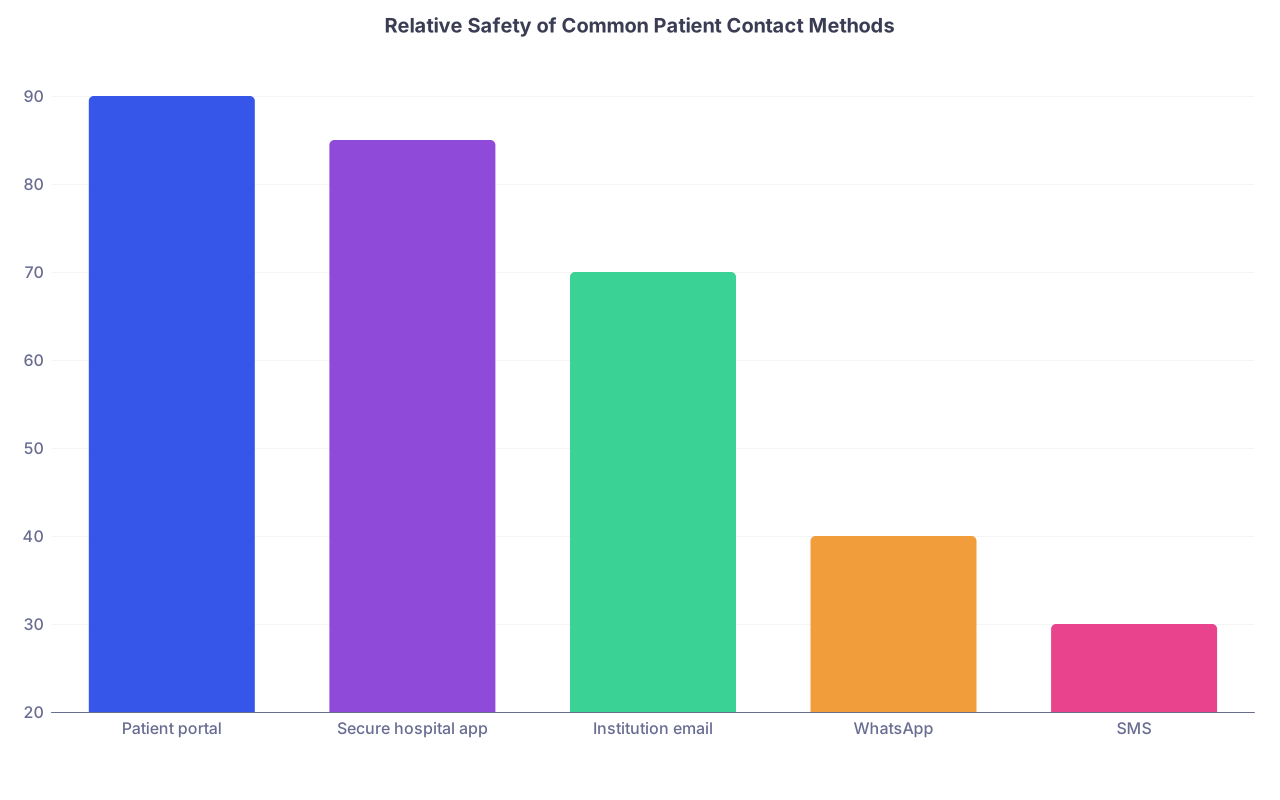
| Category | Value |
|---|---|
| Patient portal | 90 |
| Secure hospital app | 85 |
| Institution email | 70 |
| 40 | |
| SMS | 30 |
Again, numbers just illustrate the point: stay on the left side of that chart as much as possible.
FAQs: Texting Patients and Using WhatsApp
1. Is it ever “HIPAA compliant” to use WhatsApp with patients?
Practically speaking, no. WhatsApp does not sign Business Associate Agreements, and your institution doesn’t control the data. Some clinicians technically avoid PHI and use it only for logistics, but that’s a workaround, not true compliance.
2. Can I text a patient from my personal phone about urgent results?
You shouldn’t send results by text. You can text: “Please call the clinic/ER immediately; we need to discuss your recent test.” Then document the attempt and follow up by phone. Actual result disclosure belongs on a secure call or portal, then charted.
3. What if my attending tells me to just WhatsApp the patient?
You’re responsible for your own professional conduct. A safe response: “Our policy says we shouldn’t use WhatsApp for patient care because of privacy risks. I can call them or use the portal.” If your institution later finds out, “the attending told me to” won’t fully protect you.
4. Can I use WhatsApp to discuss cases with colleagues if I remove names?
If it’s truly de-identified (no name, date of birth, MRN, room number, or any combo that could identify), risk is lower. But in small hospitals or rare cases, “de-identified” is often a myth. Better to use an approved secure app for case discussion.
5. Patients keep asking for my cell/WhatsApp so they can reach me. How do I say no?
Be honest and firm: “For your privacy and so everything is properly documented, I’m not allowed to use my personal phone or WhatsApp for medical care. The safest ways to reach me are through the clinic line or patient portal.” Repeat as needed. You’re protecting them and yourself.
6. If a patient texts me something clinically important, and I already told them not to, what do I do?
Do not ignore it. Reply once, briefly: “I saw your message. For your safety, I can’t manage care by text. Please call the clinic/ER.” Then document in the chart that the patient contacted you via text, what they reported, your recommendation, and that you reinforced communication boundaries.
Bottom line:
Use secure, institution-approved systems for anything clinical.
If you’re forced into texting, keep it minimal, non-clinical, and documented.
Never let “everyone does it” be your privacy strategy.


