

The biggest mistake PGY‑2s make is assuming “I’ll learn the legal and ethics stuff on the fly once I’m in charge.” That is how people end up in front of risk management. Or the medical board.
You’re about to supervise. That means your ethical blind spots and legal ignorance become a systems problem, not just a personal one. You need a plan. On a timeline. Before you’re the one everyone turns to when things go sideways.
Below is a concrete, time‑structured guide: what to do before PGY‑2, during PGY‑2, and how to build on it in PGY‑3 and fellowship so that when you say “I’ll take responsibility,” you actually know what that involves.
Big Picture Timeline: From “I’m Just the Intern” to “I’m the One Signing”
At this point, you need a rough roadmap. Then we’ll zoom in to months and weeks.
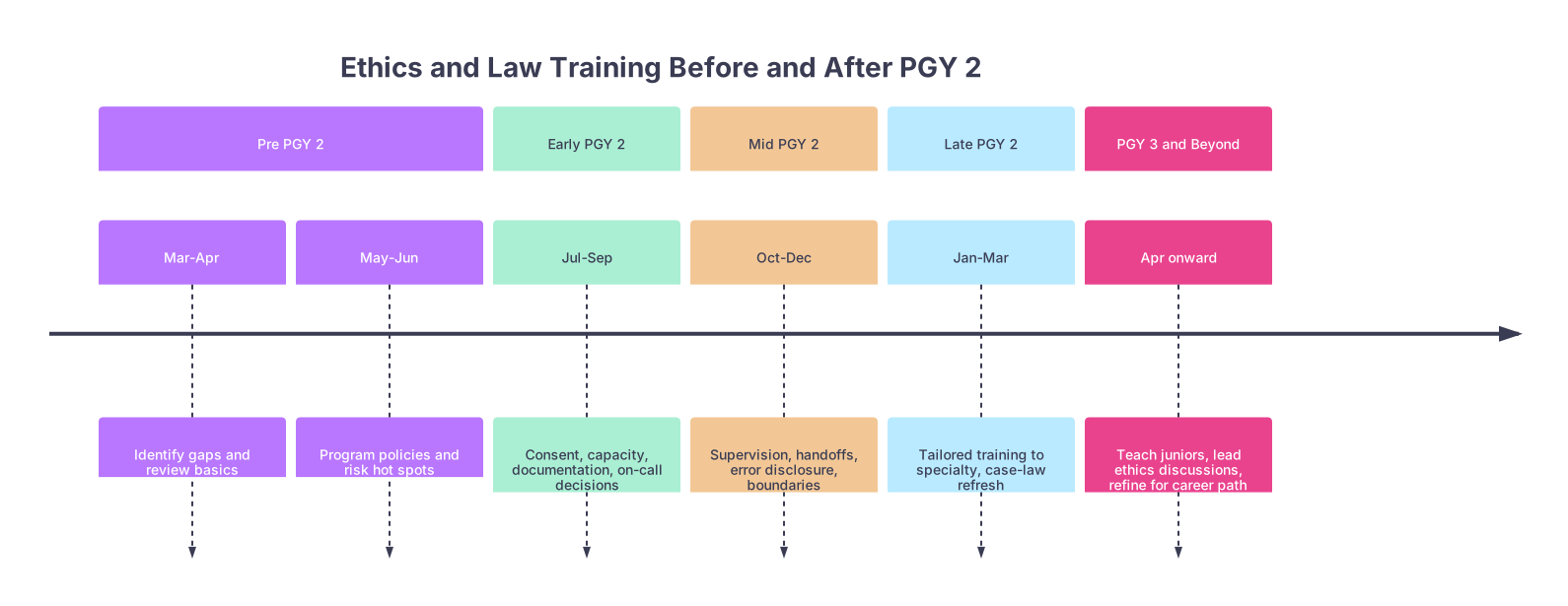
| Period | Event |
|---|---|
| Pre PGY 2 - Mar-Apr | Identify gaps and review basics |
| Pre PGY 2 - May-Jun | Program policies and risk hot spots |
| Early PGY 2 - Jul-Sep | Consent, capacity, documentation, on-call decisions |
| Mid PGY 2 - Oct-Dec | Supervision, handoffs, error disclosure, boundaries |
| Late PGY 2 - Jan-Mar | Tailored training to specialty, case-law refresh |
| PGY 3 and Beyond - Apr onward | Teach juniors, lead ethics discussions, refine for career path |
Here’s the core structure you’ll work through:
Pre‑PGY‑2 (3–4 months out):
Audit your gaps. Learn the non‑negotiable laws and institutional rules that will actually get you in trouble if you miss them.Early PGY‑2 (first 3 months):
Build “bedside usable” skills: consent, capacity, documentation, and what to do when you’re the only one in house.Mid PGY‑2 (months 4–6):
Focus on supervising, delegation, handoffs, and error management—exactly where junior residents get burned.Late PGY‑2 and PGY‑3+:
Go specialty‑deep, learn to teach this stuff, and prepare for attending‑level responsibility.
Let’s run it chronologically and concretely.
3–4 Months Before PGY‑2: Build Your Legal & Ethics Baseline
At this point, you’re probably still PGY‑1, juggling notes and pages. But this is where you quietly build your foundation.
Step 1 (Week 1–2): Do a Brutally Honest Gap Check
Sit down for 30 minutes. No more. List what actually made you nervous this year:
- Times you thought: “Is this even legal?”
- Situations where attendings disagreed on “the right thing ethically.”
- Cases where risk management or ethics was consulted.
- Topics you awkwardly avoided with families.
Turn that into a focused list. It usually includes:
- Consent and refusal
- Capacity vs competence
- Documentation around high‑risk events
- Reporting duties (abuse, impaired drivers, communicable diseases)
- End‑of‑life decisions and surrogates
Now pick 4–5 to explicitly work on. Not 30.
Step 2 (Week 2–4): Learn the Non‑Negotiable Legal Basics
You do not need to be a lawyer. You do need to know where the landmines are.
At this point you should:
Identify your state / country rules on:
- Mandatory reporting (child/elder abuse, certain injuries, communicable diseases)
- Involuntary holds / psychiatric detention
- Driving restrictions for seizures, syncope, vision loss
- Who can act as surrogate decision maker and in what order
Read your hospital’s:
- Informed consent policy
- Code status / DNR policy
- Use of restraints policy
- EMTALA or equivalent ED transfer/stabilization policy (if in the US)
20–30 minutes per document, max. Skim for:
- “Resident” specific requirements
- Signatures needed
- Documentation phrases they want (“risks, benefits, and alternatives discussed,” “patient verbalizes understanding…”)
Create a one‑page cheat sheet. Print it. Tape it inside your locker.
1–2 Months Before PGY‑2: Program‑Specific Rules and High‑Risk Areas
Now you know the big legal pieces. Time to translate that into how your specific program works.
Step 3 (Month –2): Map Your Program’s Risk Hot Spots
At this point you should ask your PD or chief (yes, directly):
“As I get ready for PGY‑2, where do residents most often get into trouble ethically or legally?”
You’ll hear the same themes in most places:
- Poor consent for procedures
- Inadequate escalation when patients decompensate
- Sloppy documentation after bad outcomes (codes, falls, AMA)
- Unclear communication about code status
- Social media / confidentiality mistakes
- Supervising students doing procedures without enough oversight
Turn those answers into a short list of “never screw this up” situations.
| Situation | Why It Matters |
|---|---|
| High-risk procedure consent | Negligence, informed consent claims |
| AMA discharge | Liability, readmission disputes |
| Code status changes | Family conflict, ethics consults |
| Involuntary holds | Civil liberties, legal challenge |
| Resident-supervised procedures | Supervision standards, credentialing |
Step 4 (Month –1): Case‑Based Micro‑Training
Take 3–4 real cases (from M&M, ethics conference, or just the grapevine):
- A patient left AMA and returned septic
- An ICU family fight over withdrawal of care
- A psych hold that was overturned
- A med error that required disclosure
For each case, you should walk yourself through:
- What happened ethically?
- What were the legal friction points?
- What would your role be as PGY‑2 supervising the intern or student?
- Exactly what would you document?
Do this with a senior resident or fellow if you can. 30 minutes once a week. That’s it.
First 3 Months of PGY‑2: Consent, Capacity, Documentation, On‑Call Reality
Day 1 of PGY‑2, the culture shifts. Interns look at you. Nurses call you first. Families ask, “So you’re the doctor in charge?”
You need “street‑ready” ethics and law, not abstract principles.
Month 1: Consent and Capacity in Real Time
At this point, you should aim to be the best person on your team at basic consent and capacity assessments.
Week 1–2: Create a consent script
You do not improvise consent for high‑risk procedures. That’s how you miss material risks.
Build a 3–4 sentence default script:
- The nature of the procedure
- The main serious risks (not every 1 in a million)
- Reasonable alternatives, including doing nothing
- A check that they understand and have a chance to ask questions
Example (for central line):
“We’re planning to place a central line, a large IV in a neck or chest vein to give medications and measure pressures. Risks include bleeding, infection, puncture of nearby structures like the lung which could cause a collapse, and rare serious complications that might need more procedures. Alternatives include continuing with your current IVs, though they may not be enough for the medications you need. Tell me what you understand about why we’re recommending this and what questions you have.”
Practice this out loud. Yes, actually out loud. You need the muscle memory.
Week 3–4: Capacity mini‑checklist
You should be able to judge capacity on the spot using 4 pillars:
- Can they communicate a choice?
- Do they understand the relevant information?
- Can they appreciate how it applies to them?
- Can they reason about options?
Build a one‑liner for your note:
“Patient demonstrates decision‑making capacity: communicates a consistent choice, understands risks/benefits/alternatives, appreciates consequences for self, and reasons about options.”
If any pillar fails, you escalate. Not because a form says so—because capacity is now in question and legally fragile.
Month 2: Documentation That Protects Patients and You
At this point you should stop writing vague, anemic notes for high‑risk events.
Focus on four scenarios:
- AMA discharges
- Rapid responses / codes
- Bad news / serious prognosis discussions
- Refusal of recommended treatment
For each, you need 3 things in writing:
- What you recommended
- The risks you explained
- The patient’s/surrogate’s understanding and decision
Example AMA note skeleton:
- Why admission is recommended
- Specific risks of leaving (e.g., “could result in sepsis, ICU admission, death”)
- Patient’s reasons for leaving
- That they were offered alternatives (follow‑up, meds, etc.)
- That they demonstrate capacity or why they do not
- That they know they may return for care at any time
Make your own templated phrases, save them in your dot phrases / macros. You’ll thank yourself at 3 a.m.
Month 3: On‑Call Escalation and Saying “I Need Backup”
First few months as PGY‑2, you’ll be “the only one here” more than you’re comfortable with. Ethically and legally, your new skill is knowing when not to manage alone.
At this point you should:
Know your escalation thresholds:
- Any unanticipated deterioration
- Any conflict about goals of care
- Any use of restraints or involuntary measures
- Any serious complaint or threat of legal action (“I’ll sue all of you”)
Use a simple escalation script with attendings:
- “I’m concerned because…”
- “I’m out of my depth on…”
- “I’m worried about the ethical / legal risk here because…”
If you feel a “this feels wrong” twinge, that is not something you ignore. That’s exactly when you call.
Mid‑PGY‑2 (Months 4–6): Ethics of Supervision, Errors, and Boundaries
You’re now somewhat comfortable being the senior. This is when you’re most at risk of overestimating your judgment.
Month 4: Supervision and Delegation
At this point, you’re responsible for what your interns and students do under your name.
Focus on three questions:
- What can a student do?
- What can an intern do?
- When must you physically be there?
Learn:
- Your program’s explicit supervision policy (yes, it exists).
- Which procedures require direct supervision.
- How notes and orders from learners should be cosigned or revised.
Then, set ground rules with your team in Week 1 of each rotation:
- What interns should always call you about
- When they should not let you sleep through something
- What they should never promise families without your okay
Say it out loud on Day 1. Clear expectations are both ethically and legally protective.
Month 5: Errors, Near Misses, and Disclosure
You will be involved in a serious error or near miss. If you haven’t yet, it is coming.
At this point you should:
- Know how to file an incident report at your institution (not optional).
- Know your hospital’s disclosure policy—who talks to the family, and when.
- Practice how you’ll speak when something bad happens, even if it wasn’t purely “your fault.”
Core structure when discussing an error with a patient/family (usually with attending support):
- A clear, jargon‑free description of what happened
- An honest acknowledgment of harm or potential harm
- A direct expression of regret
- Immediate next steps to address the harm
- How the team will look for system improvements
Do not:
- Blame the nurse, the intern, “the system,” or anyone else in front of the patient.
- Speculate on legal judgments (“this is malpractice” / “this isn’t malpractice”). That’s not your lane.
Month 6: Professional Boundaries and Modern Hazards
Halfway through PGY‑2, burnout peaks. That’s when boundary problems sneak in.
At this point you should set firm rules for yourself:
- No connecting with current patients or their families on social media.
- No texting PHI through unsecure channels.
- No accepting “small” gifts that could influence decisions.
- No romantic or exploitive relationships with patients, period.
You know all this in theory. The issue is when you’re exhausted, flattered, or “just trying to help.” Draw your lines now. Before you rationalize around them later.
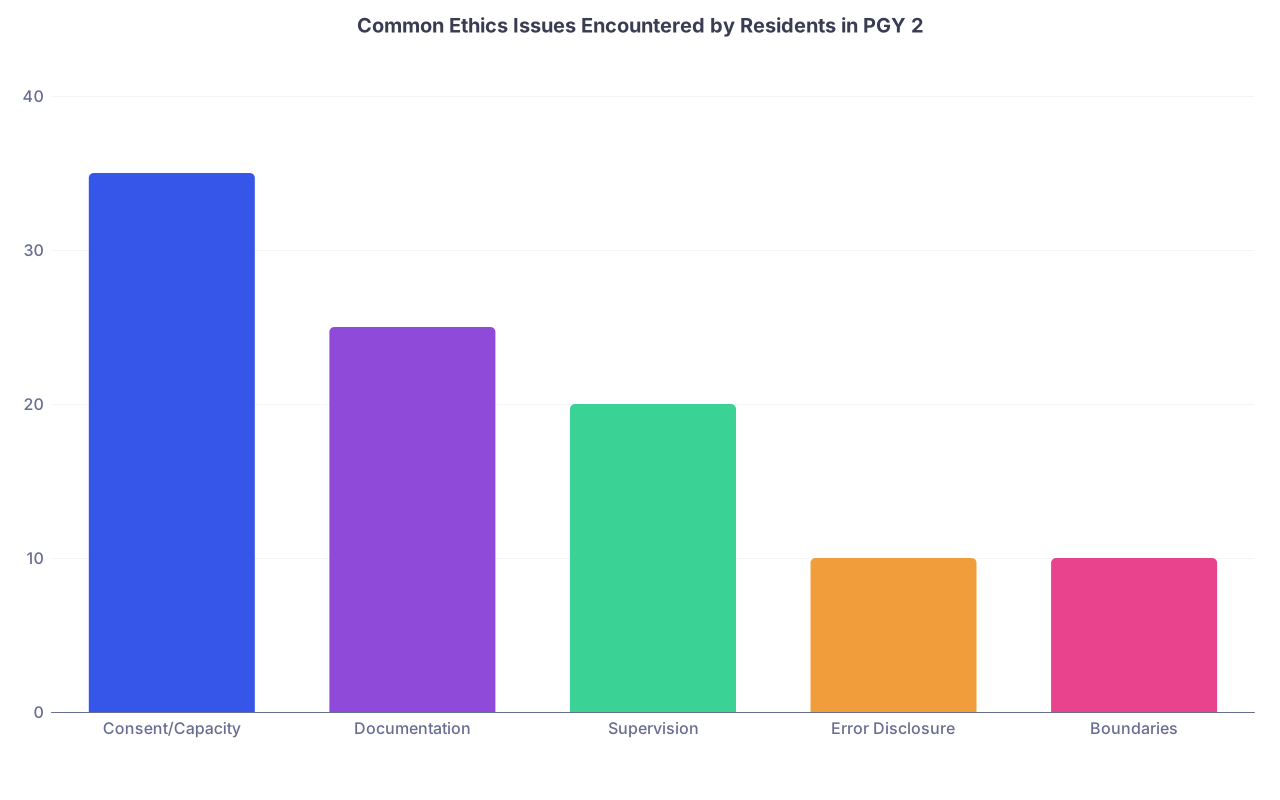
| Category | Value |
|---|---|
| Consent/Capacity | 35 |
| Documentation | 25 |
| Supervision | 20 |
| Error Disclosure | 10 |
| Boundaries | 10 |
Late PGY‑2 and PGY‑3+: Specialty‑Specific Ethics and Teaching Others
By late PGY‑2, the basics should feel less terrifying. Now you refine based on where you’re going.
Months 7–9: Go Deep in Your Specialty’s Ethical Traps
Internal medicine vs surgery vs psych vs EM—they all have signature ethical disasters.
At this point you should:
Identify 2–3 “classic” ethical/legal issues in your field, for example:
- Psych: involuntary treatment, seclusion/restraints, confidentiality vs safety
- OB/GYN: fetal vs maternal interests, refusal of C‑section, abortion law
- Surgery: informed consent for high‑risk procedures, DNR in the OR
- EM: EMTALA issues, refusal of care while intoxicated, triage decisions
- Peds: parental refusal, assent, reporting abuse
Read 1–2 short position statements or review articles on each (from specialty societies).
Find one local attending who is good at this stuff and ask to discuss a case for 20 minutes. Targeted mentoring beats another generic lecture.
Months 10–12: Start Teaching Juniors (That’s How You Master It)
Teaching ethics and law locks in your own learning.
At this point you should:
Run a 15–20 minute case discussion on morning report or rounds:
- Pick a real patient (de‑identified)
- Pose the ethical question
- Ask interns and students what they’d do
- Then walk through the correct legal / policy framework
Model out loud:
- How you assess capacity
- How you phrase consent
- How you document a tough refusal
- When you escalate for help
If you can explain it simply to an MS3, you probably actually understand it.
PGY‑3 and Beyond: Cementing “Ethics and Law” into Your Professional Identity
By the time you’re senior senior, this should not be a side topic. It’s part of how you practice medicine.
At this point you should:
Own at least one recurring role:
- M&M moderator or contributor focused on systems and ethics, not just “who screwed up.”
- Participant in your hospital ethics committee meetings (even as a visitor).
- The resident who people page when there’s a question about AMA, capacity, or involuntary measures.
Build a tiny personal library:
- Your institution’s 4–5 key policies (latest versions).
- A short handbook or pocket guide on medical law/ethics in your region.
- A folder of anonymized, instructive cases you’ve been involved with.
Tune this to your next step:
- Going into fellowship? Learn that field’s specific regulations (transplant, oncology trials, ICU triage).
- Going straight to attending community practice? Focus on consent, documentation, scope of practice, and local statute quirks.
Quick Time‑Structured Checklist
Use this as a reality check. If you’re behind, pick up at your current point; don’t try to “catch up” retroactively. Just start now.
3–4 Months Before PGY‑2
- List 4–5 personal ethics/legal anxiety points
- Learn state rules: reporting, involuntary holds, driving, surrogates
- Skim hospital policies: consent, DNR, restraints, EMTALA/ED
- Make a 1‑page cheat sheet
1–2 Months Before PGY‑2
- Ask leadership: “Where do residents get in trouble here?”
- Identify 3–4 real local cases as “teaching files”
- Walk through what your PGY‑2 role would have been in those cases
First 3 Months of PGY‑2
- Write and practice your procedure consent script
- Memorize a 4‑pillar capacity check and note phrase
- Build AMA / refusal / code event documentation templates
- Clarify your on‑call escalation rules with attendings
Mid‑PGY‑2
- Learn explicit supervision rules for students/interns
- State your team’s “always call me” list on Day 1 of rotation
- Learn how to file an incident report and your disclosure policy
- Set non‑negotiable personal boundaries (social media, gifts, relationships)
Late PGY‑2 and PGY‑3+
- Identify 2–3 specialty‑specific ethical traps
- Discuss at least one tough case with a trusted attending mentor
- Lead a short ethics/law case discussion with juniors
- Commit to one ongoing role (M&M, ethics committee, team “ethics person”)
To wrap this up in plain language:
- You cannot “wing” ethics and law once you’re supervising. Build a specific, timed plan before PGY‑2 starts.
- Focus on high‑yield, real situations. Consent, capacity, documentation, escalation, supervision. If you get those mostly right, you’re ahead of most residents.
- Use your role as PGY‑2 and PGY‑3 to teach others. That’s how you stop being scared of this stuff and start owning it as part of who you are as a physician.


