
The fastest way to tank a competitive fellowship application is to bolt a random “medical mission” onto your CV in the middle of peak research season.
You are not just planning a trip. You are planning a career signal. And fellowship committees are ruthless about how they interpret your timing.
Below is a chronological, point‑blank guide: month‑by‑month, then week‑by‑week, for when to schedule medical missions so they complement—rather than cannibalize—your research productivity and fellowship application.
Big Picture: How Missions and Research Compete on Your Timeline
At this stage you should understand one thing clearly: fellowships care far more about sustained scholarly output than about a single short‑term mission, no matter how moving it was for you.
For a typical internal medicine → subspecialty fellowship applicant (cards, GI, heme/onc, ID, pulm/crit, etc.), your critical timeline looks roughly like this:
| Period | Primary Focus |
|---|---|
| PGY-1 winter–spring | Learn the job, explore ideas |
| PGY-1 summer–PGY-2 fall | Heavy research build phase |
| PGY-2 winter–spring | Abstracts, manuscripts, polish |
| PGY-3 summer | ERAS submission, interviews |
Overlay “medical missions” on this, and three truths emerge:
- Killing your data collection / early writing time (late PGY-1 → early PGY-2) for a mission is a bad trade.
- A mission right before or during interview season looks unserious and disorganized.
- Missions that align with your research theme and fall in lower‑impact windows signal maturity and purpose.
So the real question is not “mission or research?” but “exactly when can I leave without sabotaging the output that gets me interviews?”
PGY‑1: Do Not Vanish… But You Can Lay Groundwork
PGY‑1, July–December: Absolutely No Long Missions
At this point you should:
- Learn your job.
- Avoid leaving your program scrambling to cover you.
- Start collecting names, not passport stamps.
Why long missions here are a mistake:
- You look unserious about baseline clinical competence.
- You have no research traction yet, so you are burning time that could be used networking with potential mentors.
- You do not know your schedule well enough to negotiate smart time off.
What you can do:
- Attend global health / ethics conferences locally or virtually.
- Join your institution’s global health or ethics interest group.
- Start informal conversations: “I am interested in global oncology / global cardiology, are there ongoing projects where I could help with data, even remotely?”
PGY‑1, January–June: Micro‑Exposure, Zero Disruption
At this point you should:
- Secure a research mentor.
- Define at least one concrete project.
- If you must do something “mission‑like,” keep it tiny and local.
Good windows for minimal travel:
- 2–3 days tagged onto a vacation block.
- A long weekend with a local NGO serving migrant communities or free clinics.
- Virtual collaboration with existing mission partners (chart review, protocol drafting).
Bad idea:
- A 2‑week trip to another country with no research linkage, right as you are trying to launch your first project. That is lost data, lost early abstracts, and lost credibility.
PGY‑2: Research Backbone Year — Schedule Missions Like a Surgeon Schedules Cases
PGY‑2 is where most strong applicants separate from the pack. Your research productivity now defines your application.
Structure the Year First, Then Fit Missions In
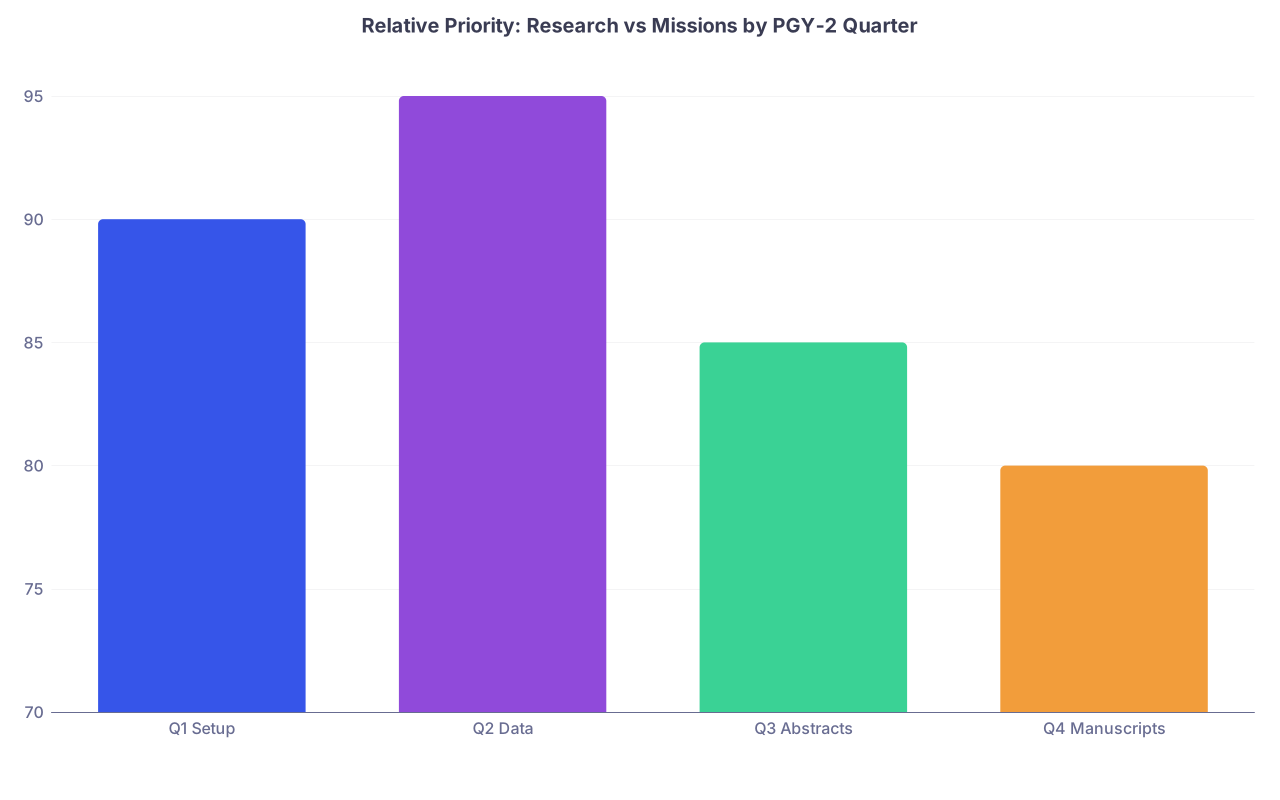
At this point you should map PGY‑2 like a Gantt chart in your head:
- Q1 (July–September): Project setup, IRB submissions, learn data systems.
- Q2 (October–December): Data collection and preliminary analyses.
- Q3 (January–March): Abstracts for key meetings (e.g., AHA, ASCO, IDWeek, ATS).
- Q4 (April–June): Manuscript drafting and revision.
| Category | Value |
|---|---|
| Q1 Setup | 90 |
| Q2 Data | 95 |
| Q3 Abstracts | 85 |
| Q4 Manuscripts | 80 |
Those numbers are “percent of effort that absolutely must remain research‑protected” if you care about being competitive. Look at that and tell me where a 2‑week mission truly fits. It does not—unless you are strategic.
Best Window for a Short Mission in PGY‑2
There is one relatively safer window:
Late Q4 (April–June), chest slightly above water:
- IRB approved.
- Data collection stable or delegated (e.g., coordinator, med students).
- At least one abstract submitted or accepted.
- Manuscript outlines started, not just “I’ll write it later.”
At this point you should:
- Negotiate a 1‑week mission at most, aligned with a slower rotation (short call months, electives, or easier clinic blocks).
- Have a concrete plan for remote research work during travel:
- Data cleaning on your laptop.
- Literature review.
- Drafting introduction/discussion sections.
If your mission is connected to your research (e.g., global TB outcomes, cardiomyopathy in low‑resource settings), you can count some of that time as field exposure that enriches your eventual publication. That is the sweet spot.
Times to Absolutely Avoid Missions in PGY‑2
- October–December: Deep in data collection. You step away, things stall, and suddenly your sample size is underpowered.
- January–March: Abstract deadlines and revisions. Leaving now means missing key national meeting submissions that would front‑load your CV with “accepted for presentation at…”
This is the period where I watch people blow a cycle: they go on a 2‑week mission in February, then spend March “catching up” and never submit that abstract.
PGY‑3: Application Year — Hyper‑Controlled Scheduling
PGY‑3 is when ERAS opens, letters are locked in, and interviews eat your calendar.
PGY‑3, July–September: No Major Missions. Period.
At this point you should:
- Finalize your ERAS application.
- Polish your personal statement and global health narrative if relevant.
- Convert any “submitted” manuscripts into “accepted” or “in press” if possible.
- Be immediately reachable and flexible for early interview offers.
A mission trip here sends the wrong message:
- Programs see gaps where you are not available for interviews.
- You cannot easily attend last‑minute virtual interview offers across time zones.
- If your Wi‑Fi is terrible, you miss key emails and their limited scheduling slots.
Even if you think “I will just do a 1‑week trip in August,” it always expands—prep, fatigue, backup coverage planning. Your attention fragments at exactly the wrong moment.
PGY‑3, October–January: Interview Season — Micro‑Only, If At All
You might be tempted:
- “I have a light interview month; I’ll disappear for two weeks.”
Do not. Interview schedules are dynamic. Programs add dates, move you around, or invite you late from waitlists.
At this point you should:
- Keep any “service” experiences local or virtual.
- If you must travel, think in 2–3 day bites, on either side of weekends, explicitly blocked on your shared calendars.
If a program coordinator emails on Monday offering a Thursday slot and you are in rural Guatemala with inconsistent cell service, you just lost an interview.
PGY‑3, February–June: Safest High‑Yield Mission Window
After rank lists are certified and your scholarly work is mostly on autopilot, the calculus changes.
At this point you should:
- Schedule more substantial missions: 2–4 weeks is reasonable if your PD approves.
- Align them with:
- Open electives.
- Global health tracks that count the time for credit.
- Research that you can process later during fellowship (e.g., longitudinal global cohort).
This is the right time for a “capstone” mission that feels meaningful and will inform your fellowship interviews retroactively (you can reference it in future academic conversations, grand rounds, and early fellowship talks, even if it was not on ERAS).
If You Are on a Dedicated Research Year (or Chief Year)
Different rules apply if you have an extra year.
Full‑Time Research Year Before Fellowship
At this point you should structure your year around publications first, travel second.
Model it like this:
- Months 1–3: IRBs, database building, recruitment start.
- Months 4–6: Heavy data collection, early analysis.
- Months 7–9: Abstracts, first manuscripts.
- Months 10–12: Revisions, secondary projects.
Ideal mission timing:
- Months 7–10: When the initial pipeline is stable and you can work remotely on analysis and writing.
- Duration: 2–3 weeks, but only if you:
- Have clear remote responsibilities.
- Coordinate with your PI on exact deliverables before you leave.
- Align the mission thematically with your research (otherwise it looks like a distraction).
Terrible timing:
- Months 1–4: You have no credibility yet in that lab or group and you vanish. Mentors remember this when writing your letters.
Chief Year
Chiefs are visible. Leaving for long missions mid‑year can create resentment if not handled well.
At this point you should:
- Use end‑of‑year windows (post‑July 1, after handoff) or pre‑chief elective periods.
- Or keep missions short and highly structured: 1 week max, clearly approved by PD and co‑chiefs.
Week‑by‑Week Planning: How to Build Around a Mission Without Bleeding Research Output
You picked a window. Good. Now you need to avoid the classic “I will just catch up later” lie.
8–12 Weeks Before Departure
At this point you should:
- Lock your mission dates with:
- Your program (vacation/elective forms).
- Your research mentors (email with dates, expectations).
- Define precise research deliverables before you leave:
- One completed dataset.
- One draft abstract.
- A full methods section written.
- Delegate and automate:
- Train a med student or co‑resident to help with data entry while you are gone.
- Set up REDCap or similar with clear SOPs so nothing pauses in your absence.
4–6 Weeks Before Departure
Now it is about defensive scheduling.
At this point you should:
- Front‑load:
- Clinic note templates.
- Research meetings (shift key ones earlier).
- Lit reviews for any ongoing project.
- Pre‑schedule:
- Two follow‑up meetings for after you return (so re‑entry is not lost to “let’s find a time”).
You are trying to ensure that, on paper, your productivity line looks like a small dip, not a canyon.
1–2 Weeks Before Departure
At this point you should:
- Freeze new project intake. No “exciting new idea” that will distract you.
- Make a one‑page research status brief:
- Current datasets and where to find them.
- In‑progress drafts with file paths.
- Who does what while you are gone.
This is what serious people do. And mentors notice.
During the Mission: What You Actually Work On Each Day
If you vanish from research for 10–14 straight days, you will feel it later. You do not need to be insane about this, but you do need structure.
Daily 30–60 Minute Research Block
At this point each day you should:
- Wake 30 minutes earlier or stay 30 minutes later.
- Do one of:
- Clean 100 rows of data.
- Edit half a page of a manuscript.
- Respond to research emails.
- Update a short log of potential research questions arising from the mission.
This is not about massive output. It is about continuity and signaling to yourself and your mentors that you are still in the game.
Capture Mission‑Linked Data Ethically
If your mission is tied to research, do it correctly:
- IRB approvals in place before travel.
- Local permissions and cultural sensitivity.
- Realistic sample sizes and follow‑up feasibility (do not promise a longitudinal study if you will never be back).
Fellowship reviewers are not impressed by sloppy “data” gathered in global settings. They have seen the ethics debates. You need to be on the right side of that.
After the Mission: Turn Experience Into Fellowship Fuel, Not Just a Nice Story
The week you return is high‑risk: jet lag, back‑to‑back shifts, and a pile of unanswered messages.
At this point you should:
First 7 Days Back
- Clear your inbox fully.
- Reconnect with mentors:
- One brief email: “Back in town—here is what got done while I was away, and next steps.”
- Re‑open your main manuscript and commit to two focused writing blocks that week.
First 4 Weeks Back
- If the mission had research or scholarly potential:
- Outline a short communication, commentary, or educational piece:
- “Implementing X in resource‑limited setting Y.”
- Or add a global health perspectives paragraph to an existing research paper discussion.
- Outline a short communication, commentary, or educational piece:
You are trying to convert lived experience into scholarly output, not just ERAS “global health interest” fluff.
Good vs Bad Mission Timing: Concrete Scenarios
Let me make this painfully practical.
| Scenario | Timing | Verdict |
|---|---|---|
| 2-week GI mission, no research, PGY-2 Nov | Peak data collection | Bad |
| 1-week ID mission, tied to TB project, PGY-2 May | Late Q4, IRB active | Good |
| 3-week mission, PGY-3 August | ERAS + letters | Very bad |
| 2-week mission, PGY-3 March | Post-rank list | Good |
| 4-week global cardiology rotation as fellow | Protected elective | Excellent |
If your situation looks like the first or third row, re‑schedule. You are setting yourself up to explain away weak research productivity with “but I did a mission.” Committees do not buy it.
Fellowship Phase and Mission Timing: Quick Snapshot
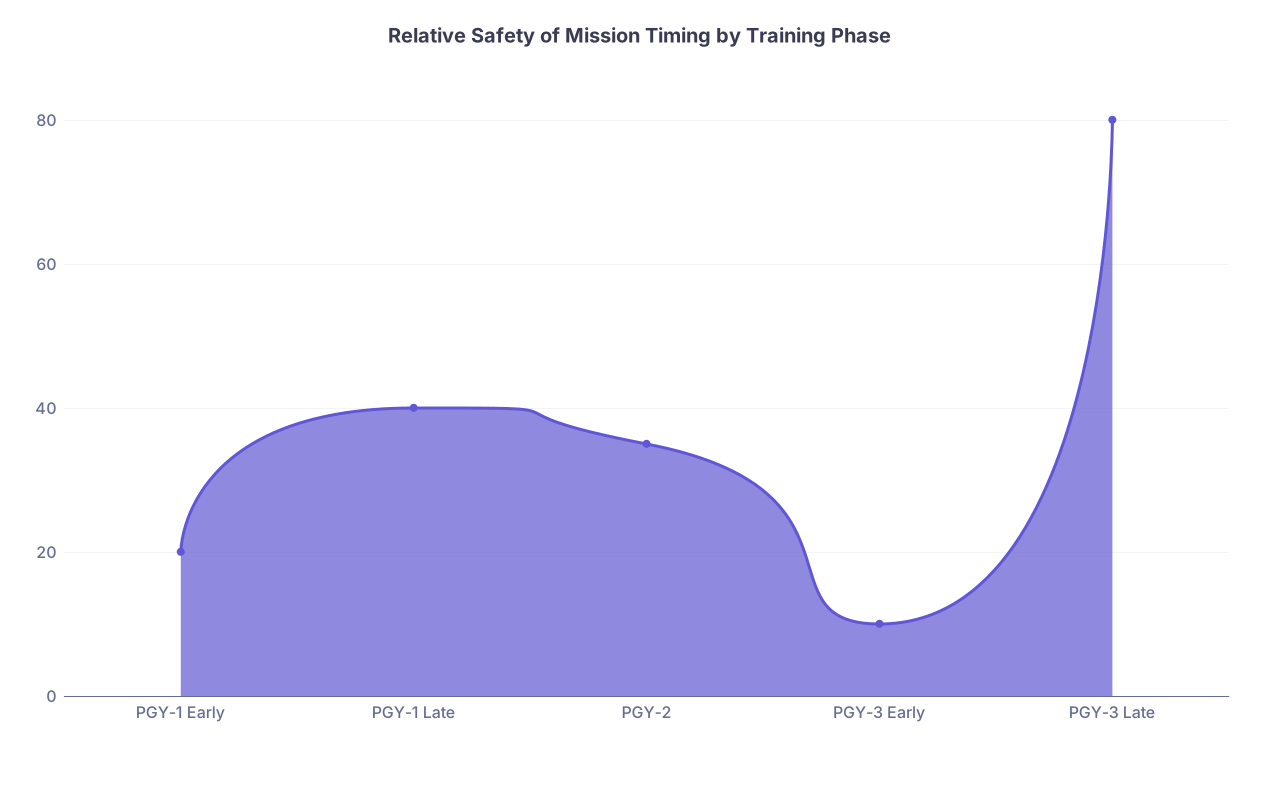
To tie everything together, here is a high‑level view.
| Category | Value |
|---|---|
| PGY-1 Early | 20 |
| PGY-1 Late | 40 |
| PGY-2 | 35 |
| PGY-3 Early | 10 |
| PGY-3 Late | 80 |
Think of those numbers as “percent safety” for a multi‑week mission if you care about competitiveness. Short, well‑planned, research‑linked missions can sometimes sneak into moderate‑risk zones, but the pattern holds.
Final Takeaways
- Schedule missions in lower‑impact windows: late PGY‑2 after projects stabilize, or late PGY‑3 after rank lists—never during prime data, abstract, or interview seasons.
- Tie your missions to a coherent research and ethics narrative, then protect research continuity with pre‑planned deliverables, delegation, and daily micro‑work.
- If you are forced to choose between a mission and a key research year, pick research now—and build deeper, better‑structured global health work later in fellowship when you have real leverage and time.


