

The biggest ethical mess in medical missions isn’t lack of resources. It’s bad donations that nobody wants to talk about.
You know exactly what I mean. Boxes of random drugs in languages nobody can read. Expired sutures. Single crutches with no pair. Broken blood pressure cuffs. “Gently used” stuff that’s really just clinical trash someone didn’t want to pay to dispose of.
I’ve seen mission teams quietly shove this junk in a corner, or worse, hand it out anyway because “it’s better than nothing.” That’s wrong. And it’s how you lose trust with patients, staff, and partner communities.
Let’s walk through what to do when you’re actually standing in front of those boxes. Not theory. Practice.
Step 1: Face the Situation Honestly
You arrive at a clinic or hospital. Someone proudly says, “We’ve saved all the donations for your team!” They open a storeroom and your heart sinks.
Common scenarios:
- Shelves stacked with dusty boxes from multiple mission teams over 5–10 years
- Pharmacy cabinets full of mixed drugs, many expired, all jumbled together
- Boxes labelled “medical donations” from a church, Rotary club, or NGO, untouched because local staff are afraid to throw them away
- Local staff shyly asking, “Can you use any of this?” because they feel guilty saying no
First rule: do not pretend this is fine.
Say something like:
- “Let’s go through this together and sort what’s usable and what’s not.”
- “We want to make sure everything we use is safe and appropriate for your patients.”
Your goal in this moment:
- Acknowledge their effort and goodwill
- Signal you take safety and ethics seriously
- Avoid shaming or insulting the donors or the local staff
If you act like free supplies automatically equal “good,” you are part of the problem.
Step 2: Triage the Donations Like You Triage Patients
You need a fast, practical system. I use a three-pile approach: Safe to Use, Questionable, and No-Go.
| Category | Use Status | Typical Examples |
|---|---|---|
| Safe to Use | Yes | In-date antibiotics, dressings |
| Questionable | Maybe/Review | Near-expiry meds, unfamiliar meds |
| No-Go | Never use | Expired meds, broken devices |
Set up three physical areas:
- Table/shelf 1: CLEARLY SAFE
- Table/shelf 2: NEEDS REVIEW
- Box/area 3: DO NOT USE
What goes into “No-Go” (automatic rejection)
Don’t overthink these. They’re out.
- Expired medications unless you are in a true crisis/disaster setting and working under explicit local policy that allows very specific, limited use. For missions and routine low-resource settings, expired = do not use.
- Unlabeled meds (no name, no dose, no expiry, no language you can read or verify)
- Medications illegal or unavailable in the local country or not on any local formulary
- Damaged packaging: broken seals, water damage, unknown storage exposure
- Used single-use devices: catheters, syringes, IV sets, suture kits, anything marked single-use that’s clearly been used
- Broken or incomplete equipment: BP cuff with no tubing, ophthalmoscope head with no handle or batteries that can’t be sourced locally
- Samples or leftovers from personal medicine cabinets: half-used inhalers, blisters with missing pills, random leftover antibiotics
- Culture-specific or inappropriate items: glossy pamphlets with culture-offensive imagery, clothing that doesn’t match local norms but is presented as “medical aid”
If you feel even a faint, creeping “this might be unsafe or disrespectful,” it almost certainly belongs in No-Go.
What goes into “Questionable”
This pile is for “we might use this, but only after we ask the right people.” Examples:
- Medications very near expiry (within 3–6 months) that match the local formulary
- Drugs with labels in another language, but generic name and expiry are clearly legible and can be cross-checked
- Devices that appear intact but you’re not familiar with local servicing, power compatibility, or spare parts
- Supplies where you don’t know local practice (e.g., specific wound dressings, ostomy supplies, feeding tubes)
You’ll evaluate this category with local leadership or pharmacy later.
What goes into “Safe to Use”
- Medications that:
- Are in-date with clear labels
- Match conditions frequently seen locally
- Are on or similar to the local formulary
- Consumables:
- Gloves in common sizes
- Sterile dressings, bandages
- IV sets compatible with local equipment
- Common sutures that match local practice
- Simple, robust equipment that can be maintained locally:
- Manual BP cuffs that fit local arm sizes
- Manual thermometers
- Basic stethoscopes
- Headlamps with batteries easily available locally
Do this triage quickly but not sloppily. You’re building trust with how you handle this first pass.
Step 3: Do Not Hide Disposal – Make It a Shared Ethical Decision
The most awkward part: what do you do with the No-Go pile?
Here’s where many teams go weak. They either:
- Quietly use some of it anyway, or
- Quietly dump it somewhere and pretend it never existed
Both are ethically lazy.
Instead, sit down with:
- A senior local clinician (doctor, nurse, or clinical officer)
- Pharmacy lead or store manager (if there is one)
- A representative from your team who understands the donors and your organization’s politics
Lay it out clearly:
“I’ve sorted everything into three categories: safe, questionable, and unusable. I’d like to walk you through what’s in the unusable group and why, and then decide together how to dispose of it properly.”
This step does three things:
- Respects local authority and avoids paternalism
- Prevents “but the foreign team threw away our supplies” drama
- Creates a teaching moment about quality standards that aligns both sides
Ask directly:
- “What is your current process for disposing expired medications and broken equipment?”
- “Who is allowed to authorize disposal?”
Then work within their system. If they lack a clear process, help them outline one.

| Step | Description |
|---|---|
| Step 1 | Sort Donations |
| Step 2 | Store for Clinical Use |
| Step 3 | Move to Questionable for Policy Decision |
| Step 4 | Approve Disposal Method |
| Step 5 | Document Items Disposed |
| Step 6 | Safe to Use? |
| Step 7 | Review with Local Leaders |
| Step 8 | Can be Used Safely? |
Step 4: Respect Local Rules, But Don’t Compromise on Ethics
Sometimes you’ll hear: “But we might use those expired antibiotics if we really need them.”
This is where you need a spine.
Your line should be something like:
- “As a clinician, I cannot ethically prescribe medications I believe may be unsafe or ineffective. I respect your resource limitations, but I also have to follow professional standards.”
Then offer something constructive:
- “Can we separate them clearly, label them ‘expired – not for routine use,’ and agree they’re only used under explicit local policy in an emergency and not part of our mission work?”
Never:
- Sneak expired medications into use because “patients are desperate”
- Allow your team to hand out questionable meds at outreach clinics to “clear the boxes”
Your name, your profession, your organization’s reputation—those are on the line.
Step 5: Communicate Back to Donors Without Being Cowardly
You’ll be tempted to leave the donor conversation to someone else. That’s how the cycle repeats.
Your job is to create feedback loops.
Typical donor scenarios:
- A church or community group mailed random supplies from medicine cabinets
- A hospital offloaded soon-to-expire or inconvenient items under the banner of “charity”
- A company used your mission as an excuse to dump unsellable inventory
For each, you need different language but the same backbone.
Example email/script for well-meaning community donors:
“We’re grateful for your support. During our last trip, we had to discard a significant portion of donated items because they were expired, unlabeled, or not appropriate or legal for use in the country we serve.
Going forward, we’ll only accept donations that meet these criteria: (list specifics: in-date, unopened, on our requested list, etc.).
This ensures we uphold patient safety and local regulations and don’t burden our partners with unusable supplies.”
For hospitals or institutions:
“I want to be transparent. A large fraction of the supplies we received from your facility were expired or non-usable locally and had to be destroyed on site. This creates ethical concerns and disposal burdens for our partners.
We’re revising our donation policy and can only receive items that meet defined quality and relevance criteria. I’d be happy to share our updated list and work with your team if you’re interested in sustainable partnership.”
Is it uncomfortable? Yes. But if you don’t say it, they will keep treating your mission partners as a disposal solution.
Step 6: Build a Real Donation Policy (Even If You’re “Just a Volunteer”)
You might be “just joining a trip” and feel like policy is someone else’s job. That’s a cop-out.
At minimum, push your team or organization to adopt clear rules. It doesn’t have to be a 20-page SOP. A one-page set of hard lines is better than hand-wavy generosity.
Basic elements to include:
What you will accept
- Only in-date medications with ≥ 12 months before expiry (or a justified, documented exception agreed with local partners)
- Items on a pre-approved list created with the host site
- Unopened, intact packaging
- Devices that match local power, maintenance capacity, and training level
What you refuse outright
- Anything expired
- Leftover personal prescriptions
- Used single-use devices
- Equipment that cannot be maintained locally
Who approves donations
- One named clinical lead
- One local partner sign-off for non-consumables
Enforce it. Consistently. Even if that means saying “no” to an enthusiastic donor.
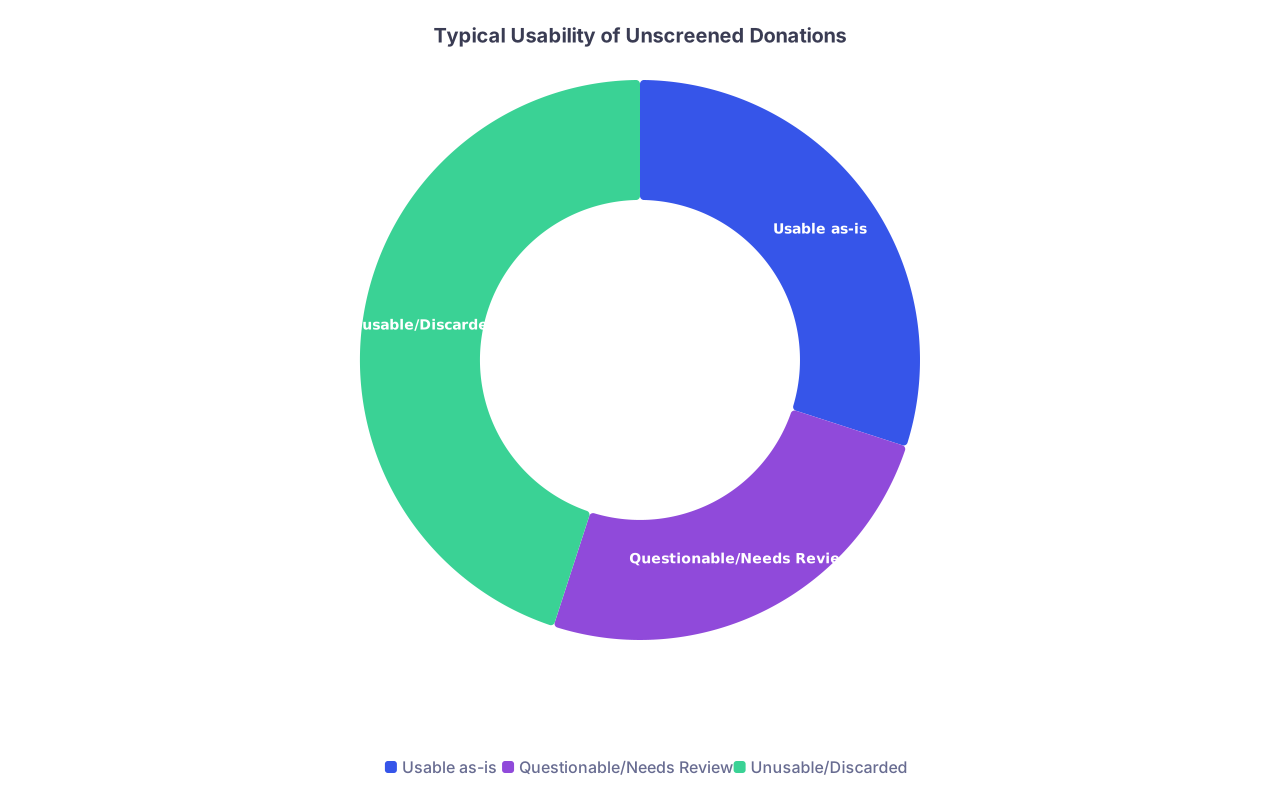
| Category | Value |
|---|---|
| Usable as-is | 30 |
| Questionable/Needs Review | 25 |
| Unusable/Discarded | 45 |
These numbers are not exaggerated. I’ve been in storerooms where closer to 70–80% was junk.
Step 7: Handle the Emotional and Cultural Fallout
This part blindsides a lot of people.
You will face:
- Local staff who feel guilty discarding anything because they’ve seen real scarcity
- Donors who feel personally attacked when you tell them their contributions weren’t used
- Team members who think you’re being “too picky”
You need simple, clear framing you can repeat:
To local staff:
- “Our standard is that your patients deserve the same quality and safety we would expect for ourselves. Poverty does not mean lower standards.”
To donors:
- “Your generosity is not in question. We’re just aligning donations with safety, legality, and real needs so your impact is actually meaningful.”
To your own team:
- “We are not here to relieve Western storage closets. We are here to support patient care and local systems. If something compromises that, we don’t use it.”
Repeat versions of these lines until people stop pushing back.
Step 8: Use the Situation as Professional and Ethical Training
If you’re a student, resident, or early-career clinician, this is where your “personal development and medical ethics” actually happen—on the floor of a hot, dusty storeroom, arguing (politely) about expired ceftriaxone.
Take advantage of it:
- Ask the local pharmacist how they handle expiry and stock management
- Reflect honestly: would you give this to your own family member?
- Talk about it during debriefs—what felt uncomfortable, what boundaries you drew, what you’d change next time
This experience will sharpen:
- Your understanding of global inequities
- Your ability to hold ethical lines under pressure
- Your courage to push back against bad systems, not just bad individuals
The clinicians I trust most in global work are the ones who refuse to cut corners “because these patients are poor.”
Quick Scripts for Awkward Conversations
Use these if you freeze in the moment.
Patient asks: “Why can’t I have that medication in the cabinet?”
“That box is expired and could be unsafe. I will only give you medications that I believe are safe and effective for you.”
Local staff says: “We sometimes still use those after expiry.”
“I understand why, given the shortages you face. As a visiting clinician, I’m required to follow my professional standards and cannot prescribe expired medications. Let’s work together to identify safe alternatives and advocate for better supply.”
Donor proudly says: “We collected all the meds people had at home!”
“Thank you for organizing that. For safety and legal reasons, we’re not able to use personal leftover medications. The most helpful way to support us is by funding locally purchased, appropriate supplies or donating items from our approved list.”
Team member whispers: “Should we just use some of this? Nobody will know.”
“We’ll know. And if something goes wrong, that’s on us. The fact that this is a low-resource setting does not make it acceptable to use unsafe supplies.”
FAQs
1. Are there any situations where using expired medications is ethically acceptable on a mission?
Extremely rare, and only if all three conditions are met:
- You’re in a true emergency or disaster context with absolutely no alternative,
- There is either local policy or WHO/recognized guidance explicitly supporting limited use of specific expired medications under clear conditions, and
- The decision is made transparently with local leadership and documented as an extraordinary measure, not routine practice.
For standard short-term medical missions and ongoing clinics, you should treat expired medications as unusable.
2. What if the local team insists we leave all donations, even the bad ones, “for later”?
You’re not obligated to participate in harm just because you’re a guest. You can’t control what happens after you leave, but you can refuse to endorse or normalize unsafe supplies. Clearly label boxes you believe are unsafe: “Expired – Not for Clinical Use.” Put your concerns in writing in a debrief or handover note. Then have a direct conversation with your own organization: if your presence is being used to legitimize bad practices, that’s a bigger problem you may need to walk away from.
3. How do I push my mission organization to change its donation practices without being seen as ungrateful or difficult?
Come with specifics, not complaints. Document: how much you had to discard, how long it took, how local staff reacted, and what ethical tensions you faced. Propose a simple, written donation policy and a pre-trip approved list co-created with local partners. Frame it as risk reduction (legal, reputational, ethical) and impact improvement, not moral superiority. If leadership still refuses to change, you have to ask yourself whether this is an organization you can ethically represent.
Key points: unsafe or inappropriate donations are not “better than nothing”; you must triage and dispose of them transparently with local partners, and you owe clear, sometimes uncomfortable feedback to donors and your own organization. If you hold that line, you’ll do less visible harm and far more real good.


