
You’re staring at your phone at 1:37 a.m., scrolling back through emails, group texts, and that awful Excel schedule. Your heart drops as you realize it: you just worked a moonlighting shift that… might not have been yours. Or you agreed to one that conflicts with your residency schedule. Or you technically weren’t credentialed yet.
And now the question that won’t leave your head: “Could I actually get fired for this?”
Let’s not sugarcoat it. Sometimes? Yes, people do get into real trouble over moonlighting. But most of the time, what actually happens is less dramatic than the horror stories you hear whispered in the resident lounge. The problem is, when you’re exhausted at 3 a.m., your brain goes straight to: “I’m going to get fired, my license will be revoked, and no fellowship will touch me.”
So let’s go through this like someone who’s also anxious and wants to know the worst case… but also what usually happens in real life.
First, what does “wrong moonlighting shift” even mean?
Because your definition of “wrong” probably feels like “anything I could possibly be blamed for.” But there are actually different flavors of “wrong” here, and they’re not all career-ending.
Some common scenarios I’ve seen or heard about:
- You took a moonlighting shift at an outside hospital without written approval from your PD first.
- You worked a shift that put you over the ACGME 80-hour rule when combined with your residency hours.
- You worked before you were officially credentialed or privileged at that site.
- You picked up a shift that overlapped with your “home” call or clinic responsibilities (or it ran late and you were clearly too tired the next day).
- You moonlighted at a place your contract explicitly forbids (like a competing hospital in the same system).
- You coded/ billed as an attending when you were only supposed to function as a resident-level provider.
- You misrepresented your level of training or license level.
Notice how some of those are paperwork/technical, and some are more like “this could be interpreted as fraud or patient endangerment.” Your risk level depends heavily on which category you’re in.
Could I literally get fired for this?
Let me be blunt: yes, you can be fired. Residents have been terminated for moonlighting violations. It’s not common, but it’s not imaginary either.
The big question is: what path do you fall into?

Here’s the hierarchy I’ve seen in real life:
| Type of Issue | Risk of Being Fired |
|---|---|
| Minor paperwork / approval gap | Low |
| ACGME duty hour overage (isolated) | Low–Moderate |
| Repeated duty hour issues + warnings | Moderate–High |
| Direct conflict with residency duties | Moderate–High |
| Clear policy violation (forbidden site) | High |
| Fraud / misrepresentation / billing | Very High |
The actual firing tends to happen when:
- There’s a pattern, not just one mistake.
- You lied or tried to cover it up.
- Someone got hurt, or there was clear patient safety risk.
- The program already sees you as a “problem” resident and this becomes the tipping point.
- The violation is so blatant that GME or legal is forced to make an example of it.
One isolated, honest screw-up where you:
- Own it,
- Stop it immediately,
- Cooperate with whatever corrective plan they give you,
is much more likely to end in “no more moonlighting for you” than “you’re fired tomorrow.”
But your anxiety brain doesn’t care about “likely.” It only knows the words: possible. So let’s go deeper into the specific worst cases you’re imagining.
Scenario 1: “I moonlighted without telling my program.”
This is such a classic it might as well be a rite of passage. You get offered a shift by a senior or a friend who says, “Don’t worry, everyone does it. Just don’t tell anybody.” And then later you realize your contract says: All moonlighting must be approved in writing by the program director.
What’s the real risk?
- Contract violation? Yes.
- Automatic firing? No, not usually.
Common outcomes I’ve seen:
- You get called in, they say, “Why didn’t you tell us?”
- You get a stern talk about ACGME rules and duty hours.
- They freeze your moonlighting privileges for a while.
- Worst-case in this bucket: a formal written warning in your file.
When does it get truly dangerous?
- You lied directly when asked (“I don’t moonlight anywhere.”) and they have proof.
- The shifts clearly pushed you over 80 hours consistently.
- It caused a direct problem: you no-showed your own call, showed up post-call dangerously tired, or had a documented patient error related to fatigue.
If you’re on your couch spiraling because you took two unapproved shifts last month, odds are you’ll be dealing with a painful conversation, not a career obituary.
Scenario 2: “I took a shift that put me over 80 hours this week.”
The ACGME duty hour boogeyman.
Here’s the ugly truth: plenty of residents are quietly over 80 hours with moonlighting if you actually counted every minute. Programs know this. Some ignore it as long as nothing explodes; some are strict.
But if your moonlighting causes a clear, documented ACGME violation, now people higher up in GME may have to act. Not necessarily with firing, but with something.
What can happen:
- You’re told to stop moonlighting temporarily or permanently.
- Your hours get audited more closely.
- If the program is under the microscope already, they may come down harder just to protect their accreditation.
Could you be fired just for one week at 84 hours? Highly unlikely.
Could it add fuel to the fire if you’re already on remediation for professionalism, attendance, or clinical performance? Yes. Now it becomes: “Despite being on remediation, continued to moonlight in violation of duty hour policy.”
The context matters more than the raw number.
Scenario 3: “I worked without credentials or privileges.”
This one is scarier. Because now we’re flirting with liability.
Examples:
- You worked at an outside ED or urgent care before your hospital credentialing was finalized.
- You weren’t fully licensed for independent practice but were functioning as if you were.
Hospitals and malpractice insurers really, really hate this.
That said, if nothing bad happened, what usually plays out is:
- Legal/compliance freaks out internally.
- The site may retroactively scramble paperwork or just eat the risk.
- You may get banned from working at that site again.
- Your PD gets told and chews you out; your moonlighting may be shut down.
Could this lead to termination? Yes, especially if:
- You knew you weren’t cleared and did it anyway.
- You misrepresented your status (e.g., said you had a full unrestricted license when you didn’t).
- There’s a pattern of dishonest or sloppy behavior.
If you were genuinely confused (“I thought credentialing was done; they scheduled me”), that’s a very different story than, “Yeah, I knew, but I needed the money.”
Still scary. But again, not automatically the end.
Scenario 4: “My moonlighting conflicted with my residency duties.”
This is where PDs get hot.
Think:
- You took an overnight moonlighting shift and rolled into your own 7 a.m.–7 p.m. ward day totally wrecked.
- You agreed to a shift and then had to trade or call out sick for your real residency shift to make it work.
- You missed clinic, sign-out, mandatory conference, etc., because of moonlighting.
Programs are territorial. They will remind you: “Your primary responsibility is to your training program.” And they’re not wrong.
This kind of thing often gets framed as a professionalism issue. And once that word enters your record, fellowship and credentialing committees pay attention.
Could you be fired for this? Yes, if:
- It wasn’t a one-off, it was repeated.
- You were directly told to stop and did it anyway.
- Patient care or coverage truly suffered.
More commonly:
- You lose moonlighting privileges.
- You may get pulled into remediation for professionalism.
- You get an awkward narrative section on your MSPE-equivalent for fellowship.
Is it survivable? Yes. But this is one where doing damage control early really matters.
Scenario 5: “What if they call it fraud?”
This is the big nightmare word.
Fraud-type issues with moonlighting are things like:
- Billing under someone else’s name when you shouldn’t.
- Billing as an attending when your license or privileges didn’t allow that level.
- Documenting services you didn’t actually provide.
- Misrepresenting your training level (“PGY-3 resident” when you’re actually PGY-1).
This is where “I might get fired” turns into “I might get in trouble with the state board, OIG, or worse.”
If you’re in this category, you need:
- To stop whatever you’re doing immediately.
- To talk to someone who’s actually a lawyer, not just your co-resident or Reddit.
I’m not going to fake it here: this is the highest-risk scenario. People absolutely have been fired and reported over this stuff. It’s not the majority, but it’s not rare enough to ignore.
How programs actually handle moonlighting screw-ups
PDs and GME offices are stuck in an annoying position. They have to:
- Protect patient safety.
- Protect accreditation.
- Protect the institution from legal and financial mess.
- Also, theoretically, train you and not destroy your future over a single bad decision.
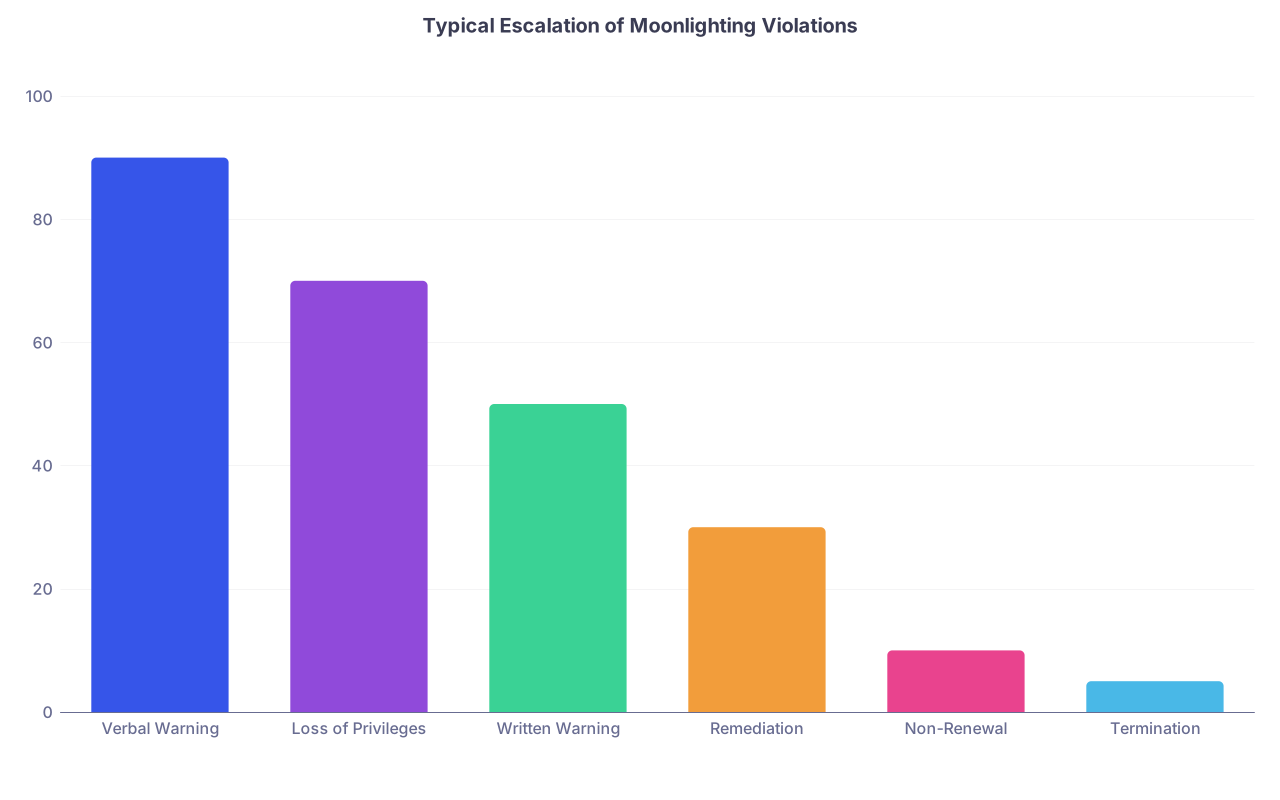
So in real life, the “punishment ladder” looks more like this:
- Verbal warning / “coaching” conversation.
- Loss or suspension of moonlighting privileges.
- Written warning in your file.
- Formal remediation plan (professionalism, duty hours, etc.).
- Non-renewal of contract at end of year.
- Immediate suspension or termination (this is the nuclear option).
| Category | Value |
|---|---|
| Verbal Warning | 90 |
| Loss of Privileges | 70 |
| Written Warning | 50 |
| Remediation | 30 |
| Non-Renewal | 10 |
| Termination | 5 |
Those numbers aren’t exact data, but that shape is real: most things die in the “warning/privilege loss” zone. Very few go all the way to firing, and when they do, there’s usually more going on than “wrong shift.”
If you already messed up, what should you do now?
I know the instinct: lie low, say nothing, hope it disappears. But that instinct is how small problems become career-threatening.
Here’s what I’d do if I were you and my stomach was already in knots:
Figure out exactly what happened.
Not the vague “I think I screwed up.” Pull the schedule. Check your hours. Look at your contract. Write down: dates, times, locations, who scheduled you, what you were told.Assess the category.
Is this:- Unapproved but otherwise ok?
- Duty hour overage?
- Credential/privilege issue?
- Direct conflict with residency duties?
- Possible billing/misrepresentation?
Talk to a safe person first.
A chief resident you trust. A senior who’s not reckless. Sometimes a GME ombudsperson if your institution has one. Don’t start with a panicked confession to the PD if you don’t even know what you’re confessing to.Then, own it early.
Once you understand the situation, go to your PD or APD before they find out another way. Programs are a lot more forgiving when you come in saying:
“I realized I made a mistake. Here’s exactly what happened, and I’ve already stopped doing it.”Do not lie or minimize.
Once you’re in that office, half-truths are your worst enemy. If they catch even one lie, suddenly your entire story looks shaky.Accept the hit.
Maybe you lose moonlighting. Maybe you get a warning. It sucks. So does being investigated or fired. Pick your poison.

| Step | Description |
|---|---|
| Step 1 | Realize mistake |
| Step 2 | Gather facts |
| Step 3 | Talk to trusted senior or chief |
| Step 4 | Consult legal or GME ombudsperson |
| Step 5 | Schedule meeting with PD |
| Step 6 | Disclose fully and own mistake |
| Step 7 | Follow corrective plan |
| Step 8 | Serious risk? |
How to avoid getting yourself into this mess in the first place
I know this part is obvious, but your future 3 a.m. self will thank you.
Get written approval before you start.
Email, form, whatever your program uses. Not “my senior said it’s cool.”Know your duty hours.
Actually add them up before saying yes. Don’t just “feel” like it’s fine.Ask the outside site bluntly:
- Am I fully credentialed?
- How will I be billing?
- Who is supervising, if anyone?
Never let moonlighting touch your core schedules.
If there’s even a small risk you’ll be late or unsafe, say no. That money is not worth an adverse clinical event.Document everything.
Save emails. Save texts. Save credentialing paperwork. If something goes sideways, having receipts that you asked the right questions can save you.
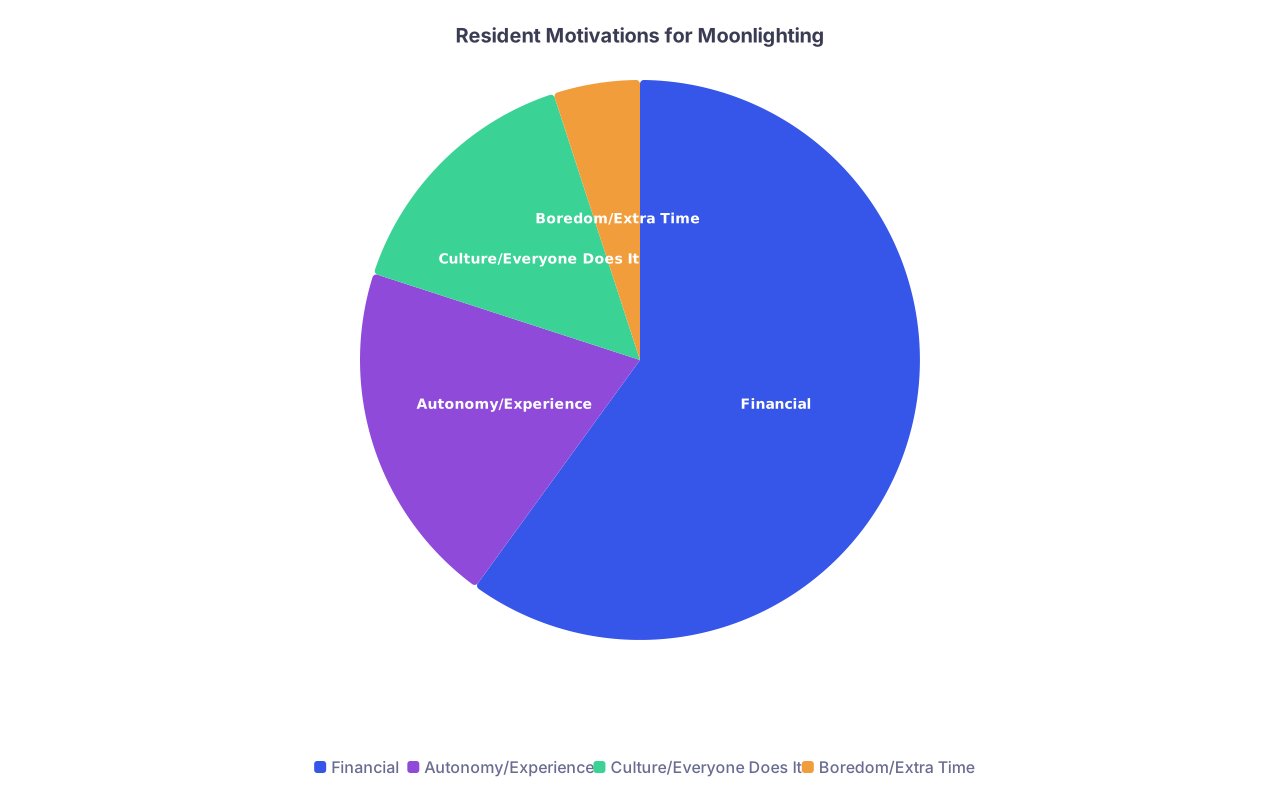
| Category | Value |
|---|---|
| Financial | 60 |
| Autonomy/Experience | 20 |
| Culture/Everyone Does It | 15 |
| Boredom/Extra Time | 5 |
The quiet thing no one says out loud
A lot of older attendings and even some chiefs will shrug and say, “Relax, everyone moonlights, nobody cares.” And to some extent, that’s true. The system kind of relies on your cheap labor quietly filling coverage gaps.
But if something goes wrong, those same people will suddenly rediscover the policy manual and say, “Well, technically you violated X, Y, and Z.”
So you have to be the paranoid one. Because nobody is going to care about your career as much as you do. Not the hospital, not the program, not the moonlighting site. You.

So… could you get fired for taking the wrong moonlighting shift?
Yes. You could. That possibility is not just in your head. If the wrong factors line up—unsafe hours, policy violations, misrepresentation, a bad outcome, some politics—you could absolutely find yourself on the wrong end of a termination letter.
But here’s the part your anxiety keeps deleting:
Most of the time, what actually happens is not “you’re done in medicine.” It’s:
- A hard conversation.
- A restriction on moonlighting.
- A scarier-sounding letter in your file than you deserve.
- Maybe some awkward explaining at fellowship interviews.
It feels catastrophic when you’re in it. It’s usually survivable.
If you already made a mistake, your choices now matter more than the mistake itself. You can either pretend it didn’t happen and hope nobody notices, or you can be the slightly over-honest resident who walks in and says, “I messed this up; help me fix it.”
Years from now, you probably won’t remember the exact email that offered that sketchy moonlighting shift, or the number of hours you logged that week. What will stick with you is whether you protected your integrity when it would’ve been easier to hide—and that ends up counting for more in this field than one “wrong” shift ever will.