
The hidden power structure of a hospital is revealed in tumor boards and case conferences.
If you are ignoring them, you are voluntarily staying invisible.
Let me break this down specifically.
Tumor boards and multidisciplinary case conferences are not just about patient care and education. They are recurring, semi-formal networking arenas where people with real power in your future—division chiefs, fellowship directors, research leads, and the person who will write your make-or-break letter—show up, talk, argue, and remember faces.
You can either be a nameless body in the back row.
Or you can turn these meetings into deliberate engines for career visibility.
1. Understanding the Real Function of Tumor Boards
Everyone pretends tumor boards are purely about “multidisciplinary care optimization.” That is only half the story.
Tumor boards and complex case conferences are where:
- Service chiefs signal their culture and priorities
- Fellows quietly audition for faculty jobs
- Residents get informally ranked in people’s heads
- Research collaborators are identified
- Who-gets-what-opportunity is decided in an entirely unspoken way
If you have ever heard a PD say, “We know them from conference, they always ask good questions,” that is exactly what I mean. The fifteen minutes you spend presenting a case will outweigh fifty hours of anonymous ward work in how people remember you.
There are usually several “layers”:
- Formal purpose: Review complex or new cancer cases, align management, meet accreditation requirements.
- Educational purpose: Residents, fellows, med students learn staging, guidelines, and nuance.
- Political purpose: Services negotiate turf (who “owns” this patient, which treatment is prioritized).
- Social purpose: People see who shows up, who is prepared, who is thoughtful, who is careless.
If you treat tumor boards as a box to check, you get zero non-clinical value from them. If you treat them like recurring, low-risk performance stages, they become one of the most efficient platforms for building professional reputation.
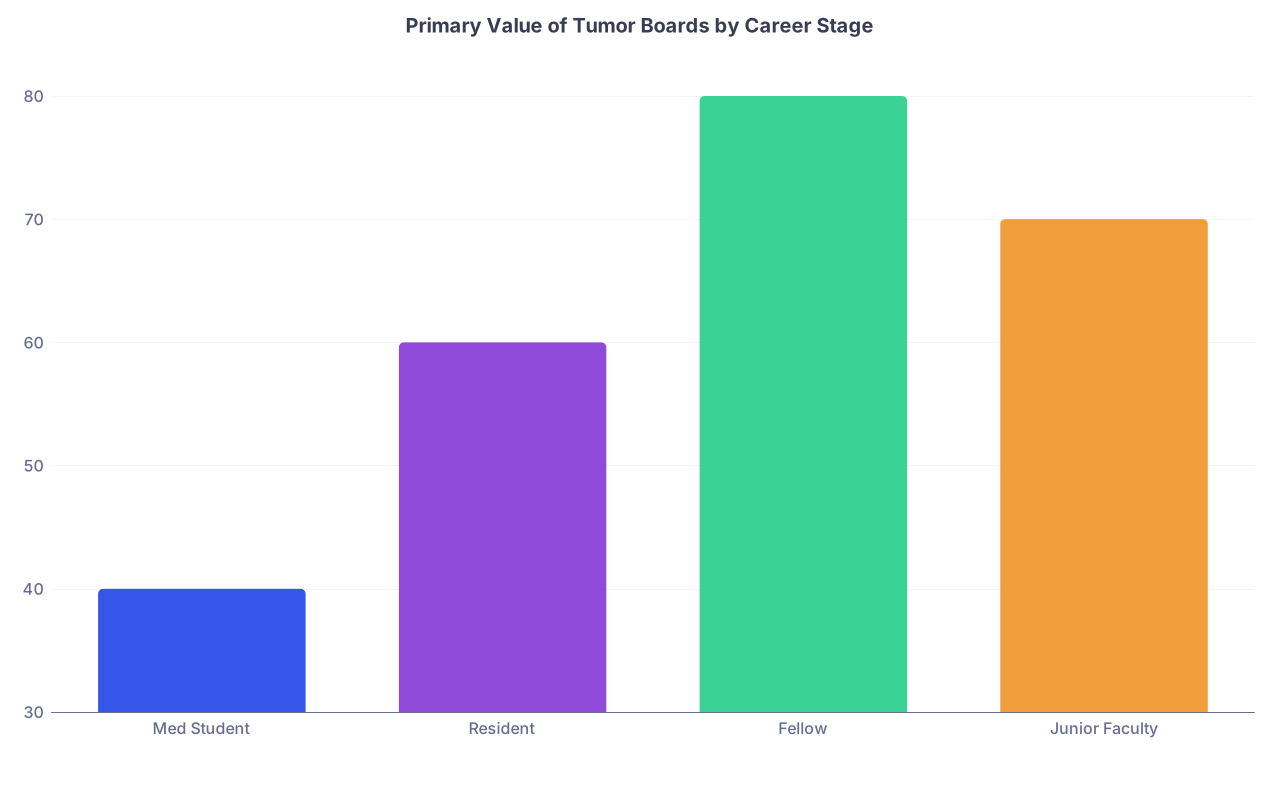
| Category | Value |
|---|---|
| Med Student | 40 |
| Resident | 60 |
| Fellow | 80 |
| Junior Faculty | 70 |
(Think of the numbers as “career visibility potential” out of 100. Fellows and junior faculty have the most to gain, but residents are not far behind.)
2. Who Actually Notices You in These Rooms
You are not performing for “the room.” You are performing for specific people.
Let’s map the usual attendees:
- Medical oncologists – Often fellowship gatekeepers, trial PIs, and section leaders.
- Surgical oncologists / subspecialty surgeons – Control high-stakes letters, OR opportunities, and often have strong academic networks.
- Radiation oncologists – Frequently involved in clinical trials, protocol development, and national guideline work.
- Radiologists – Especially breast, thoracic, neuro, or abdominal imagers; they maintain a long memory of which trainees are thoughtful and reliable.
- Pathologists – Less flashy but heavily involved in academics and sometimes key to research projects.
- Nurse navigators, advanced practitioners – They quietly know who is good to work with and talk to attendings about it.
- Administrators / coordinators – They notice who is consistently prepared or flaky.
You are also visible to:
- Program directors (sometimes quietly sitting in the back or joining virtually)
- Fellowship directors
- Division chiefs
- Faculty who sit on promotions and awards committees
If you are a medical student or early resident, you might assume, “No one knows who I am anyway.” That is incorrect. People in stable, recurring meetings track patterns. They notice the intern who always shows up on time. The fellow who always has complete data. The resident who asks one sharp question every few weeks rather than random comments every session.
I have seen fellowship decisions swayed by comments like:
- “They were always well-prepared during tumor board.”
- “They seemed checked-out. I never heard a thoughtful question from them.”
- “They handled that brutal question from [famous surgeon] very gracefully.”
No one writes this into an official rubric. They do not have to.
3. Choosing the Right Conferences for Visibility
Not all conferences are equal for career leverage. You want recurring, interdisciplinary, decision-making forums, not one-off didactics.
High-yield for visibility:
- Disease-specific tumor boards (breast, GI, thoracic, GU, neuro-onc, heme malignancies)
- Complex case conferences (M&M, transplant review, advanced heart failure, ECMO, etc.)
- Multidisciplinary new-patient conferences in cancer centers
- Radiology–pathology correlation conferences
- Quality review or outcomes conferences where cases are dissected
Lower-yield (but can still matter):
- Single-service teaching rounds with one attending
- Resident-only case conferences
- Grand rounds where you never speak or appear on the schedule
If you have limited time, prioritize:
- Forums where people outside your own department attend
- Rooms where the people you want letters from reliably show up
- Conferences that feed into tangible outputs: protocols, trial enrollment, QI projects, etc.
| Conference Type | Visibility Impact | Cross-Specialty Exposure |
|---|---|---|
| Disease-specific tumor board | Very High | High |
| M&M (Multidisciplinary) | High | Moderate–High |
| Single-department M&M | Moderate | Low |
| General grand rounds (passive) | Low | Moderate |
| Radiology–pathology correlation | High | Moderate |
If you are aiming for oncology, surgery, radiology, pathology, or any subspecialty that traffics in complex cases, tumor boards are not optional. They are your stage.
4. How to Be Seen Without Being Annoying
There is a narrow window between “invisible” and “trying too hard.” You need to live in that window.
Show up like a professional, not a bystander
Basic, but most trainees still fail at this:
- Be on time. For recurring boards, that means you are in the room (or logged in on Zoom) before sharing starts.
- Sit where people can see you. Not hidden behind a column or off-camera with your video off.
- Put your name on your display correctly. No “iPhone” logins. Use “First Last – PGY-2 Internal Medicine” if your institution allows it.
- Have a notebook or laptop open for notes. Looking engaged visually matters.
If you are online: camera on when possible, neutral background, no multitasking posture. I have watched attendings comment after a Zoom tumor board: “X clearly wasn’t paying attention; they were looking down at their phone half the time.” You think no one sees; they do.
Speak rarely but with substance
You do not need to talk every session. In fact, you should not.
Aim for:
- Roughly one meaningful contribution every few boards (as a med student or junior resident)
- One sharp question or clarification when you know the case or have actually read the relevant guideline or paper
- Updates only when you have direct knowledge of the patient
What qualifies as “substance”?
- Clarifying staging, performance status, or key comorbidity that changes management
- Referencing guideline-based recommendations when there is confusion
- Briefly summarizing a recent trial that directly affects the decision at hand
Example of a good intervention from a PGY-2 IM resident:
“Just to add from the medicine side: her ECOG is 2 mainly due to deconditioning post-ICU, but she walked 150 feet with PT yesterday. Cardiology felt her EF is stable enough for chemo if needed.”
Short, relevant, no grandstanding.
Bad intervention:
“So, like, in my experience, patients really don’t want chemotherapy…”
You have no experience. Do not do this.

Learn the “board culture” first
Before speaking much, quietly observe two to three sessions:
- Who usually moderates? (Onc? Surgeon? Rotates?)
- Who asks hard questions?
- How do they treat trainees who speak up? Supportive? Aggressive?
- How formal are the presentations? Template slides? Off-the-cuff?
Your goal is to match the culture but raise your game slightly above the median. If no residents ever speak, you can stand out with one well-placed comment per month. If residents routinely present, you must be tighter and more prepared.
5. Presenting at Tumor Board: Turning a Task into an Audition
The day you are assigned to present a case, your career potential in that room spikes. Do not wing it.
Step 1: Understand the real question
You are not presenting for fun. You are presenting because someone wants the group’s opinion on something:
- Unclear diagnosis
- Conflicting treatment options
- Borderline resectable vs unresectable
- Questionable performance status for aggressive therapy
- Rare histology or staging ambiguity
Ask the supervising fellow or attending:
“What exact question do you want the board to weigh in on?”
Then you build your presentation around that.
Step 2: Pre-brief the key players
High-level move that almost no trainee bothers to do:
- The day before (or morning of) tumor board, email or talk briefly with:
- The attending who will be “responsible” for the patient
- The fellow if there is one
- The coordinator if they manage the slide deck
Offer:
“I am presenting Ms. X’s case tomorrow. I put together a short slide set. Do you want to review it or adjust the focus?”
This does three things:
- Shows initiative and professionalism.
- Allows them to correct you before you mismatch expectations in public.
- Makes them more invested in your success because their name is subtly attached to your performance.
Step 3: Build a tight, decision-focused slide set
For a typical solid tumor case, you need:
- 1 slide: Key demographics / performance status / comorbidities
- 1–2 slides: Timeline and relevant clinical features
- 1 slide: Staging data – imaging summary in plain language, not radiology-speak
- 1 slide: Pathology essentials – histology, receptors, molecular markers
- 1 slide: The specific decision question
That is it. You are not giving a grand rounds.
Two crucial points:
- Put the decision question early, either verbally or on a slide: “The main question is whether she is a candidate for neoadjuvant therapy versus upfront surgery.”
- Anticipate what each specialty cares about. Surgeons want margins, resectability, functional status. Oncologists want staging, molecular data, prior therapies. Radiation wants target volumes, organ motion, contraindications.
Step 4: Rehearse the opening 60 seconds
The first minute sets the tone. Fumble it, and people mentally tag you as unprepared, even if you recover.
Practice out loud something like:
“This is a 62-year-old woman with stage IIIB triple-negative breast cancer, good performance status, and no major comorbidities. The main question is timing and type of systemic therapy in relation to surgery and radiation.”
Then move into the concise history. You should be able to present the full case in 3–4 minutes.
Step 5: Handling questions without dying
You will be challenged. Sometimes harshly. That is not necessarily bad; how you respond is what they remember.
Basic rules:
- If you do not know, say: “I do not have that data right now, but I can get it and update the team.”
- Do not guess about imaging or pathology. Ever.
- Do not argue on thin ground. If a senior person has clear expertise, you do not win by debating.
You can, however, think out loud safely:
“That is a good point. Given her EF and baseline neuropathy, I imagine we would lean away from a regimen heavy in neurotoxic agents, but I would defer to oncology on the specific choice.”
This shows clinical reasoning without pretending expertise you do not have.
6. Converting Case Conferences into Research and Leadership Opportunities
Career visibility is not just about being remembered. It is about converting that visibility into concrete opportunities: projects, roles, and letters.
Mine recurring themes for project ideas
If you attend tumor board regularly, you will hear the same frustrations over and over:
- “We never have molecular results in time.”
- “Our staging documentation is inconsistent.”
- “We keep missing early referrals for radiation.”
- “These cases always get delayed because of insurance approvals.”
Each repeated pain point is a potential:
- Quality improvement project
- Retrospective study
- Process mapping initiative
- Implementation science project
You do not have to be a genius. You just need to be the person who says:
“I have noticed we keep running into X issue. Would it be useful if someone systematically reviewed the last 6–12 months of cases to quantify how often this happens and what the outcomes look like?”
Then you follow this up with:
“Would you be willing to mentor that project if I do the legwork?”
You just created your own research / QI project, anchored in real-world frustration. That is how useful work gets done.
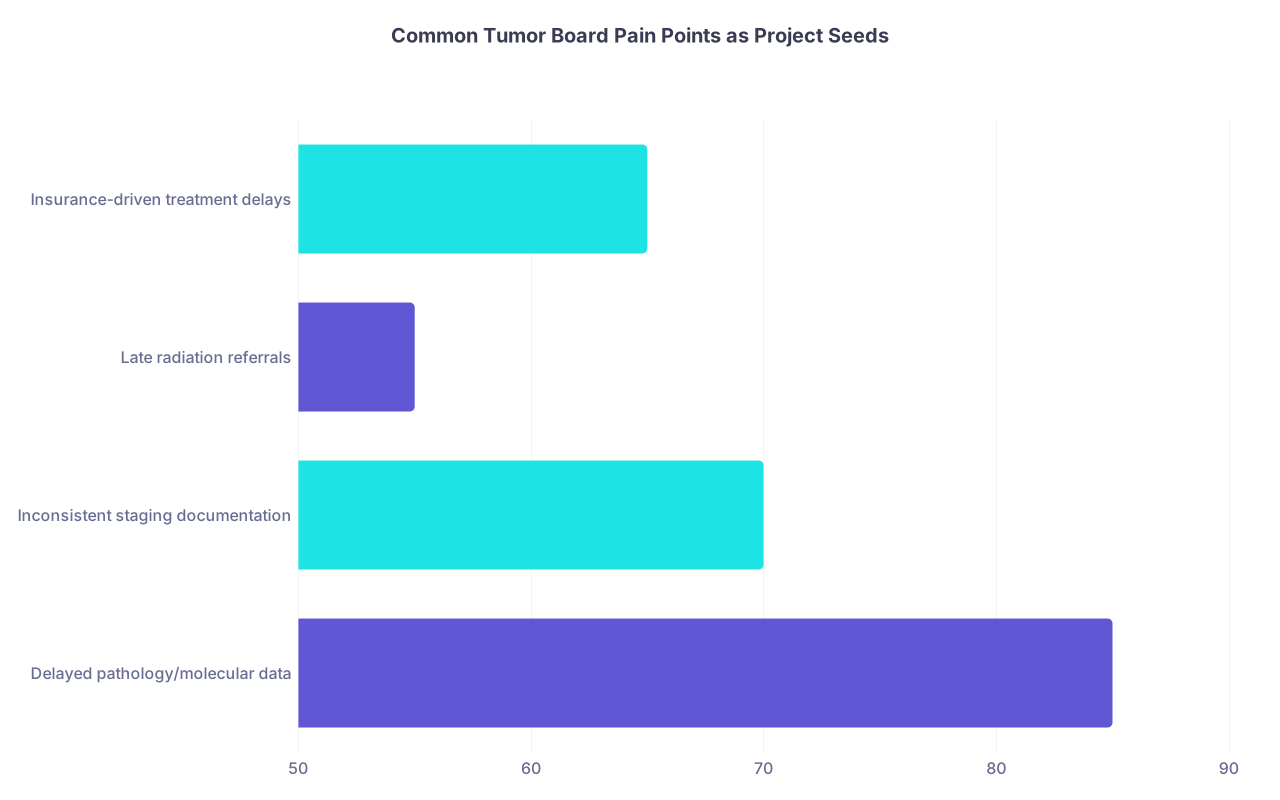
| Category | Value |
|---|---|
| Delayed pathology/molecular data | 85 |
| Inconsistent staging documentation | 70 |
| Late radiation referrals | 55 |
| Insurance-driven treatment delays | 65 |
Targeted follow-up with specific attendings
Generic “networking” emails go nowhere. Precise follow-ups after boards work.
Concrete pattern:
- You attend tumor board.
- A particular attending makes an insightful comment in your area of interest.
- Within 24 hours, you send a concise email:
“Dr. Smith, I appreciated your point at GI tumor board about how frequently we see stage III patients present without adequate nutritional assessment. I am a PGY-2 interested in GI oncology. If you ever consider a chart review or QI project on this theme, I would be very interested in helping with data collection or analysis.”
That is not “Can I have a research project?” It is “I listened to you, I understand your concern, and I am volunteering as labor attached to your priority.”
Try this with 3–5 attendings over a few months, and you will almost certainly land at least one project or mentoring relationship.
Volunteering for non-sexy but visible roles
Some tumor boards have chronic logistic gaps:
- Updating the case list
- Tracking follow-up outcomes (did the recommended plan actually happen?)
- Compiling a small database for accreditation
- Developing a better template for presentations
If you see a gap, propose a solution and offer to own it:
“I noticed we do not consistently track whether tumor board recommendations are carried out. Would it help if I built a simple spreadsheet to capture initial plan, actual treatment, and a few outcomes, at least for a subset of cases? It might help with future QI or certification documentation.”
That sounds like admin work. It is. But it also:
- Puts you at the center of information flow
- Makes you indispensable to the attendings who rely on that data
- Naturally produces material for posters, abstracts, and leadership bullets on your CV
This is how people end up as “coordinators” of a conference or QI effort far earlier in their career than their peers—and how they accumulate meaningful, actionable letters.
7. Using Tumor Boards to Support Letters and Applications
When it comes time to apply for fellowship or jobs, vague “hard worker” comments in letters are useless. Tumor boards give your letter writers specific, memorable material.
Your job is to give them that material.
Make your performance easy to remember
People remember:
- One excellent, crisply presented complex case.
- One high-yield research or QI project that came out of board.
- One visible leadership role (e.g., resident liaison to tumor board, QI coordinator).
They do not remember:
- That you showed up quietly 40 times.
- That you “were interested in oncology.”
So in your last year before applying, engineer at least:
- 1–2 high-complexity case presentations you prepare meticulously
- 1 concrete project that you can present as “born out of tumor board observations”
- 1 ongoing contribution (tracking metrics, improving documentation, etc.)
Then, when you request a letter, you frame it clearly:
“When possible, I would be very grateful if you could comment on my work in GI tumor board, including the [specific project] we developed from recurrent issues identified there, and my presentations of [one or two notable cases].”
You are not scripting their letter. You are reminding them of real, specific things they saw you do.
How committees interpret these signals
Fellowship and job selection committees think in shorthand. They will not articulate it out loud, but the code looks something like this:
- “Regular, prepared presence in tumor board” → This person understands team-based, multidisciplinary care and is reliable.
- “Led QI or research tied to case conferences” → They can translate clinical frustrations into scholarship and system improvement.
- “Highly regarded by multiple different specialties in board” → Safe hire. Will not embarrass us in complex clinical settings.
That is what you want.
8. Common Mistakes That Quietly Destroy Your Reputation
Let me be blunt. I have seen people damage themselves in tumor boards so badly that it colored how attendings viewed them for years.
Avoid these.
1. Arguing aggressively without knowledge
If you are a PGY-2 arguing with a thoracic surgeon about resectability based on a CT you glanced at 5 minutes ago, you look foolish.
Healthy ways to disagree as a trainee:
“I may be misunderstanding, but I thought for T4 lesions involving [specific structure], guideline X suggested… Could you clarify how you are thinking about this case?”
That invites teaching rather than head-to-head combat.
2. Showing up unprepared when you are responsible for the patient
If the patient is on your service, and you:
- Do not know their ECOG or key comorbidity
- Misstate their stage
- Cannot answer basic questions about labs or prior treatments
You are telling the entire room—and by extension, the institution—that your team’s care is loose. Worse, they will anchor that impression to you personally.
3. Being visibly disengaged
Scrolling your phone. Laptops with social media open. Camera off with obvious background noise. Laughing or chatting while a serious complication is being discussed.
People do not forget disrespect in these settings, even if it is unintentional.
4. Grandstanding “academic” questions
You do not need to ask a question every time. Especially not questions that sound like Step-style trivia.
“Has anyone seen the latest phase II trial from Japan that looked at…” is fine if you have a direct, practical point. It is unimpressive if you are obviously trying to show off that you read an abstract on Twitter the night before.

| Step | Description |
|---|---|
| Step 1 | Attend Tumor Board |
| Step 2 | Prepare focused slides |
| Step 3 | Observe and take notes |
| Step 4 | Answer concisely |
| Step 5 | Admit and offer to follow up |
| Step 6 | Ask brief relevant question |
| Step 7 | Stay silent |
| Step 8 | Stay engaged |
| Step 9 | Visible disengagement and lost credibility |
| Step 10 | Have role today |
| Step 11 | Question asked |
| Step 12 | Opportunity to speak |
| Step 13 | Tempted to multitask |
9. The Future of Tumor Boards: Hybrid, Data-Driven, and Even More Visible
Tumor boards are changing. That changes how you can leverage them.
Hybrid and virtual formats increase reach
Many centers now run hybrid boards—half the room in person, half on Zoom, sometimes across multiple sites. That means:
- More attendings and external experts in the “room”
- Easier access for off-service trainees
- More recording and archiving (which means your presentations live longer)
For you, that means:
- You can attend boards in your target subspecialty even when not on that rotation.
- You can ask to present cases from satellite clinics that would never make it to the main campus otherwise.
- Your performance might be watched asynchronously, not just live.
Decision support and AI will not replace the human politics
Yes, AI-driven tools will assist with:
- Automatic staging
- Guideline-based suggestions
- Risk prediction
- Structured documentation
But the core questions remain human:
- Can this specific patient tolerate this plan?
- How do we coordinate between three services with conflicting interests?
- Who will own this complication when it happens?
As these tools roll into tumor boards, the people who can:
- Interpret them critically
- Communicate their implications clearly
- Spot when the algorithm is wrong or too rigid
…will stand out even more.
Increasing pressures for documentation and QI = more opportunities
Accreditation bodies and cancer centers want:
- Documented adherence to board recommendations
- Metrics on timeliness of care
- Evidence of multidisciplinary input
That means:
- More structured data collection around tumor board
- More need for people who can build and maintain those data streams
- More low-hanging fruit for publishable QI and outcomes work
If you position yourself early as the trainee who understands both the clinical and the data side of these conferences, your visibility skyrockets.

10. A Practical Action Plan by Training Level
Let me make this painfully concrete.
Medical students
- Pick one or two subspecialty tumor boards aligned with your interests. Show up consistently during that rotation.
- Ask your resident or fellow if you can help assemble a case for board; even drafting a simple summary can get you on the radar.
- Aim for 1–2 short, thoughtful questions or clarifications during the whole rotation. Not every session.
Junior residents (PGY-1/2)
- Become the most reliable person at basic data: performance status, staging, comorbidities.
- Volunteer to present at least one case per rotation in oncology-heavy services.
- Have at least one project idea seeded by tumor board observations by the end of the year.
Senior residents / fellows
- Take ownership of a recurring board function: case tracking, outcomes follow-up, improved presentation templates.
- Engineer 1–2 high-visibility, complex case presentations annually.
- Turn one recurring tumor board issue into a QI or research project with clear outputs (poster, abstract, paper).
- Use boards to intentionally strengthen relationships with at least 2–3 letter writers.
Early faculty
- Use tumor board performance to position yourself as the “go-to” person for a niche (e.g., geriatric oncology, survivorship, rare tumors).
- Mentor trainees explicitly through their first or most complex presentations. People remember who saved them from public humiliation.
- Tie your academic identity to recurring, recognized contributions in these forums—either as a surgical decision-maker, trial enroller, or QI leader.
Key points, stripped down:
- Tumor boards and case conferences are not just clinical exercises; they are recurring auditions where people with power quietly form opinions about you.
- Speaking rarely but with preparation, clarity, and respect for expertise will make you memorable for the right reasons.
- If you consistently translate what you see in these rooms into projects, roles, and relationships, tumor boards become one of the highest-yield networking tools in modern medicine.