

You land in a new city on a Sunday. Your apartment is still half in boxes, orientation starts in the morning, and you already feel behind. Everyone keeps saying, “Make sure you find good mentors early.” But the attendings you’ve met so far are rotating faces, your seniors are drowning, and you have no clue how to turn “I’m new here” into actual mentorship instead of awkward small talk in the hallway.
If that’s where you are, good. This is exactly when you should be thinking about mentors—before the year steamrolls you.
Step 1: Define What You Actually Need From a Mentor
Do this before you start hunting people down. Otherwise you’ll just latch onto the first “nice attending” and hope it works out. That’s how people end up with a CV-padding research PI when what they really needed was someone to show them how to not get destroyed on nights.
Ask yourself three blunt questions:
In the next 12 months, what do I need most?
Examples:- Survive intern year without burning out
- Publish 1–2 papers for fellowship
- Figure out if I even want fellowship vs hospitalist life
- Get stronger clinically on X service (ICU, ED, ward medicine, etc.)
What kind of mentor fits that?
- Career/fellowship mentor
- Research mentor
- Day-to-day clinical coach
- Life/sanity mentor (yes, that’s a thing and often the most valuable)
How much time can I realistically commit?
Be honest. If you’re on a q4 call schedule, you’re not doing weekly 1-hour meetings with three different people. You’ll fail, they’ll disengage, and you’ll feel guilty.
Now sketch this out:
| Type of Mentor | Priority | Time Needed / Month | Main Goal in 12 Months |
|---|---|---|---|
| Career/Fellowship | High | 1–2 hours | Decide path + create plan |
| Research | Medium | 4–6 hours | 1–2 abstracts/papers |
| Clinical Coach | High | 1–2 hours | Strong attending evals |
| Wellness/Life | Medium | 1 hour | Prevent burnout |
That’s your target. You’re not “finding a mentor.” You’re recruiting for specific roles.
Step 2: Map the Mentorship Landscape at Your New Institution
Most residents massively underuse what’s already sitting there. Before you start cold-emailing big names, figure out the formal and informal structures.
Start with official channels (but don’t stop there)
During orientation week, look for:
- GME office emails about mentoring programs
- Departmental “resident-faculty mentoring” sign-ups
- Diversity, equity, and inclusion (DEI) or Women in Medicine groups
- Physician well-being/peer support programs
You’re looking for words like “matching,” “mentorship,” “faculty advisor,” “resident coach,” “scholar track,” “professional development series.”
If you see any of these, you do two things immediately:
- Sign up. Even if it looks generic or clunky.
- Ask, “Can I request someone in [your area of interest: cards, critical care, medical education, etc.]?”
These systems can be hit-or-miss, but they’re a fast way to get at least one or two names on your radar.
Step 3: Use Residents Strategically—They’re Your Shortcut
Your best intel is not on the website. It’s in the mouths of PGY-2s and 3s who just lived your next 12–24 months.
Do this within your first 2 weeks:
- One chief resident
- One PGY-2 on your current team
- One senior from your home service (IM, surgery, etc.)
- One person matching into a fellowship you’re vaguely interested in
- One resident known to be “well-connected” (there’s always one)
Ask them each a very specific question:
“If you were me—new here, interested in [X area or still undecided]—who are the 2–3 attendings you’d want to meet in the next month?”
Then a follow-up:
“Who’s actually responsive to residents? Not just big-name, but actually answers emails and gives feedback.”
Write down the names. You’ll start seeing repeats. Pay attention to those.
That list is gold. Those are the people you prioritize for early contact.
Step 4: Make Low-Awkwardness First Contact
The biggest barrier is not that attendings don’t want to mentor. It’s that residents send vague, time-consuming, or needy emails that are easy to ignore.
Here’s how you do it right.
The cold-ish email template that actually gets answered
Subject lines that work:
- “New PGY-1 interested in [X] – quick intro?”
- “New resident hoping to learn more about [field/track]”
- “Referred by Dr [Resident/Faculty] – brief meeting?”
Body (adapt as needed):
Dear Dr [Name],
My name is [Name] and I’m a new PGY-[year] in [program]. Dr [resident/faculty] recommended you as someone who’s particularly supportive of residents.
I’m early in residency and trying to get oriented to opportunities in [fellowship field / research area / med ed / quality improvement], and your work in [specific thing they do—clinic, ICU, project, role] really stood out to me.
Would you be open to a brief 20-minute meeting in the next few weeks so I can ask a few questions and get your advice on how to make the most of my time here? I’m happy to come by your office or meet on Zoom at whatever time is easiest for you.
Thank you for considering this,
[Name]
[Program, PGY-X]
[Cell]
Key details:
- 20 minutes (not an “hour of your time”)
- A clear reason why them
- A specific time frame (“next few weeks”)
Once they say yes, you send 2–3 specific time windows. Do not say “whenever works for you.” Make it easy for them to say yes.
Step 5: Turn a 20-Minute Chat Into an Actual Mentorship
You’ve got the meeting. Don’t waste it on, “So… tell me about yourself.”
Come in with a loose agenda. On a scrap sheet or in your notes app, have:
Your 1–2 sentence story:
- “I’m a new IM resident, still deciding between cards and heme-onc, and I know I want some kind of academic career but not sure what that should look like yet.”
Three focused questions:
- “For residents who are successful in [their field/track], what are they doing in PGY-1?”
- “If you were starting residency again here, what would you do differently?”
- “Are there 1–2 people or projects you think I should learn about or get involved with?”
A very light ask at the end:
- “Would you be open to me checking in again in a few months once I’ve explored some of these things?”
- or “Would it be okay if I emailed you as questions come up?”
You are not asking, “Will you be my mentor?” This is not middle school. You’re testing for fit and responsiveness.
What you’re watching for:
- Do they look at you, or at their email the entire time?
- Do they give concrete advice or just say “it all works out”?
- Do they offer names, introductions, or specific steps?
If they casually say, “Send me your CV” or “Let me connect you with X,” act on it that day. Fast follow-through signals you’re serious.
Step 6: Leverage Clinical Rotations as Live Auditions
You’ll rotate with dozens of attendings. Most residents treat this as pure survival. You’re smarter than that.
During a rotation, if you notice:
- An attending who teaches well and clearly enjoys it
- Someone whose career or lifestyle you might want
- A person residents speak highly of when they’re not in the room
Do two things:
- Perform. Be on time, do your notes, read about your patients, ask a couple of thoughtful questions. You’re building credibility before you ask for anything.
- In the last 2–3 days of the rotation, say something like:
“I’ve really appreciated working with you this month. I’m still new to the program and trying to figure out how to build a good foundation and find mentors. Would you be open to a brief meeting sometime to talk about career development and how to use my time here well?”
If they light up and say yes, follow up with that same short email you used before. Attach your CV if they ask; if not, have it ready.
Step 7: Use Interest Groups and Committees Without Wasting Time
You don’t need to join every committee. But a couple of targeted ones can plug you directly into mentor-rich environments.
Places to look:
- Residency “tracks” (research, global health, med ed, QI, leadership)
- Hospital or department committees (sepsis, patient safety, curriculum)
- Affinity groups (Women in Medicine, LGBTQ+ physicians, URiM groups)
- Local specialty societies (city cardiology society, regional ACP/ATS/etc.)
Most of these have email lists or meetings. Your move:
- Join 1–2 that match your goals. Not 6.
- Introduce yourself briefly at the first meeting:
- “I’m [Name], new PGY-1 in [program], interested in [X]. I’m mostly here to listen and learn where residents can be useful.”
- After the meeting, pick the one or two senior people who spoke the most or clearly run things and send:
“I appreciated your perspective at today’s [committee/meeting]. As a new resident, I’m trying to find ways to get involved meaningfully without overcommitting. Would you mind if I asked your advice on 1–2 small ways a resident could contribute to [their area]?”
Again, you’re not asking them to be your mentor yet. You’re asking for a small, concrete next step. That’s how mentorship usually starts in real life.
Step 8: Protect Yourself From Bad or Useless “Mentors”
Not every senior person should mentor residents. Some are chronically unavailable; some are toxic. Here’s what to watch for in the first 1–2 meetings:
Red flags:
- They talk 90% of the time and never ask what you want
- They name-drop constantly but offer you nothing practical
- They’re vague: “We’ll see what comes up” with no specifics
- They cancel repeatedly or take weeks to answer a simple email
- They discourage you without even understanding your background
If you see that, do not invest more. You do not have to confront them. You just… stop pushing. Send an occasional update if you feel obligated, but redirect your energy.
Green flags:
- They ask what you want and push you to be more specific
- They introduce you to other people quickly
- They remember things you said and follow up
- They give you clear next steps (“Sign up for X,” “Read Y,” “Talk to Z”)
Those are your people. Stick with them.
Step 9: Maintain Multiple Mentors Without Dropping the Ball
You’re not looking for One True Mentor. You want a small, functional “board of advisors” with different roles.
A simple structure that works well:
- 1 primary career/fellowship mentor
- 1 clinical mentor (often on your home service)
- 1–2 project or research mentors
- 1 person you’d call when things are falling apart (burnout, life chaos)
How to keep this going without it consuming your life:
- Send a brief update email every 3–4 months to core mentors:
- 3–5 bullet points:
- What you’ve been doing
- What’s gone well
- A challenge you’re facing
- Any concrete question or decision you’re wrestling with
- 3–5 bullet points:
- Ask for meetings only when you have decisions to make or updates that matter.
- If you drop the ball (and you will), own it:
“I realized I let things go quiet over the last few months during a rough stretch of rotations. I’ve made some progress on X and would appreciate your input on Y if you have time.”
No drama. Just honesty and a next step.
Step 10: Use the City, Not Just the Hospital
You just moved to a new city. There are physicians outside your training hospital who can be incredibly valuable and less overrun by residents.
Places to look:
- Local specialty society meetings (county medical society, specialty chapters)
- State ACP/ACS/ACEP/ATS/etc. events
- Academic half-days or grand rounds at neighboring institutions
- Community hospitals your attendings moonlight at
This is where a quick process map helps you visualize the path:

| Step | Description |
|---|---|
| Step 1 | New in City |
| Step 2 | Ask Residents for Names |
| Step 3 | Email 3 to 5 Faculty |
| Step 4 | Meet 2 to 3 Interested Mentors |
| Step 5 | Join 1 to 2 Committees or Tracks |
| Step 6 | Attend Local Society Events |
| Step 7 | Build Small Mentor Network |
When you attend these external events:
- Wear your badge, say what program you’re from
- Don’t pitch yourself with your entire CV
- Ask 1–2 good questions and then, if the conversation clicks, follow up with an email the next day
Step 11: Track Your Network Like a Grown-Up
If you do this well, you’ll meet a lot of people quickly. You will forget who said what unless you write it down. This is where residents mess up—they treat mentorship like random encounters rather than relationships to steward.
Open a simple spreadsheet or note and track:
| Name | Role/Area | How You Met | Last Contact | Next Step |
|---|---|---|---|---|
| Dr A Smith | Heme-Onc | Wards June | 7/1 | Send update 9/1 |
| Dr B Patel | Med Ed | Med Ed track | 7/10 | Ask about project |
| Dr C Lopez | Wellness | Peer support | 6/28 | Coffee in Oct |
Update this once a month. 10 minutes. That’s it. This keeps people from slipping through the cracks and helps you see where you’re overloaded or missing a type of mentor.
What This Looks Like Over the First 3 Months
Let me give you a realistic timeline. Not theoretical. This is what it looks like when people actually do it.
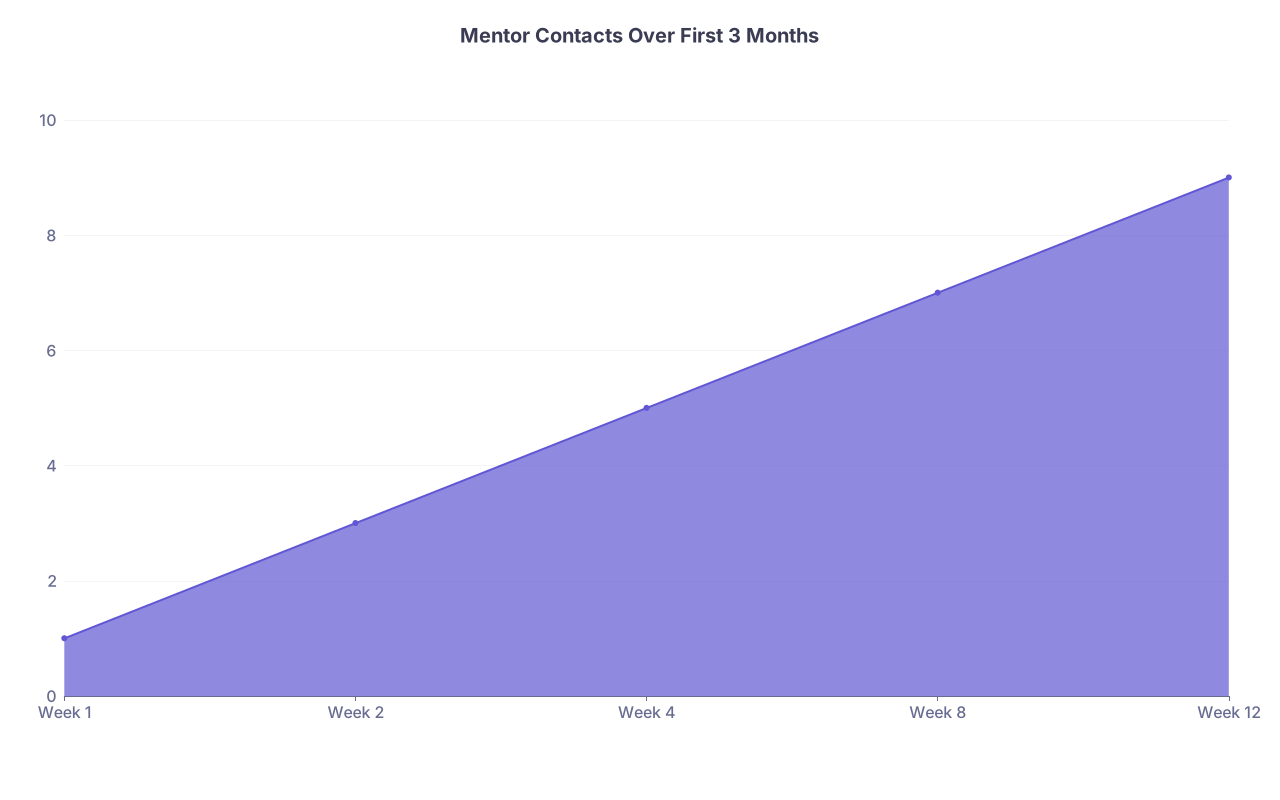
| Category | Value |
|---|---|
| Week 1 | 1 |
| Week 2 | 3 |
| Week 4 | 5 |
| Week 8 | 7 |
| Week 12 | 9 |
- Week 1–2: You talk to chiefs and seniors, collect 5–8 names, send 3–5 emails. Maybe 2 respond.
- Week 3–4: You’ve had 1–2 short meetings and identified 1 person you click with. You’ve also noticed 1 attending on service who seems promising.
- Week 5–8: You ask that attending for a quick follow-up meeting post-rotation. You join one committee or track and go to a meeting.
- Week 9–12: You’ve now got 2–3 faculty you can email with real questions, maybe 1 project on the horizon, and you’re no longer feeling like you’re “mentorless” in a new city.
That’s a win. Not a perfect network. A functional one.
FAQs
1. What if I’m totally undecided about my specialty or career path—who should I approach first?
Start broad. Target people who are known as “resident people,” not strictly subspecialists. Your PD, APDs, chiefs, and a few generalists (hospitalists, general pediatricians, general internists) are good starting points. Tell them explicitly you’re undecided and want help exploring. Ask who they’ve seen do that well in your program and who helped those residents. Your first mentor doesn’t have to match your eventual specialty; they need to be invested in residents and well-connected so they can point you in different directions as your interests sharpen.
2. How do I handle it if a mentor relationship just isn’t working?
Quietly and cleanly. Stop asking for big chunks of their time. Transition to occasional updates instead of regular meetings. Meanwhile, build new relationships elsewhere. If they ask directly, you can say: “My plans have evolved a bit and I’ve been getting more involved in [X area], so I’ve been working more closely with Dr [Y] on that front. I really appreciate the guidance you gave me early on—it helped me get oriented.” You don’t owe anyone a dramatic breakup speech; you do owe them basic professionalism.
3. I’m an introvert and hate “networking.” Can this still work for me?
Yes, but don’t try to be the schmoozy resident working every room. Focus on 1:1 or very small-group interactions, which tend to be better for mentorship anyway. Use email and short, purposeful meetings instead of big social events. Prepare 3–4 questions in advance so you do not have to improvise. Think of it less as “networking” and more as “finding smart people to help me not waste my residency.” You don’t need to charm a crowd. You need 3–5 solid relationships over three years. That’s absolutely doable, even if you’d rather be home on your couch.
Open your calendar and your email right now. Pick one senior resident to text for recommended names, and send one short intro email to a faculty member this week. One step. One conversation. That’s how your mentor network in this new city starts—quietly, in the middle of a chaotic month, with one deliberate reach-out.


