

The biggest lie about switching specialties is that “if you’re good, it will just work out.” It will not. Not without rewiring your network on purpose.
If you’re mid-training and even thinking about switching specialties, you’re not dealing with a simple career choice. You’re about to redo the entire social and professional scaffolding that’s been built around you since med school. Colleagues, mentors, PDs, letter writers, program reputation—your whole network is calibrated for Specialty A, and you’re planning to move to Specialty B.
Here’s how to handle that without blowing yourself up.
Step 1: Get Clear On Your Story Before You Talk To Anyone
If you start “exploring a switch” without a tight story, you’ll leak anxiety all over the place and word will spread in exactly the wrong way.
You need answers to three questions before you speak to anyone outside your inner circle:
- Why are you leaving your current specialty—in language that doesn’t burn bridges?
- Why this new specialty specifically—in a way that sounds like pull, not escape?
- Why now—with a reasonable explanation of timing and logistics?
Bad version:
“I hate surgery; the lifestyle sucks and my attendings are toxic. I think derm would be nicer.”
Good version:
“I learned a lot in surgery, especially procedural thinking and working under pressure. Over the last year, I’ve realized that what energizes me most long term is longitudinal patient care and complex diagnostics, which is why I’m pursuing internal medicine.”
You need a version of this that you’re willing to repeat, almost word for word, to:
- Your current PD
- Potential new mentors
- Future letter writers
- Program coordinators
- Random colleagues who ask, “Wait, aren’t you in anesthesia?”
Write it out. Say it out loud. Fix the parts that sound whiny, confused, or purely lifestyle-driven. Lifestyle can be part of the story, but if it’s the whole story, you’ll sound like a flight risk.
Step 2: Map Your Existing Network—And Decide Who Gets Loop-In Status
You already have a network. It’s just oriented around the wrong target specialty.
Do a quick brain dump. No spreadsheets, no overthinking. Just a list:
- PD, APD, chief residents
- Faculty who know you well (attendings you’ve impressed or worked closely with)
- Co-residents across classes
- Med school mentors and deans
- People you’ve done research with
- Anyone you’ve stayed in touch with from away rotations or conferences
Now tag each name with three simple labels:
- Influence: High / Medium / Low
- Trust: High / Medium / Low
- Alignment: Likely Supportive / Unknown / Risky
You’re looking for:
- High influence + high trust → your core strategy group
- Medium influence + high trust → safe sounding boards
- High influence + low trust / “risky” → people you approach carefully and late, or not at all
This is not paranoia. Once you say, “I’m thinking of switching,” you no longer fully control the narrative. I’ve seen people mention it vaguely to one gossipy co-resident and, two days later, their PD hears a twisted version third-hand.
So for now, your “inner ring” is:
- One or two trusted co-residents who won’t gossip
- One faculty mentor who genuinely likes you
- Maybe a med school mentor or dean who knows your broader history
With them, you’re honest and explicit:
“I’m seriously considering switching from [Current Specialty] to [Target Specialty]. I want your candid take, and I need help thinking about how to approach this strategically.”
Step 3: Approach Your Current PD Without Self-Sabotage
You cannot rewire your network successfully while pretending your PD doesn’t exist. Programs talk. PDs talk more. Your future PD will likely call your current one. Count on it.
So you need a plan for this conversation.
Timing:
- Not in the middle of a crisis.
- Not after a terrible evaluation or conflict.
- Ideally when you’ve been performing solidly for a stretch.
Your goals in that meeting:
- Be respectful and direct, not dramatic.
- Frame this as a thoughtful career choice, not a meltdown.
- Show you care about a graceful, professional transition.
A decent script to adapt:
“Dr. Smith, thank you for meeting with me. I want to share something important and get your guidance. Over the past year, I’ve done a lot of reflection about my long-term fit in [Current Specialty]. I’ve realized that my interests and strengths align more with [Target Specialty], especially [specific aspects—e.g., longitudinal care, diagnostic complexity, procedural mix].
I’m grateful for the training here. I’ve learned a lot and want to finish this year strong. At the same time, I’d like to explore options to transition into [Target Specialty] in a way that’s respectful to this program and fair to the team. I’d appreciate your honest feedback and any advice you’re willing to offer.”
You are not asking for permission. You are asking for guidance and support. But your tone should make it clear this is a considered plan, not a whim.
Things you’re trying to preserve in this conversation:
- A non-toxic relationship
- A chance at a neutral or even supportive backchannel reference
- Potential help with logistics (release dates, timing, documentation)
If the PD reacts badly—guilt, anger, veiled threats—that tells you something. You may have to accept that you’ll be getting a lukewarm or even negative reference. That just means you lean harder into building strong advocates on the new side.
Step 4: Identify Your Target-Specialty “Anchor People”
You cannot switch into a specialty you know only from med school rotations and Reddit threads. You need real, current people in that field who can:
- Tell you what programs care about
- Vet your story for red flags
- Tell you which PDs are open to “retrainers”
- Eventually, vouch for you
You’re looking for 3–5 “anchor people” in the target specialty:
- A PD or APD (gold)
- A faculty member at your institution in that specialty
- A former resident from your program who switched into that field
- A med school connection now in that field
- Research collaborator or conference contact in that specialty
Start at home base:
“Dr. X, I’m currently a PGY-2 in [Current Specialty] here. I’ve been seriously considering transitioning into [Target Specialty] and wanted to ask if you’d be open to a brief conversation about the field and what programs look for in applicants coming from another specialty.”
You’re not asking for a job yet. You’re asking for insight. People are much more willing to help when you start there.
Once you have 1–2 anchor people, ask explicitly:
- “Which programs tend to be open to residents switching in?”
- “Are there PDs you’d feel comfortable introducing me to, once you’ve gotten to know me a bit better?”
- “What would make me a credible candidate in your eyes—over the next 6–12 months?”
Step 5: Rebuild Your Day-to-Day Exposure in the New Field
Your network follows your time. If you’re physically and mentally still 90% in the old specialty, your network will stay there too.
You need structured exposure to the new field:
- Elective rotations in the target specialty at your home institution
- If possible, an away elective (for fields like derm, rad onc, etc.)
- Shadowing + joining conferences and didactics regularly
- Getting on a small project or QI initiative in that department
Your goal is to become “that resident from [Current Specialty] who really shows up and might be switching into our field.” Present. Reliable. Helpful.
And yes, this often means doing more than your co-residents for a while.

| Step | Description |
|---|---|
| Step 1 | Decide to Explore Switch |
| Step 2 | Clarify Story |
| Step 3 | Inner Circle Mentors |
| Step 4 | Talk to Current PD |
| Step 5 | Connect with Target Specialty Faculty |
| Step 6 | Electives and Projects in Target Specialty |
| Step 7 | Obtain Letters and PD Intros |
| Step 8 | Apply and Interview |
On those electives, act like you’re already in that specialty:
- Be early. Not on time. Early.
- Ask for feedback mid-rotation, not just at the end.
- Tell the attending clearly: “I’m strongly interested in switching into [Target Specialty] and would really value feedback on whether you think I’d be a good fit and what I should improve.”
You’re recruiting future letter writers every day you’re there.
Step 6: Convert Weak Ties Into Advocates
You already know this, but I’ll say it bluntly: ERAS applications from internal transfers get screened with extra suspicion. PDs want human confirmation that:
- You’re not a problem child
- You’re not switching because you failed out or imploded
- You understand the new specialty’s reality
That’s what your network is for. Not just to get interviews, but to neutralize doubt.
Here’s your hierarchy of value:
| Connection Type | Influence for Switch |
|---|---|
| Target specialty PD who knows you | Very High |
| Target specialty faculty letter writer | High |
| Current PD who is at least neutral | High |
| Program alumni who have switched before | Medium |
| Co-residents and peers | Low to Medium |
Turning a “weak tie” into a real advocate usually takes three steps:
- Initial conversation (informational, low ask)
- Visible follow-through (you do what you said you’d do: electives, research, reading)
- Explicit ask once they know you:
“Based on the time we’ve worked together, would you feel comfortable supporting my application to [Target Specialty] with a letter or by reaching out to PDs you know?”
If they hesitate or give vague non-answers, take the hint. You don’t want a tepid letter. Thank them, stay polite, and move on.
Step 7: Manage the Cross-Talk Between Programs
Your current PD and your future PD are going to talk. That conversation can help you or kill you.
You cannot script it, but you can influence the inputs.
You influence it by:
- Performing well right up to the end in your current program
- Not trash-talking your old specialty or program—ever
- Being clear that your switch is about fit and trajectory, not running from conflict
What you want your current PD to be able to say is something like:
“Dr. Lee has been a solid resident. No professionalism concerns. They’ve done good work here. They came to me early and honestly when they realized they were better suited for another field. We were disappointed to lose them but support their decision.”
That’s the ideal.
Sometimes you’ll get: “Competent but not outstanding, and struggled with [X].” Fine. Programs in your target field know you’re not coming in as a superhero. They just want someone stable who won’t leave again.
Do not try to “work around” your current PD by hiding your switch. Programs hate surprises. If a PD finds out after they’ve ranked you that your prior PD had no idea you were leaving, that can blow up your reputation fast.
Step 8: Use Formal Structures That Already Exist (Quietly)
Some specialties and institutions quietly have mechanisms for people like you:
- “Re-trainer” positions
- Advanced standing for prior training
- Internal transfers across departments
- GME-level approval processes for specialty switches
You’re not going to find those in glossy brochures. You hear about them from:
- GME office staff who’ve processed these before
- Faculty who’ve seen residents switch out or in
- Senior residents who watched someone do it three years ago
Ask targeted questions:
“Has your program ever taken someone who started in another specialty?”
“What did that process look like?”
“Did they get any credit for previous years?”
Some of this is timing and budget. Some is politics. If you find out a department historically never takes switchers, do not waste energy there. You need friendly territory.
Step 9: Rework Your Application Materials Like You’re Changing Languages
Your current CV, personal statement, and letters all speak “I am a [Current Specialty] person.” You need them to read “I have learned from [Current Specialty], but I am fundamentally a strong fit for [Target Specialty].”
Key moves:
- Personal statement: 20–30% on what you gained from your current training, 70–80% on why the new specialty is home base for your skills and values.
- CV: Move target-specialty-relevant activities up (research, electives, QI, teaching). De-emphasize ultra-niche stuff that screams “I was all in on ortho.”
- Letters: Get at least one strong letter from someone in the new specialty. Ideally two. One letter from current PD is usually expected, even if it’s just factual and neutral.
You want program leadership in the target field to think, within 30 seconds of glancing at your app:
“Okay, they started in [X], but they’ve thought this through, they’ve actually spent real time in our field, and people we trust say they’re solid.”
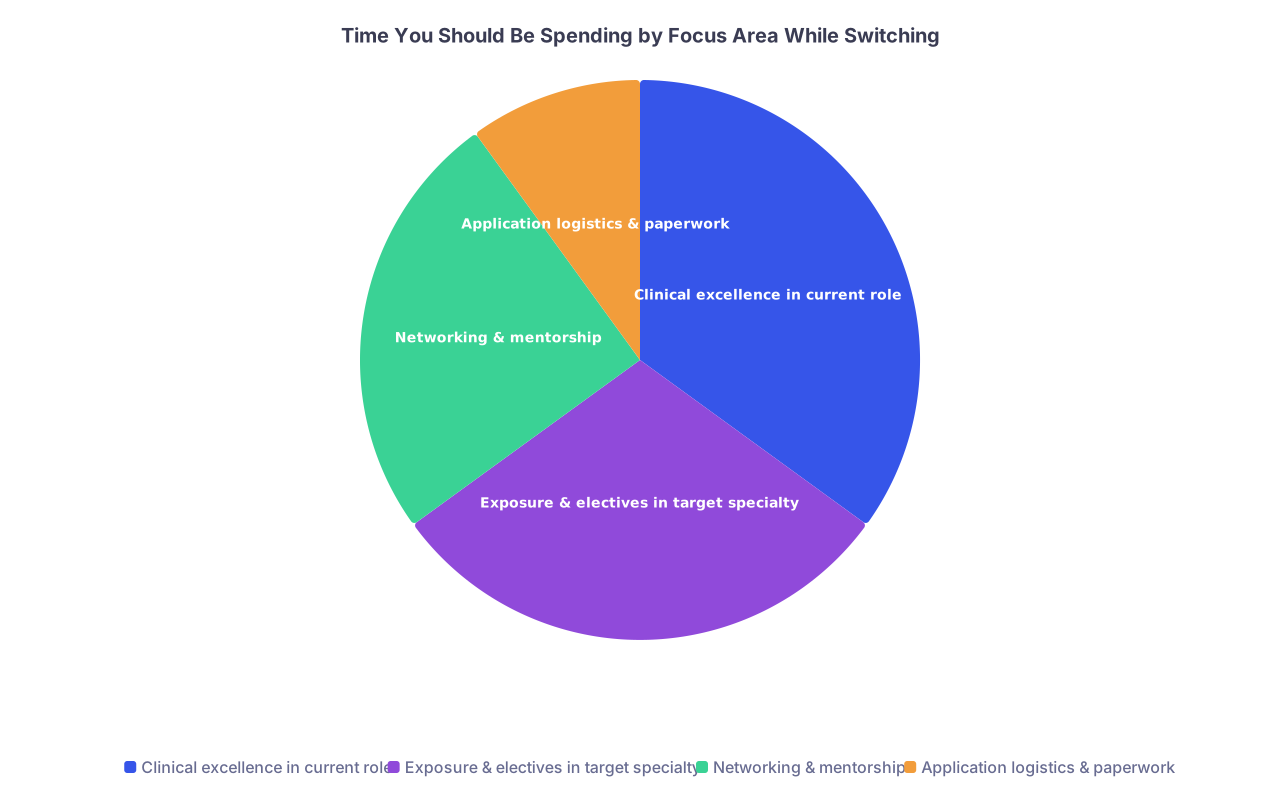
| Category | Value |
|---|---|
| Clinical excellence in current role | 35 |
| Exposure & electives in target specialty | 30 |
| Networking & mentorship | 25 |
| Application logistics & paperwork | 10 |
Step 10: Handle the Social Awkwardness Like an Adult
This part no one tells you about. The day-to-day weirdness.
You will get:
- Co-residents making half-jokes: “So you’re abandoning us for the cush life, huh?”
- Attendings saying, “But you’re good at this, are you sure?”
- People treating you as “already gone” months before you leave
- Some subtle resentment from those who feel trapped
Your job is not to fix their feelings. Your job is to stay professional and not torch relationships.
Simple tactics:
- Keep your explanations consistent and neutral. “I realized my long-term fit is more in [Target Specialty], especially [X]. I’m grateful for what I’ve learned here, though.”
- Don’t argue when people try to sell you on staying. Just: “I really considered that. But I’m confident this is the right direction for me.”
- Don’t brag about interviews, offers, or how much better the new lifestyle/pay/prestige is. That’s how you turn neutral people into enemies.
Some of these people you will still see at conferences for years. You’re building a 30–40-year career. You can tolerate six months of social awkwardness without over-reacting.
Step 11: Think Long-Term: Your Network Will Be Hybrid For A While
For several years, your network will be a weird blend:
- Old specialty colleagues who know you well
- New specialty mentors and peers who know you less well but are your future
- Admin and GME folks who remember the switch
That’s not a bug; it’s an asset—if you maintain it well.
You never know when:
- Your old specialty skills become useful in a niche clinic or research line
- A friend from your original residency becomes an attending who can send you referrals
- You collaborate on multi-disciplinary projects or grants
So, do not ghost your old network once you land the new spot. Send the occasional update, thank people directly who helped you, answer emails from old co-residents asking how you did it.
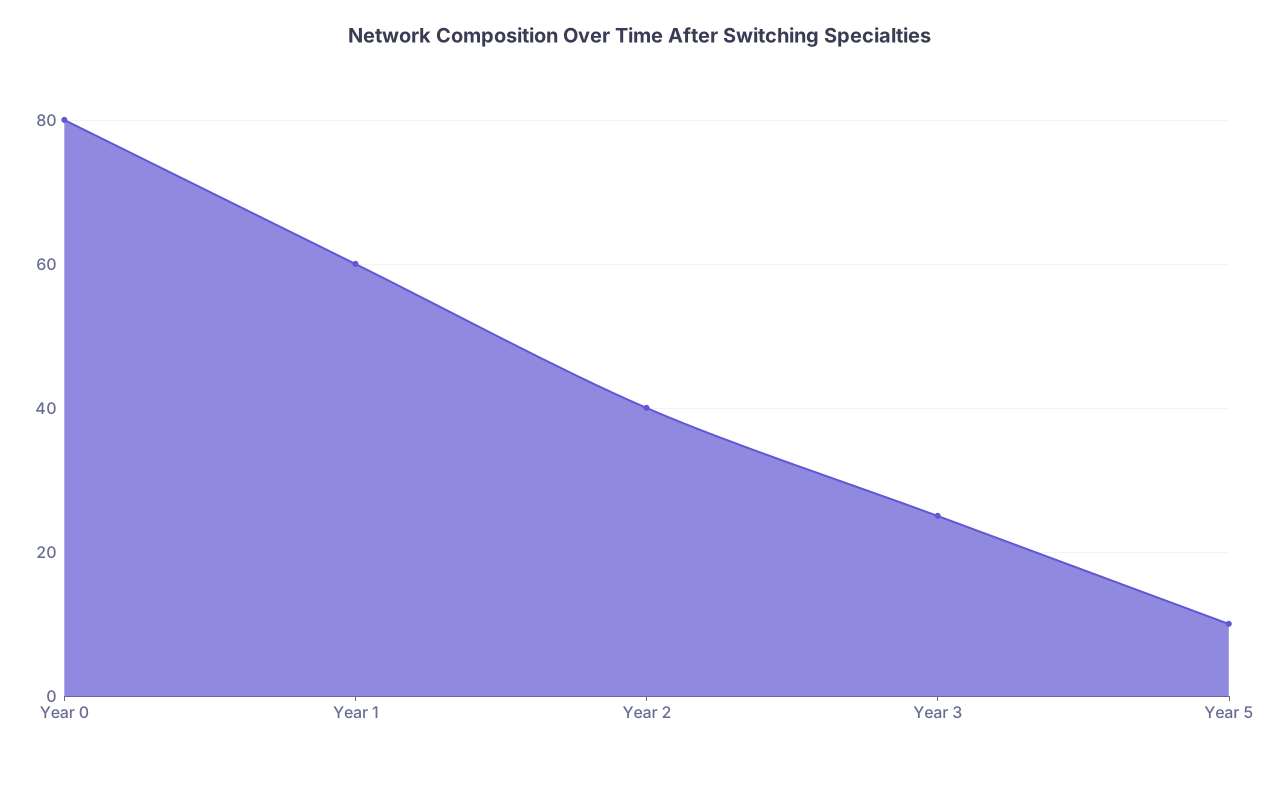
| Category | Value |
|---|---|
| Year 0 | 80 |
| Year 1 | 60 |
| Year 2 | 40 |
| Year 3 | 25 |
| Year 5 | 10 |
(Those values? Roughly the percentage of your day-to-day reliance on your original-specialty network. It shrinks, but it never hits zero.)
Step 12: If You’re Early—Prelim or PGY-1—Play It Slightly Differently
If you’re in an intern year (prelim or transitional), your leverage is a bit better and the network play changes.
Differences:
- Programs expect many prelims not to stay. The emotional charge is lower.
- You may not have deep relationships yet in any field, so you must build them fast.
- Timing matters more—you’re applying while still proving you can function as an intern.
Tactics:
- Tell your PD a bit earlier; many medicine and surgery PDs are used to this.
- Maximize rotations in the target field now. Fight hard to get on those services.
- Use your med school network more heavily; those people may still know you best.
- Treat every attending on target-specialty rotations as a potential letter writer.
You’re not “wasting a year.” You’re showing you can function in a real residency job. PDs in your future specialty like that.
Three Things To Keep Front And Center
- You’re not just changing jobs; you’re rewiring a professional web that’s been built around you for years. Treat the human side with as much seriousness as the ERAS side.
- Your story, your PD conversation, and your anchor people in the new field are the three levers that matter most. Get those right, and the rest becomes logistics.
- Do not burn bridges on your way out. Even a specialty you leave can remain part of your future support system—if you leave like a professional, not a runaway.


