
You are staring at two emails.
One is from a shiny new program at a big health system you have actually heard of. Brand-new residency. Fresh leadership. New facilities. Lots of talk about “innovation,” “flexibility,” and “shaping the culture.”
The other is from an older, lower-tier program. Not malignant, but not inspiring. Mid-pack or worse on reputation. Light on research. Residents seem fine, not thrilled. But it has one thing the new program does not:
A track record.
You have 48–72 hours to respond to one of them. Maybe less. Your friends are texting, your family is pushing for “safety,” and your brain is running in circles around the same question:
“Do I gamble on the new program, or take the known-but-mediocre one?”
Let us stop the spiral. Here is a structured way to make this decision like an adult and not like a panic-stricken MS4 at 1 a.m.
Step 1: Get Clear on What Actually Matters for Your Future
You cannot compare programs if you do not know what you are optimizing for. So you start here.
There are only five things that matter long term:
- Board eligibility and accreditation stability
- Clinical training quality (can you do the job on day 1 as an attending)
- Fellowship and job prospects
- Safety and sanity (work environment, support, not getting destroyed)
- Personal situation (location, family, visa, finances)
Everything else is dressing.
Write these on a piece of paper, and under each, answer in 1–2 sentences what you want:
- Board / accreditation: “I absolutely cannot risk losing board eligibility.”
- Training: “I want to feel competent and safe practicing independently.”
- Future plans: “I really want cardiology fellowship” or “I just want a solid job in a community hospital.”
- Safety: “I will not tolerate a malignant culture, even if it ‘helps me grow’.”
- Life: “My partner’s job is here,” “I need H-1B,” “I have kids in school,” etc.
You need those written because the rest of this decision hangs on them.
Step 2: Reality Check – How Risky Is the New Program Really?
New programs are not all the same. Big difference between:
- A new internal medicine program at a massive academic center that already runs 15 other residencies
vs. - A brand-new standalone hospital that has never had trainees, in a small system, in a shaky market.
You are assessing institutional stability + GME competence, not just the residency’s age.
Use this checklist for the new program:
Institutional track record
- Does the hospital/system already have other ACGME-accredited residencies or fellowships?
- Are those other programs stable and non-toxic by reputation?
- Is the health system financially stable (not in the news for closure, layoffs, or selling off services)?
-
- Is it already ACGME-accredited or still in pre-accreditation?
- Did they mention initial accreditation length and any citations on the site visit?
- Are there any ACGME letters or information you can request? (You can ask the PD directly: “What feedback did you receive from ACGME after your initial review?”)
Leadership
- Is the PD a known quantity? Have they been APD/PD elsewhere?
- Is the DIO / GME office experienced and overseeing multiple programs?
- What is the PD’s track record with resident advocacy, board pass rates, or prior leadership roles?
Program structure
- Is there a clear block schedule, clinic structure, and curriculum already built?
- Are core rotations already staffed with attendings who teach regularly, or are they “still recruiting”?
- Do they have formal affiliations (e.g., university partner) for didactics, subspecialty coverage, or electives?
-
- Are they limiting size the first year?
- Is there explicit built-in mentorship with faculty and leadership?
- Did they talk concrete details about how they will protect first-year residents from being treated as cheap labor while “figuring things out”?
If you are hearing vague promises but no details (“We plan to build a strong research culture”… with no faculty researchers, no protected time, no funding), downgrade heavily.
Step 3: Dissect the Lower-Tier Established Program Without Emotion
Many people either romanticize “stability” or write off a lower-tier program as “garbage.” Both are lazy takes.
You need to dissect the established program using data + lived resident experience.
For the established lower-tier program, systematically check:
-
- 3–5 year rolling pass rates for your specialty’s boards.
- If they dodge this question or say “we do not track that,” that is a red flag.
Accreditation history
- Any recent ACGME citations, warnings, or shortened accreditation cycles?
- Google “[program name] ACGME letter of warning” and check. Ask directly during follow-up: “Any current ACGME citations we should know about?”
Clinical load and supervision
- Are interns routinely carrying unsafe caps?
- Do residents complain about “just service, no teaching”?
- Is there reliable attending backup at night and on weekends?
Culture and burnout
- Are current residents bitter, cynical, counting days to graduation?
- Or tired but proud of their training and mostly supportive of each other?
- Ask: “If you had to choose again, would you come back here?” and listen for the pause.
Graduate outcomes
- Where do recent grads go? Fellowship match list? Jobs?
- Even if it is not glamorous, is it consistent?
- A program that sends people into solid community jobs every year is doing its job.
Step 4: Compare the Programs on the Only Metrics That Matter
Now you put both programs head-to-head. I like to literally score them.
Use a simple 1–5 scale (1 = terrible, 5 = excellent) for each domain, and then look at the pattern.
| Domain | New Program | Established Low-Tier |
|---|---|---|
| Accreditation stability | ||
| Board prep / pass likelihood | ||
| Clinical volume / exposure | ||
| Supervision / safety | ||
| Culture / resident support | ||
| Graduate outcomes | ||
| Location / personal fit |
Fill this out honestly. Do not give 3s just because you feel bad.
Then ask:
- Does the new program have serious upside (4–5) in enough domains to justify its risk?
- Is the established program actually “bad,” or just unglamorous? There is a difference.
If the established program gives you:
- 4–5 for safety and supervision
- 3–4 for boards and clinical exposure
- 3 for culture
…it may be dull and low-prestige, but it will train you.
If the new program is:
- 3 for accreditation
- 2–3 for unknown board outcomes
- 4–5 for culture, mentorship, innovation
- Under a strong, known academic system
…then it might be worth the gamble if your future goals are flexible.
Step 5: Understand How Each Option Impacts Fellowship and Jobs
This is where people either overestimate prestige or underestimate how much you matter.
Here is the blunt reality:
- For less competitive fellowships / direct-to-practice jobs (hospitalist, general IM, general peds, general psych, community EM):
A solid clinical training with good letters and decent board scores matters more than the name of your residency. - For competitive fellowships (cards, GI, derm, ortho, rad onc, some surgical subspecialties):
Track record, research, and strong letters from known faculty matter. Reputation of the program is not everything, but it is not nothing either.
So you need to map your situation.
Scenario A: You want a highly competitive fellowship
Ask of each program:
- Are there in-house fellowships in your desired field?
- Are there subspecialists doing research, with publications in the last 3–5 years?
- Will you actually have time and support to do projects (protected time, mentorship, IRB help)?
If the new program has:
- No in-house fellowship in your specialty
- No serious research infrastructure
- PD telling you “we plan to build research later”
…and the established low-tier program still places 1–2 people a year into your target fellowship (even at mid-tier institutions), then the “boring” program wins for your specific goal.
Scenario B: You plan on general practice / non-competitive fellowship
Here, I have seen plenty of people from so-called “no-name” or lower-tier programs get exactly what they want: solid hospitalist jobs, primary care positions, psych jobs, etc.
For that path, your priorities shift:
- Do I feel safe and adequately supervised?
- Will I be clinically strong and not terrified on day 1 as an attending?
- Will I pass boards on first attempt?
- Will I be mentally intact at the end?
For most generalist careers, a stable, lower-tier but functional program is a safer bet than a chaotic new one with no systems.
Step 6: Identify the Real Failure Modes of a New Program
Let me be blunt about where new programs go wrong. I have watched this play out.
Common failure modes:
Over-reliance on residents as cheap labor
- They open the program to fill service gaps, not to train.
- Result: residents become warm bodies with badges, not learners.
Administrative chaos
- Schedules constantly changing.
- Rotations promised but not delivered because no agreements or faculty yet.
- Poor documentation for ACGME requirements.
Lack of supervision
- Night float with attendings not physically present.
- Seniors who are only PGY-2s with no one above them in the early years.
Weak advocacy
- PDs with little power within the hospital.
- Residents complain but nothing changes.
- GME office is understaffed or inexperienced.
Accreditation problems
- ACGME citations for duty hours, supervision, educational content.
- Shortened accreditation cycle or—even worse—withdrawal of accreditation.
You need to hunt for signs of these.
Ask very specific questions to the PD and residents (if any already there):
- “How will you ensure supervision during nights in year 1 and year 2?”
- “What do you see as the biggest risks or challenges in starting this program, and how are you addressing them?”
- “What concrete changes have you made in the last 6 months based on resident feedback?” (If there are no residents yet, “what feedback loops have you set up?”)
If their answers are vague, ideological, or defensive, treat that as a major warning.
Step 7: Quantify the Risk of Accreditation and Board Eligibility
This is non-negotiable. You cannot gamble with board eligibility. Full stop.
You need clear answers for the new program:
- Are they already ACGME accredited for your specialty?
- If they are new, were there any concerns raised by ACGME that could threaten continuation?
- What is the contingency plan if accreditation is withdrawn?
- Will the sponsoring institution guarantee placement for you in another program within their system?
- Have they ever had an ACGME program lose accreditation before?
Here is where a quick timeline/logic flow helps.

| Step | Description |
|---|---|
| Step 1 | New Residency Offer |
| Step 2 | High risk - strongly reconsider |
| Step 3 | Moderate to high risk |
| Step 4 | Moderate risk - need strong upside |
| Step 5 | Risk likely acceptable |
| Step 6 | ACGME accredited now |
| Step 7 | Institution has other stable programs |
| Step 8 | Clear PD plan and GME support |
If you are an IMG, on a visa, or in a situation where transferring programs is extremely difficult, your risk tolerance here should be low. “We are confident it will work out” is not enough.
Step 8: Factor in Your Personal Situation Without Lying to Yourself
Training is not in a vacuum. You are a person.
You have to weigh:
- Geography (family, partner, support system)
- Financial cost of moving
- Visa/immigration constraints
- Your mental health history and tolerance for chaos
If you have:
- A history of depression or burnout
- A fragile support system
- Heavy financial strain
Then a brand-new program with high uncertainty might not be smart, no matter how exciting it sounds on paper.
On the other hand, if you are:
- Young, flexible, single or with a fully remote partner
- Less constrained by location or visa issues
- Very motivated to shape a new culture
Then you can afford to take more risk if the institutional backing is strong.
Step 9: Do a Hard 48-Hour Deep Dive Before You Decide
You are not going to fix this by vibes alone. You have to do some focused work.
In 48 hours, you can:
Talk to at least 2–3 current residents at the established program
- Different PGY levels.
- Ask blunt questions: “What sucks here?” “What has actually improved?”
- Listen for consistency; if everyone says, “The PD has our back,” that matters.
Talk to at least 1–2 faculty or GME leaders at the new program
- PD, APD, or DIO.
- Ask specifically: “Why do you think this program will succeed where some new programs struggle?”
- Ask: “If your own child wanted this specialty, would you be comfortable with them in this brand-new program?”
Search:
- ACGME public site for accreditation status.
- Google + forums (Reddit, SDN) for serious red flags, not just random complaining.
- Hospital/health system news for financial or closure concerns.
Check your own documents
- What letters and metrics do you have?
- How much do you realistically need “brand name” versus just a competent, safe training?
Step 10: Use a Simple Decision Framework, Not 20 What-Ifs
At the end, you need a rule that cuts through the noise. Here is one that works.
You choose the new program if:
- It is already ACGME-accredited, and
- The institution has a strong GME history with multiple successful programs, and
- Leadership is experienced and gave concrete, specific answers about structure, supervision, and contingency plans, and
- Your fellowship/career goals do not absolutely require a heavy research pedigree or name recognition, and
- You have the psychological and logistical buffer to handle some chaos.
You choose the lower-tier established program if:
- Board pass rates are solid or improving, and
- Supervision and safety are clearly better understood and more reliable, and
- Graduates are getting jobs or fellowships reasonably aligned with what you want, and
- Culture is at least neutral to mildly positive, not malignant, and
- The new program has large unknowns or red flags you cannot verify.
If your scoring sheet has the established program winning on board prep, safety, and graduate outcomes, you are not “settling.” You are choosing the path that protects your license and future.
Quick Visual: When Risk May Be Worth It
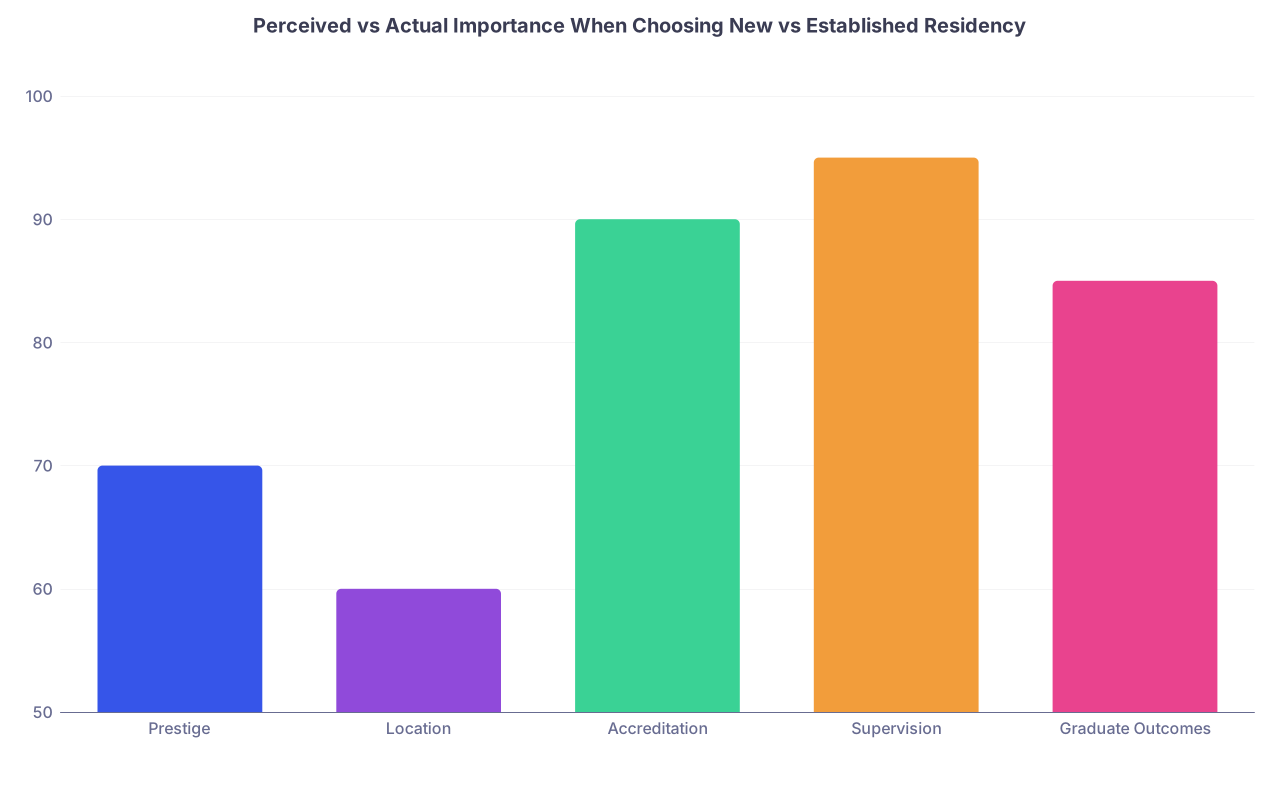
Here is a simple snapshot of how people often think versus what actually matters when these choices come up.
| Category | Value |
|---|---|
| Prestige | 70 |
| Location | 60 |
| Accreditation | 90 |
| Supervision | 95 |
| Graduate Outcomes | 85 |
People over-focus on prestige and geography. The real heavy hitters: accreditation stability, supervision, and where graduates end up.
Step 11: Commit and Then Work the Program Hard
Once you decide, the worst thing you can do is second-guess for three years.
If you pick the new program:
- Meet with your PD early and often. Be proactive but not entitled.
- Volunteer (strategically) to help build systems—curriculum feedback, scheduling input, QI projects.
- Document issues professionally and use formal reporting channels when needed.
- Make yourself one of the residents whose success the PD will point to when talking to ACGME or fellowship PDs.
If you pick the established lower-tier program:
- Do not treat it as purgatory. Treat it as your launchpad.
- Identify the 2–3 faculty who actually care about teaching and align with your goals. Glue yourself to them.
- Overperform on boards, procedures, clinical competence. You can outgrow the program’s reputation.
- Seek external electives or research at bigger centers if you want competitive fellowships.
I have seen people at “top-10” residencies squander every opportunity and people at tiny community programs land outstanding jobs and fellowships because they worked their situation rather than resenting it.
The Short Version
If you made it this far, you probably already know where you are leaning. To lock it in, keep three points in front of you:
- Do not gamble with accreditation and boards. If the new program cannot give you a clear, credible story on stability and supervision, walk away.
- Clinical safety and graduate outcomes beat prestige. A quieter, lower-tier program that trains you well and gets people into decent jobs or fellowships is a win.
- Your risk tolerance is personal. New programs can be fantastic—for the right person, in the right system, with the right leadership. If that is not clearly true here, default to stable.