

The idea that it’s “selfish” to start medicine late is nonsense. And the data backs that up far more than the guilt-tripping anecdotes people throw at you.
You’ve probably heard the script: “You’ll be 35 before you’re an attending.” “What about your future kids?” “Is it fair to your partner?” Occasionally someone adds the moral dagger: “You should have decided earlier. It’s selfish to start now.”
Let me be blunt: late-start physicians are not the problem in healthcare. Burned-out, misaligned, and rushed-into-it-at-18 physicians are. If anything, nontraditional doctors are often the ones propping up a broken system longer than they should.
Let’s separate myth from reality.
The “Selfish” Argument: What People Actually Mean
No one says “selfish” in a vacuum. They mean a few specific things:
- You’ll “waste” societal resources by training so late.
- You’ll deprive your family of time, money, and stability.
- You’ll retire soon after finally becoming useful.
- You’ll block younger, more “efficient” trainees from spots.
All wrapped in a faux-utilitarian moral framing: if you cared about others, you’d pick something shorter, cheaper, or earlier.
Now let’s see what actual numbers say instead of vibes.
What the Data Shows About Age, Training, and Career Length
First, some basic realities about timelines.
In the US, average ages:
| Stage | Typical Age Range |
|---|---|
| Start of Medical School | 23–26 |
| Nontraditional Matriculants | 27–35+ |
| Completion of Residency (Primary Care) | 30–34 |
| Completion of Residency (Surgical/Long) | 32–38 |
Nontraditional matriculants are not unicorns. Depending on the year and school, 20–30% of entering US med students are 25 or older. Plenty are in their late 20s and early 30s. A meaningful minority are 35+.
The idea that medical education is designed only for people who started at 22 is already false. The system is quietly built around absorbing late entrants. Programs know this; they actively recruit them.
Now the “career length” anxiety: “If you start at 32 and finish residency at 38, you’ll only work 20 years before retiring. What’s the point?”
Let’s compare what people imagine vs what actually happens.
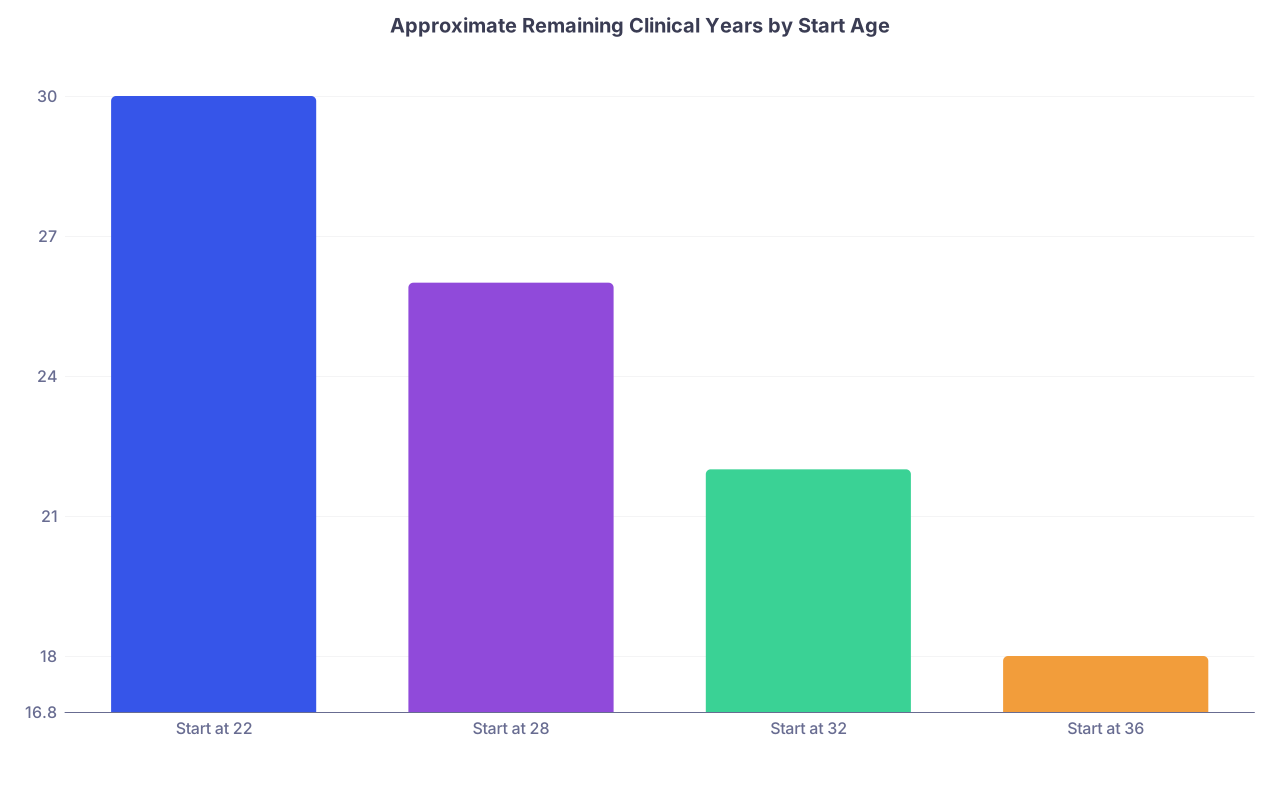
| Category | Value |
|---|---|
| Start at 22 | 30 |
| Start at 28 | 26 |
| Start at 32 | 22 |
| Start at 36 | 18 |
Those numbers assume:
- Board-certified by about 30, 34, 38, 42
- Practicing to around 60–62 (many go longer, some shorter)
So a person starting in their early 30s still realistically has two decades of potential practice. That’s an entire career in most other industries. Nobody looks at a 38-year-old starting a 20-year career in software engineering and calls it “selfish.” They call it normal.
And that’s before you factor in:
- A large subset of doctors cut clinical time or leave medicine in their 40s and 50s because they were misaligned or burned out from the start.
- Late entrants often have better retention because they knew what they were getting into, chose after real-world exposure, and have more mature coping and decision frameworks.
You want to talk about “wasted” training investment? The real sink is people who were pushed in at 18, never seriously considered alternatives, and then spend a miserable decade trying to claw their way back out.
Family, Kids, and Relationships: The Guilt Narrative vs Reality
Here’s the script I hear constantly: “If you go to med school at 30, you’re choosing patients over your future kids.”
No. You’re choosing a specific kind of life trade-off that millions of people make in different fields and at different ages. The medicine part just makes everyone dramatic.
Data first. There are plenty of studies on physician families. A few consistent findings:
Physician parents work a lot, yes. But family satisfaction and child well-being correlate far more strongly with:
- Emotional availability when present
- Financial stability
- Reduced chaos and conflict at home
…than with “raw hours per week.”
Dual-physician or physician–professional households often have more financial flexibility to buy back time (childcare, house help, flexible locations), especially mid-career.
Many physicians delay kids to late 20s / 30s / even 40s, regardless of when they started training. Delayed parenthood is not some unique burden of late-starters; it’s baked into modern medicine, period.
So is it “selfish” to put your family through training? Only if you pretend medicine at any age is a casual 9–5 that doesn’t affect them.
The honest framing is this: medical training stresses families. Starting at 24 stresses them. Starting at 32 stresses them. The question isn’t “selfish or not?” The question is: are you and your partner clear-eyed, aligned, and prepared?
I’ve watched two very different cases:
25-year-old MS1, married, no kids yet. Spouse didn’t really understand what residency meant; thought it was “like grad school but for doctors.” Cue fights, resentment, and near-divorce by PGY2.
33-year-old MS1, two kids, spouse in a stable non-medical field. They had spreadsheets, backup childcare plans, savings buffers, and explicit goals. Was it easy? No. Was it “selfish”? Hardly. It was deliberate.
The late starter usually has more life experience negotiating expectations, handling logistics, and boundary-setting. That doesn’t make the work light, but it makes it far less chaotic.
The Resource Argument: “You’re Wasting a Spot”
Here’s the moralistic version: medical school seats and residency spots are scarce societal resources. If you start at 32, someone who could work 35 years instead of 20 is displaced. So, by this reasoning, you’re selfish.
Sounds tidy. It falls apart quickly.
First, that logic applied consistently would mean:
- Physicians should be forced to retire late if they can still safely practice (maximizing “return”)
- Applicants with chronic illness risk should be deprioritized (might work fewer years)
- Anyone planning part-time or non-clinical work is morally inferior to the 80-hours-to-the-grave workhorse
Most people aren’t ready to swallow that whole ethical package. They only selectively deploy the argument to shame older applicants.
Second, productivity in medicine is not just “years × hours.” It’s:
- Quality of care
- Specialty choice
- Willingness to work in under-served areas
- Leadership, teaching, system-building
- Likelihood of actually staying in clinical practice
I’ve seen a 40-year-old new attending step into a community hospital, stabilize a flailing clinic, mentor residents, and design workflows that improved outcomes for thousands of patients. You want to compare that to an anonymous “extra 10 years” of a burned-out doc who checks out mentally at 45?
Late starters are disproportionately:
- Primary care, psychiatry, family medicine, hospitalist, or outpatient-focused
- Mission-oriented (rural, underserved, second-career from nursing, EMS, military, social work)
- Systems-aware—they’ve seen non-medical workplaces, know how dysfunctional healthcare is, and sometimes actually fix things
If you’re going to run the utilitarian math, run it honestly.
Performance and Burnout: Are Late Starters Actually Worse?
There’s this quiet insinuation that if you start late, you’ll:
- Learn more slowly
- Score lower
- Burn out faster
- Struggle more physically
The evidence doesn’t support the doom narrative.
Studies of nontraditional med students repeatedly show:
- Academic performance equal to or slightly better than traditional students
- Higher professionalism ratings
- Stronger communication and team skills
- Often better feedback from patients and staff
Why? Because life experience counts. People who have:
- Worked in real jobs
- Been fired or promoted
- Dealt with rent, aging parents, kids, or actual emergencies
…tend to take feedback better, panic less about grades, and anchor their identity less in “I must be perfect at everything.”
On burnout, simplistic “older = more tired” thinking is lazy. Burnout risk skyrockets among people who felt cornered into medicine, or whose self-worth is entirely tied to their doctor identity. Late starters usually have a clearer “why,” more developed identities outside of medicine, and more realistic expectations.
Do some late starters struggle with stamina, call, or the pure grind of residency? Of course. But guess what—so do plenty of 26-year-olds. Age is not the core variable. Fit, support, boundaries, specialty choice, and program culture matter more.
Financial Reality: Is It Irresponsible to Start Late?
The money version of “selfish” sounds like this: “You’ll have less time to pay off loans. You’ll burden your family. You’ll never catch up financially.”
Let’s look at the structure, not the fear.
For a late starter at, say, 30:
- Med school: 4 years
- Residency: 3–5 years (say 4)
- Attending at ~38
- Working to ~60 (could be more or less)
That’s potentially 20+ years at attending income. Even with heavy loans, that’s not financial doom. It’s just a different curve.
I’ve seen 40-year-old new attendings who:
- Paid off student loans in 7–10 years with disciplined saving and a moderate lifestyle
- Buy a home mid-40s with a strong down payment
- Fully fund retirement starting at 40 and still reach healthy nest eggs
Is it “optimal” compared to starting at 25 and investing from day one? No. Compounding math doesn’t care about your dreams. But “less optimal financially” is not the same as “selfish” or “irresponsible.”
Selfish is refusing to run the numbers honestly. Late starters who succeed financially usually:
- Live way below attending-level lifestyle for several years
- Choose reasonable specialties and practice settings (not everything needs to be boutique and coastal)
- Protect against burnout so they don’t implode precisely when their financial engine is strongest
Plenty of people who started at 22 and finished training at 30 are broke at 45 because they inflated their lifestyle and never built buffers. Starting early doesn’t magically make you financially responsible.
Who Actually Calls It “Selfish” — And Why
Let me be direct: almost no one inside admissions or residency leadership is calling late applicants “selfish.” They may question your stamina, your plan, your motivation. But the word “selfish” comes far more often from:
- Family members projecting their own fears
- Colleagues who regret not choosing differently and resent your pivot
- Online comment sections populated by people who barely understand how training works
Within the system, we care about:
- Can you do the work?
- Do you know what you’re getting into?
- Are you likely to finish training and practice?
- Do you bring perspectives and skills that help teams and patients?
Age only matters insofar as it interacts with those questions.
I’ve sat in conference rooms where a 33-year-old applicant with a prior career in nursing or engineering was the favorite candidate specifically because of their maturity and background. The hesitation wasn’t moral; it was practical—“Do they have the stamina for a 5-year surgical residency?” Not “Are they selfish for showing up at 33?”
There’s a big difference.
A Better Question Than “Is It Selfish?”
“Is it selfish to start medicine late?” is the wrong frame. It assumes your existence and ambitions need moral permission from people who aren’t going to live your life or pay your bills.
Better questions are:
- Am I choosing medicine because I’ve actually seen it up close, or because it’s the only prestigious escape hatch I can imagine?
- Have I had blunt conversations with my partner, kids (if old enough), and support system about what the next 7–10 years look like?
- Have I done a serious financial analysis and scenario planning? Not vibes—numbers.
- Do I have enough non-medical identity that if it turns out differently than expected, I’m not shattered?
If you line those up honestly and still choose this path, you’re not selfish. You’re an adult making a high-cost, high-impact decision with open eyes.
The people who call that “selfish” almost always have one of two problems:
- They can’t tolerate the idea that someone their age is making a big move they were too scared to make.
- They need everyone else to conform to a narrow timeline so they can feel safe about their own.
Neither of those is your problem to solve.
The Bottom Line
Three things to walk away with:
- Late starters in medicine are normal, needed, and often highly effective. The data on age, performance, and career length does not support the idea that they’re “wasting” resources.
- The real risks are not moral but practical: finances, family strain, and stamina. Those are solvable with brutal honesty, planning, and the right specialty and program choices.
- “Selfish” is mostly a projection. The system, imperfect as it is, is already built to accept and benefit from nontraditional physicians. The real ethical failure isn’t starting late. It’s sleepwalking into a career you never truly chose.
If you’re going to do medicine late, do it eyes open, numbers in hand, and with zero patience for guilt that isn’t grounded in reality.


