The fear that a PhD will make you “unemployable” clinically is wildly exaggerated. But the anxiety behind it is very real.
Let me just say the quiet part out loud: I have absolutely spiraled on this exact question. The “what if I do a PhD and no one ever wants to hire me as a clinician because I’m too expensive / overqualified / ‘too academic’ and then I’ve wasted 4–7 years of my life” spiral.
So if that’s where your brain is at 2 a.m.? You’re not crazy. You’re just thinking like someone who has seen how messy medicine and hiring can be.
Let’s rip this apart properly.
The Core Question: Can a PhD Make You Overqualified for Clinical Jobs?
Short answer: Not in the way you’re afraid of.
If your primary qualification for clinical practice is an MD/DO (or PA/NP, PT, OT, etc.), you are hired clinically based on:
- Your clinical degree and training
- Your license and board certification
- Your ability to bill and generate RVUs
- Your clinical skills, references, and fit
The PhD is usually a bonus, not a barrier.
Hospitals and clinics don’t say, “Wow, this person has more expertise and potential for grants and academic prestige. Pass.” That’s not how chairs think. They think: “Can this person see patients? Will they stay? Can we afford the FTE? Do they fit our needs?”
The places where a PhD might make things weird:
- Very small private practices that want max clinical hours, zero research
- Employers scared you’ll leave for academia in 1–2 years
- Jobs explicitly designed for someone who just wants to grind full-time clinical with no “extra”
But that’s less “overqualified” and more “mismatch of priorities.”
You’re not going to be rejected from a hospitalist job or family med job because you know how to run a Western blot.
Where the “Overqualified” Fear Comes From (And When It’s Real)
There are some half-legit sources of this anxiety. I’ve seen specific situations where people with PhDs feel stuck or sidelined. Let me break those down.
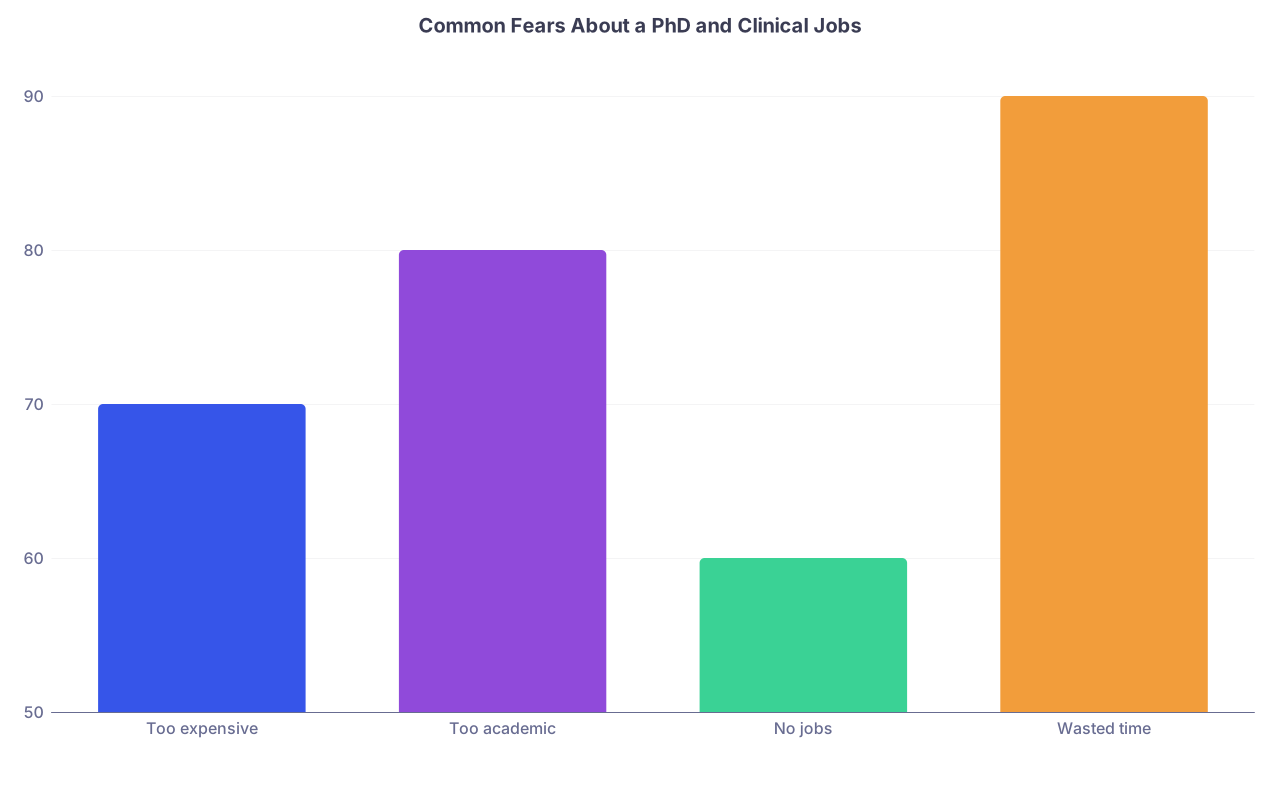
| Category | Value |
|---|---|
| Too expensive | 70 |
| Too academic | 80 |
| No jobs | 60 |
| Wasted time | 90 |
Fear 1: “They’ll think I’m too expensive”
Clinically, you’re not being paid because you have a PhD. You’re being paid for:
- Your clinical FTE
- Your clinical productivity (RVUs)
- Market rate for your specialty
Someone with MD-only and someone with MD/PhD from the same residency usually get the same base clinical offer for a straight-up clinical job. A PhD doesn’t automatically bump your salary band into some un-hirable stratosphere.
Where cost can show up:
- If you insist on a lot of protected research time without funding yet
- If your expectations are “50% research, 50% clinical, all funded” right away
- If you want startup packages (lab, techs, etc.) where the department is broke
Programs don’t say “no” because you’re overqualified. They say “no” because they can’t justify paying you to do things that don’t generate clinical revenue unless you bring grants.
So if your fear is, “Will a PhD make my base clinic job offer higher so no one wants me?” — no. That’s not how this works.
Fear 2: “They’ll assume I don’t actually want to see patients”
This one I have seen.
You walk in with “Dr. So-and-So, PhD, MD” and the whisper is: “Okay, so they’re here until the first R01 hits and then they’re gone.”
Some employers—especially high-volume private groups—want:
- Long-term, stable, full-time clinicians
- People who aren’t going to peace out for a K-award in 3 years
So yes, there is a small risk that some clinical employers will doubt your clinical commitment.
But that’s not a hard barrier. That’s a messaging problem. And it’s fixable.
You can say things like:
- “I did a PhD, but my main career goal is 80–100% clinical work with minor QI or clinical research.”
- “I’m applying specifically to heavy clinical roles. If I do any research, it would be small-scale and secondary.”
- “I chose to do a PhD because I care about understanding disease deeply, but my long-term plan is to be a clinician first.”
Hiring committees listen to that. Especially if your application (and references) back it up.
Where a PhD Actually Helps for Clinical Jobs
Here’s the part people weirdly underplay: a PhD opens doors, especially in academic or hybrid settings.
These are the jobs that literally light up when they see “MD/PhD” or “NP, PhD”, etc.:
- Academic hospitalist roles with research/QI expectations
- Specialty departments that want clinician–scientists (oncology, neurology, cardiology, etc.)
- University-affiliated clinics that want people who can teach, research, and see patients
- VA and government systems that value research experience a lot
- Big children’s hospitals and tertiary centers with research infrastructure
A PhD also makes you more competitive for:
- Leadership in clinical research units
- Directing fellowship programs or resident research tracks
- Getting protected time once you show some grant or project productivity
And when you inevitably want to shift gears (because medicine burns people out), the PhD gives you options:
- Part-time clinical, part-time research
- Transition to industry (medical director, clinical trial design, pharma)
- Academic leadership roles
So can a PhD close some super-narrow doors? Maybe. But it opens a whole hallway of others.
When a PhD Can Make Life Awkward Clinically
Let me not sugarcoat this. There are scenarios where a PhD on top of a clinical degree makes things…complicated.
| Situation | Why It Feels Bad |
|---|---|
| 100% RVU-driven private practice | Little to no value placed on research background |
| You secretly hate research now | PhD years feel like sunk cost and regret |
| You want 50% protected time with no funding | Departments can’t support it |
| You’re geographically restricted | Fewer academic/hybrid jobs to leverage PhD |
Places where you might actually feel “overqualified” (emotionally, not on paper):
- You spent 6 years doing complex translational work and now you’re in a job where nobody cares if you can read a Kaplan–Meier curve.
- You’re in a high-volume urgent care or primary care mill that just wants you to churn, and you’re like, “Why did I train to think so deeply if the job is 7-minute visits and productivity dashboards?”
- Colleagues joke: “Ask the PhD, they’re the smart one,” but then your actual role is identical to everyone else’s.
That disconnect can feel brutal. Like you did this massive extra training just to be treated like any other warm body in the call schedule.
But again—that’s not you being “unemployable.” That’s misalignment between your training and your environment.
And it’s something you can adjust for when you choose your job.
Clinical Hiring: What Actually Matters More Than the PhD
I’ve watched how chairs and hiring committees talk behind closed doors. The themes repeat.
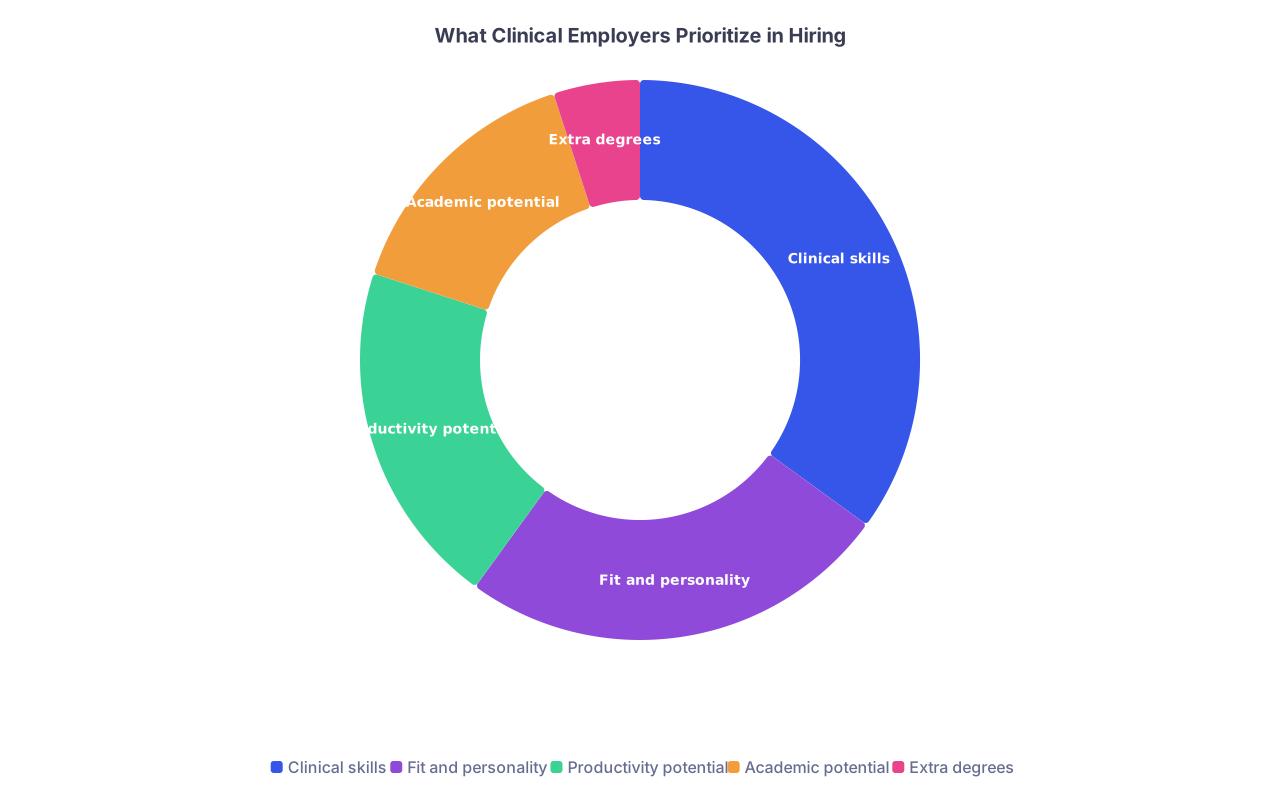
| Category | Value |
|---|---|
| Clinical skills | 35 |
| Fit and personality | 25 |
| Productivity potential | 20 |
| Academic potential | 15 |
| Extra degrees | 5 |
What they really care about:
Can you do the clinical work well without drama?
Good notes, safe decisions, not constantly needing rescue.Are you going to fit with the team?
Not toxic, not arrogant, not disappearing mid-shift because “research call.”Will you stay at least a few years?
It costs a lot to onboard someone. Turnover hurts.Are you reliable and not a walking lawsuit?
No major professionalism or safety red flags.If academic: Can you contribute to teaching/research in a realistic way?
Not just big talk. Actual outputs: QI projects, papers, grant potential.
The PhD is like a strong line on the CV that affects #5 most. It doesn’t override #1–4.
If you show up with: solid residency, good letters, strong interview, clear story for why you want this job—and you also happen to have a PhD? They’re not going to throw your application in the trash because you understand PCR too well.
MD vs PhD vs MD/PhD: What Actually Happens Long-Term
This is the part that often gets distorted. People imagine their life path splitting dramatically forever depending on this one decision.
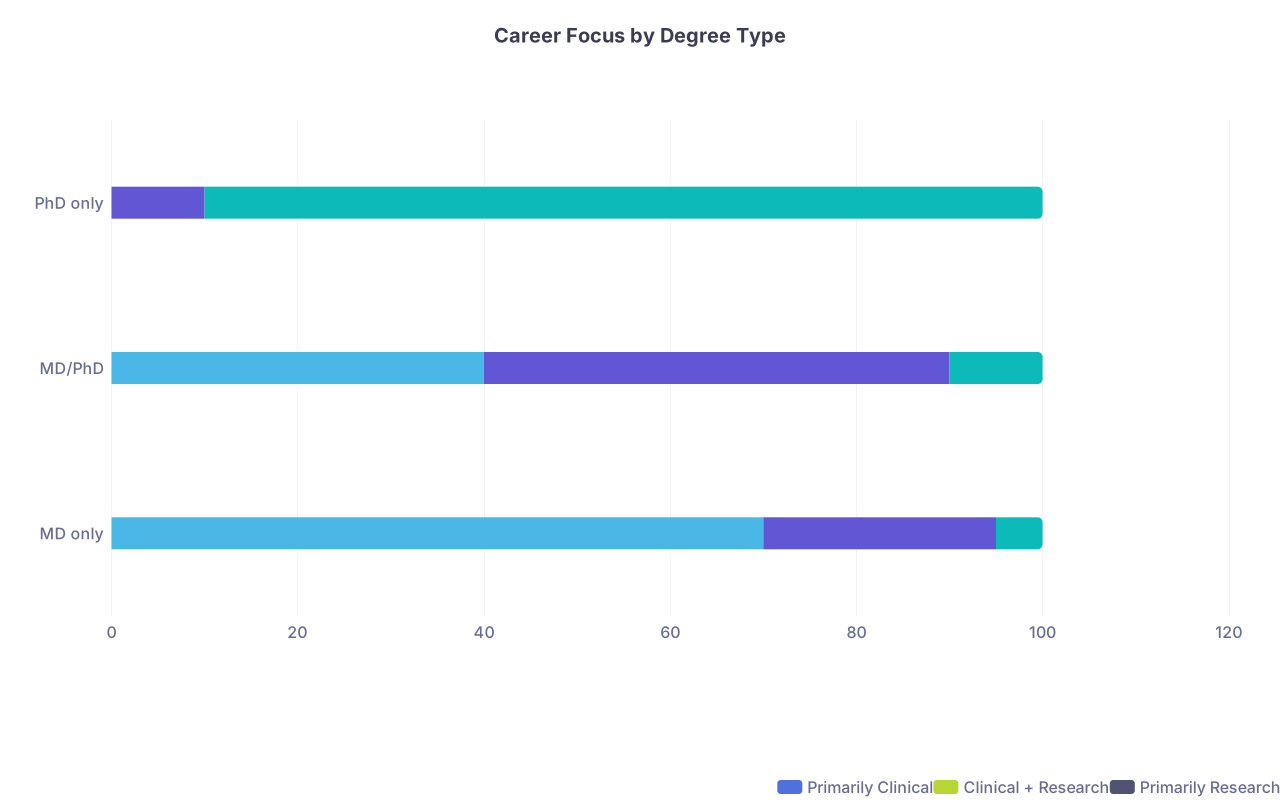
| Category | Primarily Clinical | Clinical + Research | Primarily Research |
|---|---|---|---|
| MD only | 70 | 25 | 5 |
| MD/PhD | 40 | 50 | 10 |
| PhD only | 0 | 10 | 90 |
Reality:
MD/DO only:
Some end up purely clinical, some do research/QI/teaching, some go part-time, some go industry. Very flexible.MD/PhD:
Many go into academic/hybrid clinical-research roles. A non-trivial number end up mostly clinical anyway (life, loans, burnout, kids, whatever). And they still get hired.PhD only (non-clinical):
This is where “overqualified and underemployed” is a more serious risk—especially outside academia. But you’re not talking about that path if you’re focused on clinical jobs.
If your main identity and income will be from clinical work, the letter combo after your name is not what makes you employable or not. Your training, reputation, and adaptability matter much more.
How to Protect Your Clinical Options If You’re Seriously Considering a PhD
Let’s say you’re still interested in a PhD or MD/PhD or DNP/PhD. You’re scared but curious. How do you not sabotage your future clinical self?

| Step | Description |
|---|---|
| Step 1 | Considering PhD |
| Step 2 | Clarify Career Goal |
| Step 3 | Prioritize Clinically Strong Programs |
| Step 4 | Target Research Heavy Centers |
| Step 5 | Maintain Strong Clinical CV |
| Step 6 | Build Grants and Projects |
| Step 7 | Signal Clinical Focus in Interviews |
Do these things:
Choose training environments with strong clinical reputations.
If you do MD/PhD, don’t sacrifice solid clinical residency training just to chase fancy lab names. Your residency brand often matters more clinically than where you did your PhD.Keep your story coherent.
You want to be able to say, without stuttering:- “Here’s why I did a PhD.”
- “Here’s what I learned.”
- “Here’s why I’m now choosing a job that’s X% clinical and Y% other stuff.”
Don’t disappear from clinical work during your PhD years.
Stay involved: student-run clinics, shadowing, small clinical projects. It keeps your narrative believable: “I always cared about patients, not just pipettes.”Be explicit with employers about your priorities.
If you want mostly clinical work, say that clearly. Don’t play coy thinking you need to “sell” the PhD. Sell yourself as a clinician who also has deep research training—not the other way around (unless you want a heavy research role).
The Ugly “What If”: What If I Do a PhD and End Up Regretting It?
Let’s say the nightmare happens: you do the PhD, you’re 6–8 years older, you’re exhausted, you hate research, and you just want a stable clinical job.
No. But you may:
- Feel behind your MD peers financially
- Feel like you “wasted” time (even if you picked up skills)
- Be annoyed at being treated exactly like colleagues who trained shorter
- Wish you’d just gone straight through and started residency earlier
Is that a real risk? Yes. I’ve seen MD/PhDs say bluntly, “If I’d known I was going to be 90% clinical, I wouldn’t have done the PhD.”
But even those people? They’re employed. Hospitalists. Oncologists. Neurologists. They have jobs. Many well-paid ones.
The regret is almost never: “I did a PhD and now no one will hire me clinically.”
It’s more: “I did a PhD and emotionally/financially I wish I’d taken a different route.”
Different problem. Hard in its own way. But not the “overqualified and unemployable” disaster your brain is inventing.
A Sanity Check: What Should You Actually Do Right Now?
You don’t need to solve your entire life path tonight. But you can take tangible steps to ground this in reality instead of worst-case fantasies.

Try this:
Talk to three people in these categories:
- One MD-only who is mostly clinical
- One MD/PhD (or equivalent) who’s mostly clinical
- One MD/PhD who’s in a real clinician–scientist role
Ask them very specific questions:
- “Have you ever seen someone not get hired clinically because of a PhD?”
- “If you could redo it, would you still do your path?”
- “How did your degree combo affect your first job offers?”
Look at real job postings.
Find hospitalist, EM, IM, peds, etc. jobs. Notice how few care about PhD vs not. They care about board certification, visa status, FTE, call coverage, etc.Write down your actual top 3 career priorities for the next 10 years.
Stuff like: location, debt, research intensity, flexibility, family. Compare that to what a PhD realistically adds and delays.Be honest with yourself about how much you enjoy research day-to-day.
Not the idea of being “a scientist.” The actual work: failed experiments, stats, revisions, grants. If that life doesn’t deeply appeal to you, forcing a PhD just because it sounds impressive is a recipe for regret.
FAQ (Exactly 4 Questions)
1. Will community hospitals or private practices refuse to hire me because I have a PhD?
Almost never. What they care about is: can you see patients efficiently, are you board-certified, and will you stay? Some private groups might worry you’ll leave for academia fast, but if you’re clear that you want a stable, primarily clinical role, a PhD doesn’t blacklist you. At worst, it just doesn’t matter much to them.
2. Will I be expected to do more work or extra projects for the same pay just because I have a PhD?
In some academic settings, yes, there can be subtle pressure: “Can you help with this study? Can you mentor this resident?” You’ll have to set boundaries. The key is to negotiate your role upfront—how much time is officially protected for research or teaching versus pure clinical work. If your contract says 100% clinical, you’re not obligated to become free research labor.
3. If I do a PhD and later apply only to heavy clinical jobs, will programs see that as a red flag?
Not necessarily. You just need a coherent story. Something like: “I did a PhD to understand disease mechanisms deeply, but over time I realized I’m happiest in direct patient care. I still value research but want it to be secondary.” If your recent actions (electives, projects, letters) match a clinical focus, employers accept that.
4. Is it smarter to skip the PhD now, work clinically, and maybe do research or a part-time degree later?
For many people who are unsure, yes. You can always layer research, a master’s, or targeted training on top of a clinical career. You can’t get back the years and lost income easily. If you’re not strongly pulled toward research as a long-term, central piece of your career, defaulting to clinical first and adding later is usually the safer move.
Open a blank page and write two short paragraphs: one that starts with “If I don’t do a PhD, my biggest fear is…” and another that starts with “If I do a PhD, my biggest fear is…”. Get both monsters on paper. Then you can actually compare the risks instead of letting them just scream in your head.